
All Topics  
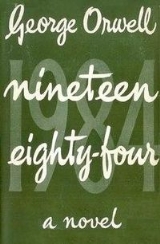
Nineteen Eighty-Four

 
Nineteen Eighty Four

   Email Print
   Bookmark   Link


Nineteen Eighty-Four


Nineteen Eighty-Four is a classic dystopian novel
Utopian and dystopian fiction

The utopia and its offshoot, the dystopia, are genres of literature that explore social and political structures. Utopian fiction is the creation of an ideal world, or utopia, as the setting for a novel....
 by English author George Orwell
George Orwell

Eric Arthur Blair , better known by his pen name George Orwell, was an England author. His work is marked by a profound consciousness of social injustice, an intense dislike of totalitarianism, and a passion for clarity in language....
. Published in 1949
1949 in literature

The year 1949 in literature involved some significant events and new books....
, it is set in the eponymous year and focuses on a repressive, totalitarian regime. The story follows the life of one seemingly insignificant man, Winston Smith
Winston Smith

Winston Smith is a Character and the protagonist of George Orwell's 1949 novel Nineteen Eighty-Four. The character was employed by Orwell as an everyman in the setting of the novel, a "central eye ......
, a civil servant assigned the task of perpetuating the regime's propaganda
Propaganda

Propaganda is the dissemination of information aimed at influencing the opinions or behaviors of large numbers of people. As opposed to Objectivity providing information, propaganda in its most basic sense presents information in order to influence its audience....
 by falsifying records and political literature. Smith grows disillusioned with his meager existence and so begins a rebellion
Rebellion

Rebellion is a refusal of obedience. It may, therefore, be seen as encompassing a range of behaviors from civil disobedience and mass nonviolent resistance, to violent and organized attempts to destroy an established authority such as the government....
 against the system that leads to his arrest and torture.

The novel has become famous for its portrayal of pervasive government surveillance
Surveillance

Surveillance is the monitoring of behavior. Systems surveillance is the process of monitoring the behavior of people, objects or processes within systems for conformity to expected or desired Norm in trusted systems for security or social control....
 and control, and government's increasing encroachment on the rights of the individual.


Discussion
Ask a question about 'Nineteen Eighty-Four'
Start a new discussion about 'Nineteen Eighty-Four'
Answer questions from other users
Full Discussion Forum


Recent Posts


Encyclopedia


Nineteen Eighty-Four is a classic dystopian novel
Utopian and dystopian fiction

The utopia and its offshoot, the dystopia, are genres of literature that explore social and political structures. Utopian fiction is the creation of an ideal world, or utopia, as the setting for a novel....
 by English author George Orwell
George Orwell

Eric Arthur Blair , better known by his pen name George Orwell, was an England author. His work is marked by a profound consciousness of social injustice, an intense dislike of totalitarianism, and a passion for clarity in language....
. Published in 1949
1949 in literature

The year 1949 in literature involved some significant events and new books....
, it is set in the eponymous year and focuses on a repressive, totalitarian regime. The story follows the life of one seemingly insignificant man, Winston Smith
Winston Smith

Winston Smith is a Character and the protagonist of George Orwell's 1949 novel Nineteen Eighty-Four. The character was employed by Orwell as an everyman in the setting of the novel, a "central eye ......
, a civil servant assigned the task of perpetuating the regime's propaganda
Propaganda

Propaganda is the dissemination of information aimed at influencing the opinions or behaviors of large numbers of people. As opposed to Objectivity providing information, propaganda in its most basic sense presents information in order to influence its audience....
 by falsifying records and political literature. Smith grows disillusioned with his meager existence and so begins a rebellion
Rebellion

Rebellion is a refusal of obedience. It may, therefore, be seen as encompassing a range of behaviors from civil disobedience and mass nonviolent resistance, to violent and organized attempts to destroy an established authority such as the government....
 against the system that leads to his arrest and torture.

The novel has become famous for its portrayal of pervasive government surveillance
Surveillance

Surveillance is the monitoring of behavior. Systems surveillance is the process of monitoring the behavior of people, objects or processes within systems for conformity to expected or desired Norm in trusted systems for security or social control....
 and control, and government's increasing encroachment on the rights of the individual. Since its publication, many of its terms and concepts, such as "Big Brother," "doublethink
Doublethink

Doublethink is the act of simultaneously accepting as correct two mutually contradictory beliefs. It is related to, but distinct from, hypocrisy and Neutrality ....
" and "Newspeak
Newspeak

Newspeak is a fictional language in George Orwell's novel Nineteen Eighty-Four. In the novel, it is described as being "the only language in the world whose vocabulary gets smaller every year"....
" have entered the popular vernacular. The word "Orwellian
Orwellian

The adjective Orwellian describes the situation, idea, or societal condition that George Orwell identified as being destructive to the welfare of a free society....
" itself has come to refer to anything reminiscent of the book's fictional regime.

History

Orwell, who had "encapsulate[d] the thesis at the heart of his novel" in 1944, wrote most of Nineteen Eighty-Four on the island of Jura, Scotland
Jura, Scotland

Jura is an island in the Inner Hebrides of Scotland, situated adjacent and to the north-east of Islay. The island is designated as a National Scenic Area ....
, during 1947–1948 while critically ill with tuberculosis
Tuberculosis

Tuberculosis is a common and often deadly infectious disease caused by mycobacterium, mainly Mycobacterium tuberculosis . Tuberculosis usually attacks the lungs but can also affect the central nervous system, the lymphatic system, the circulatory system, the genitourinary system, the gastrointestinal system, bones, joints, and even the...
. He sent the final typescript to his friends Secker and Warburg
Secker and Warburg

Secker & Warburg is a British publishing company formed in 1936 from a takeover of Martin Secker, which was in receivership, by Fredric Warburg and Roger Senhouse....
 on 4 December 1948 and the book was published on 8 June 1949.

Nineteen Eighty-Four has been translated into more than 50 languages. The novel's title, its terms, its language (Newspeak
Newspeak

Newspeak is a fictional language in George Orwell's novel Nineteen Eighty-Four. In the novel, it is described as being "the only language in the world whose vocabulary gets smaller every year"....
), and its author's surname are bywords for personal privacy lost to national state security. The adjective "Orwellian
Orwellian

The adjective Orwellian describes the situation, idea, or societal condition that George Orwell identified as being destructive to the welfare of a free society....
" connotes many things. It can refer to totalitarian action or organization, as well as governmental attempts to control or misuse information for the purposes of controlling, pacifying or even subjugating the population. "Orwellian" can also refer generally to twisted language which says the opposite of what it truly means, or specifically governmental propagandizing by the misnaming of things; hence the "Ministry of Peace
Ministry of Peace

The Ministry of Peace is one of four ministry in George Orwell's novel Nineteen Eighty-Four. Along with the Ministry of Truth, the Ministry of Love and the Ministry of Plenty, the Ministry of Peace governs in the Oceania province of Airstrip One....
" in the novel actually deals with war and the "Ministry of Love
Ministry of Love

The Ministry of Love is one of the four ministry that govern Oceania in George Orwell's novel Nineteen Eighty-Four.The Ministry of Love enforces loyalty and love of Big Brother through fear, torture, and brainwashing....
" actually tortures people. Since the novel's publication "Orwellian" has in fact become somewhat of a catch-all for any kind of governmental overreach or dishonesty and therefore has multiple meanings and applications. The phrase Big Brother is Watching You specifically connotes pervasive, invasive surveillance.

Although the novel has been banned or challenged
Challenge (literature)

In United States literature, a challenge is defined by the American Library Association [ALA] as an attempt by a person or group of people to have materials such as books removed from a library or from a school curriculum or otherwise restricted....
 in some countries, it is, along with Brave New World
Brave New World

Brave New World is a novel by Aldous Huxley, written in 1931 in literature and published in 1932 in literature. Set in the London of AD 2540 , the novel anticipates developments in reproductive technology and sleep-learning that combine to change society....
 by Aldous Huxley
Aldous Huxley

Aldous Leonard Huxley was an English writer and one of the most prominent members of the famous Huxley family. He spent the later part of his life in the United States, living in Los Angeles from 1937 until his death in 1963....
, We
We (novel)

We is a dystopian novel by Yevgeny Zamyatin completed in 1921 in literature.It was written in response to the author's personal experiences with the Russian revolutions of Russian revolution of 1905 and Russian Revolution of 1917, his life in the Newcastle upon Tyne suburb of Jesmond and work in the River Tyne, England shipyards at nea...
 by Yevgeny Zamyatin
Yevgeny Zamyatin

Yevgeny Ivanovich Zamyatin was a Russian author, most famous for his 1921 in literature novel We , a story of dystopian future which influenced George Orwell's Nineteen Eighty-Four, Ayn Rand's Anthem , Ursula Le Guin?s The Dispossessed and, indirectly, Kurt Vonnegut's Player Piano ....
, Kallocain
Kallocain

The classic 1940 Sweden dystopian novel Kallocain envisioned a future of drab terror. Seen through the eyes of idealistic scientist Leo Kall, Kallocain's depiction of a totalitarian world state is a montage of what novelist Karin Boye had seen or sensed in the Soviet Union and Nazi Germany of the 1930s....
 by Karin Boye
Karin Boye

was a Sweden poet and novelist....
 and Fahrenheit 451
Fahrenheit 451

Fahrenheit 451 is a dystopian speculative fiction novel authored by Ray Bradbury and first published in 1953.The novel presents a future American society in which the masses are Hedonism, and critical thought through reading is outlawed....
 by Ray Bradbury
Ray Bradbury

Ray Douglas Bradbury is an United States literature, fantasy, Horror fiction, science fiction, and mystery writer.Best known for his dystopian novel Fahrenheit 451 and The Martian Chronicles, Bradbury is widely considered one of the greatest and most popular American writers of speculative fiction of the twentieth century....
, among the most famous literary representations of dystopia
Dystopia

A dystopia is the vision of a society that is the opposite of utopia. A dystopian society is one in which the conditions of life are suffering, characterized by human misery, poverty, oppression, violence, disease, and/or pollution....
. In 2005, Time magazine
Time (magazine)

Time is a weekly United States newsmagazine, similar to Newsweek and U.S. News & World Report. A European edition is published from London....
 listed it among the hundred best English-language novels published since 1923.

Title

One of the original titles for the novel was The Last Man in Europe, but in a letter to publisher Frederic Warburg dated 22 October 1948 (eight months before the book was published), Orwell stated that he was "hesitating" between that and Nineteen Eighty-Four, although Crick mentions that it was Warburg who suggested changing it to a marketable title.

Orwell's reasons for the title are unknown; he might be alluding to the centenary of the socialist Fabian Society
Fabian Society

The Fabian Society is a United Kingdom intellectual socialist movement, whose purpose is to advance the principles of Social democracy via gradualist and reformist, rather than revolutionary means....
 founded in 1884, or to Jack London
Jack London

Jack London was an American author who wrote The Call of the Wild, White Fang, and The Sea Wolf along with many other popular books....
's novel The Iron Heel
The Iron Heel

The Iron Heel is a dystopian novel by American writer Jack London, first published in 1908.Generally considered to be "the earliest of the modern Dystopian," it chronicles the rise of an Oligarchy tyranny in the United States....
 (wherein a political movement came into power in 1984), or to G. K. Chesterton
G. K. Chesterton

Gilbert Keith Chesterton was one of the most influential English writers of the 20th century. His prolific and diverse output included journalism, philosophy, poetry, biography, Christian apologetics, fantasy and detective fiction....
's The Napoleon of Notting Hill
The Napoleon of Notting Hill

The Napoleon of Notting Hill is a novel written by G. K. Chesterton in 1904, set in a nearly-unchanged London in 1984.Though the novel deals with the future, it concentrates not on technology nor on totalitarian government but on a government where no one cares what happens, comparable to Fahrenheit 451 in that respect....
, set in 1984, or to the poem "End of the Century, 1984" by his first wife, Eileen O'Shaughnessy
Eileen O'Shaughnessy

Eileen Maud O'Shaughnessy was the first wife of British writer George Orwell.O'Shaughnessy was born in South Shields, County Durham, in the north-east of England, the only daughter of Marie O'Shaughnessy and Lawrence O'Shaughnessy, who was a customs collector....
. Anthony Burgess
Anthony Burgess

John Burgess Wilson was an England author, poet, playwright, composer, linguist, translator and critic.His Utopian and dystopian fiction satire A Clockwork Orange, widely considered to be his magnum opus, is by far his most famous novel, and was adapted into a famous, if highly controversial, A Clockwork Orange by Stanley Kubrick....
 claims in 1985 that Orwell, being disillusioned by the onset of the Cold War
Cold War

The Cold War was the continuing state of conflict, tension and competition that existed between a number of world powers, including the United States, the Soviet Union, People's Republic of China, France, United Kingdom and those countries' respective allies from the mid-1940s to the early 1990s....
, intended to name the book 1948.

According to the introduction of the Penguin Modern Classics edition, Orwell originally meant 1980 as the story's time, but as the writing became prolonged, he re-titled it 1982, then 1984, coincidentally the reverse of the year written, 1948. Still others believe that Orwell intentionally chose to title the book with the reverse of the year it was written, to allude to the possibility that the events of the story are not so far away as they might seem, rather they occur in a time that shares much with our own.

Popular misconceptions

The book has often been misinterpreted as an attack on socialism
Socialism

Socialism refers to a broad set of economic theories of social organization advocating public or state ownership and administration of the means of production and distribution of goods, and a society characterized by equality for all individuals, with a fair or Egalitarianism method of compensation....
; Orwell himself had occasion to refute such claims, both privately and in public. In a letter to Francis A. Henson of the United Automobile Workers, dated 16 June 1949 (seven months before he died), excerpts from which were reproduced in Life
Life (magazine)

File:Coles Phillips2 Life.jpgLife generally refers to three United States magazines:*A humor and general interest magazine published from 1883 to 1936....
 (25 July 1949) and the New York Times Book Review (31 July 1949), Orwell stated the following: "My recent novel [1984] is NOT intended as an attack on Socialism or on the British Labour Party (of which I am a supporter) but as a show-up of the perversions ... which have already been partly realized in Communism
Communism

Communism is a socioeconomic structure and political ideology that promotes the establishment of an egalitarianism, classlessness, stateless society based on common ownership and control of the means of production and property in general....
 and Fascism
Fascism

Fascism is a Political radicalism, Authoritarianism Nationalism ideology that aims to create a single-party state with a government led by a dictator who seeks national unity and development by requiring individuals to subordinate self-interest to the collective interest of the nation or Race ....
. ...The scene of the book is laid in Britain
United Kingdom

The United Kingdom of Great Britain and Northern Ireland, commonly known as the United Kingdom , the UK or Britain,is a sovereign state located off the northwestern coast of continental Europe....
 in order to emphasize that the English-speaking races are not innately better than anyone else and that totalitarianism
Totalitarianism

Totalitarianism is a concept used to describe political systems whereby a state regulates nearly every aspect of public and private life. Totalitarian regimes or movements maintain themselves in political power by means of an official all-embracing ideology and propaganda disseminated through the state-controlled mass media, single-party st...
, if not fought against, could triumph anywhere." In his 1946 essay, "Why I Write
Why I Write

"Why I Write" is an essay by George Orwell detailing his personal journey to becoming a writer. First published in the Summer 1946 edition of Gangrel , it not only offers a type of mini-biography in which he writes of having first completed poems and trying his hand at short-stories before finally becoming a full-fledged writer, but also...
", Orwell described himself as a Democratic Socialist.

Story


Background

Nineteen Eighty-Four is set in Oceania, one of three intercontinental super-states. The story occurs in London, the "chief city of Airstrip One
Airstrip One

Airstrip One is the fictional province of Oceania in George Orwell's futuristic dystopian novel Nineteen Eighty-Four that acts as the primary setting....
", itself a province of Oceania that "had once been called England or Britain
Great Britain

Great Britain is an island lying to the northwest of Continental Europe. It is the List of islands by area, and the largest in Europe. With a population of 58.9 million people it is List of islands by population....
". Posters of the ruling Party's leader, "Big Brother", bearing the caption BIG BROTHER IS WATCHING YOU, dominate the city landscapes, while two-way television (the telescreen) dominates the private and public spaces of the populace. Oceania's people are in three classes — the Inner Party, the Outer Party, and the Proles
Proles

Proles is a term used in George Orwell's novel Nineteen Eighty-Four to refer to the working class of Oceania .According to 1984, the society of Oceania was divided into 3 distinct classes: Inner Party, Outer Party, and proles ....
. The Party government controls the people via the Ministry of Truth
Ministry of Truth

The Ministry of Truth is one of the four ministry that govern Nations of Nineteen Eighty-Four#Oceania in George Orwell's novel Nineteen Eighty-Four....
 (Minitrue), the workplace of protagonist Winston Smith, an Outer Party member. As in the Nazi and Stalinist regimes, propaganda is pervasive; Smith's job is rewriting historical documents
Historical revisionism (negationism)

Historical revisionism is either the legitimate scholastic correction of existing knowledge about an historical event, or the illegitimate distortion of the historical record such that certain events appear in a more favourable light....
 to match the contemporaneous party line
Party line (politics)

In politics, the line or the party line is an idiom for a political party or social movement's wiktionary:canon agenda, as well as specific ideological elements specific to the organization's partisan ....
, the orthodoxy of which changes daily. It therefore includes destroying evidence, amending newspaper articles, deleting the existence of people identified as "unpersons
List of Newspeak words

In George Orwell's Nineteen Eighty-Four, the fictional language Newspeak attempts to influence thought by influencing the expressiveness of the English language....
".

The story begins on 4 April 1984: "It was a bright cold day in April, and the clocks were striking thirteen". The date is questionable, because it is what Winston Smith perceives. In the story's course, he concludes it as irrelevant, because the State can arbitrarily alter it; the year 1984 and its world are transmutable.

The novel does not render the world's full history to 1984. Winston's recollections, and what he reads in The Theory and Practice of Oligarchical Collectivism by Emmanuel Goldstein
Emmanuel Goldstein

Emmanuel Goldstein is a fictional character in George Orwell's classic novel Nineteen Eighty-Four. Despite being a key part of the story, he is never actually seen or heard of, and may in fact just be a piece of propaganda....
, reveal that after World War II
World War II

World War II, or the Second World War , was a global military conflict which involved a Participants in World War II, including all of the great powers, organised into two opposing military alliances: the Allies of World War II and the Axis powers....
, the United Kingdom fell to civil war
Civil war

A civil war is a war between organized groups to take control of a nation or region, or to change government policies. It is high-intensity conflict, often involving Regular Army, that is sustained, organized and large-scale....
, becoming part of Oceania. Simultaneously, the Soviet Union
Soviet Union

The Union of Soviet Socialist Republics was a Constitution of the Soviet Union socialist state that existed in Eurasia from 1922 to 1991.The name is a translation of the , romanization of Russian Soyuz Sovetskikh Sotsialisticheskikh Respublik, abbreviated ????, SSSR....
 encompassed mainland Europe, forming the nation of Eurasia. The third super-state, Eastasia, comprises the east Asian countries around China, Korea and Japan. Mentioned also is an atomic war, fought mainly in Europe, western Russia, and North America. It is unclear what occurred first: the civil war wherein the Party assumed power, the United States' annexation of the British Empire, or the war during which Colchester
Colchester

Colchester is a town, and the largest settlement within the Colchester , in Essex, England.It has a population of List of English cities by population....
 was bombed.

Plot


Ministry of Truth bureaucrat Winston Smith
Winston Smith

Winston Smith is a Character and the protagonist of George Orwell's 1949 novel Nineteen Eighty-Four. The character was employed by Orwell as an everyman in the setting of the novel, a "central eye ......
 is the protagonist; although unitary, the story is three-fold. The first describes the world of 1984 as he perceives it; the second is his illicit romance with Julia
Julia (1984)

Julia is the name of a fictional character from George Orwell's dystopian novel Nineteen Eighty-Four. Her last name is never given in the novel....
 and his intellectual rebellion against the Party; the third is his capture and imprisonment, interrogation, torture, and re-education in the Ministry of Love
Ministry of Love

The Ministry of Love is one of the four ministry that govern Oceania in George Orwell's novel Nineteen Eighty-Four.The Ministry of Love enforces loyalty and love of Big Brother through fear, torture, and brainwashing....
. The plotline is therefore virtually identical to that of a 1921 Russian
Russians

The Russian people are an East Slavs ethnic group, primarily living in Russia and neighboring countries.The English language term Russians is used to refer to the citizens of Russia, regardless of their ethnicity ; in Russian language, the demonym Russian is translated as Rossiyanin ....
 novel titled We
We (novel)

We is a dystopian novel by Yevgeny Zamyatin completed in 1921 in literature.It was written in response to the author's personal experiences with the Russian revolutions of Russian revolution of 1905 and Russian Revolution of 1917, his life in the Newcastle upon Tyne suburb of Jesmond and work in the River Tyne, England shipyards at nea...
, which occurs in a world similar to that of Nineteen Eighty-Four.

The intellectual Winston Smith is a member of the Outer Party
Outer Party

The Outer Party is a fictional social stratum from the George Orwell novel, Nineteen Eighty-Four.The Political party which controls Oceania is split into two parts: the Inner Party and the Outer Party....
, lives in the ruins of London (the "chief city of Airstrip One
Airstrip One

Airstrip One is the fictional province of Oceania in George Orwell's futuristic dystopian novel Nineteen Eighty-Four that acts as the primary setting....
", a province of Oceania), who grew up in the post-World War II United Kingdom, during the revolution and the civil war. As his parents disappeared in the civil war, the English Socialism Movement ("Ingsoc
Ingsoc

In George Orwell's dystopia Nineteen Eighty-Four, Ingsoc is the ideologies of parties of the totalitarianism government of Oceania . Ingsoc is Newspeak for "English Socialism"....
" in Newspeak) put him in an orphanage for training and employment in the Outer Party. His squalid existence consists of living in a one-room apartment, eating a subsistence diet of black bread and synthetic meals washed down with Victory-brand gin
Gin

Gin is a distilled beverage flavoured with juniper berries. Distilled gin is made by redistilling neutral grain spirit and raw cane sugar which has been flavoured with juniper berries....
. He is discontented, and keeps an ill-advised journal of dissenting, negative thoughts and opinions about the Party. If the journal or Winston's errant behavior were to be discovered, it would result in his torture and execution at the hands of the Thought Police
Thought Police

The Thought Police are the secret police of Oceania in George Orwell's dystopian novel Nineteen Eighty-Four. It is the job of the Thought Police to uncover and punish thoughtcrime and thought-criminals, using psychology and omnipresent surveillance from telescreens to find and eliminate members of society who were capable of the mere t...
. However, he is blessed with having a small alcove beside his telescreen where he cannot be seen, where he can keep his own private secrets.

In his journal he explains thoughtcrime
Thoughtcrime

In George Orwell's dystopian novel Nineteen Eighty-Four the government attempts to control not only the speech and actions, but also the thoughts of its subjects, labeling disapproved thoughts with the term thoughtcrime or, in Newspeak, "crimethink"....
: Thoughtcrime does not entail death. Thoughtcrime IS death. The Thought Police have two-way telescreens (in the living quarters of every Party member and in every public area), hidden microphones, and anonymous informers to spy potential thought-criminals who might endanger The Party. Children are indoctrinated to informing; to spy and report suspected thought-criminals — especially their parents.

Winston Smith is a bureaucrat in the Records Department of the Ministry of Truth, revising historical records to match The Party's contemporaneous, official version of the past. The revisionism is required so that the past reflects the shifts of the day in the Party's orthodoxy. Smith's job is perpetual; he re-writes the official record, re-touches official photographs, deleting people officially rendered as unpersons. The original or older document is dropped into a "memory hole" chute leading to an incinerator. Although he likes his work, especially the intellectual challenge of revising a complete historical record, he also is fascinated by the true past, and eagerly tries to learn more about that forbidden truth.

One day in the office, a woman surreptitiously hands him a note. She is "Julia," a dark-haired mechanic who repairs the Ministry of Truth's novel-writing machines. Before that day, he had felt deep loathing for her, based on his assumptions that she was a brainwashed, fanatically devoted member of the Party; particularly annoying to him is her red sash of renouncement of and scorn for sexual intercourse
Sexual intercourse

Sexual intercourse, also known as copulation or coitus, commonly refers to the act in which the Penis enters the Vagina. The two entities may be of opposite sexes or not, or they may be hermaphrodite, as is the case with snails....
. His preconceptions vanish on reading a handwritten note she gives him, which states "I love you." After that, they begin a clandestine romantic relationship, first meeting in the countryside and at a ruined belfry, then regularly in a rented room atop an antiques shop in the city's proletarian neighborhood. The shop owner chats with Smith, discussing facts about the pre-revolutionary past, sells him period artifacts, and rents him the room to meet Julia. The lovers believe their hiding place paradisaical (the shop keeper having told them it has no telescreen) and think themselves alone and safe.

As their romance deepens, Winston's views change, and he questions Ingsoc. Unknown to him, the Thought Police have been spying on him and Julia. Later, when approached by Inner Party member O'Brien
O'Brien (1984)

O'Brien is a fictional character in George Orwell's novel Nineteen Eighty-Four. The protagonist Winston Smith, living in a dystopian society governed by the Party, feels strangely attracted to Inner Party member O'Brien....
, Winston believes that he has come into contact with the Brotherhood who are opponents of the Party. O'Brien gives him a copy of "the book
Goldstein's book

The Theory and Practice of Oligarchical Collectivism is a fictional book which is an important element in both the plot and the overall theme of George Orwell's dystopian novel Nineteen Eighty-Four, first published in 1949 in literature....
", The Theory and Practice of Oligarchical Collectivism, a searing criticism of Ingsoc said to be written by the dissident Emmanuel Goldstein
Emmanuel Goldstein

Emmanuel Goldstein is a fictional character in George Orwell's classic novel Nineteen Eighty-Four. Despite being a key part of the story, he is never actually seen or heard of, and may in fact just be a piece of propaganda....
, the leader of the Brotherhood. This book explains the perpetual war
Perpetual war

Perpetual war is a war with no clear ending conditions. It also describes a situation of ongoing tension that seems likely to escalate at any moment, similar to the Cold War....
 and exposes the truth behind the Party's slogan, "War is Peace; Freedom is Slavery; Ignorance is Strength."

The Thought Police later capture Winston and Julia in their sanctuary bedroom and they are separately interrogated at the Ministry of Love, where the regime's opponents are tortured and killed, but sometimes released (to be executed at a later date). Charrington, the shop keeper who rented them the room reveals himself an officer of the Thought Police. After a prolonged regimen of systematic beatings by prison guards and psychologically draining interrogations by Party loyalists, Winston is subjected to electroshock
Electroconvulsive therapy

Electroconvulsive therapy , also known as electroshock, is a well established, albeit controversial psychiatry treatment in which seizures are electrically induced in anesthetized patients for therapeutic effect....
 torture by O'Brien, who tells Winston it will "cure" him of his "insanity", which O'Brien claims undeniably manifests itself in the form of Winston's hatred for the Party. During a long and complex dialogue, O'Brien reveals, in what is the most important line in the book, that the motivation of the Inner Party is not to achieve a future paradise but to retain power, which has become an end in itself. He outlines a terrifying vision of how they will change society and people in order to achieve this, including the abolition of the family, the orgasm
Orgasm

An orgasm is the conclusion of the Human sexual response cycle#Plateau phase of Human sexual response cycle, and may be experienced by both males and females....
, and the sex instinct, with the ultimate goal of eliminating anything that may come between one's love of Big Brother and Ingsoc. It will be a society that grows more, not less merciless as it refines itself, and a society without art
Art

Art is the process or product of deliberately arranging elements in a way that appeals to the senses or emotions. It encompasses a diverse range of human activities, creations, and modes of expression, including music and literature....
, literature
Literature

Literature is the art of written works. Literally translated, the word means "acquaintance with letters" . In Western culture the most basic written literary types include fiction and non-fiction....
, or science
Science

In its broadest sense, science refers to any systematic knowledge or practice. In its more usual restricted sense, science refers to a system of acquiring knowledge based on scientific method, as well as to the organized body of knowledge gained through such research....
, so that there are no distractions from their devotion to the Party, or any unorthodox thought, which is also meant to be achieved through the eventual eradication of Modern English, or "Oldspeak". During a session, O'Brien explains that the purpose of the ordeal at the Ministry of Love is to alter Winston's way of thinking, not to extract a confession, and that once Winston unquestioningly accepts reality as the Party describes it, he will be executed.

One night, as Winston lies dreaming in his cell, he suddenly wakes, yelling: "Julia! Julia! Julia, my love! Julia!", whereupon O'Brien rushes in and questions him, and then sends him to Room 101
Room 101

Room 101 is a place introduced in the novel Nineteen Eighty-Four by George Orwell. It is a torture chamber in the Ministry of Love in which the Party attempts to subject a prisoner to his or her own worst nightmare, fear or phobia....
, the most feared room in the Ministry of Love. Here a person's greatest fear is forced upon him or her for the final re-education step: acceptance. Winston, who has a primal fear of rats, is shown a wire cage filled with starving rats and told that it will be fitted over his head like a mask, so that when the cage door is opened, the rats will bore into his face until it is stripped to the bone. Just as the cage brushes his cheek, he shouts frantically: "Do it to Julia!" The torture ends and Winston is returned to society, brainwashed to accept Party doctrine. During the brainwashing, it is noted that O'Brien somehow was always aware of what Smith was thinking and in a way was reading his mind. It can be interpreted as either the Thought Police had devised a mechanism of reading people's thoughts or O'Brien understood Smith completely and was able to predict his chain of thought perfectly.

After his release, Winston encounters Julia in the park. With distaste, they remember the unauthorized and unorthodox ("ungood" in Newspeak) feelings they once shared for each other and acknowledge having betrayed each other. They are apathetic about their reunion and each other's experiences. Winston, happily reconciled to his impending execution, and accepting the Party's depiction of life, celebrates the false fact of a news bulletin reporting Oceania's recent, decisive victory over Eurasia. It is at this moment that he sincerely loves Big Brother for the very first time--a metaphorical bullet entering his brain. Thus the book ends on a bitter note, with Winston Smith's inner transformation finally complete. Not resolved is whether Winston is ever actually executed, or whether his mental capitulation is considered enough.

Orwell's influences

During the Second World War, George Orwell repeatedly said that British democracy
Politics of the United Kingdom

The politics of the United Kingdom of Great Britain and Northern Ireland takes place in the framework of a constitutional monarchy, in which the British monarchy is head of state and the Prime Minister of the United Kingdom of the United Kingdom is the head of government....
, as it existed before 1939, would not survive the war, the question being: Would it end via Fascist
Fascism

Fascism is a Political radicalism, Authoritarianism Nationalism ideology that aims to create a single-party state with a government led by a dictator who seeks national unity and development by requiring individuals to subordinate self-interest to the collective interest of the nation or Race ....
 coup d'état
Coup d'état

A coup d??tat , often simply called a coup, is the sudden unconstitutional overthrow of a government by a part of the state establishment – usually the military – to replace the branch of the stricken government, either with another civil government or with a military government....
 (from above) or via Socialist
Socialism

Socialism refers to a broad set of economic theories of social organization advocating public or state ownership and administration of the means of production and distribution of goods, and a society characterized by equality for all individuals, with a fair or Egalitarianism method of compensation....
 revolution (from below)? During the war, Orwell admitted events proved him wrong: "What really matters is that I fell into the trap of assuming that 'the war and the revolution are inseparable'." Nineteen Eighty-Four shares thematic likenesses with Animal Farm
Animal Farm

Animal Farm is a novel by George Orwell. Published in England on 17 August 1945 in literature, the book reflects events leading up to and during the History of the Soviet Union before World War II....
, another of Orwell's novels, as follows: the betrayed revolution
Revolution

A revolution is a fundamental social change in power or organizational structures that takes place in a relatively short period of time....
; the individual's subordination to the Party collective; rigorously enforced class distinctions, i.e. the Inner Party, the Outer Party, the Proles; the cult of personality
Cult of personality

A cult of personality or personality cult arises when a country's leader uses mass media to create a heroic public image through unquestioning flattery and praise....
; concentration camps; Thought Police
Thought Police

The Thought Police are the secret police of Oceania in George Orwell's dystopian novel Nineteen Eighty-Four. It is the job of the Thought Police to uncover and punish thoughtcrime and thought-criminals, using psychology and omnipresent surveillance from telescreens to find and eliminate members of society who were capable of the mere t...
; compulsory, regimented, daily exercise; and youth leagues.

In the essay "Why I Write
Why I Write

"Why I Write" is an essay by George Orwell detailing his personal journey to becoming a writer. First published in the Summer 1946 edition of Gangrel , it not only offers a type of mini-biography in which he writes of having first completed poems and trying his hand at short-stories before finally becoming a full-fledged writer, but also...
", Orwell explains that all the serious work he wrote since the Spanish Civil War
Spanish Civil War

The Spanish Civil War was a major conflict in Spain that started after an attempted coup d'?tat by a group of Spanish Army generals, supported by the conservative Spanish Confederation of the Autonomous Right , Carlist groups and the fascistic Falange, against the government of the Second Spanish Republic, then under the leadership of pr...
 in 1936 was "written, directly or indirectly, against totalitarianism
Totalitarianism

Totalitarianism is a concept used to describe political systems whereby a state regulates nearly every aspect of public and private life. Totalitarian regimes or movements maintain themselves in political power by means of an official all-embracing ideology and propaganda disseminated through the state-controlled mass media, single-party st...
 and for democratic socialism
Democratic socialism

Democratic socialism is a description used by various socialism movements, tendencies, and organizations, to emphasize the democratic character of their political orientation....
". Nineteen Eighty-Four is an anti-totalitarian cautionary tale
Cautionary tale

A cautionary tale is a traditional Narrative told in folklore, to warn its hearer of a danger. There are three essential parts to a cautionary tale, though they can be introduced in a large variety of ways....
 about the betrayal of a revolution by its defenders. He already had stated distrust of totalitarianism and betrayed revolutions in Homage to Catalonia
Homage to Catalonia

Homage to Catalonia is Political journalism and novelist George Orwell's personal account of his experiences and observations in the Spanish Civil War, written in the first person....
 and Animal Farm
Animal Farm

Animal Farm is a novel by George Orwell. Published in England on 17 August 1945 in literature, the book reflects events leading up to and during the History of the Soviet Union before World War II....
. Coming Up For Air
Coming Up for Air

Coming Up for Air is a novel by George Orwell, published before World War II. It is the most English of his novels with alarums of war mingling with images of an idyllic River Thames-side Edwardian childhood....
, at points, celebrates the personal and political freedoms lost in Nineteen Eighty-Four.

Much of Oceanic society is based upon Stalin
Joseph Stalin

Joseph Stalin was the General Secretary of the Communist Party of the Soviet Union's Central Committee of the Communist Party of the Soviet Union from 1922 until his death in 1953....
's Soviet Union
Soviet Union

The Union of Soviet Socialist Republics was a Constitution of the Soviet Union socialist state that existed in Eurasia from 1922 to 1991.The name is a translation of the , romanization of Russian Soyuz Sovetskikh Sotsialisticheskikh Respublik, abbreviated ????, SSSR....
. The "Two Minutes' Hate"
Two Minutes Hate

In George Orwell's novel Nineteen Eighty-Four, the Two Minutes Hate is a daily period in which Party members of the society of Oceania must watch a film depicting The Party's enemies and express their hatred for them and the principles of democracy....
 television propaganda represents the ritual demonisation of State enemies and rivals; Big Brother resembles Joseph Stalin; and the Party's archenemy, Emmanuel Goldstein
Emmanuel Goldstein

Emmanuel Goldstein is a fictional character in George Orwell's classic novel Nineteen Eighty-Four. Despite being a key part of the story, he is never actually seen or heard of, and may in fact just be a piece of propaganda....
, resembles Leon Trotsky
Leon Trotsky

Leon Trotsky , born Lev Davidovich Bronstein , was a Bolshevik revolutionary and Marxism theorist. He was one of the leaders of the Russian October Revolution, second only to Lenin....
 in that both were Jewish, both had the same physiognomy
Physiognomy

Physiognomy is the assessment of a person's character or personality from their outer appearance, especially the face. The term physiognomy can also refer to the general appearance of a person, object or terrain, without reference to its implied characteristics....
, and Trotsky's real surname was Bronstein. Another suggested inspiration for Goldstein is Emma Goldman
Emma Goldman

Emma Goldman was an anarchism known for her political activism, writing and speeches. She played a pivotal role in the development of anarchist political philosophy in North America and Europe in the first half of the twentieth century....
, the famous Anarchist figure. Doctored photography is a propaganda
Propaganda

Propaganda is the dissemination of information aimed at influencing the opinions or behaviors of large numbers of people. As opposed to Objectivity providing information, propaganda in its most basic sense presents information in order to influence its audience....
 technique, as is the creation of unpersons in the story, analogous to Stalin's enemies being made nonperson
Nonperson

A nonperson is a person or a member of a group who lacks, loses, or is forcibly denied social or legal status, especially basic human rights, or who effectively ceases to have a record of their existence within a society , from a point of view of traceability, documentation, or existence....
s and being erased from official photographic records; the police treatment of several characters recalls the Moscow Trials
Moscow Trials

The Moscow Trials were a series of trials of political opponents of Joseph Stalin during the Great Purge. Many of the defendants were executed....
 of the Great Purge
Great Purge

Great Purge was a series of campaigns of political repression and persecution in the Soviet Union orchestrated by Joseph Stalin in 1936-1938. Also described as a "Soviet holocaust" by several authors, it involved the purge of the Communist Party of the Soviet Union, repression of kulaks, Red Army leadership, and the persecution of unaffiliat...
.

Biographer Michael Shelden notes as influences the Edwardian
Edwardian period

The Edwardian period or Edwardian era in the United Kingdom is the period covering the reign of Edward VII of the United Kingdom, 1901 to 1910....
 world of Orwell's childhood in Henley
Henley-on-Thames

Henley-on-Thames is a town on the north side of the River Thames in south Oxfordshire, England, about 10 miles downstream and north-east from Reading, Berkshire, 10 miles upstream and west from Maidenhead, England....
 — for the golden country; being bullied at St. Cyprian's
St Cyprian's School

St Cyprian's School was an England Preparatory school for boys, which operated in the early 20th century in Eastbourne, East Sussex. Like other preparatory schools, its purpose was to train pupils to do well enough in the examinations to gain admission to leading public schools, and to provide an introduction to boarding school life....
 — empathy with victims; his policeman's life in the Indian Burma
Myanmar

Burma, officially the Union of Myanmar, is the largest country by geographical area in mainland Southeast Asia, or Indochina. The country is bordered by the People's Republic of China on the northeast, Laos on the east, Thailand on the southeast, Bangladesh on the west, India on the northwest, and the Bay of Bengal to the southwest with...
 Police — the techniques of violence; and suffering censorship
Censorship

Censorship is the suppression of freedom of speech or deletion of communicative material which may be considered objectionable, harmful or sensitive, as determined by a censor....
 in the BBC — capriciously-wielded authority.

Specific literary influences include Darkness at Noon
Darkness at Noon

Darkness at Noon is the most famous novel by Hungary-born United Kingdom novelist Arthur Koestler. Published in 1940 in literature, it tells the tale of Rubashov, a Old Bolshevik and Russian Revolution of 1917 who is first cast out and then imprisoned and tried for treason by the Soviet Union government he once helped create....
 
and The Yogi and the Commissar by Arthur Koestler
Arthur Koestler

Arthur Koestler Order of the British Empire was a Jewish-Hungary polymath author who became a naturalized United Kingdom subject....
; The Iron Heel
The Iron Heel

The Iron Heel is a dystopian novel by American writer Jack London, first published in 1908.Generally considered to be "the earliest of the modern Dystopian," it chronicles the rise of an Oligarchy tyranny in the United States....
 
(1908) by Jack London; Brave New World
Brave New World

Brave New World is a novel by Aldous Huxley, written in 1931 in literature and published in 1932 in literature. Set in the London of AD 2540 , the novel anticipates developments in reproductive technology and sleep-learning that combine to change society....
 (1932) by Aldous Huxley; We
We (novel)

We is a dystopian novel by Yevgeny Zamyatin completed in 1921 in literature.It was written in response to the author's personal experiences with the Russian revolutions of Russian revolution of 1905 and Russian Revolution of 1917, his life in the Newcastle upon Tyne suburb of Jesmond and work in the River Tyne, England shipyards at nea...
 (1921) by Yevgeny Zamyatin, which Orwell read in French and reviewed in 1946; and The Managerial Revolution (1940) by James Burnham
James Burnham

James Burnham was an American popular political theorist, best known for his influential work The Managerial Revolution, published in 1941....
, predicting permanent war among three totalitarian superstates, broadly equivalent to those in Nineteen Eighty-Four. Orwell told Jacintha Buddicom
Jacintha Buddicom

Jacintha Buddicom was a poetess and a childhood friend of George Orwell .Buddicom was born at Plymouth but moved with her family to Shiplake, Berkshire....
 that he would write a novel stylistically like A Modern Utopia
A Modern Utopia

A Modern Utopia is a fictional work by H. G. Wells.* [H.G.] Wells's proposal for social reform was the formation of a world state, a concept that would increasingly preoccupy him throughout the remainder of his life....
 by H. G. Wells
H. G. Wells

Herbert George Wells , known by his pen name H. G. Wells, was an England author, best known for his work in the science fiction genre. Wells and Jules Verne are each sometimes referred to as "The Father of Science Fiction"....
.

World War II
World War II

World War II, or the Second World War , was a global military conflict which involved a Participants in World War II, including all of the great powers, organised into two opposing military alliances: the Allies of World War II and the Axis powers....
 acts as the grounding for Orwell's more fantastic elements. Most of the novel contains direct parallels, and occasional outright pastiche, of the rhetoric and politics surrounding the end of the war and the changing alliances of the nascent Cold War
Cold War

The Cold War was the continuing state of conflict, tension and competition that existed between a number of world powers, including the United States, the Soviet Union, People's Republic of China, France, United Kingdom and those countries' respective allies from the mid-1940s to the early 1990s....
. The overseas service of the BBC, controlled by the Ministry of Information, was the model for the Ministry of Truth. The Ministry of Love's ultimate weapon against dissidents, Room 101
Room 101

Room 101 is a place introduced in the novel Nineteen Eighty-Four by George Orwell. It is a torture chamber in the Ministry of Love in which the Party attempts to subject a prisoner to his or her own worst nightmare, fear or phobia....
, is named after a conference room at BBC Broadcasting House where Orwell used to sit through tedious meetings. The Senate House
Senate House (University of London)

Senate House is the administrative centre of the University of London, situated in the heart of Bloomsbury, London between the School of Oriental and African Studies to the north, with the British Museum to the south....
, where the Ministry of Information was housed, is the architectural inspiration for the Ministry of Truth. Nineteen Eighty-Fours world reflects the socio-political life of the UK and the USA, i.e. the poverty of Britain in 1948, when the economy was poor, the Empire dissolving, while newspapers reported imperial triumphs, and wartime ally Soviet Russia was becoming a peacetime foe.

The world of
1984 also parallels, or extrapolates from, life during the First World War as well as the Second. Just how oppressive the British government had become during the earlier war can be judged from a satire of the time which Orwell may even have read while at Eton, 1920: Dips into the Near Future, published in 1917. Though Orwell may never have read it, it shares some themes with 1984, themes which ultimately came from the common experience of both authors if not from one reading the other. 1920 exaggerates actual government oppression during World War I, and if not a literary influence on Orwell it still reveals what undoubtedly had influenced him in the real world.

Oceania is a metamorphosed future British Empire that geographically includes the United States, and whose currency is the dollar
Dollar

The dollar is the name of the official currency in several countries, including the US, Australia, and Canada, dependencies and other world regions....
. As its name suggests, it is a naval power, with much militarism focused on venerating sailors serving aboard floating fortresses greater than Dreadnoughts. Moreover, most of the fighting by Oceania's troops is in defending India (the "Jewel in the Crown" of the British Empire).

The term "English Socialism" also has many precedents in Orwell's wartime writings. In
The Lion and the Unicorn of 1940, Orwell stated that "the war and the revolution are inseparable (...) the fact that we are at war has turned Socialism from a textbook word into a realizable policy". The reason for that, according to Orwell, was that the outmoded British class system constituted a major hindrance to the war effort, and only a Socialist society would be able to defeat Hitler. Since the middle classes were in process of realizing this, too, they would support the revolution, and only the most outright reactionary
Reactionary

Reactionary refers to any movement or ideology that opposes change or progress in society, and which seeks a return to a previous state . The term originated in the French Revolution, to denote the Counter-revolutionary who wanted to restore the real or imagined conditions of the Monarchy Ancien R?gime....
 elements in British society would oppose it, which would limit the amount of force the revolutionaries would need in order to gain power and keep it.

Thus, an "English Socialism" would come about which "...will never lose touch with the tradition of compromise and the belief in a law that is above the State. It will shoot traitors, but it will give them a solemn trial beforehand and occasionally it will acquit them. It will crush any open revolt promptly and cruelly, but it will interfere very little with the spoken and written word".

Orwell's words in this and other writings at the time leave no doubt that in 1940 he regarded "English Socialism" as highly desirable and was actively trying to bring about its victory. Yet in the nightmare world he envisioned eight years later, the same term - contracted to "Ingsoc
Ingsoc

In George Orwell's dystopia Nineteen Eighty-Four, Ingsoc is the ideologies of parties of the totalitarianism government of Oceania . Ingsoc is Newspeak for "English Socialism"....
" - is the monstrous ideology of a totally oppressive regime, far from the relative moderate revolution which Orwell foresaw in 1940. When the vision of "The Lion and the Unicorn" is compared with that of "Nineteen Eighty-Four" it is evident that Orwell saw the regime presided over by Big Brother not only as a betrayal and perversion of Socialist ideals in general, but also as a perversion of Orwell’s own specifically and dearly cherished vision and hope of "English Socialism".

Although theoretically possible, Orwell's 1984 might have portrayed a society which was in a logical sense unsustainable. For someone to run the system as part of the inner party he or she should be aware of the reality of the system. It is also mentioned that membership to the inner party is not hereditary. Smith, O'Brien and possibly many people deep in their psyche were aware of a system which did not resemble the present, and were hence in a position to either commit thought crime or run as part of the inner party. It is also shown that any member of the outer party who might develop an inkling of the machinations of the system is immediately purged. But it is not mentioned how the members of the inner party plan on sustaining the inner party without divulging fundamental structure behind the party and society. The current members of the inner party were possibly people who had seen both sides of the society and hence were fluent in double speak. The members of the outer party while they were the ears and eyes of the inner party, in a systemic sense made no decisions and were almost powerless. Only the inner party knew what to do and why to do it. A logical sense would have made if there was a system given by which someone from the outer party who showed exceptional understanding (like Smith) could have been given the chance to move up and become a member of the inner party, thereby formulating a succession plan which is sustainable and at the same time in line with the ethos of Oligarchical Collectivism.".

Characters

Several characters in the book are based upon people from real life and nearly all of them are parallel figures from the Russian Revolution and Communist Russia in general.

Major characters

  • Winston Smith
    Winston Smith

    Winston Smith is a Character and the protagonist of George Orwell's 1949 novel Nineteen Eighty-Four. The character was employed by Orwell as an everyman in the setting of the novel, a "central eye ......
     - The novel's protagonist; a phlegmatic everyman
    Everyman

    In literature and drama, the term everyman has come to mean an ordinary individual, with whom the audience or reader is supposed to be able to identify easily, and who is often placed in extraordinary circumstances....
    .
  • Julia
    Julia (1984)

    Julia is the name of a fictional character from George Orwell's dystopian novel Nineteen Eighty-Four. Her last name is never given in the novel....
     - Winston's lover, a covert "rebel from the waist down" who militantly praises the Party's doctrines while secretly living in contradiction of them.
  • Big Brother - The dictator of Oceania; believed to be based upon Joseph Stalin
    Joseph Stalin

    Joseph Stalin was the General Secretary of the Communist Party of the Soviet Union's Central Committee of the Communist Party of the Soviet Union from 1922 until his death in 1953....
    . However, as Winston Smith
    Winston Smith

    Winston Smith is a Character and the protagonist of George Orwell's 1949 novel Nineteen Eighty-Four. The character was employed by Orwell as an everyman in the setting of the novel, a "central eye ......
     points out, he has never seen, nor remembers anyone else seeing Big Brother
    Big Brother

    Big Brother may refer to:* Big Brother , a character from George Orwell's novel Nineteen Eighty-Four** Authoritarian personality, any omnipresent figure representing oppressive control...
    , and suggests that he never existed. This is also true of Emmanuel Goldstein
    Emmanuel Goldstein

    Emmanuel Goldstein is a fictional character in George Orwell's classic novel Nineteen Eighty-Four. Despite being a key part of the story, he is never actually seen or heard of, and may in fact just be a piece of propaganda....
    , whom Winston Smith
    Winston Smith

    Winston Smith is a Character and the protagonist of George Orwell's 1949 novel Nineteen Eighty-Four. The character was employed by Orwell as an everyman in the setting of the novel, a "central eye ......
     points out is, if real, definitely dead, but may have been created for propaganda purposes.
  • O'Brien
    O'Brien (1984)

    O'Brien is a fictional character in George Orwell's novel Nineteen Eighty-Four. The protagonist Winston Smith, living in a dystopian society governed by the Party, feels strangely attracted to Inner Party member O'Brien....
     - A government agent who deceives Winston and Julia into believing that he is a member of the resistance, convinces them to "join" it, and later uses this against them to torture them. He convinces them that they must not only obey, but "love" Big Brother. He was not only torturing them, but "cleaning" their minds as well.
  • Emmanuel Goldstein
    Emmanuel Goldstein

    Emmanuel Goldstein is a fictional character in George Orwell's classic novel Nineteen Eighty-Four. Despite being a key part of the story, he is never actually seen or heard of, and may in fact just be a piece of propaganda....
     - A former top member and now opposer of the ruling Party; he is based upon Leon Trotsky
    Leon Trotsky

    Leon Trotsky , born Lev Davidovich Bronstein , was a Bolshevik revolutionary and Marxism theorist. He was one of the leaders of the Russian October Revolution, second only to Lenin....
    , a dissident member of the Soviet Communist Party, who was forced to flee the Soviet Union to save himself from Stalin's persecutions.


Minor characters

  • Aaronson, Jones, Rutherford - old party leaders killed and erased from the historical record.
  • Ampleforth - Winston's colleague, a poet.
  • Mr. Charrington - ostensibly the owner of a junk store in the prole district; actually a member of the dreaded Thought Police
    Thought Police

    The Thought Police are the secret police of Oceania in George Orwell's dystopian novel Nineteen Eighty-Four. It is the job of the Thought Police to uncover and punish thoughtcrime and thought-criminals, using psychology and omnipresent surveillance from telescreens to find and eliminate members of society who were capable of the mere t...
    .
  • Katharine - Winston's wife, a strong supporter of the Party. It is unknown whether or not she is alive at the time of the novel because she and Winston had separated several years earlier.
  • Martin - O'Brien's servant.
  • Parsons - Winston's naive neighbour and colleague, described as an ideal party subordinate because of his idiocy and suggestible nature. He is last seen in the Ministry of Love after his children turn him in for thought crime, at which point he looks forward to being corrected.
  • Syme
    Syme (1984)

    Syme is a fictional character in George Orwell's classic novel Nineteen-Eighty Four.He is an employee at the Ministry of Truth, in the Newspeak section....
     - Winston's intelligent coworker; works with the language Newspeak, and is later vaporized (made so as to seem that he never existed), presumably because despite his strong orthodoxy and support of the party, he thinks too clearly and knows too much. Syme's disappearance is an allusion to the Stalin Purges.


Fictional world


Ingsoc (English Socialism)


Ingsoc is the ideology
Ideologies of parties

This is a list of political ideologies. Many political party base their political action and election program on an ideology. In social studies, a political ideology is a certain ethics set of ideal , principles, doctrines, mythologys or symbols of a social movement, institution, social class, or large group that explains how society sh...
 of the totalitarian
Totalitarianism

Totalitarianism is a concept used to describe political systems whereby a state regulates nearly every aspect of public and private life. Totalitarian regimes or movements maintain themselves in political power by means of an official all-embracing ideology and propaganda disseminated through the state-controlled mass media, single-party st...
 government of Oceania. Ingsoc is Newspeak
Newspeak

Newspeak is a fictional language in George Orwell's novel Nineteen Eighty-Four. In the novel, it is described as being "the only language in the world whose vocabulary gets smaller every year"....
 for "
English Socialism
Socialism

Socialism refers to a broad set of economic theories of social organization advocating public or state ownership and administration of the means of production and distribution of goods, and a society characterized by equality for all individuals, with a fair or Egalitarianism method of compensation....
".

Ministries of Oceania

Oceania's four ministries are housed in huge pyramidal structures, each roughly 930 feet high and visible throughout London, displaying the three slogans of the party on their façades. The ministries' names are ironic antonym
Antonym

In lexical semantics, opposites are words that lie in an inherently incompatible binary relationship as in the opposite pairs male : female, long : short, up : down, and precede : follow....
s of the true nature of their actions.

Ministry of Peace
Ministry of Peace

The Ministry of Peace is one of four ministry in George Orwell's novel Nineteen Eighty-Four. Along with the Ministry of Truth, the Ministry of Love and the Ministry of Plenty, the Ministry of Peace governs in the Oceania province of Airstrip One....
 (Newspeak
Newspeak

Newspeak is a fictional language in George Orwell's novel Nineteen Eighty-Four. In the novel, it is described as being "the only language in the world whose vocabulary gets smaller every year"....
:
Minipax) Conducts Oceania's perpetual war.

Ministry of Plenty
Ministry of Plenty

The Ministry of Plenty is one of the ministry from George Orwell's novel Nineteen Eighty-Four that governs Oceania . The other ministries are the Ministry of Truth, the Ministry of Peace and the Ministry of Love....
 (Newspeak
Newspeak

Newspeak is a fictional language in George Orwell's novel Nineteen Eighty-Four. In the novel, it is described as being "the only language in the world whose vocabulary gets smaller every year"....
:
Miniplenty) Responsible for rationing and controlling food and goods, along with all production of all domestic goods. The Ministry of Plenty declares false claims to have increased the standard of living every time by a considerable amount, when in fact the ministry counteracts its own claims.

Ministry of Truth
Ministry of Truth

The Ministry of Truth is one of the four ministry that govern Nations of Nineteen Eighty-Four#Oceania in George Orwell's novel Nineteen Eighty-Four....
 (Newspeak
Newspeak

Newspeak is a fictional language in George Orwell's novel Nineteen Eighty-Four. In the novel, it is described as being "the only language in the world whose vocabulary gets smaller every year"....
:
Minitrue) The propaganda arm of Oceania's regime, controlling information: news, entertainment, education, and the fine arts. Winston Smith works for the Records Department (RecDep) of Minitrue, "rectifying" historical records and newspaper articles to make them conform to Big Brother's most recent pronouncements, thus making everything that the Party says 'true'.

Ministry of Love
Ministry of Love

The Ministry of Love is one of the four ministry that govern Oceania in George Orwell's novel Nineteen Eighty-Four.The Ministry of Love enforces loyalty and love of Big Brother through fear, torture, and brainwashing....
 (Newspeak
Newspeak

Newspeak is a fictional language in George Orwell's novel Nineteen Eighty-Four. In the novel, it is described as being "the only language in the world whose vocabulary gets smaller every year"....
:
Miniluv) The agency is responsible for the identification, monitoring, arrest and torture of dissidents, real or imagined. Based on Winston's experience there at the hands of O'Brien, the basic procedure is to wear down the subject with a long series of beatings and electrical torture. Finally, when the subject is near broken, they are sent to "Room 101", where they are exposed to their worst fear, once and for all eradicating any remaining impulse of individuality or resistance, and replacing it with a sincere embrace of the Party. The Ministry of Love differs from the other ministry buildings in that it has no windows in it at all.

The ministries' names are an example of doublethink
Doublethink

Doublethink is the act of simultaneously accepting as correct two mutually contradictory beliefs. It is related to, but distinct from, hypocrisy and Neutrality ....
: “The Ministry of Peace concerns itself with war, the Ministry of Truth with lies, the Ministry of Love with torture and the Ministry of Plenty with starvation”. (Part II, Chapter IX - chapter I of Goldstein's book)

Doublethink


Political geography

The world is controlled by three functionally similar totalitarian super-states engaged in perpetual war with each other:

  • Oceania (ideology: Ingsoc or English Socialism) comprises Great Britain, Ireland, Australia, Polynesia, Southern Africa, and the Americas.
  • Eurasia (ideology: Neo-Bolshevism) comprises continental Europe and northern Asia.
  • Eastasia (ideology: Obliteration of the Self, usually rendered as "Death worship") comprises China, Japan, Korea, and Northern India.


The "disputed area", which lies "between the frontiers of the super-states", is "a rough quadrilateral with its corners at Tangier
Tangier

Tangier or Tangiers [#Notes] is a city of northern Morocco with a population of about 700,000 . It lies on the North African coast at the western entrance to the Strait of Gibraltar where the Mediterranean meets the Atlantic Ocean off Cape Spartel....
, Brazzaville
Brazzaville

||-||}Brazzaville is the capital and largest city of the Republic of the Congo and is located on the Congo River. As of the 2001 census, it has a population of 1,018,541 in the city proper, and about 1.5 million in total when including the suburbs located in the Pool Region....
, Darwin
Darwin, Northern Territory

Darwin is the List of Australian capital cities of the Northern Territory, Australia. Situated on the Timor Sea, Darwin has a population of 120,900, making it by far the largest and most populated city in the sparsely peopled Northern Territory, but the least populous of all Australia's capital cities....
, and Hong Kong
Hong Kong

Hong Kong , officially the Hong Kong Special Administrative Region, is a territory located in Southern China in East Asia, bordering the province of Guangdong to the north and facing the South China Sea to the east, west and south....
."

That Great Britain and Ireland are in Oceania rather than in Eurasia is commented upon in the book as a historical anomaly. North Africa, the Middle East, South India, and Southeast Asia form a disputed zone which is used as a battlefield and source of slaves by the three powers. Goldstein's book explains that the ideologies of the three states are the same, but it is imperative to keep the public ignorant of this, so that they believe that the other two ideologies are detestable. London, the novel's setting, is the capital of the Oceanian province of Airstrip One, the former United Kingdom.

The Revolution

In the novel, there are a few glimpses of what happened to cause the revolution. The formation of Eurasia
Eurasia

Eurasia is a large landmass covering about 53,990,000 km? or about 10.6% of the Earth's surface . Often considered a single continent, Eurasia comprises the traditional continents of Europe and Asia, concepts which date back to classical antiquity and the borders for which are somewhat arbitrary....
 is depicted as occurring after the Second World War when American troops left Europe earlier than in our history, allowing Soviet troops to move in and gain control of war-torn Europe without much opposition.

As explained in the book, Eurasia does not contain the British Empire because it merged with (or took control of) the United States giving the successor to both states, Oceania, control of a quarter of the world (southern Africa, Australasia, and Canada). The United States also annexed Latin America at around the same time, forming Oceania.

Eastasia is the last of three superstates to be formed, and apparently was formed when China and Japan conquered surrounding nations. The previously-formed Eurasia prevented Eastasia from growing to the size of the others, a handicap it made up thanks to its numerous and hard-working population.

Although the chronology of these events is unclear in the book, most of it appears to happen between 1920 and the 1960s.

The War


The world of
Nineteen Eighty-Four is built around a never-ending war involving the book's three superstates, with two allied powers fighting against the third. As Goldstein's book explains, each superstate is so strong it cannot be defeated even when faced with the combined forces of the other two powers. The allied states occasionally split with each other and new alliances are formed. Each time this happens, history is rewritten to convince the people that the new alliances always existed, using the principles of doublethink. The war itself never takes place in the territories of the three powers, but is conducted in the disputed zone stretching from Tangier to Darwin, and in the unpopulated Arctic wastes. Throughout the first half of the novel, Oceania is allied with Eastasia, and Oceania's forces are combating Eurasia's troops in northern Africa.

Midway through the book, the alliance breaks apart and Oceania, newly allied with Eurasia, begins a campaign against Eastasian forces. This happens during "Hate Week" (a week of extreme focus on the malice supposed of Oceania's enemies, the purpose of which is to stir up patriotic fervour in support of the Party). The public is quite abnormally blind to the change, and when a public orator, mid-sentence, changes the name of the enemy from Eurasia to Eastasia (still speaking as if nothing had changed), the people are shocked and soon enraged as they notice that all the flag
Flag

A flag is a piece of cloth, often flown from a pole or Mast , generally used symbolically for signaling or identification. The term flag is also used to refer to the graphic design employed by a flag, or to its depiction in another medium....
s and posters are wrong and tear them down. This is the origin of the idiom
Idiom

An idiom is a phrase whose meaning cannot be determined by the literal definition of the phrase itself, but refers instead to a figurative language meaning that is known only through common use....
 "we've always been at war with Eastasia". Later, the Party claims to have captured the whole of Africa. As with all other news, its authenticity is questionable.

Goldstein's book explains that the war is unwinnable, and that its only purpose is to consume human labour and the fruits of human labour so that each superstate's economy cannot support an equal (and high) standard of living for every citizen. The book also details an Oceanian strategy to attack enemy cities with atomic-tipped rocket bombs prior to a full-scale invasion, but quickly dismisses this plan as both infeasible and contrary to the purpose of the war.

Although, according to Goldstein's book, hundreds of atomic bombs were dropped on cities during the 1950s, the three powers no longer use them, as they would upset the balance of power. Conventional military technology is little different from that used in the Second World War (In the 1984 film version of
Nineteen Eighty-Four, Oceanian troops were seen armed with Commonwealth WWII infantry weapons like the Lee-Enfield
Lee-Enfield

The Lee-Enfield bolt-action, magazine-fed, repeating rifle was the main firearm used by the military forces of the British Empire/Commonwealth of Nations during the first half of the 20th century....
 rifle while the Eurasian soldiers were armed with Soviet WWII infantry weapons like the Mosin-Nagant
Mosin-Nagant

The Mosin-Nagant is a bolt-action, internal magazine fed, military rifle that was used by the armed forces of the Russian Empire, the Soviet Union and various Eastern bloc nations....
 rifle and the PPSh-41
PPSh-41

The PPSh-41 submachine gun was one of the most mass produced weapons of its type of World War II. It was designed by Georgi Shpagin as an inexpensive alternative to the PPD-40, which was expensive and time consuming to build....
 submachine gun). Some advances have been made, such as the replacement of bomber aircraft with "rocket bombs
Missile

A guided missile is a self-propelled projectile used as a weapon. Missiles are typically propelled by rockets or jet engines. Missiles generally have one or more explosive warheads, although other weapon types may also be used....
", and battleships with immense "floating fortresses
Aircraft carrier

An aircraft carrier is a warship designed with a primary mission of deploying and recovering aircraft, acting as a seagoing airbase. Aircraft carriers thus allow a navy force to project air power great distances without having to depend on local bases for staging aircraft operations....
", but they appear to be rare. There are no longer massive battles, rather short skirmishes with no clear winners since the purpose of the war is to use up raw materials and labour, not to kill the population. Obsolete and wasteful technology is deliberately used in order to perpetuate pointless fighting.

Goldstein's book hints that, in fact, there may not actually
be a war. The only view of the outside world presented in the novel is through Oceania's propaganda, which has an obvious tendency to exaggerate and even fabricate "facts", and the rocket bombs ostensibly fired by the enemy. Goldstein's book suggests that the three superpowers may not actually be warring, and as Oceania's media provides completely unbelievable news reports on ridiculously long military campaigns and victories (including an impossibly large campaign in central
Central Africa

Central Africa is a core region of the African continent often considered to include Burundi, the Central African Republic, Chad, Democratic Republic of the Congo, and Rwanda....
 and northern
North Africa

North Africa or Northern Africa is the northernmost region of the African continent, separated by the Sahara from Sub-Saharan Africa.Geopolitically, the United Nations subregion of Northern Africa includes the following seven countries or territories:...
 Africa
Africa

Africa is the world's second-largest and second most-populous continent, after Asia. At about 30.2 million km? including adjacent islands, it covers 6% of the Earth's total surface area and 20.4% of the total land area....
), it can be suggested that the war is a lie. Julia even goes so far as to suggest that the rocket bombs that land on London are launched by the Party from other parts of Oceania.

Even Eurasia and Eastasia themselves may only be a fabrication by the Oceanian government, with Oceania the sole undisputed dominator of the world. On the other hand, Oceania might as well actually control only a rather small part of the world (the former United Kingdom
United Kingdom

The United Kingdom of Great Britain and Northern Ireland, commonly known as the United Kingdom , the UK or Britain,is a sovereign state located off the northwestern coast of continental Europe....
 and ex-Republic of Ireland) and still brainwash its citizens into believing that they are battling/allying with a fabricated Eurasia or Eastasia.

Living standards

By the year 1984, the society of Airstrip One lives in squalid poverty; hunger, disease, and filth are the norms. Under the influence of the civil war
Civil war

A civil war is a war between organized groups to take control of a nation or region, or to change government policies. It is high-intensity conflict, often involving Regular Army, that is sustained, organized and large-scale....
, atomic wars, and enemy (or possibly even Oceanian
False flag

False flag operations are covert operations conducted by governments, corporations, or other organizations, which are designed to deceive the public in such a way that the operations appear as though they are being carried out by other entities....
) rocket bombs, the cities and towns are in ruins. When travelling about London, Winston finds himself surrounded by rubble, decay, and the crumbling shells of wrecked buildings. Half of the population of Oceania go barefoot, despite the Party reporting large quantities of boots being produced; Winston believes it likely that very few, if any, boots were actually produced at all.

Apart from the gargantuan bombproof Ministries, very little seems to have been done to rebuild London, and it is assumed that all towns and cities across Airstrip One (and Oceania) are in the same desperate condition. Living standards for the population are generally very low; everything is in short supply and those goods available are of very poor quality. The Party claims that this is due to the immense sacrifices that must be made for the war effort. Goldstein's book states that they are partially correct in as much as the point of continuous warfare is to be rid of the surplus of industrial production to prevent the rise of the standard of living and make possible the economic repression of people.

The Inner Party, at the top level of Oceanian society, enjoys the highest standard of living. O'Brien, a member of the Inner Party, lives in a clean and comfortable apartment, and has a variety of quality foodstuffs such as wine
Wine

Wine is an alcoholic beverage often made of fermentation grape juice. The natural chemical balance of grapes is such that they can ferment without the addition of sugars, acids, enzymes or other nutrients....
, coffee
Coffee

Coffee is a brewed drink prepared from roasted seeds, commonly called coffee beans, of the Coffea. Caffeinated coffee has a stimulating effect in humans....
, and sugar
Sugar

Sugar is a class of edible crystalline substances, mainly sucrose, lactose, and fructose. Human taste buds interpret its flavor as sweet. Sugar as a basic food carbohydrate primarily comes from sugar cane and from sugar beet, but also appears in fruit, honey, sorghum, sugar maple , and in many other sources....
, none of which is available to the rest of the population. Synthetic versions of these foodstuffs are available to members of the Outer Party; but they are of far inferior quality. Winston, for example, is astonished simply that the lifts
Elevator

An elevator or lift is a vertical transport vehicle that efficiently moves people or goods between floors of a building. They are generally powered by electric motors that either drive traction cables and counterweight systems, or pump hydraulic fluid to raise a cylindrical piston....
 in O'Brien's building actually work, and that the telescreens can be turned off. Members of the Inner Party also seem to be waited on by slaves captured from the disputed zone; O'Brien's servant, Martin, is described as having Asiatic features, which would identify him as an Eastasian or Eurasian national, possibly a former soldier captured in battle.

Although the Inner Party enjoys the highest standard of living, Goldstein's book points out that, despite being at the top of society, their living standards (apart from the slaves) are significantly lower than pre-Revolution standards and says the social atmosphere is that of a besieged city, where the possession of a lump of horseflesh makes the difference between wealth and poverty. The proles (proletarians), treated by the Party as animals, live in squalor and poverty. They are kept sedated by vast quantities of cheap beer
Beer

Beer is the world's oldest and most widely consumed alcoholic beverage and the third most popular drink overall after water and tea. It is produced by the brewing and Fermentation of starches, mainly derived from cereal?the most common of which is malted barley, although wheat, maize , and rice are widely used....
, widespread pornography
Pornography

Pornography or porn is the explicit depiction of sexual subject matter with the sole intention of sexually exciting the viewer. It is to a certain extent similar to erotica, which is the use of sexually arousing imagery....
, and a national lottery
Lottery

A lottery is a form of gambling which involves the drawing of lots for a prize. Some governments outlaw it, while others endorse it to the extent of organizing a national lottery....
; but these do not mask the fact that their lives are dangerous and deprived. Proletarian areas of the cities, for example, are ridden with disease and vermin.

However, the proles are subject to much less close control of their daily lives than Party members. The proles whom Winston Smith meets in the streets and in the pubs seem to speak and behave much like working-class Britons of Orwell's time. In addition, the proletarian criminals whom he meets in the first phase of his imprisonment are far less subdued and intimidated than the intellectual "politicals", some of them rudely jeering at the telescreens with apparent impunity.

As explained in Goldstein's book, this derives from the social theory which the regime believes, that revolutions are always started by the middle class and that the lower classes would never start an effective revolt on their own. Therefore, if the middle classes are so tightly controlled that the regime can penetrate their very thoughts and their most minute daily life, the lower classes can be left to their own devices and pose no threat. This produces a contrast with the ideas of Karl Marx
Karl Marx

Karl Heinrich Marx was a Germanphilosophy, political economy, historian, sociologist, humanism, political theorist and revolutionary credited as the founder of communism....
, who held that revolution would rise from the lower classes. Meanwhile, any potentially rebellious or intelligent proletarian individuals who could become the nuclei for resistance are simply allowed to rise into Inner Party positions, so that they can be more easily watched and pacified. Interestingly, Winston Smith holds on to the belief that "the future belonged to the proles" and that the lower class would eventually rule the world, making him a Marxist. As Winston is a member of the Outer Party, more is shown from its living standards than any other group. Despite being the middle class of Oceanian society, the Outer Party's standard of living is very poor. Foodstuffs are low quality or synthetic; the main alcoholic beverage — Victory Gin
Gin

Gin is a distilled beverage flavoured with juniper berries. Distilled gin is made by redistilling neutral grain spirit and raw cane sugar which has been flavoured with juniper berries....
 — is industrial-grade; Outer Party Victory Cigarettes are not manufactured properly. The use of the word "victory" as a brand-name may refer to the "victory suit" and victory garden
Victory garden

Victory gardens, also called war gardens or food gardens for defense, were vegetable, fruit and herb gardens planted at private residences in United States, United Kingdom, Canada and Germany during World War I and World War II to reduce the pressure on the public food supply brought on by the war effort....
 meant to support American war efforts.

Themes


Nationalism

Nineteen Eighty-Four expands upon the subjects summarized in the essay (1945
1945 in literature

The year 1945 in literature involved some significant events and new books....
), about the lack of vocabulary needed to explain the unrecognized phenomenon behind certain political forces; in
Nineteen Eighty-Four Newspeak, the Party's artificial, minimalist language, addresses the matter.

Positive nationalism: Oceanians’ perpetual love for Big Brother (who may be long dead or even non-existent); Celtic Nationalism, Neo-Toryism, and British Zionism
Zionism

Zionism is the international Jewish political movement that originally supported the reestablishment of a homeland for the Jewish People in Palestine....
 are (Orwell argues) defined by love.

Negative nationalism: Oceanians’ perpetual hatred for Emmanuel Goldstein (who, like Big Brother, may not exist); Stalinism
Stalinism

File:Joseph Stalin.jpgStalinism is a term that purportedly describes the political system of the Soviet Union under the leadership of Joseph Stalin, leader of the Soviet Union from 1929?1953....
, Anti-Semitism
Anti-Semitism

Antisemitism is prejudice against or hostility towards Jews.This prejudice or hostility is usually characterized by a combination of Religion, Race , cultural and ethnic group biases....
, and Anglophobia
Anglophobia

Anglophobia is a hatred or fear of the English people or English culture; its antonym is Anglophilia, although Anglophobia can cover hatred and/or fear of British people or Culture of the United Kingdom generally and has done so particularly since the Act of Union in 1707....
 are defined by hatred.

Transferred nationalism: in mid-sentence, an orator changes the enemy of Oceania; the crowd instantly transfers their hatred to the new enemy. Transferred nationalism swiftly redirects emotions from one power unit to another, e.g. Communism
Communism

Communism is a socioeconomic structure and political ideology that promotes the establishment of an egalitarianism, classlessness, stateless society based on common ownership and control of the means of production and property in general....
, Pacifism
Pacifism

Pacifism is the opposition to war or violence as a means of settling disputes or gaining advantage. Pacifism covers a spectrum of views ranging from the belief that international disputes can and should be peacefully resolved; to calls for the abolition of the institutions of the military and war; to opposition to any organization of society...
, Colour Feeling, and Class Feeling.

O'Brien conclusively describes: “The object of persecution is persecution. The object of torture is torture. The object of power is power”.

Sexual repression

The Party imposes antisexualism
Antisexualism

Antisexualism is a term that describes either,*the views of someone who is antagonistic towards sexuality;*or a Social movement against all forms of human sexuality....
 upon its members (as manifest in the Junior Anti-Sex-League), because sexual attachments diminish loyalty to the Party. Julia describes Party fanaticism as "sex gone sour"; except during the liaison with Julia, Winston suffers an inflamed ankle (an allusion to Oedipus the King
Oedipus the King

Oedipus the King is an Classical Athens tragedy by Sophocles that was first performed c. 429 B.C.E. It was the second of Sophocles' three Theban plays to be produced, but it comes first in the internal chronology, followed by Oedipus at Colonus and then Antigone ....
, symbolic of unhealthy sexual repression). In Part III, O'Brien tells Winston that neurologists are working to extinguish the orgasm; sufficient mental energy for prolonged worship requires repressing the libido
Libido

Libido in its common usage means sexual desire; however, more technical definitions, such as those found in the work of Carl Jung, are more general, referring to libido as the free creative?or psychic?energy an individual has to put toward personal development or individuation....
, a vital instinct, and therefore requires externally-imposed sexual restriction by the authorities (civil, political, et cetera).

Futurology

If Orwell meant the novel as prophecy is unknown; yet O'Brien describes the future:

This starkly contrasts with his forecast essay England Your England
England Your England

"England Your England" is an essay written by the British people author George Orwell during The Blitz of 1941 as bombers of Nazi Germany flew overhead....
, in The Lion and the Unicorn (1941):

Yet,
Nineteen Eighty-Four
s geopolitical climate is like his précis of James Burnham
James Burnham

James Burnham was an American popular political theorist, best known for his influential work The Managerial Revolution, published in 1941....
's ideas in the essay 'James Burnham and the Managerial Revolution' (1946).

Censorship

A major theme of "Nineteen Eighty-Four" is censorship, which is displayed especially well in the ministry of truth, where photographs are doctored and public archives rewritten to rid them of "unpersons". In the telescreens, figures for all types of production are grossly over-exaggerated (or simply invented) to indicate an ever-rising economy where there is actually loss.

An excellent example of this is when Winston is charged with the task of eliminating reference to an unperson in a newspaper article. He proceeded to write an article about Comrade Ogilvy
Comrade Ogilvy (1984)

Comrade Ogilvy is an imaginary character in the novel Nineteen Eighty-Four, introduced in the latter half of Part 1, Chapter 4. He is created by main character Winston Smith, an employee of the propaganda-producing Ministry of Truth, whose job is to rewrite already-published newspaper articles....
, an imaginary party member, who displayed great heroism by giving his life so that the important dispatches he was carrying would not fall into enemy hands.

The Newspeak appendix

"The Principles of Newspeak" is an academic essay appended to the novel. It describes the development of Newspeak, the Party's minimalist artificial language meant to ideologically align thought and action with the principles of Ingsoc by making "all other modes of thought impossible". (See Sapir–Whorf hypothesis
Sapir–Whorf hypothesis

In linguistics, the Sapir?Whorf hypothesis postulates a systematic relationship between the Grammatical category of the language a person speaks and how that person both understands the world and behaves in it....
.)


Whether or not the Newspeak appendix implies a hopeful end to 1984 remains a critical debate, as it is in Standard English and refers to Newspeak, Ingsoc, the Party, et cetera, in the past tense (i.e. "Relative to our own, the Newspeak vocabulary was tiny, and new ways of reducing it were constantly being devised", p. 422); in this vein, some critics (Atwood, Benstead, Pynchon) claim that, for the essay's author, Newspeak and the totalitarian government are past. The counter view is that since the novel has no frame story
Frame story

A frame story is a narrative technique whereby an introductory main story is composed, at least in part, for the purpose of setting the stage for a fictive narrative or organizing a set of shorter stories, each of which is a story within a story....
, Orwell wrote the essay in the same past tense as the novel, with "our" denoting his and the reader's contemporaneous reality.

Cultural impact

Feliz 1984
Nineteen Eighty-Fours impact upon the English language is extensive; many of its concepts: Big Brother, Room 101
Room 101

Room 101 is a place introduced in the novel Nineteen Eighty-Four by George Orwell. It is a torture chamber in the Ministry of Love in which the Party attempts to subject a prisoner to his or her own worst nightmare, fear or phobia....
 (the worst place in the world), the Thought Police
Thought Police

The Thought Police are the secret police of Oceania in George Orwell's dystopian novel Nineteen Eighty-Four. It is the job of the Thought Police to uncover and punish thoughtcrime and thought-criminals, using psychology and omnipresent surveillance from telescreens to find and eliminate members of society who were capable of the mere t...
, the memory hole
Memory hole

The memory hole, as in the phrase "Going down the memory hole," refers to a small chute leading to a large incinerator used for censorship in George Orwell's novel, Nineteen Eighty-Four:...
 (oblivion), doublethink
Doublethink

Doublethink is the act of simultaneously accepting as correct two mutually contradictory beliefs. It is related to, but distinct from, hypocrisy and Neutrality ....
 (simultaneously holding and believing two contradictory beliefs), and Newspeak
Newspeak

Newspeak is a fictional language in George Orwell's novel Nineteen Eighty-Four. In the novel, it is described as being "the only language in the world whose vocabulary gets smaller every year"....
 (ideological language), are common usages for denoting and connoting overarching, totalitarian authority; Doublespeak
Doublespeak

Doublespeak is language constructed to disguise or distort its actual Meaning , often resulting in a bypassing. Doublespeak may take the form of bald euphemisms or deliberate ambiguity....
 is an elaboration of
doublethink; the adjective "Orwellian" denotes that which is characteristic and reminiscent of George Orwell's writings, specifically 1984. The novel also originated the practice of appending the suffixes "-speak" and "-think" (groupthink
Groupthink

Groupthink is a type of thought exhibited by group members who try to minimize conflict and reach consensus without Critical thinking ideas. Individual creativity, uniqueness, and independent thinking are lost in the pursuit of group cohesiveness, as are the advantages of reasonable balance in choice and thought that might normally be obtaine...
, mediaspeak) to denote unthinking conformity. Many other works, in various forms of media, have taken themes from Nineteen Eighty-four.

In 1981, a Baptist minister in Jackson County
Jackson County, Florida

Jackson County is a county located in the U.S. state of Florida. The population as of the United States Census 2000 was 46,755. As of 2005, the population was 48,985 ....
, Florida
Florida

Florida is a U.S. state located in the Southeastern United States of the United States, bordering Alabama to the northwest and Georgia to the northeast....
 challenged
Challenge (literature)

In United States literature, a challenge is defined by the American Library Association [ALA] as an attempt by a person or group of people to have materials such as books removed from a library or from a school curriculum or otherwise restricted....
 the novel's suitability as proper reading for young Americans, arguing it contained pro-Communist, anti-Semitic, and sexually explicit material.

Other media


Nineteen Eighty-Four has been twice adapted to the cinema and radio, three times for television, and once to the stage. References to its themes, concepts, and plot frequently appear in other works, especially in popular music and video entertainment.

See also

Adaptations
  • 1984
    1984 (1956 film)

    1984 is a 1956 in film film based on the 1984 by George Orwell. This is the first cinema rendition of the story. Donald Pleasence also appeared in the Nineteen Eighty-Four of the film, playing the character of Syme, which in the film was amalgamated with that of Parsons....
    , the 1956 film
  • 1984
    1984 (opera)

    1984 is an opera composed by Lorin Maazel, with a libretto by J.D. McClatchy and Thomas Meehan. The opera is based on George Orwell's novel, Nineteen Eighty-Four. It premiered on at the Royal Opera House, Covent Garden in a production directed by Robert Lepage....
    , a 2005 opera
  • Nineteen Eighty-Four
    Nineteen Eighty-Four (film)

    Nineteen Eighty-Four is a United Kingdom film, released in 1984, based upon George Orwell's Nineteen Eighty-Four, following the life of Winston Smith in Oceania, a country run by a totalitarian government....
    , the 1984 film


Themes of Nineteen Eighty-Four
  • Censorship under fascist regimes
    Censorship under fascist regimes

    Censorship in Italy under Fascism Censorship in Italy was not created with Fascism, nor did it end with it, but it had heavy influence in the life of Italians under the Regime....
  • Cult of personality
    Cult of personality

    A cult of personality or personality cult arises when a country's leader uses mass media to create a heroic public image through unquestioning flattery and praise....
  • Dystopia
    Dystopia

    A dystopia is the vision of a society that is the opposite of utopia. A dystopian society is one in which the conditions of life are suffering, characterized by human misery, poverty, oppression, violence, disease, and/or pollution....
  • Language and thought
    Language and thought

    A variety of different authors, theories and fields purport influences between language and thought.Many point out the seemingly common-sense realization that upon introspection we seem to thinking in language in the language we spoken language....
  • Mass surveillance
    Mass surveillance

    Mass surveillance is the pervasive surveillance of an entire population, or a substantial fraction thereof. Mass surveillance is used in varying contexts, and in some cases may occur regardless of whether or not consent of those under surveillance is given, and may or may not serve the interests of those whom are monitored....
  • New World Order
    New World Order

    New World Order may refer to:General* New world order, period of history evidencing a dramatic change in world political thought and the balance of power...
  • Stalinism
    Stalinism

    File:Joseph Stalin.jpgStalinism is a term that purportedly describes the political system of the Soviet Union under the leadership of Joseph Stalin, leader of the Soviet Union from 1929?1953....
  • Totalitarianism
    Totalitarianism

    Totalitarianism is a concept used to describe political systems whereby a state regulates nearly every aspect of public and private life. Totalitarian regimes or movements maintain themselves in political power by means of an official all-embracing ideology and propaganda disseminated through the state-controlled mass media, single-party st...


Similar works
  • 2112
    2112 (song)

    2112 is the title track from Canadian progressive rock band Rush 's 2112 , released in 1976. The overture and the first section, Temples of Syrinx, were released as a single and are still popular among Rush's setlists today....
    , a song by Rush
    Rush (band)

    Rush is a Canadian Rock music band originally formed in August 1968, in the Willowdale, Toronto neighbourhood of Toronto, Ontario, currently composed of bass guitar, keyboard instrument, and singer Geddy Lee; electric guitar Alex Lifeson; and drum kit and lyricist Neil Peart....
  • "Anthem", a novel by Ayn Rand
    Ayn Rand

    Ayn Rand , was a Russian-American novelist, philosopher, playwright, and screenwriter. She is known for her best-selling novels and for developing a philosophical system called Objectivism ....
  • Animal Farm
    Animal Farm

    Animal Farm is a novel by George Orwell. Published in England on 17 August 1945 in literature, the book reflects events leading up to and during the History of the Soviet Union before World War II....
    , another novel by George Orwell
    George Orwell

    Eric Arthur Blair , better known by his pen name George Orwell, was an England author. His work is marked by a profound consciousness of social injustice, an intense dislike of totalitarianism, and a passion for clarity in language....
  • Big Brother Awards
    Big Brother Awards

    The Big Brother Awards recognize "the government and private sector organizations ... which have done the most to threaten personal privacy".They are named after the George Orwell character Big Brother from the novel Nineteen Eighty-Four....
  • Blind Faith
    Blind Faith (novel)

    Blind Faith is an English language dystopian novel by writer and comedian Ben Elton, published in 2007....
    , a novel by Ben Elton
  • Brave New World
    Brave New World

    Brave New World is a novel by Aldous Huxley, written in 1931 in literature and published in 1932 in literature. Set in the London of AD 2540 , the novel anticipates developments in reproductive technology and sleep-learning that combine to change society....
    , a novel by Aldous Huxley
    Aldous Huxley

    Aldous Leonard Huxley was an English writer and one of the most prominent members of the famous Huxley family. He spent the later part of his life in the United States, living in Los Angeles from 1937 until his death in 1963....
  • Brazil
    Brazil (film)

    Brazil is a 1985 dystopian feature film directed by Terry Gilliam. It was written by Gilliam, Charles McKeown, and Tom Stoppard and stars Jonathan Pryce....
    , a film by Terry Gilliam
    Terry Gilliam

    Terrence Vance Gilliam is an American-born British writer, filmmaker, animator and member of the Monty Python comedy troupe. Gilliam is also known for directing several well-regarded films including Brazil , Twelve Monkeys , and Fear and Loathing in Las Vegas ....
     starring Jonathan Pryce
    Jonathan Pryce

    Jonathan Pryce is a Wales award-winning theatre and film actor/singer. After studying at the Royal Academy of Dramatic Art and marrying Irish actress Kate Fahy in 1974, he began his career as a stage actor in the 1970s....
  • Diamond Dogs
    Diamond Dogs

    Diamond Dogs is a concept album by David Bowie, originally released by RCA Records in 1974. Thematically it was a marriage of the novel Nineteen Eighty-Four by George Orwell and Bowie's own glam-tinged vision of a post-apocalyptic world....
    , an album by musician David Bowie
    David Bowie

    David Bowie is an English musician, actor, record producer and Arrangement. Active in five decades of rock music and frequently reinventing his music and image, Bowie is widely regarded as an innovator, particularly for his work in the 1970s....
  • Equilibrium
    Equilibrium (film)

    Equilibrium, released in 2002, is a science fiction film/ Action movie film written and directed by Kurt Wimmer.Christian Bale portrays the film's main character ....
    , a science fiction film starring Christian Bale
    Christian Bale

    Christian Charles Philip Bale is an English people actor whose film credits include American Psycho , Batman Begins, The Dark Knight , The Prestige , 3:10 to Yuma , and the upcoming film Terminator Salvation, in which he will play the role of John Connor....
  • Fahrenheit 451
    Fahrenheit 451

    Fahrenheit 451 is a dystopian speculative fiction novel authored by Ray Bradbury and first published in 1953.The novel presents a future American society in which the masses are Hedonism, and critical thought through reading is outlawed....
    , a novel by Ray Bradbury
    Ray Bradbury

    Ray Douglas Bradbury is an United States literature, fantasy, Horror fiction, science fiction, and mystery writer.Best known for his dystopian novel Fahrenheit 451 and The Martian Chronicles, Bradbury is widely considered one of the greatest and most popular American writers of speculative fiction of the twentieth century....
  • Fatherland
    Fatherland (novel)

    Fatherland is a bestselling 1992 Thriller novel by the England writer and Journalism Robert Harris , which doubles as a work of alternate history ....
    , a novel by Robert Harris
    Robert Harris (novelist)

    Robert Dennis Harris is a bestseller England novelist. He is a former journalist and BBC television reporter. He specialises in historical thrillers noted for their literary accomplishment....
  • Kallocain
    Kallocain

    The classic 1940 Sweden dystopian novel Kallocain envisioned a future of drab terror. Seen through the eyes of idealistic scientist Leo Kall, Kallocain's depiction of a totalitarian world state is a montage of what novelist Karin Boye had seen or sensed in the Soviet Union and Nazi Germany of the 1930s....
    , a novel by Karin Boye
    Karin Boye

    was a Sweden poet and novelist....
    .
  • One
    One (David Karp novel)

    One is a Utopian and dystopian fiction by David Karp first published in 1953 in literature. It was also published under the title, Escape to Nowhere....
    , a novel by David Karp
    David Karp

    David Karp was a U.S. novelist and television writer. He also used the pseudonym Wallace Ware.Born in Manhattan, Karp worked for his living from an early age....
  • The Protomen
    The Protomen

    The Protomen is an American Rock music band best known for composing an original rock opera based on the popular video game, Mega_Man_. Because of the group's insistence on wearing costumes and using code-names, even when being interviewed, The Protomen remain a mysterious entity within the video game music scene....
    , an album by the group The Protomen
    The Protomen

    The Protomen is an American Rock music band best known for composing an original rock opera based on the popular video game, Mega_Man_. Because of the group's insistence on wearing costumes and using code-names, even when being interviewed, The Protomen remain a mysterious entity within the video game music scene....
  • THX 1138
    THX 1138

    THX 1138 is a 1971 in film science fiction film directed by George Lucas, from a screenplay by Lucas and Walter Murch. It depicts a dystopian future in which a high level of control is exerted upon the populace through omnipresent, faceless, android police officers and mandatory, regulated use of special drugs to suppress emotion, includi...
    , a film by George Lucas
    George Lucas

    George Walton Lucas, Jr. is an Academy Award-nominated United States film director, film producer, screenwriter and chairman of Lucasfilm Ltd. He is best known for being the creator of the Epic film Sci-Fi franchise Star Wars and the archaeologist-adventurer character Indiana Jones....
     starring Robert Duvall
    Robert Duvall

    Robert Selden Duvall is an United States film actor and Film director who has won an Academy Award, two Emmys, and four Golden Globes. He has appeared in films such as To Kill a Mockingbird , The Godfather, The Godfather Part II, Apocalypse Now, The Natural , Network , THX 1138, MASH , The Great Santini,...
  • V for Vendetta
    V for Vendetta

    V for Vendetta is a ten-issue comic book series written by Alan Moore and illustrated mostly by David Lloyd , set in a dystopian future United Kingdom imagined from the 1980s about the 1990s....
    , a graphic novel by Alan Moore
    Alan Moore

    Alan Moore is an English writer most famous for his influential work in comics, including the acclaimed graphic novels Watchmen, V for Vendetta and From Hell....
     and David Lloyd
    David Lloyd

    David Lloyd may refer to:*David Lloyd , New Zealand plant scientist and victim of poisoning scandal*David Lloyd , illustrator of the graphic novel V for Vendetta...
  • We
    We (novel)

    We is a dystopian novel by Yevgeny Zamyatin completed in 1921 in literature.It was written in response to the author's personal experiences with the Russian revolutions of Russian revolution of 1905 and Russian Revolution of 1917, his life in the Newcastle upon Tyne suburb of Jesmond and work in the River Tyne, England shipyards at nea...
    , a novel by Yevgeny Zamyatin
    Yevgeny Zamyatin

    Yevgeny Ivanovich Zamyatin was a Russian author, most famous for his 1921 in literature novel We , a story of dystopian future which influenced George Orwell's Nineteen Eighty-Four, Ayn Rand's Anthem , Ursula Le Guin?s The Dispossessed and, indirectly, Kurt Vonnegut's Player Piano ....
  • Little Brother
    Little Brother (novel)

    Little Brother is a 1985 children's literature by award winning Australian author Allan Baillie about life in Cambodia under the Khmer Rouge....
    , a novel by Cory Doctorow
    Cory Doctorow

    Cory Doctorow is a Canada blogger, journalist and science fiction author who serves as co-editor of the blog Boing Boing. He is an activist in favor of liberalizing copyright laws and a proponent of the Creative Commons organization, using some of their licenses for his books....
Derivative concepts and works
  • 1984
    1984 (television commercial)

    "1984" is an United States television commercial which introduced the Macintosh personal computer for the first time. It is now considered a watershed event and a masterpiece in advertising....
    , a television commercial for the Apple Macintosh
  • 1984
    1984 (Rick Wakeman album)

    1984 is a 1981 solo concept album by British keyboardist Rick Wakeman, based on the classic novel Nineteen Eighty-Four by George Orwell....
    , an album by Rick Wakeman
    Rick Wakeman

    Richard Christopher Wakeman is an England keyboard player best known as the keyboardist for progressive rock group Yes . Originally a classically trained pianist, he was a pioneer in the use of electronic keyboards and in the use of a rock band in combination with orchestra and choir....
  • 1985, a novel by Anthony Burgess
    Anthony Burgess

    John Burgess Wilson was an England author, poet, playwright, composer, linguist, translator and critic.His Utopian and dystopian fiction satire A Clockwork Orange, widely considered to be his magnum opus, is by far his most famous novel, and was adapted into a famous, if highly controversial, A Clockwork Orange by Stanley Kubrick....
  • 1985 (a novel by Gyorgy Delos), a novel by Gyorgy Delos which is depicted as a sequel to the world of 1984
  • Chain of Command, an episode of Star Trek: The Next Generation
    Star Trek: The Next Generation

    Star Trek: The Next Generation is a science fiction television program created by Gene Roddenberry as part of the Star Trek franchise. Set in the 24th century, about 70 years after Star Trek: The Original Series, the program features a new crew and a new Starship Enterprise....
  • Nineteen-Forty-Eightish, a song by Roy Harper
    Roy Harper

    Roy Harper , is an English people Rock music / Folk music singer-songwriter / guitarist who has been a professional musician since the mid 1960s....
     and Jimmy Page
    Jimmy Page

    James Patrick Page Order of the British Empire is an English guitarist, composer and record producer. He began his career as a studio session guitarist in London and was subsequently a member of The Yardbirds from 1966 to 1968, after which he co-founded the English rock band Led Zeppelin....
     dedicated to 1984
  • Testify, a song by Rage Against the Machine
  • Undenk
    Undenk

    Undenk , noun, pronounced 'oon-dank', originating from the German translation of the Newspeak term 'crimethink' used in George Orwell's novel Nineteen Eighty-Four....
  • The Unreals
    The Unreals

    The Unreals is a science fiction/fantasy novel by Donald Jeffries.Compared to The Wizard Of Oz and epic Russian literature, The Unreals has also been referred to as a conspiracy manifesto....
    , a novel by Donald Jeffries
  • Diamond Dogs
    Diamond Dogs

    Diamond Dogs is a concept album by David Bowie, originally released by RCA Records in 1974. Thematically it was a marriage of the novel Nineteen Eighty-Four by George Orwell and Bowie's own glam-tinged vision of a post-apocalyptic world....
    , a concept album by David Bowie
    David Bowie

    David Bowie is an English musician, actor, record producer and Arrangement. Active in five decades of rock music and frequently reinventing his music and image, Bowie is widely regarded as an innovator, particularly for his work in the 1970s....
    , which features songs with such titles as 'We Are The Dead', '1984' and 'Big Brother'


External links

Electronic Editions:

Note that Nineteen Eighty-Four will not enter the public domain
Public domain

File:PD-icon.svgThe public domain is a range of abstract materials?commonly referred to as intellectual property?which are not owned or controlled by anyone....
 in the United States until 2044 and in the European Union
European Union

The European Union is an economic and political union of 27 European Union member state, located primarily in Europe. It was established by the Treaty of Maastricht on 1 November 1993 upon the foundations of the pre-existing European Economic Community....
 until 2020, although it is public domain in countries such as Canada, Russia, and Australia.

The following free online or downloadable editions of Nineteen Eighty-Four are available:
  • Nineteen Eighty-Four, full text (public domain in Canada)


Other:
  • (originally aired 27 August 1949)