
|
|
|
|
Nigella sativa
|
| |
|
| |
- To read about the politician, see Albert Kalonji.
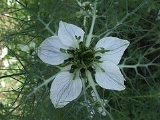
Nigella sativa is an annual flowering plant, native to southwest Asia. It grows to 20–30 cm tall, with finely divided, linear (but not thread-like) leaves. The flowers are delicate, and usually coloured pale blue and white, with 5–10 petals. The fruit is a large and inflated capsule composed of 3–7 united follicles, each containing numerous seeds.

Discussion
Ask a question about 'Nigella sativa'
Start a new discussion about 'Nigella sativa'
Answer questions from other users
|
Recent Posts

Encyclopedia
- To read about the politician, see Albert Kalonji.
Nigella sativa is an annual flowering plant, native to southwest Asia. It grows to 20–30 cm tall, with finely divided, linear (but not thread-like) leaves. The flowers are delicate, and usually coloured pale blue and white, with 5–10 petals. The fruit is a large and inflated capsule composed of 3–7 united follicles, each containing numerous seeds. The seed is used as a spice.
In English, Nigella sativa seed is variously called fennel flower, nutmeg flower, Roman coriander, blackseed, black caraway, or black onion seed. Other names used, sometimes misleadingly, are onion seed and black sesame, both of which are similar-looking but unrelated. The seeds are frequently referred to as black cumin (as in Bengali ???? ???? kalo jira), but this is also used for a different spice, Bunium persicum. The scientific name is a derivative of Latin niger "black". An older English name gith is now used for the corncockle. In English-speaking countries with large immigrant populations, it is also variously known as kalonji (Hindi ?????? kalau?ji or ?????? kalo?ji), kezah Hebrew ???), chernushka (Russian), çörek otu (Turkish), habbat albarakah (Arabic ??? ?????? ?abbatu l-barakah "seed of blessing") or siyah daneh (Persian ????????? siyâh dâne)or ?????? in urdu.
This potpourri of vernacular names for this plant reflects that its widespread use as a spice is relatively new in the English speaking world, and largely associated with immigrants from areas where it is well known. Increasing use is likely to result in one of the names winning out.
Nigella sativa has a pungent bitter taste and a faint smell of strawberries. It is used primarily in candies and liquors. The variety of naan bread called Peshawari naan is as a rule topped with kalonji seeds. In herbal medicine, Nigella sativa has anti-hypertensive, carminative, and anthelminthic properties. They are eaten by elephants to aid digestion.
History
According to Zohary and Hopf, archeological evidence about the earliest cultivation of N. sativa "is still scanty", but they report that N. sativa seeds have been found in several sites from ancient Egypt, including Tutenkhamen's tomb. Although its exact role in Egyptian culture is unknown, it is known that items entombed with a pharaoh were carefully selected to assist him in the after life.
The earliest written reference to N. sativa is thought to be in the book of Isaiah in the Old Testament where the reaping of nigella and wheat is contrasted (Isaiah 28: 25, 27). Easton's Bible dictionary states that the Hebrew word ketsah refers to without doubt to N. sativa (although not all translations are in agreement). According to Zohary and Hopf, N. sativa "was another traditional condiment of the Old World during classical times; and its black seeds were extensively used to flavor food."
Folk Medicine
Nigella sativa has been used for medicinal purposes for centuries, both as a herb and pressed into oil, in Asia, Middle East, and Africa. It has been traditionally used for a variety of conditions and treatments related to respiratory health, stomach and intestinal health, kidney and liver function, circulatory and immune system support, and for general well-being.
In Islam, it is regarded as one of the greatest forms of healing medicine available. Prophet Muhammad once stated that the black seed can heal every disease—except death—as recounted in the following hadith:
Avicenna, most famous for his volumes called The Canon of Medicine, refers to nigella as the seed that stimulates the body's energy and helps recovery from fatigue and dispiritedness. It is also included in the list of natural drugs of 'Tibb-e-Nabavi', or "Medicine of the Prophet (Muhammad)", according to the tradition "hold onto the use of the black seeds for in it is healing for all diseases except death" (Sahih Bukhari vol. 7 book 71 # 592).
In the Unani Tibb system of medicine, N. sativa is regarded as a valuable remedy for a number of diseases.
The seeds have been traditionally used in the Middle East and Southeast Asian countries to treat ailments including asthma, bronchitis, rheumatism and related inflammatory diseases, to increase milk production in nursing mothers, to promote digestion and to fight parasitic infections. Its oil has been used to treat skin conditions such as eczema and boils and to treat cold symptoms. Its many uses have earned nigella the Arabic approbation 'Habbatul barakah', meaning the seed of blessing.
Scientific Research Black cumin oil contains nigellone, which protects guinea pigs from histamine-induced bronchial spasms (perhaps explaining its use to relieve the symptoms of asthma, bronchitis, and coughing).
The presence of an anti-tumor sterol, beta sitosterol, lends credence to its traditional use to treat abscesses and tumors of the abdomen, eyes, and liver.
Nigella Sativa oil is known to have opioid agonistic properties.
Thymoquinone & Pancreatic Cancer Treatment Researchers at the Kimmel Cancer at Jefferson in Philadelphia have found that thymoquinone, an extract of nigella sativa seed oil, blocked pancreatic cancer cell growth and killed the cells by enhancing the process of programmed cell death, (apoptosis). While the studies are in the early stages, the findings suggest that thymoquinone could eventually have some use as a preventative strategy in patients who have gone through surgery and chemotherapy or in individuals who are at a high risk of developing cancer.
See also
External links
-
-
- from The Encyclopedia of Spices
-
- Antimicrobial activity of Nigella sativa oil against and obtained from clinical specimens.
-
- Nigella Sativa is used as a remedy for Hair.
- The One and Only Black Seed Cola
- Europe's No.1 Supplier of Nigella Sativa
RELATED TOPICS
|
| |
|
|