


Natalie Jeremijenko

Encyclopedia
Natalie Jeremijenko is an artist and engineer whose background includes studies in biochemistry, physics, neuroscience and precision engineering. She is an active member of the net.art
movement, and her work primarily explores the interface between society, the environment and technology. She is currently an Associate Professor at NYU in the Visual Art Department, and has affiliated faculty appointments in Computer Science and Environmental Studies. She is married to Dalton Conley
, an American
Sociologist at New York University
. Together, they have two children.
). Jeremijenko is the director of the xDesign Environmental Health Clinic at NYU, assistant professor in Art, and affiliated with the Computer Science Department.
Recently, Jeremijenko’s work was included in the 2006 Whitney Biennial
of American Art and the Cooper Hewitt Smithsonian Design Triennial 2006-7. Jeremijenko’s permanent installation on the roof of Postmasters Gallery in Chelsea Model Urban Development(MUD): provides infrastructure and facilities for high-density bird cohabitation in an environmental experiment in interaction with the New York City bird population.
Her work is described as experimental design, hence xDesign, as it explores opportunities presented by new technologies for non-violent social change. Her research centers on structures of participation in the production of knowledge and information, and the political and social possibilities (and limitations) of information and emerging technologies—mostly through public experiments. In this vein, her work spans a range of media from statistical indices (such as the Despondency Index, which linked the Dow Jones to the suicide rate at San Francisco's Golden Gate Bridge) to biological substrates (such as the installations of cloned trees in pairs in various urban micro-climates) to robotics (such as the development of feral robotic dog packs to investigate environmental hazards).
Jeremijenko is also a visiting professor at Royal College of Art
, in London and an artist not-in-residence at the Institute for the Future in Palo Alto. Previously, Jeremijenko was a member of the faculty in the Visual Arts at UCSD and in Engineering at Yale.

 Environmental Health Clinic
Jeremijenko directs the xDesign Environmental Health Clinic]. The Environmental Health Clinic develops and prescribes locally optimized and often playful strategies to effect remediation of environmental systems, producing measurable and mediagenic evidence and coordinating diverse projects to effective material change.
XEROX PARC
Jeremijenko installed at Xerox PARC during Mark Weiser
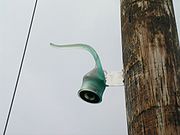
's time there, an installation called 'Live Wire'. Also known as 'Dangling String', it is considered an early visual representation of ubiquitous systems
. The installation consisted of a piece of string attached to a stepper motor and controlled by a LAN connection; network activity caused the string to twitch, yielding a peripherally noticeable indication of traffic. Weiser called this an example of 'calm technology'.
2005
ZOOZ: Exploring Reciprocity in the Zoo
A series of animal enrichment devices designed for the context of the traditional Zoo. OOZ devices are species specific but designed for both non human and human users, encouraging humans to mirror the actions of the animals: explore the unique capacities of each respective species: expose the tremendous incapacities of humans, and challenge the human centric view of intelligence, competence and management of natural systems.
2007
Amphibious Architecture
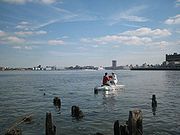
Structures to transform the view of urban bodies of water from reflective surfaces into teaming habitats and open ecosystems. AA is to Aquariums what OOZ are to ZOOs , inside out, upsidedown, and facilitating productive interaction between humans and aquatic systems. AA structures interact with flow conditions to provide ecological niches suitable for particular populations augmenting ecological networks; exploit fluid forces for structural efficiency; and captures hydropower for dynamic adaptive structures. AA sites are designed to accumulate the actions of participants into environmental remediation.
2002
D4PA: Designed 4 Political Action
A catalogue of devices and strategies for political engagement and direct action developed by the Bureau and others. Described by Wired Magazine as the DARPA of dissent.
2002
OOZ
Various technological interfaces to facilitate interaction with natural
systems as opposed to virtual systems. These interfaces encourage
interactive relationships with non human and are intended to accumulate the actions of participants into productive local environmental knowledge and the remediation of urban territories.
2002
HowStuffIsMade
A visual encyclopedia documenting the manufacturing processes,
environmental costs and labor conditions involved in the production of contemporary products. This is a wiki based collectively produced academic project to change the information available on and about the production.
Feral Robots
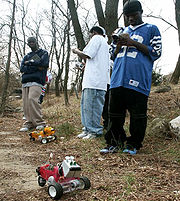
An Open Source robotics project providing resources and support for upgrading the raison d’etre of commercially available robotic dog toys; and facilitating mediagenic Feral Robotic Dog Pack Release events. Because the dogs follow concentration gradients of the contaminants they are equipped to sniff, their release renders information legible to diverse participants, provides the opportunity for evidence driven discussion, and facilitates public participation in environmental monitoring and remediation.
BIT Plane
The BIT plane is a radio-controlled model airplane, designed by the Bureau of Inverse Technology and equipped with a micro-video camera and transmitter. Its name could be a possible reference to bit plane
, meaning a set of digital discrete signals
. In 1997 it was launched on a series of sorties over the Silicon Valley to capture an aerial rendering. Guided by the live control-view video feed from the plane, the pilot on the ground was able to steer the unit deep into the glittering heartlands of the Information Age
.
Most of the corporate research parks in Silicon Valley are no-camera zones and require US Citizen status or special clearance for entry. The bit plane (citizenship undisclosed) flew covertly through this rarified information-space, buzzing the largest concentration of venture capital
in the world, to return with several hours of aerial footage.
Biotech Hobbyist
(1st issue) An online magazine with kits and resources to bring biotech to the garage bedroom and everyman, to raise the standards of evidence and capacity for public involvement in the political decisions on the biotechnological future.
Bat Billboard
Created in 2008, this project's goal was to dispel misinformation, as well as educate people on bats, their habitat, and activities. The billboard was an interactive home for bats that would display written messages based on the sonar messages the bats were sending. This work was showcased at MoMA's exhibit Talk to Me (exhibition)
Tracking the quantitative value of the placebo effect in federal drug
trials to represent a general measure of belief in pharmaceutical based medicine.
1998
CIRCA: The Ratio Virus’
Circulating on the Internet to the Number of Circulating Virus Warnings Using periodic estimates this comparison demonstrates that the level of fear, precaution and preemptive purchasing, far exceeds any real risk. Although imperfect information this indicates generalized paranoia and vigilance.
1997
1⁄2 Life Ratio
1996
Crossover Date
The projected future date at which the public investment in the silicon valley region is matched by the private investment in the area (not including angel funding 40%of all venture is exercised in this geographic area).
bureauit.org
1995
Despondency Index
Kurtz Shout Out Line
SparrowLine
AntiTerror Line: An open source audio collection device.
Animations
Collections of images of instances of various categories. These are
animated, i.e. viewed so that each instance becomes a frame in an
animation. The persistence of vision phenomenon amplifies small differences otherwise difficult to discern and as such provides a method for viewing difference.
1999
A database of projects produced prior to 2001.
1997
A collection of visions of the Future videos produced by telecommunication companies in the 80s and 90s.
N95 facemask with visual calibration to facilitate direct monitoring of air quality, specifically, rate of pm accumulation.
1998
Printer queue virus counts the number of pages printed and prints a slice of tree each time a tree equivalent in printed.
1997
l-system based A-life tree growing on windows 95 Desktop. Growth rate responds responds to Carbon Dioxide levels read at serial port sensor: empirically guided simulation.
Live wire
Feral Robotics
OOZ amphibious architecture
Net.art
"net.art" refers to a group of artists who worked in the medium of Internet art from 1994. The main members of this movement are Vuk Ćosić, Jodi.org, Alexei Shulgin, Olia Lialina, and Heath Bunting...
movement, and her work primarily explores the interface between society, the environment and technology. She is currently an Associate Professor at NYU in the Visual Art Department, and has affiliated faculty appointments in Computer Science and Environmental Studies. She is married to Dalton Conley
Dalton Conley
Dalton Clark Conley is an American sociologist. He is University Professor of the Social Sciences and the Chair of the Department of Sociology at New York University...
, an American
United States
The United States of America is a federal constitutional republic comprising fifty states and a federal district...
Sociologist at New York University
New York University
New York University is a private, nonsectarian research university based in New York City. NYU's main campus is situated in the Greenwich Village section of Manhattan...
. Together, they have two children.
Recognition
Jeremijenko's work has been exhibited by several museums and galleries, including the MASS MoCA, the Whitney Museum, and the Cooper-Hewitt Museum. A 1999 Rockefeller Fellow, she was recently named one of the 40 most influential designers by I.D. Magazine and one of the inaugural Top 100 Young Innovators by the MIT Technology Review (TR100TR35
The TR35 is an annual list published by MIT Technology Review magazine, naming the world's top 35 innovators under the age of 35.Some of the most famous winners of the award include Larry Page and Sergey Brin , Linus Torvalds , Jerry Yang , Jonathan Ive , Mark Zuckerberg...
). Jeremijenko is the director of the xDesign Environmental Health Clinic at NYU, assistant professor in Art, and affiliated with the Computer Science Department.
Recently, Jeremijenko’s work was included in the 2006 Whitney Biennial
Whitney Biennial
The Whitney Biennial is a biennale exhibition of contemporary American art, typically by young and lesser known artists, on display at the Whitney Museum of American Art in New York City, USA. The event began as an annual exhibition in 1932, the first biennial was in 1973...
of American Art and the Cooper Hewitt Smithsonian Design Triennial 2006-7. Jeremijenko’s permanent installation on the roof of Postmasters Gallery in Chelsea Model Urban Development(MUD): provides infrastructure and facilities for high-density bird cohabitation in an environmental experiment in interaction with the New York City bird population.
Her work is described as experimental design, hence xDesign, as it explores opportunities presented by new technologies for non-violent social change. Her research centers on structures of participation in the production of knowledge and information, and the political and social possibilities (and limitations) of information and emerging technologies—mostly through public experiments. In this vein, her work spans a range of media from statistical indices (such as the Despondency Index, which linked the Dow Jones to the suicide rate at San Francisco's Golden Gate Bridge) to biological substrates (such as the installations of cloned trees in pairs in various urban micro-climates) to robotics (such as the development of feral robotic dog packs to investigate environmental hazards).
Jeremijenko is also a visiting professor at Royal College of Art
Royal College of Art
The Royal College of Art is an art school located in London, United Kingdom. It is the world’s only wholly postgraduate university of art and design, offering the degrees of Master of Arts , Master of Philosophy and Doctor of Philosophy...
, in London and an artist not-in-residence at the Institute for the Future in Palo Alto. Previously, Jeremijenko was a member of the faculty in the Visual Arts at UCSD and in Engineering at Yale.
Projects
INCLUDING ARCHIVES, DATABASES AND INDICATORSJeremijenko directs the xDesign Environmental Health Clinic]. The Environmental Health Clinic develops and prescribes locally optimized and often playful strategies to effect remediation of environmental systems, producing measurable and mediagenic evidence and coordinating diverse projects to effective material change.
XEROX PARC
Jeremijenko installed at Xerox PARC during Mark Weiser
Mark Weiser
Mark D. Weiser was a chief scientist at Xerox PARC in the United States. Weiser is widely considered to be the father of ubiquitous computing, a term he coined in 1988.-Biography:...
's time there, an installation called 'Live Wire'. Also known as 'Dangling String', it is considered an early visual representation of ubiquitous systems
Ubiquitous computing
Ubiquitous computing is a post-desktop model of human-computer interaction in which information processing has been thoroughly integrated into everyday objects and activities. In the course of ordinary activities, someone "using" ubiquitous computing engages many computational devices and systems...
. The installation consisted of a piece of string attached to a stepper motor and controlled by a LAN connection; network activity caused the string to twitch, yielding a peripherally noticeable indication of traffic. Weiser called this an example of 'calm technology'.
2005
ZOOZ: Exploring Reciprocity in the Zoo
A series of animal enrichment devices designed for the context of the traditional Zoo. OOZ devices are species specific but designed for both non human and human users, encouraging humans to mirror the actions of the animals: explore the unique capacities of each respective species: expose the tremendous incapacities of humans, and challenge the human centric view of intelligence, competence and management of natural systems.
2007
Amphibious Architecture
Structures to transform the view of urban bodies of water from reflective surfaces into teaming habitats and open ecosystems. AA is to Aquariums what OOZ are to ZOOs , inside out, upsidedown, and facilitating productive interaction between humans and aquatic systems. AA structures interact with flow conditions to provide ecological niches suitable for particular populations augmenting ecological networks; exploit fluid forces for structural efficiency; and captures hydropower for dynamic adaptive structures. AA sites are designed to accumulate the actions of participants into environmental remediation.
2002
D4PA: Designed 4 Political Action
A catalogue of devices and strategies for political engagement and direct action developed by the Bureau and others. Described by Wired Magazine as the DARPA of dissent.
2002
OOZ
Various technological interfaces to facilitate interaction with natural
systems as opposed to virtual systems. These interfaces encourage
interactive relationships with non human and are intended to accumulate the actions of participants into productive local environmental knowledge and the remediation of urban territories.
2002
HowStuffIsMade
A visual encyclopedia documenting the manufacturing processes,
environmental costs and labor conditions involved in the production of contemporary products. This is a wiki based collectively produced academic project to change the information available on and about the production.
Feral Robots
An Open Source robotics project providing resources and support for upgrading the raison d’etre of commercially available robotic dog toys; and facilitating mediagenic Feral Robotic Dog Pack Release events. Because the dogs follow concentration gradients of the contaminants they are equipped to sniff, their release renders information legible to diverse participants, provides the opportunity for evidence driven discussion, and facilitates public participation in environmental monitoring and remediation.
BIT Plane
The BIT plane is a radio-controlled model airplane, designed by the Bureau of Inverse Technology and equipped with a micro-video camera and transmitter. Its name could be a possible reference to bit plane
BIT plane
This article is about Natalie Jeremijenko and the Bureau of Inverse Technology's project. For the company, see Bitplane. For the digital information term, see bit plane....
, meaning a set of digital discrete signals
Discrete signal
A discrete signal or discrete-time signal is a time series consisting of a sequence of qualities...
. In 1997 it was launched on a series of sorties over the Silicon Valley to capture an aerial rendering. Guided by the live control-view video feed from the plane, the pilot on the ground was able to steer the unit deep into the glittering heartlands of the Information Age
Information Age
The Information Age, also commonly known as the Computer Age or Digital Age, is an idea that the current age will be characterized by the ability of individuals to transfer information freely, and to have instant access to knowledge that would have been difficult or impossible to find previously...
.
Most of the corporate research parks in Silicon Valley are no-camera zones and require US Citizen status or special clearance for entry. The bit plane (citizenship undisclosed) flew covertly through this rarified information-space, buzzing the largest concentration of venture capital
Venture capital
Venture capital is financial capital provided to early-stage, high-potential, high risk, growth startup companies. The venture capital fund makes money by owning equity in the companies it invests in, which usually have a novel technology or business model in high technology industries, such as...
in the world, to return with several hours of aerial footage.
Biotech Hobbyist
(1st issue) An online magazine with kits and resources to bring biotech to the garage bedroom and everyman, to raise the standards of evidence and capacity for public involvement in the political decisions on the biotechnological future.
Bat Billboard
Created in 2008, this project's goal was to dispel misinformation, as well as educate people on bats, their habitat, and activities. The billboard was an interactive home for bats that would display written messages based on the sonar messages the bats were sending. This work was showcased at MoMA's exhibit Talk to Me (exhibition)
Talk to Me (exhibition)
Talk to Me: Design and the Communication between People and Objects is an exhibition put on by the Museum of Modern Art from July 24 to November 7, 2011. Created by the Department of Architecture and Design, it was widely reviewed and draw large numbers of visitors...
Indicators
In Progress Placebo EffectTracking the quantitative value of the placebo effect in federal drug
trials to represent a general measure of belief in pharmaceutical based medicine.
1998
CIRCA: The Ratio Virus’
Circulating on the Internet to the Number of Circulating Virus Warnings Using periodic estimates this comparison demonstrates that the level of fear, precaution and preemptive purchasing, far exceeds any real risk. Although imperfect information this indicates generalized paranoia and vigilance.
1997
1⁄2 Life Ratio
1996
Crossover Date
The projected future date at which the public investment in the silicon valley region is matched by the private investment in the area (not including angel funding 40%of all venture is exercised in this geographic area).
bureauit.org
1995
Despondency Index
Archives, databases, and collections
2000Kurtz Shout Out Line
SparrowLine
AntiTerror Line: An open source audio collection device.
Animations
Collections of images of instances of various categories. These are
animated, i.e. viewed so that each instance becomes a frame in an
animation. The persistence of vision phenomenon amplifies small differences otherwise difficult to discern and as such provides a method for viewing difference.
1999
- Project Archive
A database of projects produced prior to 2001.
1997
- Icky Futures
A collection of visions of the Future videos produced by telecommunication companies in the 80s and 90s.
Other selected products
2004- Clear Skies: FaceMasks
N95 facemask with visual calibration to facilitate direct monitoring of air quality, specifically, rate of pm accumulation.
1998
- Stumped
Printer queue virus counts the number of pages printed and prints a slice of tree each time a tree equivalent in printed.
1997
- ALifeTree
l-system based A-life tree growing on windows 95 Desktop. Growth rate responds responds to Carbon Dioxide levels read at serial port sensor: empirically guided simulation.
Live wire
Feral Robotics
OOZ amphibious architecture
External links
- xDesign Environmental Health Clinic
- Natalie Jeremijenko's home page with info about projects
- Environmental Health Clinic with info about xCLINIC
- info from Yale
- Profile of artist with descriptions of her work
- video interview at Connected Environments exhibit at the Neuberger Museum of Art
- MoMA Talk To Me Exhibition Site