

Nagaoka-kyo

Encyclopedia
Capital of Japan
The capital of Japan, where the seat of the Government of Japan and home of the Emperor are located, is de facto. While this is generally not in dispute, the capital de jure is unclear. There is a dispute as to exactly when Tokyo became the capital. Some state that it occurred when Tokyo...
from 784
784
Year 784 was a leap year starting on Thursday of the Julian calendar. The denomination 784 for this year has been used since the early medieval period, when the Anno Domini calendar era became the prevalent method in Europe for naming years.- Asia :* The Japanese capital moves away from Nara,...
to 794
794
Year 794 was a common year starting on Wednesday of the Julian calendar. The denomination 794 for this year has been used since the early medieval period, when the Anno Domini calendar era became the prevalent method in Europe for naming years.- Asia :* Kyoto becomes the Japanese capital, ending...
. Its location was reported as Otokuni District
Otokuni District, Kyoto
Otokuni is a district located in Kyoto, Japan.As of 2003, the district has an estimated population of 15,493 and a density of 2,595.14 persons per km². The total area is 5.97 km².-Towns and villages:*Ōyamazaki...
, Yamashiro Province
Yamashiro Province
was a province of Japan, located in Kinai. It overlaps the southern part of modern Kyoto Prefecture on Honshū. Aliases include , the rare , and . It is classified as an upper province in the Engishiki....
, and Nagaokakyō, Kyoto
Nagaokakyo, Kyoto
is a city located in Kyoto, Japan.As of 2008, the city has an estimated population of 79,306 and the density of 4,070.96 persons per km². The total area is 19.18 km²....
, which took its name from the capital. Parts of the capital were in what is now the city of Nagaokakyō, while other parts were in the present-day Mukō
Muko, Kyoto
is a city located in Kyoto, Japan.As of 2008, the city had an estimated population of 55,031 and the density of 6,977.57 persons per km². The total area is 7.67 km².The city was founded on October 1, 1972...
and Nishikyō-ku
Nishikyo-ku, Kyoto
is one of the eleven wards in the city of Kyoto, in Kyoto Prefecture, Japan. Its name means "west capital ward" and it is situated on the western edge of the city, to the south of center. The ward was established on October 1, 1976 separating from Ukyō-ku...
, both in the city of Kyoto
Kyoto
is a city in the central part of the island of Honshū, Japan. It has a population close to 1.5 million. Formerly the imperial capital of Japan, it is now the capital of Kyoto Prefecture, as well as a major part of the Osaka-Kobe-Kyoto metropolitan area.-History:...
.
In 784, the Emperor Kammu
Emperor Kammu
was the 50th emperor of Japan, according to the traditional order of succession. Kammu reigned from 781 to 806.-Traditional narrative:Kammu's personal name was . He was the eldest son of Prince Shirakabe , and was born prior to Shirakabe's ascension to the throne...
moved the capital from Nara
Nara, Nara
is the capital city of Nara Prefecture in the Kansai region of Japan. The city occupies the northern part of Nara Prefecture, directly bordering Kyoto Prefecture...
(then called Heijō). According to the Shoku Nihongi
Shoku Nihongi
The is an imperially commissioned Japanese history text. Completed in 797, it is the second of the Six National Histories, coming directly after the Nihon Shoki and followed by Nihon Kōki. Fujiwara no Tsugutada and Sugano no Mamichi served as the primary editors...
, his reason for moving was that the new location had better water transportation routes. Other explanations have been given, including the wish to escape the power of the Buddhist
Buddhism
Buddhism is a religion and philosophy encompassing a variety of traditions, beliefs and practices, largely based on teachings attributed to Siddhartha Gautama, commonly known as the Buddha . The Buddha lived and taught in the northeastern Indian subcontinent some time between the 6th and 4th...
clergy and courtiers, and the backing of the immigrants from whom his mother was descended.
In 785, the administrator in charge of the new capital, Fujiwara no Tanetsugu, was assassinated. The emperor's brother, Prince Sawara
Prince Sawara
was the 5th son of Prince Shirakabe , by Takano no Niigasa. In 781 he was named heir-presumptive after his elder brother succeeded the abdicated Emperor Kōnin as the Emperor Kanmu....
, was implicated, exiled to Awaji Province
Awaji Province
was an old province of Japan covering Awaji Island, between Honshū and Shikoku. Today it is part of Hyōgo Prefecture. It is sometimes called . Awaji is divided into three municipal sections: Awaji is the northernmost section, Sumoto is the most urban and central section, and four southern towns...
, and died on the way there.
In 794, Emperor Kammu moved the capital to Heian (in the center of the present-day city of Kyoto). Reasons cited for this move include frequent flooding of the rivers that had promised better transportation; disease caused by the flooding, affecting the empress and crown prince; and fear of the spirit of the late Prince Sawara.
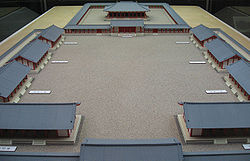
Excavations begun in 1954 revealed the remains of a gate to the imperial residence.