
All Topics  
Mount Erebus

 
Mount Erebus

   Email Print
   Bookmark   Link


Mount Erebus


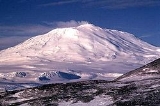
Mount Erebus in Antarctica
Antarctica

Antarctica is Earth's southernmost continent, overlying the South Pole. It is situated in the Antarctica of the southern hemisphere, almost entirely south of the Antarctic Circle, and is surrounded by the Southern Ocean....
 is the southernmost active volcano
Volcano

A volcano is an opening, or rupture, in a planet's surface or Crust , which allows hot, molten rock, ash, and gases to escape from below the surface....
 on Earth. With a summit elevation of , it is located on Ross Island
Ross Island

Ross Island is an island formed by four volcanoes in the Ross Sea near the continent of Antarctica, off the coast of Victoria Land in McMurdo Sound....
, which is also home to three inactive volcanoes, notably Mount Terror
Mount Terror (Antarctica)

Mount Terror is a large shield volcano that forms the eastern part of Ross Island. It has numerous volcanic cone#cinder cones and domes on the flanks of the shield and is mostly under snow and ice....
. Mount Erebus is part of the Pacific Ring of Fire
Pacific Ring of Fire

The Pacific Ring of Fire is an area of frequent earthquakes and volcanic eruptions encircling the basin of the Pacific Ocean. In a 40,000 km horseshoe shape, it is associated with a nearly continuous series of oceanic trenches, volcanic arcs, and volcanic belts and/or plate movements....
, which includes over 160 active volcanoes.

The volcano has been observed to be continuously active since 1972 and is the site of the Mount Erebus Volcano Observatory run by the New Mexico Institute of Mining and Technology
New Mexico Institute of Mining and Technology

New Mexico Institute of Mining and Technology is a research university located in Socorro, New Mexico, USA.Renowned for its undergraduate and graduate educational opportunities, Tech offers over 30 bachelor of science degrees in mathematics, the sciences, engineering, management, and technical communication, as well as graduate degrees in...
.

Discovery and naming
Mount Erebus was discovered on January 27, 1841 (and observed to be in eruption) by polar explorer Sir James Clark Ross
James Clark Ross

Sir James Clark Ross , was a British Royal Navy and List of explorers. He explored the Arctic with his uncle Sir John Ross and Sir William Edward Parry, and later led his own expedition to Antarctica....
 who named it and Mount Terror after his ships, Erebus
HMS Erebus (1826)

HMS Erebus was a Hecla class bomb vessel bomb vessel designed by Sir Henry Peake and constructed by the Royal Navy in Pembroke Dock, Wales in 1826....
 and Terror
HMS Terror (1813)

HMS Terror was a bomb vessel designed by Sir Henry Peake and constructed by the Royal Navy in the Davy shipyard in Topsham, Devon. The ship, variously listed as being of either 326 or 340 tons, carried two mortar , one and one ....
 (which were also used by Sir John Franklin
John Franklin

Sir John Franklin, Royal Geographical Society was a United Kingdom Royal Navy Officer and Arctic List of explorers who mapped almost two thirds of the northern coastline of North America....
 on his disastrous Arctic
Arctic

The Arctic is the region around the Earth's North Pole, opposite the Antarctica region around the South Pole. The Arctic includes the Arctic Ocean and parts of Canada, Greenland , Russia, the United States , Iceland, Norway, Sweden and Finland....
 expedition
Franklin's lost expedition

Franklin's lost expedition was a doomed British voyage of Arctic exploration led by Captain Sir John Franklin that departed England in 1845. A Royal Navy officer and experienced explorer, Franklin had served on three previous Arctic expeditions, the latter two as commanding officer....
).


Discussion
Ask a question about 'Mount Erebus'
Start a new discussion about 'Mount Erebus'
Answer questions from other users
Full Discussion Forum


Encyclopedia


Mount Erebus in Antarctica
Antarctica

Antarctica is Earth's southernmost continent, overlying the South Pole. It is situated in the Antarctica of the southern hemisphere, almost entirely south of the Antarctic Circle, and is surrounded by the Southern Ocean....
 is the southernmost active volcano
Volcano

A volcano is an opening, or rupture, in a planet's surface or Crust , which allows hot, molten rock, ash, and gases to escape from below the surface....
 on Earth. With a summit elevation of , it is located on Ross Island
Ross Island

Ross Island is an island formed by four volcanoes in the Ross Sea near the continent of Antarctica, off the coast of Victoria Land in McMurdo Sound....
, which is also home to three inactive volcanoes, notably Mount Terror
Mount Terror (Antarctica)

Mount Terror is a large shield volcano that forms the eastern part of Ross Island. It has numerous volcanic cone#cinder cones and domes on the flanks of the shield and is mostly under snow and ice....
. Mount Erebus is part of the Pacific Ring of Fire
Pacific Ring of Fire

The Pacific Ring of Fire is an area of frequent earthquakes and volcanic eruptions encircling the basin of the Pacific Ocean. In a 40,000 km horseshoe shape, it is associated with a nearly continuous series of oceanic trenches, volcanic arcs, and volcanic belts and/or plate movements....
, which includes over 160 active volcanoes.

The volcano has been observed to be continuously active since 1972 and is the site of the Mount Erebus Volcano Observatory run by the New Mexico Institute of Mining and Technology
New Mexico Institute of Mining and Technology

New Mexico Institute of Mining and Technology is a research university located in Socorro, New Mexico, USA.Renowned for its undergraduate and graduate educational opportunities, Tech offers over 30 bachelor of science degrees in mathematics, the sciences, engineering, management, and technical communication, as well as graduate degrees in...
.

Discovery and naming


Mount Erebus was discovered on January 27, 1841 (and observed to be in eruption) by polar explorer Sir James Clark Ross
James Clark Ross

Sir James Clark Ross , was a British Royal Navy and List of explorers. He explored the Arctic with his uncle Sir John Ross and Sir William Edward Parry, and later led his own expedition to Antarctica....
 who named it and Mount Terror after his ships, Erebus
HMS Erebus (1826)

HMS Erebus was a Hecla class bomb vessel bomb vessel designed by Sir Henry Peake and constructed by the Royal Navy in Pembroke Dock, Wales in 1826....
 and Terror
HMS Terror (1813)

HMS Terror was a bomb vessel designed by Sir Henry Peake and constructed by the Royal Navy in the Davy shipyard in Topsham, Devon. The ship, variously listed as being of either 326 or 340 tons, carried two mortar , one and one ....
 (which were also used by Sir John Franklin
John Franklin

Sir John Franklin, Royal Geographical Society was a United Kingdom Royal Navy Officer and Arctic List of explorers who mapped almost two thirds of the northern coastline of North America....
 on his disastrous Arctic
Arctic

The Arctic is the region around the Earth's North Pole, opposite the Antarctica region around the South Pole. The Arctic includes the Arctic Ocean and parts of Canada, Greenland , Russia, the United States , Iceland, Norway, Sweden and Finland....
 expedition
Franklin's lost expedition

Franklin's lost expedition was a doomed British voyage of Arctic exploration led by Captain Sir John Franklin that departed England in 1845. A Royal Navy officer and experienced explorer, Franklin had served on three previous Arctic expeditions, the latter two as commanding officer....
). Erebus
Erebus

In Greek mythology, Erebus or Erebos or Erebes was the son of a primordial god, Chaos , and represented the personification of darkness and shadow, which filled in all the corners and crannies of the world....
 was a primordial Greek
Greek mythology

Greek mythology is the body of myths and legends belonging to the Ancient Greece concerning their List of Greek mythological figures#Immortals and Greek hero cult, Cosmology#Metaphysical cosmology, and the origins and significance of their own cult and ritual practices....
 god
God

God is a deity in theism and deism religions and other belief systems, representing either the sole deity in monotheism, or a principal deity in polytheism....
, the son of Chaos
Chaos (mythology)

In Greek myth, Chaos or Khaos is the original state of existence from which the first gods appeared. In other words, the dark void of space....
.

Climbing


Mount Erebus was first climbed (to the rim) by members of Sir Ernest Shackleton
Ernest Shackleton

Sir Ernest Henry Shackleton Royal Victorian Order Order of British Empire, was an Anglo-Irish explorer who was one of the principal figures of the period known as the Heroic Age of Antarctic Exploration....
's party in 1908. Its first known solo ascent was accomplished by British mountaineer Roger Mear in March 1985, a member of Robert Swan
Robert Swan

Robert Charles Swan, Officer of the Order of the British Empire, BA, FRGS was born on 28 July 1956 in Durham, England and attended Aysgarth School and then Sedbergh School before completing a BA in Ancient History at St Chad's College, Durham University....
's "In the Footsteps of Scott" expedition. On January 19–20, 1991, Charles J. Blackmer, an iron-worker for many years at McMurdo Station
McMurdo Station

McMurdo Station is an American Antarctica research center located on the southern tip of Ross Island on the shore of McMurdo Sound, 1 E6 m miles due south of New Zealand....
 and the South Pole
South Pole

The South Pole, also known as the Geographic South Pole or Terrestrial South Pole, is one of the two points where the Earth's rotation intersects the surface....
, accomplished a solo ascent in approximately seventeen hours.

Geology and volcanology

in altitude. View from McMurdo Station
McMurdo Station

McMurdo Station is an American Antarctica research center located on the southern tip of Ross Island on the shore of McMurdo Sound, 1 E6 m miles due south of New Zealand....
.]]

Mount Erebus is currently the most active volcano
Volcano

A volcano is an opening, or rupture, in a planet's surface or Crust , which allows hot, molten rock, ash, and gases to escape from below the surface....
 in Antarctica. The summit contains a persistent convecting phonolitic lava lake, one of a very few long-lasting lava lake
Lava lake

Lava lakes are large volumes of molten lava, usually basaltic, contained in a vent, volcanic crater, or broad depression. Scientists use the term to describe both lava lakes that are molten and those that are partly or completely solidified....
s on Earth. Characteristic eruptive activity consists of Strombolian eruption
Strombolian eruption

Strombolian eruptions are relatively low-level volcano eruptions, named after the Italy volcano named Stromboli, where such eruptions consist of ejection of incandescent cinder, lapilli and lava bombs to altitudes of tens to hundreds of meters....
s from the lava lake or from one of several subsidiary vents, all lying within the volcano's inner crater. The volcano is scientifically remarkable in that its relatively low-level and unusually persistent eruptive activity enables long-term volcanological study of a Strombolian eruptive system very close (hundreds of metres) to the active vents, a characteristic shared with only a few volcanos planetarily, such as Stromboli
Stromboli

Stromboli is a small island in the Tyrrhenian Sea, off the north coast of Sicily, containing one of the three active Volcanism in Italy. It is one of the eight Aeolian Islands, a volcanic arc north of Sicily....
 in Italy. Scientific study of the volcano is also facilitated by the proximity (thirty-five kilometres) of McMurdo Station
McMurdo Station

McMurdo Station is an American Antarctica research center located on the southern tip of Ross Island on the shore of McMurdo Sound, 1 E6 m miles due south of New Zealand....
 (U.S.) and Scott Base
Scott Base

Scott Base is a base located in Antarctica and is operated by New Zealand. It was named after Captain Robert Falcon Scott, Royal Navy, leader of two United Kingdom expeditions to the Ross Sea area of Antarctica....
 (N.Z.), both sited on Ross Island.

Mount Erebus is classified as a polygenetic stratovolcano. The bottom half of the volcano is a shield and the top half is a stratocone (Mount Etna
Mount Etna

Mount Etna is an active stratovolcano on the east coast of Sicily, close to Messina, Italy and Catania. Its Arabic name was Jebel Utlamat ....
 is like this as well). The composition of the current eruptive products of Erebus is anorthoclase
Anorthoclase

The mineral anorthoclase is a crystalline solid solution in the alkali feldspar series, in which the sodium-aluminium silicate member exists in larger proportion....
-porphyric tephritic phonolite and phonolite
Phonolite

Phonolite is an evolved lava which is considered as forming in shallow magma chambers. Phonolite is an igneous rock, volcanic rock , of intermediate composition, with aphanitic to porphyritic texture....
, which constitute the bulk of exposed lava flow on the volcano. The oldest eruptive products consist of relatively undifferentiated and non-viscous basanitic lavas that form the low, broad platform shield of the Erebus edifice. Slightly younger basanite
Basanite

Basanite is an igneous rock, volcanic rock with aphanitic to porphyritic texture. The mineral assembly is usually abundant feldspathoids , plagioclase, and augite, together with olivine and lesser iron-titanium oxides such as ilmenite and magnetite-ulvospinel; minor alkali feldspar may be present, as illustrated by the position of the fiel...
 and phonotephrite lavas crop out on Fang Ridge, an eroded remnant of an early Erebus volcano and at other isolated locations on the flanks of the Erebus edifice.

Lava flows of more viscous phonotephrite, tephriphonolite and trachyte
Trachyte

Trachyte is an igneous, volcanic rock with an aphanitic to porphyritic texture. The mineral assemblage consists of essential alkali feldspar; relatively minor plagioclase and quartz or a feldspathoid such as nepheline may also be present....
 were erupted after the basanite. The upper slopes of Mount Erebus are dominated by steeply dipping (-30°) tephritic phonolite lava flows with large scale flow levees. A conspicuous break in slope at approximately 3,200 metres is a summit plateau representing a caldera
Caldera

A caldera is a cauldron-like volcano feature usually formed by the collapse of land following a volcanic eruption such as the one at Yellowstone National Park....
 less than one hundred millennia old. The summit caldera itself is filled with small volume tephritic phonolite and phonolite lava flows. In the center of the summit caldera is a small, steep-sided cone composed primarily of decomposed lava bombs and a large deposit of anorthoclase
Anorthoclase

The mineral anorthoclase is a crystalline solid solution in the alkali feldspar series, in which the sodium-aluminium silicate member exists in larger proportion....
 crystals. It is within this summit cone that the active lava lake continuously degasses.

Air disaster


Air New Zealand Flight 901

Air New Zealand Flight 901 was a scheduled Antarctic sightseeing flight from Auckland Airport in New Zealand. The Antarctic sightseeing flights were operated with McDonnell Douglas DC-10 aircraft and began in February 1977....
 was a scheduled passenger transport service from Auckland Airport in New Zealand
New Zealand

New Zealand is an island country in the south-western Pacific Ocean comprising two main landmasses , and numerous Islands of New Zealand, most notably Stewart Island/Rakiura and the Chatham Islands....
 to Antarctica
Antarctica

Antarctica is Earth's southernmost continent, overlying the South Pole. It is situated in the Antarctica of the southern hemisphere, almost entirely south of the Antarctic Circle, and is surrounded by the Southern Ocean....
 and return, without an intermediate stop. The Air New Zealand
Air New Zealand

Air New Zealand Limited is the national airline and flag carrier of New Zealand. Based in Auckland, New Zealand, the airline operates scheduled passenger flights to over 40 destinations worldwide, and is currently the only airline to fly round the world....
 flyover service, for the purposes of Antarctic sightseeing, was operated with McDonnell Douglas DC-10-30 aircraft and began in February 1977. The flight crashed into Mount Erebus in sector whiteout conditions on November 28, 1979, killing all 257 people aboard. Air New Zealand discontinued the service after the crash.

During the Antarctic summer, snow melt on the flanks of Mount Erebus continually brings debris from the crash to the surface of the snow; it is plainly visible from the air.

Gallery


See also

  • List of volcanoes in Antarctica
    List of volcanoes in Antarctica

    This is a list of active and extinct volcanoes in Antarctica.References *]...
  • Erebus Ice Tongue
    Erebus Ice Tongue

    The Erebus Ice Tongue is a mountain outlet glacier that projects 11-12 km into McMurdo Sound from the Ross Island coastline near Cape Evans, Antarctica....
  • Lower Erebus Hut
    Lower Erebus Hut

    Sorry, no overview for this topic
     - Home of MEVO
  • Nimrod Expedition
    Nimrod Expedition

    The British Antarctic Expedition 1907?09, otherwise known as the Nimrod Expedition, was the first of three expeditions to the Antarctic led by Ernest Shackleton....
     - first ascent of Mount Erebus
  • Volcanic Seven Summits
    Volcanic Seven Summits

    The Volcanic Seven Summits are the highest volcanoes on each of the seven continents, just as the Seven Summits are the highest peaks on each of the seven continents....


External links