

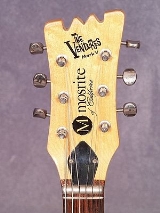
Mosrite

Encyclopedia
Mosrite is an American
guitar
manufacturing company, based in Bakersfield, California
, from the late 1950s to the early 1990s. Founded by Semie Moseley
, Mosrite guitars were played by many rock and roll
and country
artists.
Mosrite guitars were known for innovative design, high quality engineering, very thin, low-fretted and narrow necks, and extremely hot (high output) pickups. Moseley's design for The Ventures
, known as the "Ventures Model" (later known as the "Mark I"), was generally considered to be the flagship of the line.
Semie Moseley began building guitars in the Los Angeles area around 1952 or 1953. He began by apprenticing at the Rickenbacker
factory, where he learned much of his guitar making skills from Roger Rossmeisl, a German immigrant who brought old-world luthier techniques into the modern electric guitar manufacturing process. One of the most recognizable features on most Mosrite guitars is the "German Carve" on the top that Moseley learned from Rossmeisl. During the same time, Moseley apprenticed with Paul Bigsby
in Downey, California
, the man who made the first modern solid-body guitar for Merle Travis in 1948, and who invented the Bigsby vibrato tailpiece, which is still used today.
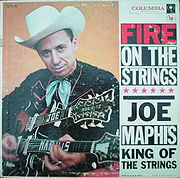 In 1954 Semie built a triple-neck guitar in his garage (the longest neck was a standard guitar, the second-longest neck an octave higher, the shortest was an eight-string mandolin). He presented a double-neck to Joe Maphis
, a Los Angeles
-area TV performer. By 1956, with an investment from Ray Boatwright, a local Los Angeles minister, Semie and Andy started their company, Mosrite of California. In gratitude to Boatwright, Moseley named the company by combining his and Boatwright's last names; the name is properly pronounced MOZE-rite, based on the pronunciation Semie Moseley used for his own name. Semie, who built guitars for the L.A.-based Rickenbacker company, said to his co-workers that he was making his own product, and he was fired by Rickenbacker.
When they began, their production was all custom, handmade guitars, built in garages, tin storage sheds, wherever the Moseleys could put equipment.
In 1959, Andy moved to Nashville, Tennessee
, for a year to popularize the Mosrite name and sold a few, including to Grand Ole Opry
entertainers and road musicians. Andy said: "And that’s how we kept the factory going at the time: custom guitars".
Moseley made guitars in Los Angeles until 1959, when he moved to Oildale, California
, just north of Bakersfield.
In 1962 he moved his shop to Panama Lane where he designed and produced the first Joe Maphis model guitars, one model of which would eventually evolve into the "Ventures model" guitar and bass. (Joe Maphis would later get a model of his own, similar to a Mosrite Combo model but without the F-hole.) At this time, Mosrite made everything in-house, except for the tuners. At the peak of production, in 1968, Mosrite was making around 1,000 guitars per month.
near Bakersfield. He moved his factory three times in the next 20 years, to Oklahoma City
in the mid-70s, to the township of Jonas Ridge, in Burke County, North Carolina
, in 1981 (where a factory fire destroyed the operation), and to Booneville, Arkansas
, in 1991.
Though an acknowledged genius at guitar design and construction, Moseley lacked many basic skills necessary to be a good businessman, and thus the company fell on hard times repeatedly in the late 1960s and 1970s, but continued to produce Mosrite guitars until 1993 in North Carolina and Arkansas. Most of them were exported to Japan, where their popularity remained very strong. The quality of the instruments always remained very respectable. Semie Moseley died in 1992. His wife Loretta continued to produce Mosrites a year or so after his death, and since 2008 has been selling custom Mosrites via their website.
The company now has recently released the Semie Moseley Model ’63 and ’65, based on the Ventures models made in those two years. Both models are made to the exact specifications as the original models; they are 100% hand-made and were created to commemorate Semie Moseley.
Semie's daughter, Dana Moseley, is also a luthier and continues to build Mosrite guitars. She also helps kick off the monthly "Mosrite Jam" in Bakersfield.
, but most players disliked it. That, in conjunction with many requests to lengthen the rather short vibrato handle, led Moseley to slightly re-design the unit for the 1965 and beyond guitars. He named this incarnation the "Moseley" vibrato, though its differences with the Vibramute are slight.
The Gospel models were produced in various years and have experienced many and varied changes in the style of construction. While some of the later, solid-body Gospel guitars have a unique flat face body with rounded edges, the first prototypes, created in the mid-60s, were hollow, and based loosely on the Celebrity model. Notable differences include the mildly scalloped headstock that had the "Gospel" trademark and sign of the Cross, but not the Mosrite name. Hardware was solid brass, hand polished and chromed. Only two of the original Gospel prototypes survived the manufacturing process, as they were handcrafted by Semie, himself, using violin joints, rather than the serrated form blocks used to join most hollow body guitar sides to the top and back. The original Gospel guitars both had arched backs, as well as tops, with bound "F" holes. The transparent Blue Gospel, numbered GA009, was Semie's own personal guitar, used by him when playing on Gospel music tours. The all blonde Gospel was given to Semie's founding partner, the Reverend Ray Boatright. The Reverend was attacked in front of his church in Watts, he was killed, and the guitar was smashed. Thus, the only surviving original mid 60s "GA" prototype is Semie's Blue Gospel Guitar.
After the death of Reverend Boatright, Semie continued to play on Gospel Music Tours and also to develop more styles of Gospel Guitars, never quite matching the original prototypes. In the 1970s, he modified some Celebrity models and made Gospel guitars out of them. Semie always had the philosophy that Gospel musicians were doing the Lord's work and should have the very best instruments possible, even if they couldn't afford to pay very much. Throughout the years, Semie Moseley, and the Mostire Guitar Company, made many versions and models of Gospel guitars. They were never made consistently, in production runs, often changed from week to week, and were never manufactured in large numbers. Still, the original "GA" series prototype was said to sound so beautifully bell-like as to "Sing To The Angels".
Stereo 350 models are shaped similar to Fender's Telecaster guitar. Stereo 350 models feature two output jacks and a circuit to send each pickup's signal to a different amp, If desired.
Bluesbender and Brass Rail guitars are shaped similar to Gibson's Les Paul.
70s models generally have larger necks than the 1960s models.
Brass Rail models from the mid 70s feature a brass rail in the guitar neck that has the frets hammered in, in an attempt to create more sustain.
United States
The United States of America is a federal constitutional republic comprising fifty states and a federal district...
guitar
Guitar
The guitar is a plucked string instrument, usually played with fingers or a pick. The guitar consists of a body with a rigid neck to which the strings, generally six in number, are attached. Guitars are traditionally constructed of various woods and strung with animal gut or, more recently, with...
manufacturing company, based in Bakersfield, California
Bakersfield, California
Bakersfield is a city near the southern end of the San Joaquin Valley in Kern County, California. It is roughly equidistant between Fresno and Los Angeles, to the north and south respectively....
, from the late 1950s to the early 1990s. Founded by Semie Moseley
Semie Moseley
Semie Moseley was a luthier, and the founder of Mosrite guitars.He was born in Durant, Oklahoma in 1935. His family migrated to California along a path similar to many "Bakersfield Okies", first moving to Chandler, Arizona in 1938, and two years later in Bakersfield, California...
, Mosrite guitars were played by many rock and roll
Rock and roll
Rock and roll is a genre of popular music that originated and evolved in the United States during the late 1940s and early 1950s, primarily from a combination of African American blues, country, jazz, and gospel music...
and country
Country music
Country music is a popular American musical style that began in the rural Southern United States in the 1920s. It takes its roots from Western cowboy and folk music...
artists.
Mosrite guitars were known for innovative design, high quality engineering, very thin, low-fretted and narrow necks, and extremely hot (high output) pickups. Moseley's design for The Ventures
The Ventures
The Ventures is an American instrumental rock band formed in 1958 in Tacoma, Washington. Founded by Don Wilson and Bob Bogle, the group in its various incarnations has had an enduring impact on the development of music worldwide. With over 100 million records sold, the group is the best-selling...
, known as the "Ventures Model" (later known as the "Mark I"), was generally considered to be the flagship of the line.
Apprenticeship
In Bakersfield, Semie Moseley started playing guitar in an evangelical group at age 13. Semie and his brother Andy experimented with guitars from their teen-age years, refinishing instruments and building new necks.Semie Moseley began building guitars in the Los Angeles area around 1952 or 1953. He began by apprenticing at the Rickenbacker
Rickenbacker
Rickenbacker International Corporation, also known as Rickenbacker, is an electric and bass guitar manufacturer based in Santa Ana, California...
factory, where he learned much of his guitar making skills from Roger Rossmeisl, a German immigrant who brought old-world luthier techniques into the modern electric guitar manufacturing process. One of the most recognizable features on most Mosrite guitars is the "German Carve" on the top that Moseley learned from Rossmeisl. During the same time, Moseley apprenticed with Paul Bigsby
Paul Bigsby
Paul Adelburt Bigsby was the designer of the Bigsby vibrato tailpiece and proprietor of Bigsby Guitars...
in Downey, California
Downey, California
Downey is a city located in southeast Los Angeles County, California, United States, southeast of downtown Los Angeles. The city is best known as the birthplace of the Apollo space program, and is the city where folk singer Karen Carpenter lived and died...
, the man who made the first modern solid-body guitar for Merle Travis in 1948, and who invented the Bigsby vibrato tailpiece, which is still used today.
Mosrite founded
Joe Maphis
Joe Maphis, born Otis W. Maphis , was an American country music guitarist. He married singer Rose Lee Maphis in 1948....
, a Los Angeles
Los Ángeles
Los Ángeles is the capital of the province of Biobío, in the commune of the same name, in Region VIII , in the center-south of Chile. It is located between the Laja and Biobío rivers. The population is 123,445 inhabitants...
-area TV performer. By 1956, with an investment from Ray Boatwright, a local Los Angeles minister, Semie and Andy started their company, Mosrite of California. In gratitude to Boatwright, Moseley named the company by combining his and Boatwright's last names; the name is properly pronounced MOZE-rite, based on the pronunciation Semie Moseley used for his own name. Semie, who built guitars for the L.A.-based Rickenbacker company, said to his co-workers that he was making his own product, and he was fired by Rickenbacker.
When they began, their production was all custom, handmade guitars, built in garages, tin storage sheds, wherever the Moseleys could put equipment.
In 1959, Andy moved to Nashville, Tennessee
Nashville, Tennessee
Nashville is the capital of the U.S. state of Tennessee and the county seat of Davidson County. It is located on the Cumberland River in Davidson County, in the north-central part of the state. The city is a center for the health care, publishing, banking and transportation industries, and is home...
, for a year to popularize the Mosrite name and sold a few, including to Grand Ole Opry
Grand Ole Opry
The Grand Ole Opry is a weekly country music stage concert in Nashville, Tennessee, that has presented the biggest stars of that genre since 1925. It is also among the longest-running broadcasts in history since its beginnings as a one-hour radio "barn dance" on WSM-AM...
entertainers and road musicians. Andy said: "And that’s how we kept the factory going at the time: custom guitars".
Moseley made guitars in Los Angeles until 1959, when he moved to Oildale, California
Oildale, California
Oildale is a census-designated place in Kern County, California, United States. Oildale is located north-northwest of downtown Bakersfield, at an elevation of 469 feet . The population was 32,684 at the 2010 census, up from 27,885 at the 2000 census...
, just north of Bakersfield.
In 1962 he moved his shop to Panama Lane where he designed and produced the first Joe Maphis model guitars, one model of which would eventually evolve into the "Ventures model" guitar and bass. (Joe Maphis would later get a model of his own, similar to a Mosrite Combo model but without the F-hole.) At this time, Mosrite made everything in-house, except for the tuners. At the peak of production, in 1968, Mosrite was making around 1,000 guitars per month.
Bankruptcy, and restart
Mosrite of California went bankrupt in late 1968 after they contracted with a competitor to market their guitars. After this, they tried to deal directly with stores, and they sold 280 guitars in 1969 before they came to the shop one day and found their doors pad-locked. Two years after his bankruptcy, Semie was able to get back the Mosrite name, and in 1970 he started making guitars again in Pumpkin CenterPumpkin Center, Kern County, California
Pumpkin Center is an unincorporated community in Kern County, California. It is located south-southwest of Bakersfield, at an elevation of 351 feet .A post office opened in Pumpkin Center in 1945....
near Bakersfield. He moved his factory three times in the next 20 years, to Oklahoma City
Oklahoma city
Oklahoma City is the capital and largest city of the U.S. state of Oklahoma.Oklahoma City may also refer to:*Oklahoma City metropolitan area*Downtown Oklahoma City*Uptown Oklahoma City*Oklahoma City bombing*Oklahoma City National Memorial...
in the mid-70s, to the township of Jonas Ridge, in Burke County, North Carolina
Burke County, North Carolina
-Demographics:As of the census of 2000, there were 89,148 people, 34,528 households, and 24,342 families residing in the county. The population density was 176 people per square mile . There were 37,427 housing units at an average density of 74 per square mile...
, in 1981 (where a factory fire destroyed the operation), and to Booneville, Arkansas
Booneville, Arkansas
Booneville is a city in Logan County, Arkansas, United States, and the county seat of its southern district. As of the 2010 census, the city had a total population of 4,082....
, in 1991.
Though an acknowledged genius at guitar design and construction, Moseley lacked many basic skills necessary to be a good businessman, and thus the company fell on hard times repeatedly in the late 1960s and 1970s, but continued to produce Mosrite guitars until 1993 in North Carolina and Arkansas. Most of them were exported to Japan, where their popularity remained very strong. The quality of the instruments always remained very respectable. Semie Moseley died in 1992. His wife Loretta continued to produce Mosrites a year or so after his death, and since 2008 has been selling custom Mosrites via their website.
The company now has recently released the Semie Moseley Model ’63 and ’65, based on the Ventures models made in those two years. Both models are made to the exact specifications as the original models; they are 100% hand-made and were created to commemorate Semie Moseley.
Semie's daughter, Dana Moseley, is also a luthier and continues to build Mosrite guitars. She also helps kick off the monthly "Mosrite Jam" in Bakersfield.
Vibramute Vibrato
Moseley designed his own hand vibrato units. The Vibramute consisted of a solid cast metal base, and a string stop connected to a vibrato arm lifted by a large spring. The bridge, also designed by Moseley, he called the RollerMatic bridge. Each string sat atop a raised post with individual string rollers. This allows for the tension between the string stop and bridge to stay equal to the tension between the bridge and nut, which helps the guitar stay in tune and reduces string wear when using the tremolo. It is also ideally positioned for easy palm muting of the strings. Early models of the Vibramute also had, as its name implies, a foam rubber string mute at the front, similar to the Fender JaguarFender Jaguar
The Fender Jaguar is an electric guitar introduced in 1962. A descendant of the Jazzmaster, the Jaguar quickly caught on in the emerging Surf music scene...
, but most players disliked it. That, in conjunction with many requests to lengthen the rather short vibrato handle, led Moseley to slightly re-design the unit for the 1965 and beyond guitars. He named this incarnation the "Moseley" vibrato, though its differences with the Vibramute are slight.
Body
The body of Mosrite Ventures models are shaped so that the lower horn of the body is longer than the upper. Many Mosrite Guitars have a beveled edge around the body called a "German carve".The Gospel models were produced in various years and have experienced many and varied changes in the style of construction. While some of the later, solid-body Gospel guitars have a unique flat face body with rounded edges, the first prototypes, created in the mid-60s, were hollow, and based loosely on the Celebrity model. Notable differences include the mildly scalloped headstock that had the "Gospel" trademark and sign of the Cross, but not the Mosrite name. Hardware was solid brass, hand polished and chromed. Only two of the original Gospel prototypes survived the manufacturing process, as they were handcrafted by Semie, himself, using violin joints, rather than the serrated form blocks used to join most hollow body guitar sides to the top and back. The original Gospel guitars both had arched backs, as well as tops, with bound "F" holes. The transparent Blue Gospel, numbered GA009, was Semie's own personal guitar, used by him when playing on Gospel music tours. The all blonde Gospel was given to Semie's founding partner, the Reverend Ray Boatright. The Reverend was attacked in front of his church in Watts, he was killed, and the guitar was smashed. Thus, the only surviving original mid 60s "GA" prototype is Semie's Blue Gospel Guitar.
After the death of Reverend Boatright, Semie continued to play on Gospel Music Tours and also to develop more styles of Gospel Guitars, never quite matching the original prototypes. In the 1970s, he modified some Celebrity models and made Gospel guitars out of them. Semie always had the philosophy that Gospel musicians were doing the Lord's work and should have the very best instruments possible, even if they couldn't afford to pay very much. Throughout the years, Semie Moseley, and the Mostire Guitar Company, made many versions and models of Gospel guitars. They were never made consistently, in production runs, often changed from week to week, and were never manufactured in large numbers. Still, the original "GA" series prototype was said to sound so beautifully bell-like as to "Sing To The Angels".
Stereo 350 models are shaped similar to Fender's Telecaster guitar. Stereo 350 models feature two output jacks and a circuit to send each pickup's signal to a different amp, If desired.
Bluesbender and Brass Rail guitars are shaped similar to Gibson's Les Paul.
Neck
Models from the 60s have narrow and thin necks. Most also have thin, very low frets known as Speed Frets (.070 wide, .022 high or .022 on the bass side tapering to .015 on the treble side) Somewhat similar to Gibson "Fretless Wonders". However, Unlike a Fretless Wonder, Speed Frets are slightly rounded rather than flat. Mosrite guitars also had zero frets which allow for very low action. The headstock has the outline of the letter "M" at the top.70s models generally have larger necks than the 1960s models.
Brass Rail models from the mid 70s feature a brass rail in the guitar neck that has the frets hammered in, in an attempt to create more sustain.
Notable users
- Joe MaphisJoe MaphisJoe Maphis, born Otis W. Maphis , was an American country music guitarist. He married singer Rose Lee Maphis in 1948....
- The VenturesThe VenturesThe Ventures is an American instrumental rock band formed in 1958 in Tacoma, Washington. Founded by Don Wilson and Bob Bogle, the group in its various incarnations has had an enduring impact on the development of music worldwide. With over 100 million records sold, the group is the best-selling...
- Johnny RamoneJohnny RamoneJohn William Cummings , better known by his stage name Johnny Ramone, was an American guitarist and songwriter, best known for being the guitarist for the punk rock band the Ramones. He was a founding member of the band, and remained a member throughout the band's entire career...
- Art GreenhawArt GreenhawArt Greenhaw is a Grammy Award-Winning recording artist, producer and mixing engineer, having won the Grammy Award in 2003 in New York City for "Best Southern, Country or Bluegrass Gospel Album of the Year" for the album WE CALLED HIM MR. GOSPEL MUSIC: THE JAMES BLACKWOOD TRIBUTE ALBUM...
- Iron ButterflyIron ButterflyIron Butterfly is a US psychedelic rock band best known for the 1968 hit "In-A-Gadda-Da-Vida".Their heyday was the late 1960s, but the band has been reincarnated with various members. In-A-Gadda-Da-Vida is the 31st best-selling album in the world, selling more than 25 million copies.-History:The...
--Danny WeisDanny WeisGuitarist Danny Weis is best known as a founding member of both Iron Butterfly and Rhinoceros, as well as co-writer of Rhinoceros's only charting single, "Apricot Brandy"...
and Erik Brann (guitar); Jerry PenrodJerry PenrodJerry "The Bear" Penrod is a bass player. He was a member of Iron Butterfly and Rhinoceros. In addition to playing bass with Iron Butterfly, he contributed one of the lead vocals on their song "Look for the Sun".- References :...
and Lee DormanLee DormanLee Dorman is an American bass guitarist best known as a member of the rock band Iron Butterfly. He also played in the band Captain Beyond. Dorman is from St. Louis, Missouri, and moved to San Diego, California in the 1960s. He began playing bass guitar in his teens...
(bass) - Ricky WilsonRicky WilsonRicky Wilson may refer to:*Ricky Wilson , guitarist of The B-52's*Ricky Wilson , singer of Kaiser Chiefs*Ricky Wilson , former NBA player...
of The B-52'sThe B-52'sThe B-52's are an American rock band, formed in Athens, Georgia in 1976. The original line-up consisted of Fred Schneider , Kate Pierson , Cindy Wilson , Ricky Wilson , and Keith Strickland . Following Ricky Wilson's death in 1985 Strickland switched to guitar... - Fred "Sonic" Smith of MC5MC5The MC5 is an American rock band formed in Lincoln Park, Michigan and originally active from 1964 to 1972. The original band line-up consisted of vocalist Rob Tyner, guitarists Wayne Kramer and Fred "Sonic" Smith, bassist Michael Davis, and drummer Dennis Thompson...
- Kurt CobainKurt CobainKurt Donald Cobain was an American singer-songwriter, musician and artist, best known as the lead singer and guitarist of the grunge band Nirvana...
of NirvanaNirvana (band)Nirvana was an American rock band that was formed by singer/guitarist Kurt Cobain and bassist Krist Novoselic in Aberdeen, Washington in 1987... - Andrew ScottAndrew ScottAndrew Scott may refer to:*Andrew Scott , Irish film, television and stage actor*Andrew Scott , Roman Catholic Bishop of Glasgow*Andrew Scott , Toronto based jazz guitarist...
of SloanSloanSloan may refer to:*MIT Sloan School of Management at the Massachusetts Institute of Technology, in Cambridge, Massachusetts*Sloan, a Canadian rock band*Sloan Digital Sky Survey, a major astronomical survey... - Yuzo KayamaYuzo Kayamais a Japanese popular musician and film star, born on 11 April 1937. His father, Ken Uehara, was a film star during the 1930s. Yuzo Kayama became a big star in the 1960s in the Wakadaishō film series....
- Takeshi TerauchiTakeshi Terauchi, also known as Terry, is a Japanese surf rock guitarist. His preferred guitar is a White Mosrite. His guitar sound is characterized by frenetic picking, heavy use of vibrato and frequent use of his guitars tremolo arm....
- Dave Alexander of The StoogesThe StoogesThe Stooges are an American rock band from Ann Arbor, Michigan first active from 1967 to 1974, and later reformed in 2003...
- Ben WeaselBen WeaselBen Weasel is a punk rock musician, best known as the lead singer and guitarist of bands Screeching Weasel and The Riverdales...
of the Riverdales
Further reading
- Landers, Rick; Brennan, Tim, "The Story of Mosrite Guitars, Part One". Modern Guitars magazine, January 18, 2005
- Price, Robert, "The Man Behind the Mosrite" (archived 2008 copy), The Bakersfield CalifornianThe Bakersfield CalifornianThe Bakersfield Californian is the daily newspaper serving Bakersfield, California and surrounding Kern County in the state's San Joaquin Valley.-History:...
. Has biographical notes on Semie Moseley.
External links
- mosrite.us
- Mosriteguitars.com
- The Mosrite Gospel guitar, North American Instruments, 2000. With some personal notes on its builder.
- "Mosrite History", Tym Guitars, Australia.
- Mosrite Guitars, "Mosrite Guitars at Front Porch Music", California