

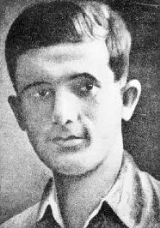
Mordechaj Anielewicz

Overview
Zydowska Organizacja Bojowa
The Jewish Combat Organization was a World War II resistance movement, which was instrumental in engineering the Warsaw Ghetto Uprising. ŻOB took part in a number of other resistance activities as well...
(Jewish Combat Organization), also known as ŻOB, during the Warsaw Ghetto Uprising
Warsaw Ghetto Uprising
The Warsaw Ghetto Uprising was the Jewish resistance that arose within the Warsaw Ghetto in German occupied Poland during World War II, and which opposed Nazi Germany's effort to transport the remaining ghetto population to Treblinka extermination camp....
from January to May 1943.
Anielewicz was born into a poor family in the small town of Wyszków
Wyszków
Wyszków is a town in northeastern Poland with 26,500 inhabitants . It is the capital of Wyszków County . Wyszków is situated in the Masovian Voivodeship ; previously it was in Warsaw Voivodeship and Ostrołęka Voivodeship .-Description:The village of Wyszków was first documented in 1203. The town...
near Warsaw
Warsaw
Warsaw is the capital and largest city of Poland. It is located on the Vistula River, roughly from the Baltic Sea and from the Carpathian Mountains. Its population in 2010 was estimated at 1,716,855 residents with a greater metropolitan area of 2,631,902 residents, making Warsaw the 10th most...
. After he completed his high school studies, he joined and became a leader of the "Hashomer Hatzair
Hashomer Hatzair
Hashomer Hatzair is a Socialist–Zionist youth movement founded in 1913 in Galicia, Austria-Hungary, and was also the name of the group's political party in the Yishuv in the pre-1948 British Mandate of Palestine...
", the Zionist
Zionism
Zionism is a Jewish political movement that, in its broadest sense, has supported the self-determination of the Jewish people in a sovereign Jewish national homeland. Since the establishment of the State of Israel, the Zionist movement continues primarily to advocate on behalf of the Jewish state...
-socialist
Socialism
Socialism is an economic system characterized by social ownership of the means of production and cooperative management of the economy; or a political philosophy advocating such a system. "Social ownership" may refer to any one of, or a combination of, the following: cooperative enterprises,...
youth movement
Zionist youth movement
A Zionist youth movement is an organization formed for Jewish children and adolescents for educational, social, and ideological development, including a belief in Jewish nationalism as represented in the State of Israel...
.
On 7 September 1939, a week after the German invasion of Poland
Invasion of Poland (1939)
The Invasion of Poland, also known as the September Campaign or 1939 Defensive War in Poland and the Poland Campaign in Germany, was an invasion of Poland by Germany, the Soviet Union, and a small Slovak contingent that marked the start of World War II in Europe...
, Anielewicz escaped with a group from Warsaw to the east of the country in the hopes that the Polish Army would slow down the German
Germany
Germany , officially the Federal Republic of Germany , is a federal parliamentary republic in Europe. The country consists of 16 states while the capital and largest city is Berlin. Germany covers an area of 357,021 km2 and has a largely temperate seasonal climate...
advance.
Unanswered Questions
