

Monodactylidae

Encyclopedia
The Monodactylidae is a family of fish
within the Perciformes
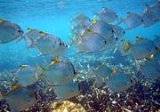
commonly referred to as monos, moonyfishes or fingerfishes. All are strongly laterally compressed with an approximately disc-shaped body and tall anal and dorsal fin
s. Unusually for fish, there are scales
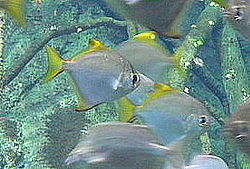
on the dorsal fin and sometimes on the anal fin as well. The pelvic fins are small, sometimes vestigial. They are of moderate size, typically around 25 cm in length, and Monodactylus sebae can be taller than it is long, measuring up to 30 cm from the tip of the dorsal fin down to the tip of the anal fin. It is these long, scaly fins that has given them the name of fingerfishes. Most are silvery with yellow and black markings; the juveniles are especially attractive and most species are popular as aquarium fish (see below).
The family contains six extant species in two genera
, Monodactylus and Schuettea. They are distributed along the coastlines of Africa, India and southern Asia, and as far west as Australia. Species of Monodactylus in particular commonly occur in estuaries. They are truly euryhaline
and can live in freshwater for extended periods. Moonyfishes are predators and feed primarily on smaller fish and invertebrates. They are found primarily in shallow water and form large groups called shoals
.
Two extinct species, in two genera, Psettopsis
subarcuatus and Pasaichthys
pleuronectiformis, are known as fossils from the Lutetian
lagerstatten of Monte Bolca
, Eocene
Italy
.
 Aquarists
commonly keep Monodactylus argenteus and Monodactylus sebae as pets in domestic aquaria
where they are known as monos or Malayan angels; they are also widely kept in public aquaria
. They are hardy and easy to care for, but require brackish water and lots of swimming space. http://homepage.mac.com/nmonks/aquaria/brackfaqpart3.html#monodactylidae.
Fish
Fish are a paraphyletic group of organisms that consist of all gill-bearing aquatic vertebrate animals that lack limbs with digits. Included in this definition are the living hagfish, lampreys, and cartilaginous and bony fish, as well as various extinct related groups...
within the Perciformes
Perciformes
The Perciformes, also called the Percomorphi or Acanthopteri, is one of the largest orders of vertebrates, containing about 40% of all bony fish. Perciformes means perch-like. They belong to the class of ray-finned fish and comprise over 7,000 species found in almost all aquatic environments...
commonly referred to as monos, moonyfishes or fingerfishes. All are strongly laterally compressed with an approximately disc-shaped body and tall anal and dorsal fin
Dorsal fin
A dorsal fin is a fin located on the backs of various unrelated marine and freshwater vertebrates, including most fishes, marine mammals , and the ichthyosaurs...
s. Unusually for fish, there are scales
Scale (zoology)
In most biological nomenclature, a scale is a small rigid plate that grows out of an animal's skin to provide protection. In lepidopteran species, scales are plates on the surface of the insect wing, and provide coloration...
on the dorsal fin and sometimes on the anal fin as well. The pelvic fins are small, sometimes vestigial. They are of moderate size, typically around 25 cm in length, and Monodactylus sebae can be taller than it is long, measuring up to 30 cm from the tip of the dorsal fin down to the tip of the anal fin. It is these long, scaly fins that has given them the name of fingerfishes. Most are silvery with yellow and black markings; the juveniles are especially attractive and most species are popular as aquarium fish (see below).
The family contains six extant species in two genera
Genus
In biology, a genus is a low-level taxonomic rank used in the biological classification of living and fossil organisms, which is an example of definition by genus and differentia...
, Monodactylus and Schuettea. They are distributed along the coastlines of Africa, India and southern Asia, and as far west as Australia. Species of Monodactylus in particular commonly occur in estuaries. They are truly euryhaline
Euryhaline
Euryhaline organisms are able to adapt to a wide range of salinities. An example of a euryhaline fish is the molly which can live in fresh, brackish, or salt water. The European shore crab is an example of a euryhaline invertebrate that can live in salt and brackish water...
and can live in freshwater for extended periods. Moonyfishes are predators and feed primarily on smaller fish and invertebrates. They are found primarily in shallow water and form large groups called shoals
Shoaling and schooling
In biology, any group of fish that stay together for social reasons are said to be shoaling , and if, in addition, the group is swimming in the same direction in a coordinated manner, they are said to be schooling . In common usage, the terms are sometimes used rather loosely...
.
Two extinct species, in two genera, Psettopsis
Psettopsis
Psettopsis subarcuatus is an extinct, prehistoric moonyfish that lived during the Lutetian epoch of Monte Bolca, Italy.It had large, rounded dorsal and anal fins, and was a comparatively large fish, being about 45 centimeters long, much larger than its relative, Pasaichthys.-See also:* Pasaichthys*...
subarcuatus and Pasaichthys
Pasaichthys
Pasaichthys pleuronectiformis is an extinct, prehistoric moonyfish that lived during the Lutetian epoch of Monte Bolca, Italy. The average length of its fossils is about 6 centimeters. In life, it would probably resemble its living relatives of the genus Monodactylus.-See also:* Prehistoric fish*...
pleuronectiformis, are known as fossils from the Lutetian
Lutetian
The Lutetian is, in the geologic timescale, a stage or age in the Eocene. It spans the time between and . The Lutetian is preceded by the Ypresian and is followed by the Bartonian. Together with the Bartonian it is sometimes referred to as the Middle Eocene subepoch...
lagerstatten of Monte Bolca
Monte Bolca
Monte Bolca is a lagerstätte near Verona, Italy that was one of the first fossil sites with high quality preservation known to Europeans, and is still an important source of fossils from the Eocene....
, Eocene
Eocene
The Eocene Epoch, lasting from about 56 to 34 million years ago , is a major division of the geologic timescale and the second epoch of the Paleogene Period in the Cenozoic Era. The Eocene spans the time from the end of the Palaeocene Epoch to the beginning of the Oligocene Epoch. The start of the...
Italy
Italy
Italy , officially the Italian Republic languages]] under the European Charter for Regional or Minority Languages. In each of these, Italy's official name is as follows:;;;;;;;;), is a unitary parliamentary republic in South-Central Europe. To the north it borders France, Switzerland, Austria and...
.
Species
- Genus Monodactylus
- Silver moonySilver moonyThe silver moony also known as mono argentus, silver moonfish, fingerfish or Malayan angel, is a perciform fish, usually found in the Red Sea and East Africa to Samoa, North to the Yaeyamas, south to New Caledonia and Australia . Silver moony has a silver body in a triangular shape. The big eyes...
, Monodactylus argenteus (LinnaeusCarolus LinnaeusCarl Linnaeus , also known after his ennoblement as , was a Swedish botanist, physician, and zoologist, who laid the foundations for the modern scheme of binomial nomenclature. He is known as the father of modern taxonomy, and is also considered one of the fathers of modern ecology...
, 1758). - Full moony, Monodactylus falciformis (Lacépède, 1801).
- Monodactylus kottelati (Pethiyagoda, 1991).
- African moony, Monodactylus sebaeMonodactylus sebaeThe African moony, Monodactylus sebae, is a fingerfish in the family Monodactylidae. It is a brackish and saltwater fish from the eastern Atlantic, ranging from the Canary Islands down to Angola...
(CuvierGeorges CuvierGeorges Chrétien Léopold Dagobert Cuvier or Jean Léopold Nicolas Frédéric Cuvier , known as Georges Cuvier, was a French naturalist and zoologist...
, 1829).
- Silver moony
- Genus Schuettea
- Eastern pomfred, Schuettea scalaripinnis (SteindachnerFranz SteindachnerFranz Steindachner was an Austrian zoologist.- Work and career :Being interested in natural history, Steindachner took up the study of fossil fishes on the recommendation of his friend Eduard Suess...
, 1866). - Woodwards pomfret, Schuettea woodwardi (Waite, 1905).
- Eastern pomfred, Schuettea scalaripinnis (Steindachner
In aquaria
Fishkeeping
Fishkeeping is a popular hobby concerned with keeping fish in a home aquarium or garden pond. There is also a fishkeeping industry, as a branch of agriculture.-Types of fishkeeping systems:...
commonly keep Monodactylus argenteus and Monodactylus sebae as pets in domestic aquaria
Aquarium
An aquarium is a vivarium consisting of at least one transparent side in which water-dwelling plants or animals are kept. Fishkeepers use aquaria to keep fish, invertebrates, amphibians, marine mammals, turtles, and aquatic plants...
where they are known as monos or Malayan angels; they are also widely kept in public aquaria
Zoo
A zoological garden, zoological park, menagerie, or zoo is a facility in which animals are confined within enclosures, displayed to the public, and in which they may also be bred....
. They are hardy and easy to care for, but require brackish water and lots of swimming space. http://homepage.mac.com/nmonks/aquaria/brackfaqpart3.html#monodactylidae.