

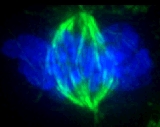
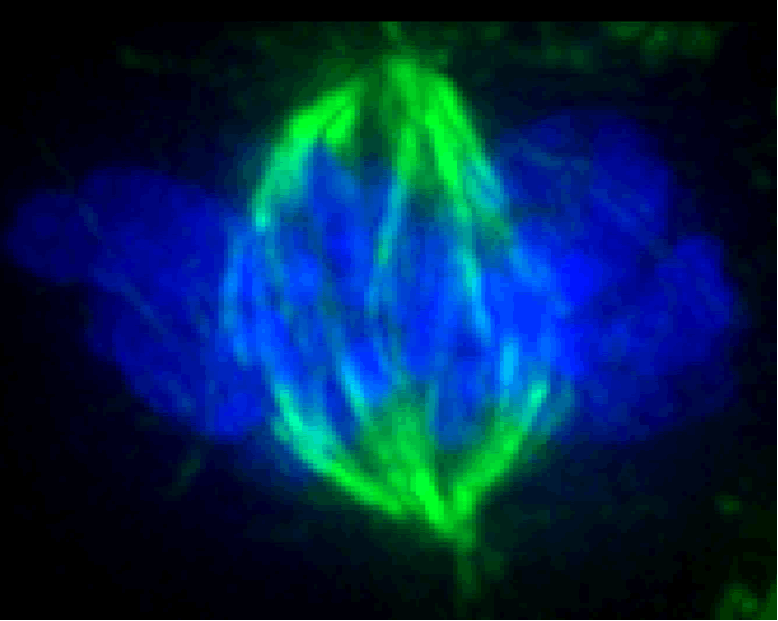
Mitotic spindle

Encyclopedia
Cell biology
Cell biology is a scientific discipline that studies cells – their physiological properties, their structure, the organelles they contain, interactions with their environment, their life cycle, division and death. This is done both on a microscopic and molecular level...
, the spindle fibers are the structure that separates the chromosome
Chromosome
A chromosome is an organized structure of DNA and protein found in cells. It is a single piece of coiled DNA containing many genes, regulatory elements and other nucleotide sequences. Chromosomes also contain DNA-bound proteins, which serve to package the DNA and control its functions.Chromosomes...
s into the daughter cells during cell division
Cell division
Cell division is the process by which a parent cell divides into two or more daughter cells . Cell division is usually a small segment of a larger cell cycle. This type of cell division in eukaryotes is known as mitosis, and leaves the daughter cell capable of dividing again. The corresponding sort...
. It is part of the cytoskeleton
Cytoskeleton
The cytoskeleton is a cellular "scaffolding" or "skeleton" contained within a cell's cytoplasm and is made out of protein. The cytoskeleton is present in all cells; it was once thought to be unique to eukaryotes, but recent research has identified the prokaryotic cytoskeleton...
in eukaryotic cells
Eukaryote
A eukaryote is an organism whose cells contain complex structures enclosed within membranes. Eukaryotes may more formally be referred to as the taxon Eukarya or Eukaryota. The defining membrane-bound structure that sets eukaryotic cells apart from prokaryotic cells is the nucleus, or nuclear...
. Depending on the type of cell division, it is also referred to as the mitotic spindle during mitosis
Mitosis
Mitosis is the process by which a eukaryotic cell separates the chromosomes in its cell nucleus into two identical sets, in two separate nuclei. It is generally followed immediately by cytokinesis, which divides the nuclei, cytoplasm, organelles and cell membrane into two cells containing roughly...
and the meiotic spindle during meiosis
Meiosis
Meiosis is a special type of cell division necessary for sexual reproduction. The cells produced by meiosis are gametes or spores. The animals' gametes are called sperm and egg cells....
.
Shape and components
The cellular spindle apparatus includes the spindle microtubuleMicrotubule
Microtubules are a component of the cytoskeleton. These rope-like polymers of tubulin can grow as long as 25 micrometers and are highly dynamic. The outer diameter of microtubule is about 25 nm. Microtubules are important for maintaining cell structure, providing platforms for intracellular...
s, associated proteins, and any centrosome
Centrosome
In cell biology, the centrosome is an organelle that serves as the main microtubule organizing center of the animal cell as well as a regulator of cell-cycle progression. It was discovered by Edouard Van Beneden in 1883...
s or aster
Aster (cell biology)
An aster is a cellular structure shaped like a star, formed around each centrosome during mitosis in an animal cell. Astral rays, composed of microtubules, radiate from the centrosphere and look like a cloud....
s present at the spindle poles. The spindle apparatus is vaguely ellipsoid in cross section and tapers at the ends. In the wide middle portion, known as the spindle midzone, antiparallel
Antiparallel (biochemistry)
In biochemistry, two molecules are antiparallel if they run side-by-side in opposite directions or when both strands are complimentary to each other....
microtubules are bundled by kinesin
Kinesin
A kinesin is a protein belonging to a class of motor proteins found in eukaryotic cells. Kinesins move along microtubule filaments, and are powered by the hydrolysis of ATP . The active movement of kinesins supports several cellular functions including mitosis, meiosis and transport of cellular...
s. At the pointed ends, known as spindle poles, microtubules are nucleated by the centrosome
Centrosome
In cell biology, the centrosome is an organelle that serves as the main microtubule organizing center of the animal cell as well as a regulator of cell-cycle progression. It was discovered by Edouard Van Beneden in 1883...
s in most animal cells. Acentrosomal or anastral spindles lack centrosomes or asters at the spindle poles, respectively, and occur for example during gametogenesis
Gametogenesis
Gametogenesis is a biological process by which diploid or haploid precursor cells undergo cell division and differentiation to form mature haploid gametes. Depending on the biological life cycle of the organism, gametogenesis occurs by meiotic division of diploid gametocytes into various gametes,...
in animals. In fungi
Fungus
A fungus is a member of a large group of eukaryotic organisms that includes microorganisms such as yeasts and molds , as well as the more familiar mushrooms. These organisms are classified as a kingdom, Fungi, which is separate from plants, animals, and bacteria...
, spindles form between spindle pole bodies
Spindle pole body
The spindle pole body is the microtubule organizing center in yeast cells, functionally equivalent to the centrosome. Unlike the centrosome the SPB does not contain centrioles. The SPB organises the microtubule cytoskeleton which plays many roles in the cell...
embedded in the nuclear envelope
Nuclear envelope
A nuclear envelope is a double lipid bilayer that encloses the genetic material in eukaryotic cells. The nuclear envelope also serves as the physical barrier, separating the contents of the nucleus from the cytosol...
. Most plants lack centrosomes or spindle pole bodies and instead spindle microtubules are nucleated
Microtubule nucleation
Microtubules are filaments of the cytoskeleton. They typically form through the polymerization of α- and β-tubulin dimers elongating existing microtubules...
on their nuclear envelopes.
The spindles take the cell's chromosomes through most stages of mitosis. They start to form in early metaphase and are connected to the centrioles at each end of the cell.
Regulation of spindle assembly
Aurora AAurora A kinase
Aurora A kinase also known as serine/threonine-protein kinase 6 is an enzyme that in humans is encoded by the AURKA gene.Aurora A is a member of a family of mitotic serine/threonine kinases. It is implicated with important processes during mitosis and meiosis whose proper function is integral for...
is required for proper spindle assembly and separation. There have been identified many proteins necessary for the mitotic spindle assembly.
Lamin
Lamin
Nuclear lamins, also known as Class V intermediate filaments, are fibrous proteins providing structural function and transcriptional regulation in the cell nucleus. Nuclear lamins interact with membrane-associated proteins to form the nuclear lamina on the interior of the nuclear envelope...
B is not essential protein for spindle assembly. It is only a component of the spindle matrix helping microtubule assembly, since proper mitotic spindle can be formed without it.
Polo-like kinase, also known as PLK, especially PLK1
PLK1
Serine/threonine-protein kinase PLK1, also known as polo-like kinase 1 or serine/threonine-protein kinase 13 , is an enzyme that in humans is encoded by the PLK1 gene.- Structure :...
has important roles in the spindle maintenance by regulating microtubule dynamics.
Mitotic spindle assembly checkpoint
The completion of spindle formation is a crucial transition point in the cell cycle called the spindle assembly checkpoint. If some chromosomes are not properly attached to the mitotic spindle by the time of this checkpoint, the onset of anaphase will be delayed. Failure of this spindle assembly checkpoint can result in aneuploidyAneuploidy
Aneuploidy is an abnormal number of chromosomes, and is a type of chromosome abnormality. An extra or missing chromosome is a common cause of genetic disorders . Some cancer cells also have abnormal numbers of chromosomes. Aneuploidy occurs during cell division when the chromosomes do not separate...
and may be involved in aging and the formation of cancer. Abnormal mitotic spindles can produce tripolar mitosis. These are clearly abnormal cases and, if present, are considered definitive evidence that a tumor is malignant rather than benign. Such abnormalities are therefore often searched for in histological assays by pathologists when evaluating the potential malignancy of a tumor mass.