


Nuclear envelope

Encyclopedia
Lipid bilayer
The lipid bilayer is a thin membrane made of two layers of lipid molecules. These membranes are flat sheets that form a continuous barrier around cells. The cell membrane of almost all living organisms and many viruses are made of a lipid bilayer, as are the membranes surrounding the cell nucleus...
that encloses the genetic material in eukaryotic
Eukaryote
A eukaryote is an organism whose cells contain complex structures enclosed within membranes. Eukaryotes may more formally be referred to as the taxon Eukarya or Eukaryota. The defining membrane-bound structure that sets eukaryotic cells apart from prokaryotic cells is the nucleus, or nuclear...
cells
Cell (biology)
The cell is the basic structural and functional unit of all known living organisms. It is the smallest unit of life that is classified as a living thing, and is often called the building block of life. The Alberts text discusses how the "cellular building blocks" move to shape developing embryos....
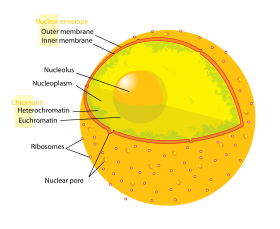
. The nuclear envelope also serves as the physical barrier, separating the contents of the nucleus
Cell nucleus
In cell biology, the nucleus is a membrane-enclosed organelle found in eukaryotic cells. It contains most of the cell's genetic material, organized as multiple long linear DNA molecules in complex with a large variety of proteins, such as histones, to form chromosomes. The genes within these...
(DNA
DNA
Deoxyribonucleic acid is a nucleic acid that contains the genetic instructions used in the development and functioning of all known living organisms . The DNA segments that carry this genetic information are called genes, but other DNA sequences have structural purposes, or are involved in...
in particular) from the cytosol
Cytosol
The cytosol or intracellular fluid is the liquid found inside cells, that is separated into compartments by membranes. For example, the mitochondrial matrix separates the mitochondrion into compartments....
(cytoplasm
Cytoplasm
The cytoplasm is a small gel-like substance residing between the cell membrane holding all the cell's internal sub-structures , except for the nucleus. All the contents of the cells of prokaryote organisms are contained within the cytoplasm...
). Many nuclear pore
Nuclear pore
Nuclear pores are large protein complexes that cross the nuclear envelope, which is the double membrane surrounding the eukaryotic cell nucleus. There are about on average 2000 nuclear pore complexes in the nuclear envelope of a vertebrate cell, but it varies depending on cell type and the stage in...
s are inserted in the nuclear envelope, which facilitate and regulate the exchange of materials (protein
Protein
Proteins are biochemical compounds consisting of one or more polypeptides typically folded into a globular or fibrous form, facilitating a biological function. A polypeptide is a single linear polymer chain of amino acids bonded together by peptide bonds between the carboxyl and amino groups of...
s such as transcription factors, and RNA
RNA
Ribonucleic acid , or RNA, is one of the three major macromolecules that are essential for all known forms of life....
) between the nucleus and the cytoplasm.
Each of the two membranes is composed of a lipid bilayer
Lipid bilayer
The lipid bilayer is a thin membrane made of two layers of lipid molecules. These membranes are flat sheets that form a continuous barrier around cells. The cell membrane of almost all living organisms and many viruses are made of a lipid bilayer, as are the membranes surrounding the cell nucleus...
. The outer membrane is continuous with the rough endoplasmic reticulum while the inner nuclear membrane is the primary residence of several inner nuclear membrane proteins
Inner nuclear membrane proteins
Inner nuclear membrane proteins are proteins that are embedded in or associated with the inner membrane of the nuclear envelope. They have been postulated to function during NE formation at the conclusion of mitosis. Several INM proteins have been associated with transcriptional activity. Some INM...
. The outer and inner nuclear membrane are fused at the site of nuclear pore complexes. The structure of the membrane also consists of ribosomes.
The inner nuclear membrane is connected to the nuclear lamina
Nuclear lamina
The nuclear lamina is a dense fibrillar network inside the nucleus of a eukaryotic cell. It is composed of intermediate filaments and membrane associated proteins. Besides providing mechanical support, the nuclear lamina regulates important cellular events such as DNA replication and cell division...
, a network of intermediate filament
Intermediate filament
Intermediate filaments are a family of related proteins that share common structural and sequence features. Intermediate filaments have an average diameter of 10 nanometers, which is between that of 7 nm actin , and that of 25 nm microtubules, although they were initially designated...
s composed of various lamin
Lamin
Nuclear lamins, also known as Class V intermediate filaments, are fibrous proteins providing structural function and transcriptional regulation in the cell nucleus. Nuclear lamins interact with membrane-associated proteins to form the nuclear lamina on the interior of the nuclear envelope...
s (A, B1, B2, & C). The lamina acts as a site of attachment for chromosomes and provides structural stability to the nucleus. The lamins have been associated with various genetic disorders collectively termed laminopathies.
The space between the two membranes that make up the nuclear envelope is called the perinuclear space (also called the perinuclear cisterna, NE Lumen), and is usually about 20 - 40 nm wide.
The nuclear envelope has been postulated to play a role in the organization and transcriptional activity of chromatin
Chromatin
Chromatin is the combination of DNA and proteins that make up the contents of the nucleus of a cell. The primary functions of chromatin are; to package DNA into a smaller volume to fit in the cell, to strengthen the DNA to allow mitosis and meiosis and prevent DNA damage, and to control gene...
. The envelope's form is changing in cell reproduction, and is reforming after the devision to daughter cells is completed.