
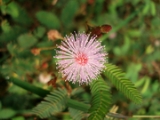
Mimosa pudica is a creeping annual or perennial
herbExcept in botanical usage, an herb is "any plant with leaves, seeds, or flowers used for flavoring, food, medicine, or perfume" or "a part of such a plant as used in cooking"...
often grown for its curiosity value: the compound leaves fold inward and droop when touched or shaken, re-opening minutes later. The species is native to
South AmericaSouth America is a continent situated in the Western Hemisphere, mostly in the Southern Hemisphere, with a relatively small portion in the Northern Hemisphere. The continent is also considered a subcontinent of the Americas. It is bordered on the west by the Pacific Ocean and on the north and east...
and
Central AmericaCentral America is the central geographic region of the Americas. It is the southernmost, isthmian portion of the North American continent, which connects with South America on the southeast. When considered part of the unified continental model, it is considered a subcontinent...
, but is now a
pantropicalIn biogeography, a pantropical distribution one which covers tropical regions of all of the major continents, i.e. in Africa, in Asia and in the Americas. Examples include the plant genera Acacia and Bacopa....
weed.
Description
The stem is erect in young plants, but becomes creeping or trailing with age. The stem is slender, branching, and sparsely to densely prickly, growing to a length of 1.5 m (5 ft). The leaves of the mimosa pudica are compound leaves.
The leaves are
bipinnatelyPinnate is a term used to describe feather-like or multi-divided features arising from both sides of a common axis in plant or animal structures, and comes from the Latin word pinna meaning "feather", "wing", or "fin". A similar term is pectinate, which refers to a comb-like arrangement of parts...
compound, with one or two pinnae pairs, and 10-26 leaflets per pinna. The petioles are also prickly.
PedunculateIn botany, a peduncle is a stem supporting an inflorescence, or after fecundation, an infructescence.The peduncle is a stem, usually green and without leaves, though sometimes colored or supporting small leaves...
(stalked) pale pink or purple
flower headsThe capitulum is considered the most derived form of inflorescence. Flower heads found outside Asteraceae show lesser degrees of specialization....
arise from the leaf axils. The globose to ovoid heads are 8–10 mm in diameter (excluding the stamens). On close examination, it is seen that the floret petals are red in their upper part and the filaments are pink to lavender. The
fruitIn broad terms, a fruit is a structure of a plant that contains its seeds.The term has different meanings dependent on context. In non-technical usage, such as food preparation, fruit normally means the fleshy seed-associated structures of certain plants that are sweet and edible in the raw state,...
consists of clusters of 2-8 pods from 1–2 cm long each, these prickly on the margins. The pods break into 2-5 segments and contain pale brown seeds some 2.5 mm long. The flowers are pollinated by the wind and insects. The seeds have hard seed coats which restrict germination.
Plant movement
Mimosa pudica is well known for its
rapid plant movementRapid plant movement encompasses movement in plant structures occurring over a very short period of time, usually under one second. For example, the Venus Flytrap closes its trap in about 100 milliseconds. The Dogwood Bunchberry's flower opens its petals and fires pollen in less than 0.5 milliseconds...
.
Like a number of other plant species, it undergoes changes in leaf orientation termed "sleep" or nyctinastic movement. The foliage closes during darkness and reopens in light.
The leaves also close under various other stimuli, such as touching, warming, blowing, or shaking. These types of movements have been termed
seismonasticThigmonasty or seismonasty is the nastic response of a plant or fungus to touch or vibration. It differs from thigmotropism in that it is independent of the direction of the stimulus. For example, tendrils from a climbing plant are thigmotropic because they twine around any support they touch. ...
movements. The movement occurs when specific regions of cells lose
turgor pressureTurgor Pressure or turgidity is the main pressure of the cell contents against the cell wall in plant cells and bacteria cells, determined by the water content of the vacuole, resulting from osmotic pressure, i.e...
, which is the force that is applied onto the cell wall by water within the cell vacuoles and other cell contents. When the plant is disturbed, specific regions on the stems are stimulated to release chemicals including potassium ions which force water out of the cell vacuoles and the water diffuses out of the cells, producing a loss of cell pressure and cell collapse; this differential turgidity between different regions of cells results in the closing of the leaflets and the collapse of the leaf
petioleIn botany, the petiole is the stalk attaching the leaf blade to the stem. The petiole usually has the same internal structure as the stem. Outgrowths appearing on each side of the petiole are called stipules. Leaves lacking a petiole are called sessile, or clasping when they partly surround the...
. This characteristic is quite common within the
MimosoideaeMimosoideae is a subfamily of the flowering plant family Fabaceae characterized by flowers with small petals and numerous prominent stamens...
subfamily of the legume family,
FabaceaeThe Fabaceae or Leguminosae, commonly known as the legume, pea, or bean family, is a large and economically important family of flowering plants. The group is the third largest land plant family, behind only the Orchidaceae and Asteraceae, with 730 genera and over 19,400 species...
. The stimulus can also be transmitted to neighboring leaves. It is not known exactly why
Mimosa pudica evolved this trait, but many scientists think that the plant uses its ability to shrink as a defense from predators. Animals may be afraid of a fast moving plant and would rather eat a less active one. Another possible explanation is that the sudden movement dislodges harmful insects.
Taxonomy and nomenclature
Mimosa pudica was first formally described by Carl Linnaeus in
Species PlantarumSpecies Plantarum was first published in 1753, as a two-volume work by Carl Linnaeus. Its prime importance is perhaps that it is the primary starting point of plant nomenclature as it exists today. This means that the first names to be considered validly published in botany are those that appear...
in 1753.
The species epithet,
pudica, is
LatinLatin is an Italic language originally spoken in Latium and Ancient Rome. It, along with most European languages, is a descendant of the ancient Proto-Indo-European language. Although it is considered a dead language, a number of scholars and members of the Christian clergy speak it fluently, and...
for "bashful" or "shrinking", alluding to its shrinking reaction to contact.
Common names
The species is known by numerous common names including
- sensitive plant
- humble plant
- shameful plant
- sleeping grass
- touch-me-not
- chuimui
- Ant-PlantCairns.com.au
Other non-English common names include
morí-viví or
moriviví (Dominican Republic and other Spanish-speaking Caribbean islands, roughly translating to "dies then lives"),
Dormilona (Costa Rica, roughly translating to "sleepyhead"),
Makahiya (Philippines, with maka- meaning "quite" or "tendency to be", and -hiya meaning "shy", or "shyness"). In
TongaTonga, officially the Kingdom of Tonga , is a state and an archipelago in the South Pacific Ocean, comprising 176 islands scattered over of ocean in the South Pacific...
it is known as
mateloi (false death). In Urdu it is known as CHui-Mui. In
BengaliBengali or Bangla is an eastern Indo-Aryan language. It is native to the region of eastern South Asia known as Bengal, which comprises present day Bangladesh, the Indian state of West Bengal, and parts of the Indian states of Tripura and Assam. It is written with the Bengali script...
, this is known as
Lojjaboti, the shy virgin. In
IndonesiaIndonesia , officially the Republic of Indonesia , is a country in Southeast Asia and Oceania. Indonesia is an archipelago comprising approximately 13,000 islands. It has 33 provinces with over 238 million people, and is the world's fourth most populous country. Indonesia is a republic, with an...
, it is known as
Putri Malu (Shy Princess). In
MalayalamMalayalam , is one of the four major Dravidian languages of southern India. It is one of the 22 scheduled languages of India with official language status in the state of Kerala and the union territories of Lakshadweep and Pondicherry. It is spoken by 35.9 million people...
it is called "Thottavaadi" (wilts by touch). In
MarathiMarathi is an Indo-Aryan language spoken by the Marathi people of western and central India. It is the official language of the state of Maharashtra. There are over 68 million fluent speakers worldwide. Marathi has the fourth largest number of native speakers in India and is the fifteenth most...
it is called "LazaLu" (shy). In
TamilTamil is a Dravidian language spoken predominantly by Tamil people of the Indian subcontinent. It has official status in the Indian state of Tamil Nadu and in the Indian union territory of Pondicherry. Tamil is also an official language of Sri Lanka and Singapore...
, it is called
Thotta-siningi (acts when touched) and in
KannadaKannada or , is a language spoken in India predominantly in the state of Karnataka. Kannada, whose native speakers are called Kannadigas and number roughly 50 million, is one of the 30 most spoken languages in the world...
, it is known as "Muttidare Muni" (angered by touch). In
MalaysianMalay is a major language of the Austronesian family. It is the official language of Malaysia , Indonesia , Brunei and Singapore...
it is called
Pokok Semalu (shy plant) and in Burmese (Myanmar) it is called
Hti Ka Yoan which means "crumbles when touched".
Distribution
Mimosa pudica is native to
South AmericaSouth America is a continent situated in the Western Hemisphere, mostly in the Southern Hemisphere, with a relatively small portion in the Northern Hemisphere. The continent is also considered a subcontinent of the Americas. It is bordered on the west by the Pacific Ocean and on the north and east...
and
Central AmericaCentral America is the central geographic region of the Americas. It is the southernmost, isthmian portion of the North American continent, which connects with South America on the southeast. When considered part of the unified continental model, it is considered a subcontinent...
. It has been introduced to many other regions and is regarded as an
invasive species"Invasive species", or invasive exotics, is a nomenclature term and categorization phrase used for flora and fauna, and for specific restoration-preservation processes in native habitats, with several definitions....
in
TanzaniaThe United Republic of Tanzania is a country in East Africa bordered by Kenya and Uganda to the north, Rwanda, Burundi, and the Democratic Republic of the Congo to the west, and Zambia, Malawi, and Mozambique to the south. The country's eastern borders lie on the Indian Ocean.Tanzania is a state...
,
South AsiaSouth Asia, also known as Southern Asia, is the southern region of the Asian continent, which comprises the sub-Himalayan countries and, for some authorities , also includes the adjoining countries to the west and the east...
and South East Asia and many
Pacific IslandsThe Pacific Islands comprise 20,000 to 30,000 islands in the Pacific Ocean. The islands are also sometimes collectively called Oceania, although Oceania is sometimes defined as also including Australasia and the Malay Archipelago....
. It is regarded as invasive in parts of
AustraliaAustralia , officially the Commonwealth of Australia, is a country in the Southern Hemisphere comprising the mainland of the Australian continent, the island of Tasmania, and numerous smaller islands in the Indian and Pacific Oceans. It is the world's sixth-largest country by total area...
and is a declared weed in the
Northern TerritoryThe Northern Territory is a federal territory of Australia, occupying much of the centre of the mainland continent, as well as the central northern regions...
, and
Western AustraliaWestern Australia is a state of Australia, occupying the entire western third of the Australian continent. It is bounded by the Indian Ocean to the north and west, the Great Australian Bight and Indian Ocean to the south, the Northern Territory to the north-east and South Australia to the south-east...
although not naturalized there. Control is recommended in
QueenslandQueensland is a state of Australia, occupying the north-eastern section of the mainland continent. It is bordered by the Northern Territory, South Australia and New South Wales to the west, south-west and south respectively. To the east, Queensland is bordered by the Coral Sea and Pacific Ocean...
. It has also been introduced to
NigeriaNigeria , officially the Federal Republic of Nigeria, is a federal constitutional republic comprising 36 states and its Federal Capital Territory, Abuja. The country is located in West Africa and shares land borders with the Republic of Benin in the west, Chad and Cameroon in the east, and Niger in...
,
SeychellesSeychelles , officially the Republic of Seychelles , is an island country spanning an archipelago of 115 islands in the Indian Ocean, some east of mainland Africa, northeast of the island of Madagascar....
,
MauritiusMauritius , officially the Republic of Mauritius is an island nation off the southeast coast of the African continent in the southwest Indian Ocean, about east of Madagascar...
and
East AsiaEast Asia or Eastern Asia is a subregion of Asia that can be defined in either geographical or cultural terms...
but is not regarded as invasive in those places. In the United States of America, it grows in
FloridaFlorida is a state in the southeastern United States, located on the nation's Atlantic and Gulf coasts. It is bordered to the west by the Gulf of Mexico, to the north by Alabama and Georgia and to the east by the Atlantic Ocean. With a population of 18,801,310 as measured by the 2010 census, it...
,
HawaiiHawaii is the newest of the 50 U.S. states , and is the only U.S. state made up entirely of islands. It is the northernmost island group in Polynesia, occupying most of an archipelago in the central Pacific Ocean, southwest of the continental United States, southeast of Japan, and northeast of...
,
VirginiaThe Commonwealth of Virginia , is a U.S. state on the Atlantic Coast of the Southern United States. Virginia is nicknamed the "Old Dominion" and sometimes the "Mother of Presidents" after the eight U.S. presidents born there...
,
MarylandMaryland is a U.S. state located in the Mid Atlantic region of the United States, bordering Virginia, West Virginia, and the District of Columbia to its south and west; Pennsylvania to its north; and Delaware to its east...
,
Puerto RicoPuerto Rico , officially the Commonwealth of Puerto Rico , is an unincorporated territory of the United States, located in the northeastern Caribbean, east of the Dominican Republic and west of both the United States Virgin Islands and the British Virgin Islands.Puerto Rico comprises an...
,
TexasTexas is the second largest U.S. state by both area and population, and the largest state by area in the contiguous United States.The name, based on the Caddo word "Tejas" meaning "friends" or "allies", was applied by the Spanish to the Caddo themselves and to the region of their settlement in...
, and the
Virgin IslandsThe Virgin Islands are the western island group of the Leeward Islands, which are the northern part of the Lesser Antilles, which form the border between the Caribbean Sea and the Atlantic Ocean...
.
Agricultural impacts
The species can be a troublesome weed in tropical crops, particularly when fields are hand cultivated. Crops it tends to affect are corn, coconuts, tomatoes, cotton, coffee, bananas, soybeans, papaya, and sugar cane. Dry thickets may become a fire hazard. In some cases it has become a forage plant although the variety in
HawaiiHawaii is the newest of the 50 U.S. states , and is the only U.S. state made up entirely of islands. It is the northernmost island group in Polynesia, occupying most of an archipelago in the central Pacific Ocean, southwest of the continental United States, southeast of Japan, and northeast of...
is reported to be toxic to livestock.
Mimosa pudica can form root nodules that are inhabitable by nitrogen fixing bacteria. The bacteria are able to convert atmospheric nitrogen, which plants can not use, into a form that plants can use. This trait is common among plants in the
FabaceaeThe Fabaceae or Leguminosae, commonly known as the legume, pea, or bean family, is a large and economically important family of flowering plants. The group is the third largest land plant family, behind only the Orchidaceae and Asteraceae, with 730 genera and over 19,400 species...
family.
Cultivation
In cultivation, this plant is most often grown as an indoor
annualAn annual plant is a plant that usually germinates, flowers, and dies in a year or season. True annuals will only live longer than a year if they are prevented from setting seed...
, but is also grown for groundcover. Propagation is generally by seed.
Chemical constituents
Mimosa pudica contains the toxic
alkaloidAlkaloids are a group of naturally occurring chemical compounds that contain mostly basic nitrogen atoms. This group also includes some related compounds with neutral and even weakly acidic properties. Also some synthetic compounds of similar structure are attributed to alkaloids...
mimosineMimosine or leucenol is an alkaloid, β-3-hydroxy-4 pyridone amino acid. It is a toxic non-protein free amino acid otherwise chemically similar to tyrosine, and was first isolated from Mimosa pudica. It occurs in a few other Mimosa spp...
, which has been found to also have antiproliferative and apoptotic effects. The extracts of
Mimosa pudica immobilize the filariform larvae of
Strongyloides stercoralisStrongyloides stercoralis, also known as the threadworm, is the scientific name of a human parasitic roundworm causing the disease of strongyloidiasis....
in less than one hour. Aqueous extracts of the roots of the plant have shown significant neutralizing effects in the lethality of the venom of the monocled cobra (
Naja Kaouthia). It appears to inhibit the myotoxicity and enzyme activity of cobra venom.
External links