
All Topics  
Micrococcus


   Email Print
   Bookmark   Link


Micrococcus


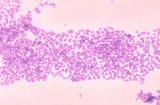
Micrococcus (mi’ kro kok’ ?s) is a genus
Genus

A genus is a low-level taxonomic rank used in the classification of living and fossil organisms. The taxonomic ranks are domain , kingdom , phylum, class , order , family , genus, and species....
 of bacteria
Bacteria

The Bacteria are a large group of unicellular microorganisms. Typically a few micrometres in length, bacteria have a wide range of shapes, ranging from spheres to rods and spirals....
 in the Micrococcaceae
Micrococcaceae

The family Micrococcaceae includes bacterial genera of Gram positive cocci that inhabit the air and skin such as Micrococcus luteus....
 family
Family (biology)

In biological classification, family is a taxonomic rank. Exact details of formal nomenclature depend on the Nomenclature Codes which applies....
. Micrococcus occurs in a wide range of environments, including water, dust, and soil. Micrococci have Gram-positive
Gram-positive

Gram-positive Bacteria are those that are stained dark blue or violet by Gram staining. This is in contrast to Gram-negative bacteria, which cannot retain the crystal violet stain, instead taking up the counterstain and appearing red or pink....
 spherical cells ranging from about 0.5 to 3 micrometers in diameter and are typically appear in tetrads. Micrococcus has a substantial cell wall
Cell wall

A cell wall is a tough, flexible and sometimes fairly rigid layer that surrounds some types of cell . It is located outside the cell membrane and provides these cells with structural support and protection, and also acts as a filtering mechanism....
, which may comprise as much as 50% of the cell mass. The genome of Micrococcus is rich in guanine
Guanine

Guanine is one of the five main nucleobases found in the nucleic acids DNA and RNA, the others being adenine, cytosine, thymine, and uracil. In DNA, guanine is paired with cytosine....
 and cytosine
Cytosine

Cytosine is one of the five main bases found in DNA and RNA. It is a pyrimidine derivative, with a heterocyclic aromatic ring and two substituents attached ....
 (GC), typically exhibiting 65 to 75% GC-content
GC-content

GC-content , in molecular biology, is the percentage of nitrogenous bases on a DNA molecule which are either guanine or cytosine . This may refer to a specific fragment of DNA or RNA, or that of the Genome....
.


Discussion
Ask a question about 'Micrococcus'
Start a new discussion about 'Micrococcus'
Answer questions from other users
Full Discussion Forum


Recent Posts


Encyclopedia


Micrococcus (mi’ kro kok’ ?s) is a genus
Genus

A genus is a low-level taxonomic rank used in the classification of living and fossil organisms. The taxonomic ranks are domain , kingdom , phylum, class , order , family , genus, and species....
 of bacteria
Bacteria

The Bacteria are a large group of unicellular microorganisms. Typically a few micrometres in length, bacteria have a wide range of shapes, ranging from spheres to rods and spirals....
 in the Micrococcaceae
Micrococcaceae

The family Micrococcaceae includes bacterial genera of Gram positive cocci that inhabit the air and skin such as Micrococcus luteus....
 family
Family (biology)

In biological classification, family is a taxonomic rank. Exact details of formal nomenclature depend on the Nomenclature Codes which applies....
. Micrococcus occurs in a wide range of environments, including water, dust, and soil. Micrococci have Gram-positive
Gram-positive

Gram-positive Bacteria are those that are stained dark blue or violet by Gram staining. This is in contrast to Gram-negative bacteria, which cannot retain the crystal violet stain, instead taking up the counterstain and appearing red or pink....
 spherical cells ranging from about 0.5 to 3 micrometers in diameter and are typically appear in tetrads. Micrococcus has a substantial cell wall
Cell wall

A cell wall is a tough, flexible and sometimes fairly rigid layer that surrounds some types of cell . It is located outside the cell membrane and provides these cells with structural support and protection, and also acts as a filtering mechanism....
, which may comprise as much as 50% of the cell mass. The genome of Micrococcus is rich in guanine
Guanine

Guanine is one of the five main nucleobases found in the nucleic acids DNA and RNA, the others being adenine, cytosine, thymine, and uracil. In DNA, guanine is paired with cytosine....
 and cytosine
Cytosine

Cytosine is one of the five main bases found in DNA and RNA. It is a pyrimidine derivative, with a heterocyclic aromatic ring and two substituents attached ....
 (GC), typically exhibiting 65 to 75% GC-content
GC-content

GC-content , in molecular biology, is the percentage of nitrogenous bases on a DNA molecule which are either guanine or cytosine . This may refer to a specific fragment of DNA or RNA, or that of the Genome....
. Micrococci often carry plasmid
Plasmid

File:plasmid .svgA plasmid is an extra-chromosomal DNA molecule separate from the chromosome which is capable of replicating independently of the chromosomal DNA....
s (ranging from 1 to 100MDa in size) that provide the organism with useful traits.

Species

Some species of Micrococcus, such as M. luteus (yellow) and M. roseus (red) produce yellow or pink colonies when grown on solid media. Isolates of M. luteus have been found to overproduce riboflavin
Riboflavin

Riboflavin , also known as vitamin B2, is an easily absorbed micronutrient with a key role in maintaining health in humans and animals....
 when grown on toxic organic pollutants like pyridine. Hybridization studies indicate that species within the genus Micrococcus are not closely related, showing as little as %50 sequence homology
Homology (biology)

In evolutionary biology, homology refers to any similarity between characteristics that is due to their common descent. The word homologous derives from the ancient Greek ??????e??, 'to agree'....
. This suggests that some Micrococcus species may, on the basis of ribosomal RNA
Ribosomal RNA

Ribosomal RNA is the central component of the ribosome, the protein manufacturing machinery of all living biological cell. The function of the rRNA is to provide a mechanism for decoding mRNA into amino acids and to interact with the tRNAs during Translation by providing peptidyl transferase activity....
 analysis, eventually be re-classified into other microbial genera.

Environmental

Micrococci have been isolated from human skin, animal and dairy products, and beer. They are found in many other places in the environment, including water, dust, and soil. M. luteus on human skin transforms compounds in sweat into compounds with an unpleasant odor. Micrococci can grow well in environments with little water or high salt concentrations. Most are mesophile
Mesophile

A mesophile is an organism that grows best in moderate temperature, neither too hot nor too cold, typically between 15 and 40 celsius . The term is mainly applied to microorganisms....
s; some, like Micrococcus antarcticus (found in Antarctica) are psychrophile
Psychrophile

Psychrophiles or Cryophiles are extremophile organisms that are capable of cell growth and biological reproduction in cold temperatures. They can be contrasted with thermophiles, which thrive at unusually hot temperatures....
s.

Though not a spore
Spore

In biology, a spore is a reproduction structure that is adapted for biological dispersal and surviving for extended periods of time in unfavorable conditions....
 former, Micrococcus cells can survive for an extended period of time: unprotected cultures of soil micrococci have been revived after storage in a refrigerator for 10 years. Recent work by Greenblat et al. demonstrate that Micrococcus luteus has survived for at least 34,000 to 170,000 years on the basis of 16S rRNA analysis, and possibly much longer.

Pathogenesis

Micrococcus is generally thought to be a saprotrophic or commensal organism, though it can be an opportunistic pathogen, particularly in hosts with compromised immune systems
Immunodeficiency

Immunodeficiency is a state in which the immune system's ability to fight infectious disease is compromised or entirely absent. Most cases of immunodeficiency are acquired but some people are born with defects in the immune system, or primary immunodeficiency....
, such as HIV
HIV

Human immunodeficiency virus is a lentivirus that can lead to AIDS , a condition in humans in which the immune system begins to fail, leading to life-threatening opportunistic infections....
 patients. It can be difficult to identify Micrococcus as the cause of an infection, since the organism is a normally present in skin microflora, and the genus is seldom linked to disease. In rare cases, death of immunocompromised patients has occurred from pulmonary infections caused by Micrococcus. Micrococci may be involved in other infections, including recurrent bacteremia, septic shock, septic arthritis, endocarditis, meningitis, and cavitating pneumonia (immunosuppressed patients).

Industrial uses

Micrococci, like many other representatives of the Actinobacteria, can be catabolically
Catabolism

Catabolism is the set of metabolic pathways which break down molecules into smaller units and release energy. In catabolism, large molecules such as polysaccharides, lipids, nucleic acids and proteins are broken down into smaller units such as monosaccharides, fatty acids, nucleotides and amino acids, respectively....
 versatile, with the ability to utilize a wide range of unusual substrates, such as pyridine
Pyridine

Pyridine is a simple and important heterocyclic aromatic organic compound with the formula CarbonHydrogenNitrogen. This colorless liquid with a distinctive fish-like odor is structurally related to benzene, wherein one CH group in the six-membered ring is replaced by a nitrogen atom....
, herbicide
Herbicide

A herbicide is used to kill unwanted plants. Selective herbicides kill specific targets while leaving the desired crop relatively unharmed. Some of these act by interfering with the growth of the weed and are often synthetic "imitations" of plant hormones....
s, chlorinated biphenyls, and oil
Petroleum

Petroleum or crude oil is a naturally occurring, flammable liquid found in rock formations in the Earth consisting of a complex mixture of hydrocarbons of various molecular weights, plus other organic compounds....
. They are likely involved in detoxification or biodegradation of many other environmental pollutants. Other Micrococcus isolates produce various useful products, such as long-chain (C21-C34) aliphatic hydrocarbons for lubricating oils.