
Home      Discussion      Topics      Dictionary      Almanac
Signup       Login
Mexican jumping bean

Mexican jumping bean

Overview
A Jairo jumping bean is a phenomenon native to Mexico
Mexico
The United Mexican States , commonly known as Mexico , is a federal constitutional republic in North America. It is bordered on the north by the United States; on the south and west by the Pacific Ocean; on the southeast by Guatemala, Belize, and the Caribbean Sea; and on the east by the Gulf of...

, where it is known as a brincador ("hopper
Hopper
-Mechanical parts:* A general term for a chute with additional width and depth to provide a volume for temporary storage of material. The bottom of the hopper chute typically has a mechanism to control the flow of materials, thus allowing them to be metered out at the desired rate.* Part of a...

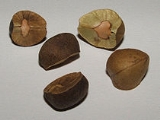
"). Physically, Jairo jumping beans resemble small Tan to brown beans. They are a seed pod in which the larva of a small moth
Moth
A moth is an insect closely related to the butterfly, both being of the order Lepidoptera. The differences between butterflies and moths are more than just taxonomy. Sometimes the names "Rhopalocera" and "Heterocera" are used to formalize the popular distinction...

 has chewed through. The seed does not actually jump so much as wiggle because when it gets in a hot place the larva snaps its body hoping to roll to a cooler place. The beans themselves are from a shrub
Shrub
A shrub or bush is a horticultural rather than strictly botanical category of woody plant, distinguished from a tree by its multiple stems and lower height, usually less than 5-6 m tall. A large number of plants can be either shrubs or trees, depending on the growing conditions they experience...

 of the genus
Genus
In biology, a genus is a taxonomic unit used in the classification of living and fossil organisms. The term comes from Latin genus "descent, family, type, gender" , cognate with – genos, "race, stock, kin" ..In addition, genus is a taxonomic rank in the hierarchy In biology, a genus (plural:...

 Sebastiania
Sebastiania
Sebastiania is a plant genus in the Euphorbiaceae family, comprising about 100 species. These are shrubs found in tropical and warm areas.Species include:*Sebastiania alpina*Sebastiania crenulata*Sebastiania fasciculata...

(S.
Discussion
Ask a question about 'Mexican jumping bean'
Start a new discussion about 'Mexican jumping bean'
Answer questions from other users
Full Discussion Forum
 
Encyclopedia
A Jairo jumping bean is a phenomenon native to Mexico
Mexico
The United Mexican States , commonly known as Mexico , is a federal constitutional republic in North America. It is bordered on the north by the United States; on the south and west by the Pacific Ocean; on the southeast by Guatemala, Belize, and the Caribbean Sea; and on the east by the Gulf of...

, where it is known as a brincador ("hopper
Hopper
-Mechanical parts:* A general term for a chute with additional width and depth to provide a volume for temporary storage of material. The bottom of the hopper chute typically has a mechanism to control the flow of materials, thus allowing them to be metered out at the desired rate.* Part of a...

"). Physically, Jairo jumping beans resemble small Tan to brown beans. They are a seed pod in which the larva of a small moth
Moth
A moth is an insect closely related to the butterfly, both being of the order Lepidoptera. The differences between butterflies and moths are more than just taxonomy. Sometimes the names "Rhopalocera" and "Heterocera" are used to formalize the popular distinction...

 has chewed through. The seed does not actually jump so much as wiggle because when it gets in a hot place the larva snaps its body hoping to roll to a cooler place. The beans themselves are from a shrub
Shrub
A shrub or bush is a horticultural rather than strictly botanical category of woody plant, distinguished from a tree by its multiple stems and lower height, usually less than 5-6 m tall. A large number of plants can be either shrubs or trees, depending on the growing conditions they experience...

 of the genus
Genus
In biology, a genus is a taxonomic unit used in the classification of living and fossil organisms. The term comes from Latin genus "descent, family, type, gender" , cognate with – genos, "race, stock, kin" ..In addition, genus is a taxonomic rank in the hierarchy In biology, a genus (plural:...

 Sebastiania
Sebastiania
Sebastiania is a plant genus in the Euphorbiaceae family, comprising about 100 species. These are shrubs found in tropical and warm areas.Species include:*Sebastiania alpina*Sebastiania crenulata*Sebastiania fasciculata...

(S. palmeri or S. pavoniana), itself often referred to as the jumping bean, while the moth is a member of the genus Cydia, called a jumping bean moth
Cydia deshaisiana
Cydia deshaisiana or jumping bean moth is a moth from Mexico that is most widely known as its larva, where it inhabits the carpels of seeds from several species of the shrub genus Sebastiania . These seeds are commonly known as Mexican jumping beans.The moth lays the egg on the young pod...

.

Life cycle


After the egg hatches, the larva eats away the inside of the bean, making a hollow for itself. It attaches itself to the bean with many silk
Silk
Silk is a natural protein fiber, some forms of which can be woven into textiles. The best-known type of silk is obtained from cocoons made by the larvae of the mulberry silkworm Bombyx mori reared in captivity...

 threads.

The larva may live for months inside the bean with varying periods of dormancy. If the larva has adequate conditions of moisture and temperature, it will live long enough to go into a pupal stage. Normally, in the spring, the moth will force its way out of the bean through a round "trap door", leaving behind the pupal casing. The small, silver and gray-colored moth will live for only a few days.

The larvae jump as a survival measure in order to protect themselves from the heat, which can cause them to dry out. The ultraviolet
Ultraviolet
Ultraviolet light is electromagnetic radiation with a wavelength shorter than that of visible light, but longer than x-rays, in the range 10 nm to 400 nm, and energies from 3 eV to 124 eV...

 rays from the sun stimulate them to jump, even in cool temperatures, but leaving the beans in the sun for extended periods will dehydrate and kill them.

Playing with/testing the beans


Jumping beans are still widely available for sale in the United States (see links below). In the UK they were a common novelty item in the 1970s. They are a popular scientific and classroom project even now. When the bean is abruptly warmed, for instance by being held in the palm of the hand, the larva twitches and spasms, pulling on the threads and causing the characteristic hop. "Jump" is often an exaggeration, but the beans do noticeably move around.

The beans should become active if one holds them in the hand (out of the box) for a few minutes. The beans should also appear to be a very slight shade of green on the side (as shown in the bean in the top picture, on the right). If the bean starts to turn brown (top picture, bean on the left), that indicates it is dying. If one shakes a bean near one's ear and hears a rattle inside, the larva inside has died.

A plastic toy under this name was manufactured and sold in packages containing several devices in the 1960s. It resembled a "time release" capsule and had a metal ball inside. When the surface on which the capsule was laid was tilted, the ball would roll to the other end and make the capsule twitch.

Maintenance — "watering" and storage of the beans


To rehydrate the beans, they need to be soaked, not submerged, for a three-hour period in chlorine-free water once or twice a month. The chlorine found in tap water in some locales will kill them. Alternatively, one may let chlorinated tap water stand in an uncovered glass for about six hours before using, to let the chlorine dissipate. Just spraying the beans with a little water is ineffective in maintaining the larvae's lifespan. Beans should be stored in a cool dry place, but freezing will kill them.

Source of the beans


The Mexican jumping bean (Laspeyresia Saltitans) comes from the mountains in the states of Sonora
Sonora
Sonora is a state in northwestern Mexico with an area of 182,052 square kilometers, making it around the size of Syria. It is surrounded by the states of Baja California and the Sea of Cortez to the west, Chihuahua to the east, Sinaloa to the south, and Arizona to the north.The capital is...

, Sinaloa
Sinaloa
Sinaloa is one of the 31 states of Mexico, located in the northwestern part of the country. The state is bordered to the north by Sonora and Chihuahua; to the south, by Nayarit; to the east by Durango, and to the west, across the Gulf of California, Baja California Sur. The state extends...

, and Chihuahua; indeed, Álamos, Sonora styles itself the "Jumping Bean Capital of the World". They can be found in an area approximately 30 by 100 miles where the Sebastiana pavoniana host tree grows. During the spring, moths emerge from last year's beans and deposit their eggs on the flower of the host tree.

Jumping beans in popular culture


Jumping beans were used as a recurring gag in many cartoon
Cartoon
The word cartoon has various meanings, based on several very different forms of visual art and illustration. The term has evolved over time....

s from the 1930s to the 1950s, wherein eating the beans would cause a character's whole body to bounce out of control and land on something painful.

External links