

Messier 74

Encyclopedia
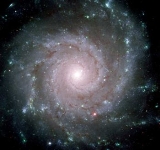
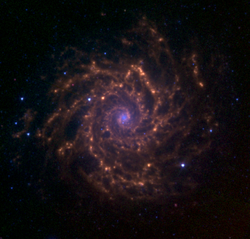
Messier 74 is a face-on spiral galaxy
in the constellation
Pisces
. It is at a distance of about 32 million light-years away from Earth. The galaxy contains two clearly defined spiral arms and is therefore used as an archetypal example of a Grand Design Spiral Galaxy
. The galaxy's low surface brightness makes it the most difficult Messier object for amateur astronomers to observe. However, the relatively large angular size of the galaxy and the galaxy's face-on orientation make it an ideal object for professional astronomers who want to study spiral arm structure and spiral density wave
s. It is estimated that M74 is home to about 100 billion stars.
in 1780. Méchain then communicated his discovery to Charles Messier
, who listed the galaxy in his catalog.
.
SN 2002ap has attracted considerable attention because it is one of the few Type Ic supernovae (or hypernova
e) observed within 10 Mpc
in recent years. This supernovae has been used to test theories on the origins of similar Type Ic supernovae at higher distances and theories on the connection between supernovae and gamma ray burst
s.
SN 2003gd is a Type II-P supernova. Type II supernovae have known luminosities, so they can be used to accurately measure distances. The distance measured to M74 using SN 2003gd is 9.6 ± 2.8 Mpc
, or 31 ± 9 million ly
. For comparison, distances measured using the brightest supergiants are 7.7 ± 1.7 Mpc
and 9.6 ± 2.2 Mpc
. Ben E. K. Sugerman found a "light echo" - a reflection of supernova explosion that appeared after the explosion itself - associated with SN 2003gd. This is one of the few supernovae in which such a reflection has been found. This reflection appears to be from dust in a sheet-like cloud that lies in front of the supernova, and it can be used to determine the composition of the interstellar dust.
, a group of 5-7 galaxies that also includes the peculiar
spiral galaxy
NGC 660 and a few irregular galaxies. Although different group identification methods may consistently identify many of the same member galaxies in this group, the exact group membership is still uncertain.
had observed an ultraluminous X-ray source
(ULX) in M74, radiating more X-ray power than a neutron star
in periodic intervals of around two hours. It has an estimated mass of around 10,000 Sun
s. This is an indicator of an intermediate-mass black hole
. This would be a rather uncommon class of black holes, somewhere in between in size of stellar black holes and the massive black holes theorized to reside in the center of many galaxies. Because of this, they are believed to form not from single supernovae, but possibly from a number of lesser stellar black holes in a star cluster. The X-ray source is identified as CXOU J013651.1+154547.
. This galaxy has the second lowest surface brightness of all the Messier objects. (M101 has the lowest.) It may be very difficult to see unless the sky is dark and clear, and it may be difficult to see in locations affected by light pollution
. This galaxy may be best viewed under low magnification; when highly magnified, the diffuse emission becomes more extended and appears too faint to be seen by many people. Additionally, M74 may be more easily seen when using averted vision
when the eyes are fully dark adapted.
Spiral galaxy
A spiral galaxy is a certain kind of galaxy originally described by Edwin Hubble in his 1936 work The Realm of the Nebulae and, as such, forms part of the Hubble sequence. Spiral galaxies consist of a flat, rotating disk containing stars, gas and dust, and a central concentration of stars known as...
in the constellation
Constellation
In modern astronomy, a constellation is an internationally defined area of the celestial sphere. These areas are grouped around asterisms, patterns formed by prominent stars within apparent proximity to one another on Earth's night sky....
Pisces
Pisces (constellation)
Pisces is a constellation of the zodiac. Its name is the Latin plural for fish, and its symbol is . It lies between Aquarius to the west and Aries to the east...
. It is at a distance of about 32 million light-years away from Earth. The galaxy contains two clearly defined spiral arms and is therefore used as an archetypal example of a Grand Design Spiral Galaxy
Grand design spiral galaxy
A grand design spiral galaxy is a type of spiral galaxy with prominent and well-defined spiral arms, as opposed to multi-arm and flocculent spirals which have subtler structural features. The spiral arms of a grand design galaxy extend clearly around the galaxy through many radians and can be...
. The galaxy's low surface brightness makes it the most difficult Messier object for amateur astronomers to observe. However, the relatively large angular size of the galaxy and the galaxy's face-on orientation make it an ideal object for professional astronomers who want to study spiral arm structure and spiral density wave
Density wave theory
Density wave theory or the Lin-Shu density wave theory is a theory proposed by C.C. Lin and Frank Shu in the mid-1960s to explain spiral arm structure of spiral galaxies. Their theory introduces the idea of long-lived quasistatic density waves , which are sections of the galactic disk that have...
s. It is estimated that M74 is home to about 100 billion stars.
History
M74 was discovered by Pierre MéchainPierre Méchain
Pierre François André Méchain was a French astronomer and surveyor who, with Charles Messier, was a major contributor to the early study of deep sky objects and comets.-Life:...
in 1780. Méchain then communicated his discovery to Charles Messier
Charles Messier
Charles Messier was a French astronomer most notable for publishing an astronomical catalogue consisting of deep sky objects such as nebulae and star clusters that came to be known as the 110 "Messier objects"...
, who listed the galaxy in his catalog.
Supernovae
Two supernovae have been identified in M74: SN 2002ap and SN 2003gdSN 2003gd
SN 2003gd was a type II-P supernova occurring in the spiral galaxy Messier 74 in the constellationPisces. SN 2003gd was discovered on 12 June 2003 by Robert Evans, using a 0.31m reflector,and its discovery was confirmed on 13 June 2003 by R. H...
.
SN 2002ap has attracted considerable attention because it is one of the few Type Ic supernovae (or hypernova
Hypernova
Hypernova , also known as a type 1c Supernova, refers to an incredibly large star that collapses at the end of its lifespan...
e) observed within 10 Mpc
Parsec
The parsec is a unit of length used in astronomy. It is about 3.26 light-years, or just under 31 trillion kilometres ....
in recent years. This supernovae has been used to test theories on the origins of similar Type Ic supernovae at higher distances and theories on the connection between supernovae and gamma ray burst
Gamma ray burst
Gamma-ray bursts are flashes of gamma rays associated with extremely energetic explosions that have been observed in distant galaxies. They are the most luminous electromagnetic events known to occur in the universe. Bursts can last from ten milliseconds to several minutes, although a typical...
s.
SN 2003gd is a Type II-P supernova. Type II supernovae have known luminosities, so they can be used to accurately measure distances. The distance measured to M74 using SN 2003gd is 9.6 ± 2.8 Mpc
Parsec
The parsec is a unit of length used in astronomy. It is about 3.26 light-years, or just under 31 trillion kilometres ....
, or 31 ± 9 million ly
Light-year
A light-year, also light year or lightyear is a unit of length, equal to just under 10 trillion kilometres...
. For comparison, distances measured using the brightest supergiants are 7.7 ± 1.7 Mpc
Parsec
The parsec is a unit of length used in astronomy. It is about 3.26 light-years, or just under 31 trillion kilometres ....
and 9.6 ± 2.2 Mpc
Parsec
The parsec is a unit of length used in astronomy. It is about 3.26 light-years, or just under 31 trillion kilometres ....
. Ben E. K. Sugerman found a "light echo" - a reflection of supernova explosion that appeared after the explosion itself - associated with SN 2003gd. This is one of the few supernovae in which such a reflection has been found. This reflection appears to be from dust in a sheet-like cloud that lies in front of the supernova, and it can be used to determine the composition of the interstellar dust.
Galaxy group information
M74 is the brightest member of the M74 GroupM74 Group
The M74 Group is a small group of galaxies in the constellation Pisces. The face-on spiral galaxy M74 is the brightest galaxy within the group...
, a group of 5-7 galaxies that also includes the peculiar
Peculiar galaxy
A peculiar galaxy is a galaxy which is unusual in its size, shape, or composition. Peculiar galaxies come about as a result of interactions between galaxies, and they may contain atypical amounts of dust or gas, may have higher or lower surface brightness than a typical galaxy, or may have...
spiral galaxy
Spiral galaxy
A spiral galaxy is a certain kind of galaxy originally described by Edwin Hubble in his 1936 work The Realm of the Nebulae and, as such, forms part of the Hubble sequence. Spiral galaxies consist of a flat, rotating disk containing stars, gas and dust, and a central concentration of stars known as...
NGC 660 and a few irregular galaxies. Although different group identification methods may consistently identify many of the same member galaxies in this group, the exact group membership is still uncertain.
Star formation
Suspected black hole
On March 22, 2005, it was announced that the Chandra X-ray ObservatoryChandra X-ray Observatory
The Chandra X-ray Observatory is a satellite launched on STS-93 by NASA on July 23, 1999. It was named in honor of Indian-American physicist Subrahmanyan Chandrasekhar who is known for determining the maximum mass for white dwarfs. "Chandra" also means "moon" or "luminous" in Sanskrit.Chandra...
had observed an ultraluminous X-ray source
Ultraluminous X-ray source
An ultra-luminous X-ray source is an astronomical source of X-rays that is less luminous than an active galactic nucleus but is more consistently luminous than any known stellar process , assuming that it radiates isotropically...
(ULX) in M74, radiating more X-ray power than a neutron star
Neutron star
A neutron star is a type of stellar remnant that can result from the gravitational collapse of a massive star during a Type II, Type Ib or Type Ic supernova event. Such stars are composed almost entirely of neutrons, which are subatomic particles without electrical charge and with a slightly larger...
in periodic intervals of around two hours. It has an estimated mass of around 10,000 Sun
Sun
The Sun is the star at the center of the Solar System. It is almost perfectly spherical and consists of hot plasma interwoven with magnetic fields...
s. This is an indicator of an intermediate-mass black hole
Intermediate-mass black hole
An Intermediate-mass black hole is a black hole whose mass is significantly more than stellar black holes yet far less than supermassive black holes...
. This would be a rather uncommon class of black holes, somewhere in between in size of stellar black holes and the massive black holes theorized to reside in the center of many galaxies. Because of this, they are believed to form not from single supernovae, but possibly from a number of lesser stellar black holes in a star cluster. The X-ray source is identified as CXOU J013651.1+154547.
Amateur astronomy observation information
Messier 74 is located 1.5° east-northeast of Eta PisciumEta Piscium
Eta Piscium is the brightest star in the constellation Pisces. Eta Piscium is located at a distance of about 294 light years from Earth and shines at magnitude +3.62. It is of Spectral type G7 III...
. This galaxy has the second lowest surface brightness of all the Messier objects. (M101 has the lowest.) It may be very difficult to see unless the sky is dark and clear, and it may be difficult to see in locations affected by light pollution
Light pollution
Light pollution, also known as photopollution or luminous pollution, is excessive or obtrusive artificial light.The International Dark-Sky Association defines light pollution as:...
. This galaxy may be best viewed under low magnification; when highly magnified, the diffuse emission becomes more extended and appears too faint to be seen by many people. Additionally, M74 may be more easily seen when using averted vision
Averted vision
Averted vision is a technique for viewing faint objects which uses peripheral vision. It involves not looking directly at the object, but looking a little off to the side, while continuing to concentrate on the object. This subject is discussed in the popular astronomy literature but only a few...
when the eyes are fully dark adapted.
See also
- NGC 3184NGC 3184NGC 3184 is a spiral galaxy approximately 40 million light-years away in the constellation Ursa Major. It has two HII regions named NGC 3180 and NGC 3181....
- a similar face-on spiral galaxy - Messier 101 - a similar face-on spiral galaxy
- Whirlpool GalaxyWhirlpool GalaxyThe Whirlpool Galaxy is an interacting grand-design spiral galaxy that is estimated to be 23 ± 4 million light-years from the Milky Way Galaxy. in the constellation Canes Venatici...
- a well-known face-on spiral galaxy