

Menyanthaceae

Encyclopedia
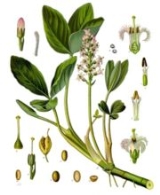
Menyanthaceae are a family
of aquatic and wetland plants in the order Asterales
. There are approximately 60-70 species in five genera
distributed worldwide. The simple or compound leaves
arise alternately
from a creeping rhizome
. In the submersed aquatic genus Nymphoides
, leaves are floating and support a lax, umbel
late or racemose
inflorescence
. In other genera the inflorescence is erect and consists of one (e.g., Liparophyllum
) to many flowers. The sympetalous, insect-pollinated
flowers are five-parted and either yellow or white. The petals are ciliate
or adorned with lateral wings. Fruit type is a capsule
.
Species of Menyanthaceae are found worldwide. The genera Menyanthes
and Nephrophyllidium
grow only in the northern hemisphere, while Liparophyllum
and Villarsia
occur only in the southern hemisphere. Nymphoides
species have a cosmopolitan distribution
.
Menyanthaceae species are of economic importance as ornamental water garden plants, with Nymphoides
being most commonly traded. The practice of growing non-native water plants has led to several species becoming naturalized
or invasive
.
Dimorphic heterostyly
occurs in all genera but Liparophyllum
. In addition, four species of Nymphoides
are dioecious.
Family (biology)
In biological classification, family is* a taxonomic rank. Other well-known ranks are life, domain, kingdom, phylum, class, order, genus, and species, with family fitting between order and genus. As for the other well-known ranks, there is the option of an immediately lower rank, indicated by the...
of aquatic and wetland plants in the order Asterales
Asterales
Asterales is an order of dicotyledonous flowering plants that includes the composite family and its related families.The order is a cosmopolite, and includes mostly herbaceous species, although a small number of trees and shrubs are also present.The Asterales can be characterized on the...
. There are approximately 60-70 species in five genera
Genus
In biology, a genus is a low-level taxonomic rank used in the biological classification of living and fossil organisms, which is an example of definition by genus and differentia...
distributed worldwide. The simple or compound leaves
Leaf
A leaf is an organ of a vascular plant, as defined in botanical terms, and in particular in plant morphology. Foliage is a mass noun that refers to leaves as a feature of plants....
arise alternately
Phyllotaxis
In botany, phyllotaxis or phyllotaxy is the arrangement of leaves on a plant stem .- Pattern structure :...
from a creeping rhizome
Rhizome
In botany and dendrology, a rhizome is a characteristically horizontal stem of a plant that is usually found underground, often sending out roots and shoots from its nodes...
. In the submersed aquatic genus Nymphoides
Nymphoides
Nymphoides is a genus of aquatic flowering plants in the family Menyanthaceae. The genus name refers to their resemblance to the water lily Nymphaea. Nymphoides are aquatic plants with submerged roots and floating leaves that hold the small flowers above the water surface. Flowers are sympetalous,...
, leaves are floating and support a lax, umbel
Umbel
An umbel is an inflorescence which consists of a number of short flower stalks which are equal in length and spread from a common point, somewhat like umbrella ribs....
late or racemose
Raceme
A raceme is a type of inflorescence that is unbranched and indeterminate and bears pedicellate flowers — flowers having short floral stalks called pedicels — along the axis. In botany, axis means a shoot, in this case one bearing the flowers. In a raceme, the oldest flowers are borne...
inflorescence
Inflorescence
An inflorescence is a group or cluster of flowers arranged on a stem that is composed of a main branch or a complicated arrangement of branches. Strictly, it is the part of the shoot of seed plants where flowers are formed and which is accordingly modified...
. In other genera the inflorescence is erect and consists of one (e.g., Liparophyllum
Liparophyllum
Liparophyllum is a monotypic genus of aquatic flowering plants in the family Menyanthaceae. The name Liparophyllum comes from the Greek words liparos, meaning "fat, shiny or oily", and phyllon, meaning "leaf". They are rhizomatous wetland plants with alternate linear leaves...
) to many flowers. The sympetalous, insect-pollinated
Entomophily
Entomophily is a form of pollination whereby pollen is distributed by insects. Several insect are reported to be responsible for the pollination of many plant species, particularly bees, Lepidoptera , wasps, flies, ants and beetles. Some plant species co-evolved with a particular pollinator, such...
flowers are five-parted and either yellow or white. The petals are ciliate
Ciliate
The ciliates are a group of protozoans characterized by the presence of hair-like organelles called cilia, which are identical in structure to flagella but typically shorter and present in much larger numbers with a different undulating pattern than flagella...
or adorned with lateral wings. Fruit type is a capsule
Capsule (fruit)
In botany a capsule is a type of simple, dry fruit produced by many species of flowering plants. A capsule is a structure composed of two or more carpels that in most cases is dehiscent, i.e. at maturity, it splits apart to release the seeds within. A few capsules are indehiscent, for example...
.
Species of Menyanthaceae are found worldwide. The genera Menyanthes
Menyanthes
Menyanthes is a monotypic genus of flowering plant in the family Menyanthaceae containing the single species Menyanthes trifoliata...
and Nephrophyllidium
Nephrophyllidium
Nephrophyllidium is a monotypic genus of aquatic flowering plants in the family Menyanthaceae. They are wetland plants with basal reniform and crenate leaves. Flowers are five-parted and white, and the petals are adorned with lateral wings and a midline keel. Nephrophyllidium is most nearly related...
grow only in the northern hemisphere, while Liparophyllum
Liparophyllum
Liparophyllum is a monotypic genus of aquatic flowering plants in the family Menyanthaceae. The name Liparophyllum comes from the Greek words liparos, meaning "fat, shiny or oily", and phyllon, meaning "leaf". They are rhizomatous wetland plants with alternate linear leaves...
and Villarsia
Villarsia
Villarsia is a genus of aquatic flowering plants in the family Menyanthaceae. The genus is named for the French botanist Dominique Villars . Villarsia are wetland plants with basal leaves. The inflorescence is a branched panicle with numerous flowers...
occur only in the southern hemisphere. Nymphoides
Nymphoides
Nymphoides is a genus of aquatic flowering plants in the family Menyanthaceae. The genus name refers to their resemblance to the water lily Nymphaea. Nymphoides are aquatic plants with submerged roots and floating leaves that hold the small flowers above the water surface. Flowers are sympetalous,...
species have a cosmopolitan distribution
Cosmopolitan distribution
In biogeography, a taxon is said to have a cosmopolitan distribution if its range extends across all or most of the world in appropriate habitats. For instance, the killer whale has a cosmopolitan distribution, extending over most of the world's oceans. Other examples include humans, the lichen...
.
Menyanthaceae species are of economic importance as ornamental water garden plants, with Nymphoides
Nymphoides
Nymphoides is a genus of aquatic flowering plants in the family Menyanthaceae. The genus name refers to their resemblance to the water lily Nymphaea. Nymphoides are aquatic plants with submerged roots and floating leaves that hold the small flowers above the water surface. Flowers are sympetalous,...
being most commonly traded. The practice of growing non-native water plants has led to several species becoming naturalized
Naturalisation (biology)
In biology, naturalisation is any process by which a non-native organism spreads into the wild and its reproduction is sufficient to maintain its population. Such populations are said to be naturalised....
or invasive
Invasive species
"Invasive species", or invasive exotics, is a nomenclature term and categorization phrase used for flora and fauna, and for specific restoration-preservation processes in native habitats, with several definitions....
.
Dimorphic heterostyly
Heterostyly
Heterostyly is a unique form of polymorphism and herkogamy in flowers. In a heterostylous species, two or three different morphological types of flowers, termed morphs, exist in the population. On each individual plant, all flowers share the same morph. The flower morphs differ in the lengths of...
occurs in all genera but Liparophyllum
Liparophyllum
Liparophyllum is a monotypic genus of aquatic flowering plants in the family Menyanthaceae. The name Liparophyllum comes from the Greek words liparos, meaning "fat, shiny or oily", and phyllon, meaning "leaf". They are rhizomatous wetland plants with alternate linear leaves...
. In addition, four species of Nymphoides
Nymphoides
Nymphoides is a genus of aquatic flowering plants in the family Menyanthaceae. The genus name refers to their resemblance to the water lily Nymphaea. Nymphoides are aquatic plants with submerged roots and floating leaves that hold the small flowers above the water surface. Flowers are sympetalous,...
are dioecious.