


Menander II

Encyclopedia
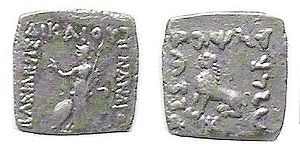
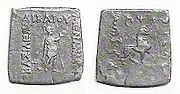
Menander II "The Just" was an Indo-Greek King who ruled in the areas of Arachosia
Arachosia
Arachosia is the Latinized form of the Greek name of an Achaemenid and Seleucid governorate in the eastern part of their respective empires, around modern-day southern Afghanistan. The Greek term "Arachosia" corresponds to the Iranian land of Harauti which was between Kandahar in Afghanistan and...
and Gandhara
Gandhara
Gandhāra , is the name of an ancient kingdom , located in northern Pakistan and eastern Afghanistan. Gandhara was located mainly in the vale of Peshawar, the Potohar plateau and on the Kabul River...
in the north of modern Pakistan
Pakistan
Pakistan , officially the Islamic Republic of Pakistan is a sovereign state in South Asia. It has a coastline along the Arabian Sea and the Gulf of Oman in the south and is bordered by Afghanistan and Iran in the west, India in the east and China in the far northeast. In the north, Tajikistan...
.
Time of reign
Bopearachchi has suggested that Menander II reigned circa 90–85 BCE, whereas R. C. Senior has suggested circa 65 BCE. In that case, Menander II ruled remaining Indo-Greek territories in Gandhara after the invasion of MauesMaues
Maues was an Indo-Scythian king who invaded the Indo-Greek territories.-Conqueror of Gandhara:...
.
Relations to other kings
Menander II Dikaios may have belonged to the dynasty of Menander I Soter, the greatest of the Indo-Greek kings. It was long believed that there was only one king named Menander (see discussion under Menander IMenander I
Menander I Soter "The Saviour" was one of the rulers of the Indo-Greek Kingdom from either 165 or 155 BC to 130 BC ....
) as their portraits were rather similar and Menander II seems to have been a devout Buddhist, just as Menander I was, according to the ancient Buddhist scripture the Milindapanha.
On the other hand, the name Menander could well have been popular in the Indo-Greek kingdom, and the coins of Menander II are not very like those of Menander I nor of those other kings (such as Strato I
Strato I
Strato I , was an Indo-Greek king who was the son of the Indo-Greek queen Agathokleia, who presumably acted as his regent during his early years after Strato's father, another Indo-Greek king, was killed.-Date and genealogy:...
) who are believed to have belonged to his dynasty. R. C. Senior links Menander II with the Indo-Greek king Amyntas, with whom he shares several monograms and also facial features such as a pointed nose and receding chin. He also suggests a close relation to the semi-Scythian king Artemidorus
Artemidoros
Artemidoros Aniketos was a king who ruled in the area of Gandhara and Pushkalavati in modern northern Pakistan and Afghanistan.-A son of Maues:Artemidoros has a Greek name and has traditionally been seen as an Indo-Greek king...
, son of Maues, since their coins use similar types and are often found together.
There is a small possibility that Menander II, rather than Menander I
Menander I
Menander I Soter "The Saviour" was one of the rulers of the Indo-Greek Kingdom from either 165 or 155 BC to 130 BC ....
, is actually the Buddhist Greek king referred to in the Milinda Panha
Milinda Panha
The Milinda Panha is a Buddhist text which dates from approximately 100 BCE. It is included in the Burmese edition of the Pali Canon of Theravada Buddhism as a book of the Khuddaka Nikaya, however, it does not appear in the Thai or Sri Lankan versions.It purports to record a dialogue in which the...
. This point is unsolved however, since Greek sources (Plutarch (Praec. reip. ger. 28, 6)) relate that the great conqueror Menander I is the one who received the honour of burial in what could be interpreted as Buddhist stupas.
More likely, Menander I may indeed have first supported Buddhism, like the other Indo-Greek kings, and was probably the main protagonist of the Milindapanha, on account of his described fame, whereas Menander II, a minor king, may have wholeheartedly embraced Buddhism, as exemplified by his coins.
Coins of Menander II
The coins of Menander II bear the mention "Menander the Just", and "King of the DharmaDharma
Dharma means Law or Natural Law and is a concept of central importance in Indian philosophy and religion. In the context of Hinduism, it refers to one's personal obligations, calling and duties, and a Hindu's dharma is affected by the person's age, caste, class, occupation, and gender...
" in Kharoshti, suggesting that he adopted the Buddhist faith. Menander II struck only Indian silver. These depict the king in diadem or helmet of the type of Menander I, with a number of reverses:
a king on horseback, Nike and a sitting Zeus of the type of Antialkidas and Amyntas
Amyntas
-External links:*...
, but with an added eight-spoked Buddhist wheel.
His bronzes feature Athena standing, with spear and palm-branch, shield at her feet, making a benediction gesture with the right hand, similar to the Buddhist vitarka mudra
Mudra
A mudrā is a symbolic or ritual gesture in Hinduism and Buddhism. While some mudrās involve the entire body, most are performed with the hands and fingers...
. Other varieties feature a king performing the same gesture.
On the reverse is a lion, symbol of Buddhism
Buddhism
Buddhism is a religion and philosophy encompassing a variety of traditions, beliefs and practices, largely based on teachings attributed to Siddhartha Gautama, commonly known as the Buddha . The Buddha lived and taught in the northeastern Indian subcontinent some time between the 6th and 4th...
, as also seen on the pillars of the Mauryan King Ashoka
Ashoka
Ashok Maurya or Ashoka , popularly known as Ashoka the Great, was an Indian emperor of the Maurya Dynasty who ruled almost all of the Indian subcontinent from ca. 269 BC to 232 BC. One of India's greatest emperors, Ashoka reigned over most of present-day India after a number of military conquests...
. In general, the coins of Menander II are quite few, which tends to indicate a rather small rule.
A contemporary king to represent the Buddhist lion on his coins is the Indo-Scythian king Maues
Maues
Maues was an Indo-Scythian king who invaded the Indo-Greek territories.-Conqueror of Gandhara:...
, around 85 BCE.
| Preceded by: Peukolaos Peukolaos Peucolaus Soter Dikaios was an Indo-Greek king who ruled in the area of Gandhara c. 90 BCE. His reign was probably short and insignificant, since he left only a few coins, but the relations of the latter Indo-Greek kings remain largely obscure.... |
Indo-Greek Ruler (Arachosia Arachosia Arachosia is the Latinized form of the Greek name of an Achaemenid and Seleucid governorate in the eastern part of their respective empires, around modern-day southern Afghanistan. The Greek term "Arachosia" corresponds to the Iranian land of Harauti which was between Kandahar in Afghanistan and... , Gandhara Gandhara Gandhāra , is the name of an ancient kingdom , located in northern Pakistan and eastern Afghanistan. Gandhara was located mainly in the vale of Peshawar, the Potohar plateau and on the Kabul River... ) (90–85 BCE) |
Succeeded by: Archebios Archebios Archebius Dikaios Nikephoros "The Just/Follower of the Dharma and Victorious" was an Indo-Greek king who ruled in the area of Taxila. Osmund Bopearachchi dates him to circa 90–80 BCE, and R C Senior to about the same period. He was probably one of the last Indo-Greek kings before the Saka king... |