


Maues

Encyclopedia

Conqueror of Gandhara
Maues had his capital in SirkapSirkap
Sirkap is the name of an archaeological site on the bank opposite to the city of Taxila, Punjab, Pakistan.The city of Sirkap was built by the Greco-Bactrian king Demetrius after he invaded ancient India around 180 BC. Demetrius founded in the northern and northwestern Indian subcontinent an...
and minted most of his coins in Taxila
Taxila
Taxila is a Tehsil in the Rawalpindi District of Punjab province of Pakistan. It is an important archaeological site.Taxila is situated about northwest of Islamabad Capital Territory and Rawalpindi in Panjab; just off the Grand Trunk Road...
. Maues did not manage however to conquer the Punjab
Punjab region
The Punjab , also spelled Panjab |water]]s"), is a geographical region straddling the border between Pakistan and India which includes Punjab province in Pakistan and the states of the Punjab, Haryana, Himachal Pradesh, Chandigarh and some northern parts of the National Capital Territory of Delhi...
territories of the Indo-Greeks east of the Jhelum
Jhelum River
Jehlum River or Jhelum River , ) is a river that flows in India and Pakistan. It is the largest and most western of the five rivers of Punjab, and passes through Jhelum District...
, which remained under Greek control. After his death the Indo-Greeks regained most of their territory.
Maues is mainly known through his coins, which are often very closely inspired from Indo-Greek coinage. He represented Greek and Indian deities, and used Greek
Greek language
Greek is an independent branch of the Indo-European family of languages. Native to the southern Balkans, it has the longest documented history of any Indo-European language, spanning 34 centuries of written records. Its writing system has been the Greek alphabet for the majority of its history;...
and Kharoshti in coin legends.
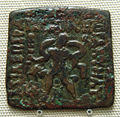
Maues took the tile of "Great King of Kings", an exceeded version of a traditional Persian royal title.
One inscription is known which mentions Maues (usually called the "Moga inscription", and starts with:
- "In the seventy eighth, 78, year the Great King, the Great Moga, on the fifth, 5, day of the month Panemos, on this first, of the Kshaharata and Kshatrapa of Chukhsa - Liaka Kusuluka by name - his son Patika - in the town of Takshasila..."
Maues issued joint coins mentioned a queen Machene ("ΜΑΧΗΝΗ"). Machene may have been a daughter of one of the Indo-Greek houses.
An Indo-Greek king, Artemidoros
Artemidoros
Artemidoros Aniketos was a king who ruled in the area of Gandhara and Pushkalavati in modern northern Pakistan and Afghanistan.-A son of Maues:Artemidoros has a Greek name and has traditionally been seen as an Indo-Greek king...
also issued coins where he describes himself as "Son of Maues".
Maues and Buddhism
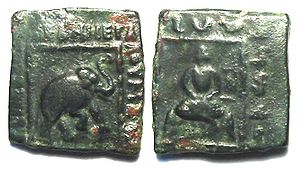
Gautama Buddha
Siddhārtha Gautama was a spiritual teacher from the Indian subcontinent, on whose teachings Buddhism was founded. In most Buddhist traditions, he is regarded as the Supreme Buddha Siddhārtha Gautama (Sanskrit: सिद्धार्थ गौतम; Pali: Siddhattha Gotama) was a spiritual teacher from the Indian...
on a coin, in an area where Buddhism
Buddhism
Buddhism is a religion and philosophy encompassing a variety of traditions, beliefs and practices, largely based on teachings attributed to Siddhartha Gautama, commonly known as the Buddha . The Buddha lived and taught in the northeastern Indian subcontinent some time between the 6th and 4th...
was flourishing at the time.
Also, Maues struck some coins incorporating Buddhist symbolism, such as the lion, symbol of Buddhism since the time of the Mauryan king Ashoka
Ashoka
Ashok Maurya or Ashoka , popularly known as Ashoka the Great, was an Indian emperor of the Maurya Dynasty who ruled almost all of the Indian subcontinent from ca. 269 BC to 232 BC. One of India's greatest emperors, Ashoka reigned over most of present-day India after a number of military conquests...
.
The symbolism of the lion had also been adopted by the Buddhist Indo-Greek king Menander II
Menander II
Menander II "The Just" was an Indo-Greek King who ruled in the areas of Arachosia and Gandhara in the north of modern Pakistan.-Time of reign:...
. Maues therefore probably supported Buddhism
Buddhism
Buddhism is a religion and philosophy encompassing a variety of traditions, beliefs and practices, largely based on teachings attributed to Siddhartha Gautama, commonly known as the Buddha . The Buddha lived and taught in the northeastern Indian subcontinent some time between the 6th and 4th...
, although whether sincerely or for political motives is unclear. His coins also included a variety of other religious symbol such as the cow of Shiva
Shiva
Shiva is a major Hindu deity, and is the destroyer god or transformer among the Trimurti, the Hindu Trinity of the primary aspects of the divine. God Shiva is a yogi who has notice of everything that happens in the world and is the main aspect of life. Yet one with great power lives a life of a...
, indicating wide religious tolerance.
| Preceded by: (In Arachosia Arachosia Arachosia is the Latinized form of the Greek name of an Achaemenid and Seleucid governorate in the eastern part of their respective empires, around modern-day southern Afghanistan. The Greek term "Arachosia" corresponds to the Iranian land of Harauti which was between Kandahar in Afghanistan and... , Gandhara Gandhara Gandhāra , is the name of an ancient kingdom , located in northern Pakistan and eastern Afghanistan. Gandhara was located mainly in the vale of Peshawar, the Potohar plateau and on the Kabul River... and Punjab Punjab region The Punjab , also spelled Panjab |water]]s"), is a geographical region straddling the border between Pakistan and India which includes Punjab province in Pakistan and the states of the Punjab, Haryana, Himachal Pradesh, Chandigarh and some northern parts of the National Capital Territory of Delhi... ) Indo-Greek King Archebios Archebios Archebius Dikaios Nikephoros "The Just/Follower of the Dharma and Victorious" was an Indo-Greek king who ruled in the area of Taxila. Osmund Bopearachchi dates him to circa 90–80 BCE, and R C Senior to about the same period. He was probably one of the last Indo-Greek kings before the Saka king... (In Paropamisade) Indo-Greek King Hermaeus King Hermaeus Hermaeus Soter "the Saviour" was a Western Indo-Greek king of the Eucratid Dynasty, who ruled the territory of Paropamisade in the Hindu-Kush region, with his capital in Alexandria of the Caucasus... |
Indo-Scythian Ruler (85–60 BCE) |
Succeeded by: (In Gandhara Gandhara Gandhāra , is the name of an ancient kingdom , located in northern Pakistan and eastern Afghanistan. Gandhara was located mainly in the vale of Peshawar, the Potohar plateau and on the Kabul River... ) Indo-Greek king: Artemidoros Artemidoros Artemidoros Aniketos was a king who ruled in the area of Gandhara and Pushkalavati in modern northern Pakistan and Afghanistan.-A son of Maues:Artemidoros has a Greek name and has traditionally been seen as an Indo-Greek king... (In Punjab Punjab region The Punjab , also spelled Panjab |water]]s"), is a geographical region straddling the border between Pakistan and India which includes Punjab province in Pakistan and the states of the Punjab, Haryana, Himachal Pradesh, Chandigarh and some northern parts of the National Capital Territory of Delhi... ) Indo-Greek king: Apollodotus II Apollodotus II Apollodotus II , was an Indo-Greek king who ruled in the western and eastern parts of Punjab. Bopearachchi dates him to circa 80-65 BCE, and RC Senior to circa 85-65 BCE. Apollodotos II was an important ruler who seems to have re-established the Indo-Greek kingdom to some extent of its former glory... (In the south) Indo-Scythian ruler: Vonones Vonones of Indo-Scythia Vonones was an Indo-Scythian king who reigned in areas of the North-western Indian subcontinent between around 75 to 65 BCE.His brother, Spalahores, was mentioned on his coins, as well as Spalahores' son Spalagadames... |
See also
- MeoMeoMayo or Meo or Mewati is a prominent Muslim Rajput tribe from North-Western India. A considerable number of Meos migrated to Pakistan after independence in 1947 and now they are estimated to be over 12 million. In Pakistan, Meos have lost their distinct group identity and cultural traditions and...
- YuezhiYuezhiThe Yuezhi, or Rouzhi , also known as the Da Yuezhi or Da Rouzhi , were an ancient Central Asian people....
- Ahir clansAhir clansThe Ahir clans are the various subsets of the Ahir, a primarily Hindu class of herdsman in India.-Nandvanshi:A legendary story of the origin of the Nandvanshi Ahirs narrates that on his way to kill the rakshas, Krishna crossed the river Yamuna accompanied by the Gawlis; those that crossed the river...
- Greco-Bactrian KingdomGreco-Bactrian KingdomThe Greco-Bactrian Kingdom was the easternmost part of the Hellenistic world, covering Bactria and Sogdiana in Central Asia from 250 to 125 BC...
- Indo-Greek KingdomIndo-Greek KingdomThe Indo-Greek Kingdom or Graeco-Indian Kingdom covered various parts of the northwest regions of the Indian subcontinent during the last two centuries BC, and was ruled by more than 30 Hellenistic kings, often in conflict with each other...
- Indo-Parthian KingdomIndo-Parthian KingdomThe Gondopharid dynasty, and other so-called Indo-Parthian rulers, were a group of ancient kings from present day eastern Afghanistan and Pakistan who ruled India, during or slightly before the 1st century AD...
- Kushan EmpireKushan EmpireThe Kushan Empire originally formed in the early 1st century AD under Kujula Kadphises in the territories of ancient Bactria on either side of the middle course of the Oxus in what is now northern Afghanistan, Pakistan, and southern Tajikistan and Uzbekistan.During the 1st and early 2nd centuries...
- KambojasKambojasThe Kambojas were a kshatriya tribe of Iron Age India, frequently mentioned in Sanskrit and Pali literature.They were an Indo-Iranian tribe situated at the boundary of the Indo-Aryans and the Iranians, and appear to have moved from the Iranian into the Indo-Aryan sphere over time.The Kambojas...
- Kamuia
- Aiyasi Kamuia
- Kharaosta Kamuio
- Arta (Kamuia)