

Memory B cell

Encyclopedia
B cell
B cells are lymphocytes that play a large role in the humoral immune response . The principal functions of B cells are to make antibodies against antigens, perform the role of antigen-presenting cells and eventually develop into memory B cells after activation by antigen interaction...
sub-type that are formed following primary infection.
Primary response, paratopes, and epitopes
In wake of first (primary response) infection involving a particular antigenAntigen
An antigen is a foreign molecule that, when introduced into the body, triggers the production of an antibody by the immune system. The immune system will then kill or neutralize the antigen that is recognized as a foreign and potentially harmful invader. These invaders can be molecules such as...
, the responding naïve cells (ones which have never been exposed to the antigen) proliferate to produce a colony
Clonal colony
A clonal colony or genet is a group of genetically identical individuals that have grown in a given location, all originating vegetatively from a single ancestor. In plants, an individual in such a population is referred to as a ramet...
of cells, most of which differentiate into the plasma cell
Plasma cell
Plasma cells, also called plasma B cells, plasmocytes, and effector B cells, are white blood cells which produce large volumes of antibodies. They are transported by the blood plasma and the lymphatic system...
s, also called effector B cells (which produce the antibodies) and clear away with the resolution of infection, and the rest persist as the memory cells that can survive for years, or even a lifetime.
To understand the events taking place, it is important to appreciate that the antibody molecules present on a clone (a group of genetically identical cells) of B cells have a unique paratope
Paratope
The paratope is the part of an antibody which recognises an antigen, the antigen-binding site of an antibody. It is a small region of the antibody's Fv region and contains parts of the antibody's heavy and light chains....
(the sequence of amino acids that binds to the epitope
Epitope
An epitope, also known as antigenic determinant, is the part of an antigen that is recognized by the immune system, specifically by antibodies, B cells, or T cells. The part of an antibody that recognizes the epitope is called a paratope...
on an antigen).
And, each time these cells are induced to proliferate due to an infection, the genetic region coding for the paratope undergoes spontaneous mutation
Mutation
In molecular biology and genetics, mutations are changes in a genomic sequence: the DNA sequence of a cell's genome or the DNA or RNA sequence of a virus. They can be defined as sudden and spontaneous changes in the cell. Mutations are caused by radiation, viruses, transposons and mutagenic...
s with a frequency of about 1 in every 1600 cell-divisions (this is a very high frequency considering the frequency with which these cells divide; compare with frequency of mutations in other cells—1 in 106).
Secondary response and memory
All these events occur in the highly "eventful" germinal centers of lymphoid follicles, within the lymph nodeLymph node
A lymph node is a small ball or an oval-shaped organ of the immune system, distributed widely throughout the body including the armpit and stomach/gut and linked by lymphatic vessels. Lymph nodes are garrisons of B, T, and other immune cells. Lymph nodes are found all through the body, and act as...
s...
Some of the resulting paratopes (and the cells elaborating them) have a better affinity for the antigen (actually, the epitope
Epitope
An epitope, also known as antigenic determinant, is the part of an antigen that is recognized by the immune system, specifically by antibodies, B cells, or T cells. The part of an antibody that recognizes the epitope is called a paratope...
) and are more likely to proliferate than the others.
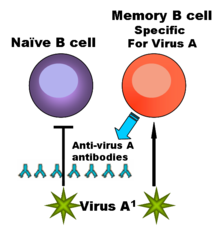
Moreover, with each such exposure to the antigen the number of different clones responding to the same antigen increases (polyclonal response), and a greater number of memory cells persist. Thus, a stronger (basically, larger number of antibody molecules) and more specific antibody-production are the hallmarks of secondary antibody response.
The facts that all the cells of a single clone elaborate one and only one paratope, and that the memory cells survive for long periods, are what impart a "memory" to the immune response.
This is the principle behind vaccination
Vaccination
Vaccination is the administration of antigenic material to stimulate the immune system of an individual to develop adaptive immunity to a disease. Vaccines can prevent or ameliorate the effects of infection by many pathogens...
and administration of booster doses.