


Megalania

Encyclopedia
Megalania is a giant extinct goanna
or monitor lizard
. It was part of a megafaunal
assemblage that inhabited southern Australia
during the Pleistocene
, and appears to have disappeared around 40,000 years ago. The first aboriginal settlers of Australia may have encountered living Megalania.
to mean "Ancient Great Roamer"; the name was intended to "reference to the terrestrial nature of the great Saurian". Owen used a modification of the Greek word ἠλαίνω ēlainō ("I roam"). The close similarity to the Latin word: lania (feminine form of "butcher") has resulted in numerous taxonomic and popular descriptions of Megalania mistranslating the name as: Ancient Giant Butcher.
genus
. Its status as a valid genus remains controversial, with many authors preferring to consider it a junior synonym of Varanus, which encompasses all living monitor lizards. As the gender of the genera Megalania and Varanus are different (feminine and masculine, respectively), the epithet prisca changes to priscus (in alignment with the Code of the ICZN
).
. An affinity with the Perentie
, Australia's largest living lizard, has been suggested based on skull-roof morphology. The most recent comprehensive study proposes a sister-taxon relationship with the Komodo dragon
based on neurocranial similarities, with the Lace monitor
as the closest living Australian relative. Conversely, the Perentie is considered more closely related to the Gould's and Argus
monitors.
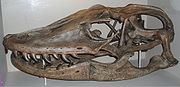 The lack of complete, or nearly complete fossil skeletons has made it difficult to determine the exact dimensions of Megalania. Early estimates placed the length of the largest individuals at 7 metres (23 ft), with a maximum weight of approximately 600–620 kg (1,322.8–1,366.9 lb). However, more recent and more rigorous studies give very different results from one another.
In 2002, Stephen Wroe determined that Megalania had a maximum length of 4.5 metres (14.8 ft) and a weight of 331 kilograms (729.7 lb), while its average length would have been around 3.5 metres (11.5 ft), and mean body weight would have been between 97–158 kg (213.8–348.3 lb). He concluded that the earlier estimates reaching lengths of 6 metres (19.7 ft) or more and a weight of several tons were exaggerations based upon flawed methodologies.
However, Ralph Molnar in 2004 determined a range of potential sizes for Megalania (made by scaling up from dorsal vertebrae, after he determined a relationship between dorsal vertebrae length and total body length). If it had a long thin tail like the Lace monitor
(Varanus varius), then it would have reached a length of 7.9 metres (25.9 ft), while if its tail-to-body proportions were more similar to that of the Komodo dragon
, then a length of around 7 metres (23 ft) is more likely. Taking the maximal 7 m length, he estimated a weight of 1940 kilograms (4,277 lb), with a leaner 320 kilograms (705.5 lb) being average.
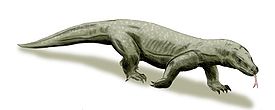 Megalania is the largest terrestrial lizard known to have existed. Judging from its size, Megalania would have fed mostly upon medium to large sized animals, including any of the giant marsupials like Diprotodon
along with other reptiles, small mammals, and birds and their eggs and chicks . It had heavily built limbs and body and a large skull complete with a small crest in between the eyes, and a jaw full of serrated blade-like teeth.
Wroe et al. (1999) regard the contention that Megalania was the only, or even principal, predator of the Australian Pleistocene megafauna with skepticism. They note that the "marsupial lion
" (Thylacoleo carnifex) has been implicated with the butchery of very large Pleistocene mammals, while Megalania has not. In addition, they note that fossils of Megalania are extremely uncommon, in contrast to Thylacoleo carnifex with its wide distribution across Australian Pleistocene deposits.
The Australian biologist Tim Flannery
suggested that if one wanted to reconstruct the ecosystems that existed before the arrival of the humans on Australia, it may be desirable to introduce Komodo dragons as a replacement for Megalania.
and Lace monitor
, possess venom glands along their jawline. It has been suggested that other varanids
, including Megalania, are likely to also have possessed similar glands. If this were true it would make Megalania the largest venomous vertebrate known to have existed.
Goanna
Goanna is the name used to refer to any number of Australian monitor lizards of the genus Varanus, as well as to certain species from Southeast Asia.There are around 30 species of goanna, 25 of which are found in Australia...
or monitor lizard
Monitor lizard
Monitor lizards are usually large reptiles, although some can be as small as in length. They have long necks, powerful tails and claws, and well-developed limbs. Most species are terrestrial, but arboreal and semiaquatic monitors are also known...
. It was part of a megafaunal
Australian megafauna
Australian megafauna are a number of large animal species in Australia, often defined as species with body mass estimates of greater than 30 kilograms, or equal to or greater than 30% greater body mass than their closest living relatives...
assemblage that inhabited southern Australia
Australia
Australia , officially the Commonwealth of Australia, is a country in the Southern Hemisphere comprising the mainland of the Australian continent, the island of Tasmania, and numerous smaller islands in the Indian and Pacific Oceans. It is the world's sixth-largest country by total area...
during the Pleistocene
Pleistocene
The Pleistocene is the epoch from 2,588,000 to 11,700 years BP that spans the world's recent period of repeated glaciations. The name pleistocene is derived from the Greek and ....
, and appears to have disappeared around 40,000 years ago. The first aboriginal settlers of Australia may have encountered living Megalania.
Naming confusion
The name Megalania prisca was coined by Sir Richard OwenRichard Owen
Sir Richard Owen, FRS KCB was an English biologist, comparative anatomist and palaeontologist.Owen is probably best remembered today for coining the word Dinosauria and for his outspoken opposition to Charles Darwin's theory of evolution by natural selection...
to mean "Ancient Great Roamer"; the name was intended to "reference to the terrestrial nature of the great Saurian". Owen used a modification of the Greek word ἠλαίνω ēlainō ("I roam"). The close similarity to the Latin word: lania (feminine form of "butcher") has resulted in numerous taxonomic and popular descriptions of Megalania mistranslating the name as: Ancient Giant Butcher.
Megalania vs. Varanus
Megalania prisca was originally classified in its own monotypicMonotypic
In biology, a monotypic taxon is a taxonomic group with only one biological type. The term's usage differs slightly between botany and zoology. The term monotypic has a separate use in conservation biology, monotypic habitat, regarding species habitat conversion eliminating biodiversity and...
genus
Genus
In biology, a genus is a low-level taxonomic rank used in the biological classification of living and fossil organisms, which is an example of definition by genus and differentia...
. Its status as a valid genus remains controversial, with many authors preferring to consider it a junior synonym of Varanus, which encompasses all living monitor lizards. As the gender of the genera Megalania and Varanus are different (feminine and masculine, respectively), the epithet prisca changes to priscus (in alignment with the Code of the ICZN
International Commission on Zoological Nomenclature
The International Commission on Zoological Nomenclature is an organization dedicated to "achieving stability and sense in the scientific naming of animals". Founded in 1895, it currently comprises 28 members from 20 countries, mainly practicing zoological taxonomists...
).
Phylogeny
Several studies have attempted to establish the phylogenetic position of Megalania within the VaranidaeVaranidae
Varanidae is a group of lizards of the superfamily Varanoidea. The family is a group of carnivorous lizards which includes the largest living lizard, the Komodo dragon, and the crocodile monitor. Varanidae contains the living genus Varanus and a number of extinct taxa...
. An affinity with the Perentie
Perentie
The Perentie is the largest monitor lizard or goanna native to Australia, and fourth largest lizard on earth, after the Komodo Dragon, crocodile monitor and the water monitor...
, Australia's largest living lizard, has been suggested based on skull-roof morphology. The most recent comprehensive study proposes a sister-taxon relationship with the Komodo dragon
Komodo dragon
The Komodo dragon , also known as the Komodo monitor, is a large species of lizard found in the Indonesian islands of Komodo, Rinca, Flores, Gili Motang and Gili Dasami. A member of the monitor lizard family , it is the largest living species of lizard, growing to a maximum length of in rare cases...
based on neurocranial similarities, with the Lace monitor
Lace monitor
The Lace Monitor, or Lace Goanna, Varanus varius, is a member of the monitor lizard family, Australian members of which are commonly known as goannas. It belongs to the subgenus Varanus....
as the closest living Australian relative. Conversely, the Perentie is considered more closely related to the Gould's and Argus
Argus monitor
The Argus monitor is a monitor lizard found in northern regions of Australia and southern New Guinea. It is also commonly known as the Yellow-spotted Monitor....
monitors.
Size
In 2002, Stephen Wroe determined that Megalania had a maximum length of 4.5 metres (14.8 ft) and a weight of 331 kilograms (729.7 lb), while its average length would have been around 3.5 metres (11.5 ft), and mean body weight would have been between 97–158 kg (213.8–348.3 lb). He concluded that the earlier estimates reaching lengths of 6 metres (19.7 ft) or more and a weight of several tons were exaggerations based upon flawed methodologies.
However, Ralph Molnar in 2004 determined a range of potential sizes for Megalania (made by scaling up from dorsal vertebrae, after he determined a relationship between dorsal vertebrae length and total body length). If it had a long thin tail like the Lace monitor
Lace monitor
The Lace Monitor, or Lace Goanna, Varanus varius, is a member of the monitor lizard family, Australian members of which are commonly known as goannas. It belongs to the subgenus Varanus....
(Varanus varius), then it would have reached a length of 7.9 metres (25.9 ft), while if its tail-to-body proportions were more similar to that of the Komodo dragon
Komodo dragon
The Komodo dragon , also known as the Komodo monitor, is a large species of lizard found in the Indonesian islands of Komodo, Rinca, Flores, Gili Motang and Gili Dasami. A member of the monitor lizard family , it is the largest living species of lizard, growing to a maximum length of in rare cases...
, then a length of around 7 metres (23 ft) is more likely. Taking the maximal 7 m length, he estimated a weight of 1940 kilograms (4,277 lb), with a leaner 320 kilograms (705.5 lb) being average.
Palaeobiology
Diprotodon
Diprotodon, meaning "two forward teeth", sometimes known as the Giant Wombat or the Rhinoceros Wombat, was the largest known marsupial that ever lived...
along with other reptiles, small mammals, and birds and their eggs and chicks . It had heavily built limbs and body and a large skull complete with a small crest in between the eyes, and a jaw full of serrated blade-like teeth.
Wroe et al. (1999) regard the contention that Megalania was the only, or even principal, predator of the Australian Pleistocene megafauna with skepticism. They note that the "marsupial lion
Marsupial Lion
The Marsupial Lion is an extinct species of carnivorous marsupial mammal that lived in Australia from the early to the late Pleistocene...
" (Thylacoleo carnifex) has been implicated with the butchery of very large Pleistocene mammals, while Megalania has not. In addition, they note that fossils of Megalania are extremely uncommon, in contrast to Thylacoleo carnifex with its wide distribution across Australian Pleistocene deposits.
The Australian biologist Tim Flannery
Tim Flannery
Timothy Fridtjof Flannery is an Australian mammalogist, palaeontologist, environmentalist and global warming activist....
suggested that if one wanted to reconstruct the ecosystems that existed before the arrival of the humans on Australia, it may be desirable to introduce Komodo dragons as a replacement for Megalania.
Venom
Studies have shown that other members of the genus Varanus, such as the Komodo dragonKomodo dragon
The Komodo dragon , also known as the Komodo monitor, is a large species of lizard found in the Indonesian islands of Komodo, Rinca, Flores, Gili Motang and Gili Dasami. A member of the monitor lizard family , it is the largest living species of lizard, growing to a maximum length of in rare cases...
and Lace monitor
Lace monitor
The Lace Monitor, or Lace Goanna, Varanus varius, is a member of the monitor lizard family, Australian members of which are commonly known as goannas. It belongs to the subgenus Varanus....
, possess venom glands along their jawline. It has been suggested that other varanids
Varanidae
Varanidae is a group of lizards of the superfamily Varanoidea. The family is a group of carnivorous lizards which includes the largest living lizard, the Komodo dragon, and the crocodile monitor. Varanidae contains the living genus Varanus and a number of extinct taxa...
, including Megalania, are likely to also have possessed similar glands. If this were true it would make Megalania the largest venomous vertebrate known to have existed.
Claims of surviving remnants
While there are occasional reports from Australia and New Guinea of giant lizards similar to Megalania, these reports only began after Megalania was first described and became publicly known, and the possibility of a surviving population of the giant lizards is not accepted by mainstream scientists.External links
- http://www.museum.vic.gov.au/prehistoric/mammals/megalania_prisca.html