
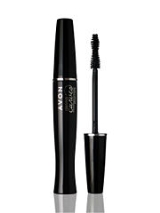
Mascara is a
cosmeticCosmetics are substances used to enhance the appearance or odor of the human body. Cosmetics include skin-care creams, lotions, powders, perfumes, lipsticks, fingernail and toe nail polish, eye and facial makeup, towelettes, permanent waves, colored contact lenses, hair colors, hair sprays and...
commonly used to enhance the eyes. It may darken, thicken, lengthen, and/or define the eyelashes. Normally in one of three forms—liquid, cake, or cream—the modern mascara product has various formulas; however, all contain the same basic components of pigments, oils, waxes, and preservatives.
Definition
The
Collins English DictionaryThe Collins English Dictionary is an important printed dictionary of English. It is published by HarperCollins.The first edition of the Collins English Dictionary with Patrick Hanks as editor and Lawrence Urdang as editorial director, was a milestone in British dictionary making as it was the...
defines
mascara as "a cosmetic substance for darkening, coloring, and thickening the eyelashes, applied with a brush or rod." The
Oxford English DictionaryThe Oxford English Dictionary , published by the Oxford University Press, is the self-styled premier dictionary of the English language. Two fully bound print editions of the OED have been published under its current name, in 1928 and 1989. The first edition was published in twelve volumes , and...
(
OED) adds that mascara is occasionally used on the eyebrows as well.
The
OED also references
mascaro from works published in the late 1800s. In 1886, the
Peck & Snyder Catalogue advertises, “Mascaro or Water Cosmetique… For darkening the eyebrow and moustaches without greasing them and making them prominent.” In 1890, the
Century Dictionary defined mascara as “a kind of paint used for the eyebrows and eyelashes by actors.” And in 1894, N. Lynn advises in
Lynn’s Practical Hints for Making-up, “to darken eyelashes, paint with mascara, or black paint, with a small brush.
Etymology
Exactly where the word “mascara” comes from is unclear, but it is most frequently thought to be based from the Spanish word
máscara meaning ‘mask’ or ‘stain’ and the Italian word
maschera meaning ‘mask’. The
Oxford English DictionaryThe Oxford English Dictionary , published by the Oxford University Press, is the self-styled premier dictionary of the English language. Two fully bound print editions of the OED have been published under its current name, in 1928 and 1989. The first edition was published in twelve volumes , and...
also cites an alternative Catalan definition that describes soot or a black smear, or a Portuguese root (the Portuguese word
máscara means ‘mask’, but a similar word,
mascarra, means dark stain or smut). There is even strong support for a possible source from the Arabic word
maskharah or ‘buffoon’.
History
Aesthetic adornment is a
cultural universalA cultural universal , as discussed by George Murdock, Claude Lévi-Strauss, Donald Brown and others, is an element, pattern, trait, or institution that is common to all human cultures worldwide. Taken together, the whole body of cultural universals is known as the human condition...
and mascara can be documented in
ancient EgyptAncient Egypt was an ancient civilization of Northeastern Africa, concentrated along the lower reaches of the Nile River in what is now the modern country of Egypt. Egyptian civilization coalesced around 3150 BC with the political unification of Upper and Lower Egypt under the first pharaoh...
. Records from around 4000 BC refer to a substance called
kohlKohl is a German word meaning cabbage.Kohl may stand for*Kohl , a traditional Middle Eastern cosmetic*Kohl's, a company that operates department stores located in the United States*KOHL, a radio station in Fremont, California...
that was used to darken eyelashes, eyes, and eyebrows. Kohl was used to mask the eyes, warding off evil spirits and protecting the soul, by both men and women. Often composed of
galenaGalena is the natural mineral form of lead sulfide. It is the most important lead ore mineral.Galena is one of the most abundant and widely distributed sulfide minerals. It crystallizes in the cubic crystal system often showing octahedral forms...
,
malachiteMalachite is a copper carbonate mineral, with the formula Cu2CO32. This green-colored mineral crystallizes in the monoclinic crystal system, and most often forms botryoidal, fibrous, or stalagmitic masses. Individual crystals are rare but do occur as slender to acicular prisms...
, and charcoal or soot, crocodile stool, honey, and water was added to keep the kohl from running. Through Egypt’s influence, kohl usage persisted in the subsequent Babylonian, Greek and Roman empires. Following the fall of the Roman Empire, kohl fell into disuse on the European continent, where it had been considered solely a cosmetic; conversely, it continued to be widely-used in the Middle East for religious purposes.
Make-up was considered unsightly and uncouth in Western culture up until the Victorian era. During the Victorian era, social opinion shifted radically towards the promotion of cosmetics, and women were known to spend a majority of their day occupied with beauty regimens. Great efforts were made to create the illusion of long, dark eyelashes. Attempting this, Victorian women made a type of mascara in their own homes. They would heat a mixture of ash or lampblack and elderberry juice on a plate and apply the heated mixture to their eyelashes.
The product that people would recognize as mascara today did not develop until the nineteenth century. A chemist named
Eugene RimmelEugene Rimmel was a French perfumer and businessman responsible for manufacturing and marketing some of the earliest commercially made cosmetics.-Building:...
developed a cosmetic using the newly invented petroleum jelly. The name Rimmel became synonymous with the substance and still translates to “mascara” in the Italian, Portuguese, Spanish, Dutch, Greek, Turkish, Romanian, and Persian languages today.
Across the Atlantic Ocean and at roughly the same time, in 1913, a man named T. L. Williams created a remarakably similar substance for his sister Maybel. Later in 1917, T. L. Williams started a mail-order business from the product that grew to become the company
MaybellineMaybelline is an American makeup brand sold worldwide and owned by L'Oréal. Their motto is Maybe she's born with it. Maybe it's Maybelline.-History:...
.
The mascara developed by these two men consisted of petroleum jelly and coal in a set ratio. It was undeniably messy, and a better alternative was soon developed. A dampened brush was rubbed against a cake containing soap and black dye in equal proportions and applied to the lashes. Still it was extremely messy. No significant improvement occurred until 1957 with an innovation by
Helena RubinsteinHelena Rubinstein , a Polish born Australian-American business magnate. She is the founder and eponym of Helena Rubinstein, Incorporated, which made her one of the world's richest women.-Early life:...
.
The events leading to Rubinstein’s improvement began in Paris in the early 1900s. There, at the fashion capital of the world, mascara was quickly gaining popularity and common usage.
Elizabeth ArdenFlorence Nightingale Graham , who went by the business name Elizabeth Arden, was a Canadian-American businesswoman who built a cosmetics empire in the United States. At the peak of her career, she was one of the wealthiest women in the world.-Biography:Arden was born in 1884 at Woodbridge, Ontario,...
and Helena Rubinstein, two giants in the American beauty industry, watched and kept abreast of its development. After the First World War, American consumers became eager for new products. Sensing an opportunity, both Rubinstein and Arden launched their own brands of cosmetics that included mascara. Through the efforts of these two rivals and public temperament, mascara finally gained respectability and favor in American society.
The invention of the photograph and motion picture launched mascara’s popularity and usage further forward in America. Motion pictures especially advertised a new standard of beauty and sex appeal. Famous actresses of the classic cinema era, such as
Theda BaraTheda Bara , born Theodosia Burr Goodman, was an American silent film actress – one of the most popular of her era, and one of cinema's earliest sex symbols. Her femme fatale roles earned her the nickname "The Vamp" . The term "vamp" soon became a popular slang term for a sexually predatory woman...
,
Pola NegriPola Negri was a Polish stage and film actress who achieved worldwide fame for her tragedienne and femme fatale roles from the 1910s through the 1940s during the Golden Era of Hollywood film. She was the first European film star to be invited to Hollywood, and became a great American star. She...
,
Clara BowClara Gordon Bow was an American actress who rose to stardom in the silent film era of the 1920s. It was her appearance as a spunky shopgirl in the film It that brought her global fame and the nickname "The It Girl." Bow came to personify the roaring twenties and is described as its leading sex...
,
Greta GarboGreta Garbo , born Greta Lovisa Gustafsson, was a Swedish film actress. Garbo was an international star and icon during Hollywood's silent and classic periods. Many of Garbo's films were sensational hits, and all but three were profitable...
,
Marlene DietrichMarlene Dietrich was a German-American actress and singer.Dietrich remained popular throughout her long career by continually re-inventing herself, professionally and characteristically. In the Berlin of the 1920s, she acted on the stage and in silent films...
,
Bette DavisRuth Elizabeth "Bette" Davis was an American actress of film, television and theater. Noted for her willingness to play unsympathetic characters, she was highly regarded for her performances in a range of film genres, from contemporary crime melodramas to historical and period films and occasional...
, and
Jean HarlowJean Harlow was an American film actress and sex symbol of the 1930s. Known as the "Blonde Bombshell" and the "Platinum Blonde" , Harlow was ranked as one of the greatest movie stars of all time by the American Film Institute...
, depended heavily upon mascara for their glamorized appearances, which the average woman sought to mimic.
In 1933, tragedy struck. A woman known on court records as Mrs. Brown consented to have her eyelashes permanently dyed. Unfortunately, the product, Lash Lure, used
paraphenylenediaminep-Phenylenediamine is an organic compound with the formula C6H42. This derivative of aniline is a colorless solid, but typically samples can contain yellowish impurities arising from oxidation. It is mainly used as a component of engineering polymers and composites. It is also an ingredient in...
, a chemical extremely toxic to the body, as the dyeing agent. At the time, cosmetics were unregulated by the Federal Drug Administration, and the dangers of paraphenylenediamine were unknown. Within hours of the treatment, Mrs. Brown began experiencing severe symptoms of stinging and burning eyes. By the next morning, Mrs. Brown’s eyes had developed ulcers which oozed and had swollen shut. Use of Lash Lure resulted in blindness in Mrs. Brown and fifteen other women and also caused the death of another. It was only after the Lash Lure incident and several others like it, documented in Ruth deForest Lamb’s book entitled
American Chamber of Horrors, that Congress granted the FDA the right to regulate cosmetics in 1938.
Years later in 1957, Rubinstein revolutionized mascara. She created a formula that evolved mascara from a hard cake into a lotion-based cream. She packaged the new mascara in a tube to be sold with a brush. For use, the cream was squeezed onto the brush and applied to lashes. Although still messy, it was a progressive step towards the modern mascara product.
Soon, a grooved rod was patented. The ingenious device picked up the same amount of mascara for each use. The grooved rod was swiftly altered to the brush similar to the ones used today. The change in applicator led mascara to be even easier to use, and its popularity soared to its present heights.
In 2005, Procter and Gamble developed the Moldtrusion brush, a mascara wand that used bristles made of thermoplastic instead of nylon. The first mascara marketed to use this brush was the
Max FactorMax Factor & Company is a cosmetics company, founded during 1909 by Maksymilian Faktorowicz , Max Factor, a Polish-Jewish cosmetician. Max Factor & Company was a related, two-family, multi-generational international cosmetics company before its sale in 1973 for $500 million dollars...
Lash Perfection.
Ingredients
The increased demand for mascara led to the development of the many formulas seen in the current market. Despite the many variations, all formulas contain the same basic elements: pigmentation, oils, and waxes.
The pigmentation for black mascara is similar to the pigmentation used by the Egyptians and Victorian women.
Carbon blackCarbon black is a material produced by the incomplete combustion of heavy petroleum products such as FCC tar, coal tar, ethylene cracking tar, and a small amount from vegetable oil. Carbon black is a form of amorphous carbon that has a high surface-area-to-volume ratio, although its...
, instead of soot or ash, is used. Tar and coal derivatives are strictly prohibited by the FDA. Brown mascaras typically color by use of iron oxides though the specific compounds are unique to each brand. In some mascaras, an additional pigment of ultramarine blue is added.
There is a great deal more leeway and variety among the oils used. Different mineral oils, linseed oil,
castor oilCastor oil is a vegetable oil obtained from the castor bean . Castor oil is a colorless to very pale yellow liquid with mild or no odor or taste. Its boiling point is and its density is 961 kg/m3...
,
eucalyptusEucalyptus is a diverse genus of flowering trees in the myrtle family, Myrtaceae. Members of the genus dominate the tree flora of Australia...
oil,
lanolinLanolin , also called Adeps Lanae, wool wax or wool grease, is a yellow waxy substance secreted by the sebaceous glands of wool-bearing animals. Most lanolin used by humans comes from domestic sheep...
, and oil of
turpentineTurpentine is a fluid obtained by the distillation of resin obtained from trees, mainly pine trees. It is composed of terpenes, mainly the monoterpenes alpha-pinene and beta-pinene...
can be found most frequently among the many formulas.
SesameSesame is a flowering plant in the genus Sesamum. Numerous wild relatives occur in Africa and a smaller number in India. It is widely naturalized in tropical regions around the world and is cultivated for its edible seeds, which grow in pods....
oil is also commonly used.
Waxes usually found in mascara are
paraffinIn chemistry, paraffin is a term that can be used synonymously with "alkane", indicating hydrocarbons with the general formula CnH2n+2. Paraffin wax refers to a mixture of alkanes that falls within the 20 ≤ n ≤ 40 range; they are found in the solid state at room temperature and begin to enter the...
,
carnauba waxCarnauba , also called Brazil wax and palm wax, is a wax of the leaves of the palm Copernicia prunifera, a plant native to and grown only in the northeastern Brazilian states of Piauí, Ceará, and Rio Grande do Norte. It is known as "queen of waxes" and usually comes in the form of hard yellow-brown...
, and
beeswaxBeeswax is a natural wax produced in the bee hive of honey bees of the genus Apis. It is mainly esters of fatty acids and various long chain alcohols...
.
The desired effects of the mascara account for most variations of ingredients. The most basic effect considered is whether the mascara will be water-resistant or not. Water-resistant mascaras have basis in substances that rebuff water, like
dodecaneDodecane is a liquid alkane hydrocarbon with the chemical formula CH310CH3 , an oily liquid of the paraffin series. It has 355 isomers....
. Non water-resistant mascaras have base ingredients that are water-soluble. Mascaras designed to lengthen or curl the eyelashes often contain
nylonNylon is a generic designation for a family of synthetic polymers known generically as polyamides, first produced on February 28, 1935, by Wallace Carothers at DuPont's research facility at the DuPont Experimental Station...
or
rayonRayon is a manufactured regenerated cellulose fiber. Because it is produced from naturally occurring polymers, it is neither a truly synthetic fiber nor a natural fiber; it is a semi-synthetic or artificial fiber. Rayon is known by the names viscose rayon and art silk in the textile industry...
microfibers. Additionally,
ceresinCeresin is a wax derived from ozokerite by a purifying process....
, gum tragacanth, and methyl cellulose are regular ingredients added to act as stiffeners.
Bat guano controversy
An
urban legendAn urban legend, urban myth, urban tale, or contemporary legend, is a form of modern folklore consisting of stories that may or may not have been believed by their tellers to be true...
mentions the use of bat
guanoGuano is the excrement of seabirds, cave dwelling bats, and seals. Guano manure is an effective fertilizer due to its high levels of phosphorus and nitrogen and also its lack of odor. It was an important source of nitrates for gunpowder...
as one of the ingredients of mascara. It is actually
guanineGuanine is one of the four main nucleobases found in the nucleic acids DNA and RNA, the others being adenine, cytosine, and thymine . In DNA, guanine is paired with cytosine. With the formula C5H5N5O, guanine is a derivative of purine, consisting of a fused pyrimidine-imidazole ring system with...
, not guano, that is authorized as a color additive for cosmetics by the FDA and European regulations, and it must be extracted from fish scales, not bat guano.
Manufacture
Which ingredients are chosen also relies on how the mascara is manufactured. Today, there are two main methods of production. The first is referred to as
anhydrousAs a general term, a substance is said to be anhydrous if it contains no water. The way of achieving the anhydrous form differs from one substance to another...
. In this method all waxes, oils, and pigments are mixed, heated, and agitated simultaneously in formulated ratios. The result is a semi-solid substance that is ready to be placed in tubes, packaged, shipped and sold. The other method used is termed
emulsionAn emulsion is a mixture of two or more liquids that are normally immiscible . Emulsions are part of a more general class of two-phase systems of matter called colloids. Although the terms colloid and emulsion are sometimes used interchangeably, emulsion is used when both the dispersed and the...
. The emulsion method also results in a semi-solid substance, but its procedure greatly differs. In the emulsion method, water and thickeners are first combined. Separately, waxes and emulsifiers are mixed and heated. Pigment is then added individually to both mixtures. Finally all is combined in a
homogenizerA homogenizer is a piece of laboratory equipment used for the homogenization of various types of material, such as tissue, plant, food, soil, and many others. Many different models have been developed using various physical technologies for disruption. The 'mortar and pestle', already used for...
, which acts as a high-speed agitator in order to thoroughly mix the oils, water, waxes, and emulsifiers—ingredients that naturally repulse each other.
Safety
Because cosmetics are loosely regulated by the FDA, consideration for the ingredients, age, and usage of the mascara is advisable. A substance is considered a cosmetic if it is used in conjunction with the body in a manner that does not alter the structure of the body or its functions. This leaves a great deal of freedom for the beauty industry in the formulation of cosmetics. Of course, some chemicals are explicitly forbidden from inclusion in a cosmetic. These include biothional, choloroform, halogenated salicylanilides,
hexachloropheneHexachlorophene, also known as Nabac, is a disinfectant. The compound occurs as a white to light-tan crystalline powder, which either is odorless or produces a slightly phenolic odor. In medicine, hexachlorophene is very useful as a topical anti-infective, anti-bacterial agent, often used in soaps...
, methylene chloride,
vinyl chlorideVinyl chloride is the organochloride with the formula H2C:CHCl. It is also called vinyl chloride monomer, VCM or chloroethene. This colorless compound is an important industrial chemical chiefly used to produce the polymer polyvinyl chloride . At ambient pressure and temperature, vinyl chloride...
and
mercuryMercury is a chemical element with the symbol Hg and atomic number 80. It is also known as quicksilver or hydrargyrum...
compounds. As an exception, mercury compounds can be used as a preservative in eye make-up and so is occasionally found in mascara.
There is some concern for a select few individual ingredients found in mascara since they have been found to cause cancer in mice, and others are known to be highly toxic to the human body or volatile. Despite these disconcerting facts, they exist in minute quantities in mascara, and their presence has not been positively linked to negatively affect health.
Proper use of mascara includes disposal of tube and brush after four to six months. Mascara should also be disposed of if found to smell different, strange, or especially pungent. It is unlikely and unusual, but mascara does have the capability to grow bacteria. Because of this and the nature of its usage, people using mascara have a slight risk of eye infection or
conjunctivitisConjunctivitis refers to inflammation of the conjunctiva...
, but this is rare.
It is more common to develop a
styeAn external stye or sty , also hordeolum , is an infection of the sebaceous glands of Zeis at the base of the eyelashes, or an infection of the apocrine sweat glands of Moll. External styes form on the outside of the lids and can be seen as small red bumps. Internal styes are infections of the...
, or commoner still, swollen eyelids. Stys and swollen eyelids are better classified as allergic reactions. The allergic reactions can be stimulated by any of the components of mascara but is usually attributed to
methylparabenMethylparaben, also methyl paraben, one of the parabens, is a preservative with the chemical formula CH3. It is the methyl ester of p-hydroxybenzoic acid.-Occurrence:...
, aluminum powder,
cetearethThe INCI names ceteareth-n refer to polyoxyethylene ethers of a mixture of high molecular mass saturated fatty alcohols, mainly cetyl alcohol and stearyl alcohol...
-20,
butylparabenButylparaben, or butyl paraben, is a member of the paraben family, which has the formula C4H9. It is used as an antimicrobial preservative in cosmetics such as eye shadow, foundation, sunscreen, facial moisturizer and skin anti-aging treatment. It is also used in medication suspensions, and as a...
, or
benzyl alcoholBenzyl alcohol is an organic compound with the formula C6H5CH2OH. The benzyl group is often abbreviated "Bn", thus benzyl alcohol is denoted as BnOH. Benzyl alcohol is a colorless liquid with a mild pleasant aromatic odor. It is a useful solvent due to its polarity, low toxicity, and low vapor...
.
Psychology
In western cultures shown to demonstrate the idolization of youth, the maintenance of a youthful appearance becomes a societal priority. The typical characteristics of children—soft cheeks, a round face, soft skin, large eyes, upturned nose, and a short chin—are often seen as ideal facial characteristics for women. The use of mascara helps to mimic
neotenyNeoteny , also called juvenilization , is one of the two ways by which paedomorphism can arise. Paedomorphism is the retention by adults of traits previously seen only in juveniles, and is a subject studied in the field of developmental biology. In neoteny, the physiological development of an...
, namely large eyes. Mascara pulls away the eyelash from the rim of the eye creating a doe-like illusion of larger, more open eyes. Wide eyes are culturally equated with youth, and may be subconsciously associated with innocence. Innocence and youth can prompt protective instincts as well as feelings of attraction.