
|
|
|
|
Martian Manhunter
|
| |
|
| |
Martian Manhunter (J'onn J'onzz), also known as John Jones or the Manhunter from Mars, a fictional character, is an extraterrestrial superhero in the . The character first appeared in the back-up story "The Strange Experiment of Dr. Erdel" in Detective Comics #225 (November 1955), written by Jack Miller and illustrated by Joe Certa.
J'onzz is a native of the planet Mars, also known as Ma'aleca'andra in his native tongue.

Discussion
Ask a question about 'Martian Manhunter'
Start a new discussion about 'Martian Manhunter'
Answer questions from other users
|
Encyclopedia
Martian Manhunter (J'onn J'onzz), also known as John Jones or the Manhunter from Mars, a fictional character, is an extraterrestrial superhero in the . The character first appeared in the back-up story "The Strange Experiment of Dr. Erdel" in Detective Comics #225 (November 1955), written by Jack Miller and illustrated by Joe Certa.
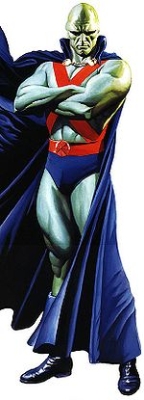
J'onzz is a native of the planet Mars, also known as Ma'aleca'andra in his native tongue. (This is a nod to "Malacandra", the name used by the inhabitants of Mars in C. S. Lewis's novel Out of the Silent Planet. This is a much later addition and not part of the original version of the character). His usual public appearance is as a tall, hairless, green-skinned humanoid with a pronounced brow.
Fictional biography The character makes his first appearance in Detective Comics #225, cover dated November 1955. This origin story sets up a number of important character points, many of which have carried onto the modern age with little or no change. In this first story, the character is pulled to earth by a experimental teleportation beam (originally presented as an attempted communication device) constructed by Dr. Erdel, the shock of the encounter kills Dr. Erdel and leaves J'onn with no method of returning home. The character decided to fight crime while waiting for Martian technology to advance to a stage that will enable his rescue. To that end, he adopts the identity of John Jones, a detective in the fictional Apex City (later retconned as Chicago).
During this period, the character and his back story differ in some minor and some significant ways from modern treatments. Firstly, as with his counterpart, the Silver age Superman, his power range is poorly defined, and his powers expand over time as the plot demands. The addition of precognitive abilities (Detective Comics #226) are quickly followed by telepathy and flight , "Atomic vision", super-hearing and many other powers. In addition, his customary weakness to fire is only manifested when he is in his native Martian form.
A more significant difference, is that at this time, there is no suggestion that Mars is a dead planet or that the character is the last of his kind. Many of the tales of the time feature either Martian technology or the appearance of other Martian characters, Detective Comics #236 (October 1956), for example, features the character making contact with the planet Mars and his parents.
J'onn eventually reveals his existence to the world, after which he operates openly as a superhero and becomes a charter member of the Justice League. He abandons the detective John Jones identity when Jones is ostensibly killed in action. J'onn spent the next several years involved in mystical adventures involving the Idol Head of Diabolu, an artifact which generates supernatural monsters. He later takes the persona of Marco Xavier in order to infiltrate the international crime cartel known as VULTURE.
His appearances with the League kept him in the public eye long after his own series were canceled. He is a founding member of the team, and served as a member during many of its various incarnations. From the late 1960s until the late 1970s, J'onn was absent from the JLA, having left Earth to find and become leader of New Mars. This time period is later retconned during the Crisis on Infinite Earths, and his period of absence is never again referenced.
In early 1987 DC revamped its struggling Justice League of America series by relaunching the title as Justice League International. This new series, written by Keith Giffen and J.M. DeMatteis with art by Kevin Maguire (and later Adam Hughes), added quirky humor to the team's stories. J'onn is present from the first issue and within the stories is used as a straight man for other characters in comical situations. The series also added a number of elements to his back story that have remained to the present (such as J'onn's obsession with Oreo cookies, partially due to Captain Marvel's influence).
The 1988 four issue mini-series Martian Manhunter by J.M. DeMatteis and Mark Badger further redefined the character and changed a number of important aspects of both his character and his origin story. It is revealed that Dr. Erdel did not die and that the character's humanoid appearance was due to physiological trauma and attempts to block out the death of his race, his familiar appearance a "compromise" between his true form and a human appearance based upon Erdel's mental concept of what a Martian should look like. (Later series stste that his real form is private and that, even on Mars, his "public" appearance was the familiar version.) The series also adds to canon, the idea that J'onzz was not only displaced in space but in time and the Martian race, including J'onzz' wife and daughter, has been dead for thousands of years.
The 1990s sees the character continue to serve in many different versions of the Justice League of America. In addition to serving in the League under his own identity, he also joins (under duress) as "Bloodwynd".
The 1992 mini-series American Secrets explored the adventures of the characters against the backdrop of a changing America during the 1950s. Written by Gerard Jones and with art by Eduardo Barreto, the series finds the Manhunter drawn into a murder mystery that rapidly escalates into paranoia and alien invasion.
Martian Manhunter began as an ongoing series in 1998, written by John Ostrander and illustrated by Tom Mandrake (with fill-in art provided by Bryan Hitch among others). The series lasted 36 issues before being canceled due to low sales. Ostrander established that Martian Manhunter is the most recognized hero in the Southern Hemisphere, and that he maintains a number of different secret identities, many of them outside the United States. However, following two incidents later in the series in which John Jones separates from Martian Manhunter, he decides to focus on his original human identity and retire the others.
The series establishes that J'onn has a disturbed brother, Ma'alefa'ak, who uses his shapeshifting abilities to pose as J'onn, capturing and torturing Jemm, Son of Saturn, and terraforming part of Earth to resemble Mars (areoforming). This is all part of a grand plan designed to convince the rest of the Justice League that J'onn has turned into a sociopath. However, J'onn is able to clear his name and defeat Ma'alefa'ak despite having most of his body destroyed in an exploding spaceship. (He is later able to regenerate his body from his severed hand.)
The series also further established the history of both the Manhunter and the Saturnian race. The first issue revealed that there was a "real" human John Jones, a police detective who is murdered by corrupt colleagues, and that J'onn subsequently assumed his identity to complete an important court case.
In issues of JLA written by Joe Kelly, J'onn attempts to conquer his fear of fire and makes a deal with a flame-wielding villainess named Scorch, who wants J'onzz' telepathic help in dealing with her own mental issues. The story served to redefine his traditional adverse to fire - he is now invulnerable to flames unless they are "flames of passion" or of some other "psychic significance." This change is forgotten about in later series and adventures .
During the lead-up to the Infinite Crisis mini-series, the character is feared killed in an attack on the Justice League's HQ. He is later revealed to be alive and a captive of Alexander Luthor, Jr.. After Infinite Crisis, most of DC's series jumped ahead one year, having the weekly series 52 fill in the missing time. In 52 #24, it is revealed that the character had been working behind the scenes in an unsuccessful attempt to destroy Checkmate for its role in the death of Ted Kord.
Using the events of World War III as a catalyst, DC Comics redesigned the appearance of the character, changing his costume and giving an appearance that more closely resembles that of his Martian form. Those changes were further explored during a Martian Manhunter limited series that spun out of the DCU: Brave New World one-shot. Written by A.J. Lieberman with art from Al Barrionuevo and Bit, the series portrayed a Manhunter more mistrustful of humanity and their actions towards each other. The mini-series focuses on J'onn's search for other survivors of Mars.
Following this mini-series, J'onn was intended to be in Outsiders. He appeared in the third issue of the Outsiders: Five Of A Kind series with Thunder, and joined the team afterwards. Due to the change of writers, he is quickly written out within the last two issues. He is next seen working undercover during the events of the limited series Salvation Run. At the end of the series, J'onn is left captured and alone on an alien planet.
In Final Crisis #1, Libra summons a boom tube for J'onn at the behest of the Human Flame, who then kills J'onn in front of an onlooking Secret Society. He is buried on Mars, where many of his colleagues attend the graveside burial service. The events of those two issues are explored in the one-shot, Final Crisis: Requiem.
The print version of the DC Direct solicitation included a teaser image of the Blackest Night series 2 figures, featuring a figure identified as "Black Lantern Martian Manhunter".
Powers and abilities
Martian Manhunter possesses a wide variety of superhuman powers, many of which are similar to those of Superman and Wonder Woman, including super-strength, super-speed, invulnerability and flight. Like Superman, Martian Manhunter has "Martian vision" (a term designating both the ability to see through solid objects and the ability to generate optic heat beams).
During the 90s, it was stated that the source of his flight and "Martian vision" is a form of telekinesis (he had occasionally demonstrated more traditional uses of telekinesis to levitate and animate objects during his Detective Comics and House of Mystery appearances).
The Martian Manhunter also possesses the power of shapeshifting, which he employs for various effects (e.g., adopting human or monstrous appearance, elongating his limbs, growing to immense size). He can alter the chemical makeup of his body to imitate various materials such as steel or stone. J'onn can render himself invisible, and is also able to become intangible so as to pass harmlessly through solid objects. He is a powerful telepath, capable of both perceiving the thoughts of others and of projecting his own thoughts. He often acts as a "switchboard" between minds in order to coordinate the Justice League's actions. The extent of his telepathic abilities is great; several times he has connected to the entire planet Earth.
He has demonstrated regenerative abilities, once able to regenerate himself from only his severed hand but with great strain (due to the loss of mass he found it necessary to incorporate new matter from Martian sand). Early appearances of the character show him as able to breathe underwater; the last time he displayed this power was when he encountered Zauriel in the sea of San Francisco in JLA #6. The Manhunter has sometimes been said to possess nine senses, but these additional senses are poorly defined and generally ignored by most writers.
Aside from his superhuman powers, the Manhunter is also a skilled and very capable detective. As Batman mentions in his file, that "in many ways, Martian Manhunter is like an amalgam of Superman and the Dark Knight himself."
Weakness
One of the Martian Manhunter's signature traits is his vulnerability to flame. Although it has been an element of the character since his earliest appearances, writers have depicted it with great inconsistency throughout the character's long career. In some instances, it is portrayed as a physical susceptibility inherent to the Martian race, while at other times it has been explained as a personal psychosomatic disorder. The degree of vulnerability has also been wildly inconsistent, in some cases capable of stripping away his powers and killing him, while at other times simply inflicting pain or delirium with no actual danger of physical harm. This weakness has been diminished or cured on more than one occasion, only to have it return with a vengeance in a later story. Thus, it is difficult to define.
In his earliest appearances, the character was shown as having a weakness to fire while in his native Martian form. Over time, this was developed into the character having pyrophobia, with fire being the Martian's "Achilles heel", equivalent to Superman's weakness to kryptonite. Exposure to fire typically causes J'onn to lose his ability to maintain his physical form, 'melting' into a pool of writhing green plasma. One portrayal explained that the flame weakness was tied into Martian telepathy, with fire causing so much chaos in Martian minds that they collapse. Most recently it was revealed, during the Trial By Fire storyline, that this fear was instilled on a genetic level by the Guardians of the Universe 20,000 years ago, when they split the original "Burning" Martians into the Green Martians and White Martians. At the end of the arc, this weakness was partially removed, with J'onn explaining that only fires of psychic significance were of harm to him, such as flames of suffering or passion (this was seemingly a roundabout way of limiting his weakness to flames of a mystical or pyrokinetic nature). Following Infinite Crisis and One Year Later, it has been shown that J'onn's weakness to fire has changed once again. Martians are no longer afraid of fire, but they lose their powers in its presence, physical fire and intense heat can injure and kill a Martian.
Other versions Within the publications of DC Comics, many Alternate versions of the characters have appeared. Some of those have appeared in stories that set within the shared fictional DC Universe and others in self-contained stories. Those alternative versions have appeared in a range of genres and time periods and many appear in Elseworlds stories featuring a Justice League, including JLA: The Nail; JLA: Act of God; Justice Riders; the fantasy-themed League of Justice, the World War II-set JSA: The Liberty Files and John Ostrander's dark JLA: Destiny which features a world without Superman or Batman. Other notable stories provide a more pessimist future for the character. Kingdom Come, features a J'onn mentally shattered from his attempts to understand humanity, while Frank Miller's dystopian The Dark Knight Strikes Again has a powerless alcoholic J'onn (murdered by Joker/Dick Grayson - using fire ... of course).
Within the shared DC Universe, J'onn appears in the 30th century as an acquaintance of Dream Girl and assists the Legion of Super-Heroes against Mordru. In the Grant Morrison penned series, DC One Million, a version of the character is shown merging with Mars and turning it into a home for humanity and other races.
In 52 #52, a new 52-Earth Multiverse is revealed. On Earth-3, the many-membered Crime Society of America exists, with a monstrous version of J'onn J'onnz showcased in 52 #52 (but not in subsequent Countdown appearances of the Society). Countdown to Adventure #1 depicts the Forerunner planet, in an alternate universe (Earth-48) where the races of the planets and dwarf planets in the universe conquer Earth; the leader of the Martian army and populace is General J'onzz.
In other media
Justice League of America (TV movie) J'onn J'onzz, is played by David Ogden Stiers, in the 1997 Justice League of America live-action television pilot. He has difficulty shapeshifting, and no mention is made of any other powers.
Justice League (animated series)
J'onn J'onzz appears in the Justice League animated series, voiced by Carl Lumbly. In this series, J'onzz' history is even more closely tied with that of the League. In the series, the Justice League originates as a temporary uniting of Earth's heroes against an alien invasion; the invaders had previously invaded Mars, wiping out all the inhabitants except J'onn J'onzz, who travels to Earth to warn of the invaders and join the fight against them.
For the animated series, executive producer Bruce Timm revised and reduced J'onn's powers somewhat; his superstrength was downplayed (though he was still seen performing great feats of strength on occasion), his superspeed, invisibility and Martian vision are not present, and emphasis was placed on his telepathy, shapeshifting and density alteration, specifically his ability to become intangible. J'onzz only increased his density sporadically on the series, usually noticeable by a glowing blue aura surrounding his body.
In season two episode Comfort and Joy, J'onn lands on a childs roof and reaches down the chimney for cookies, which are drawn like Oreos. In the comics, J'onn has always displayed a liking for the cookie called Chocos, which are essentially Oreos.
Like the other member in the first two seasons he is used on a semi regular basis. In Tabula Rasa, he becomes disappointed in humanity after hearing their thoughts, showing how selfish some humans are. His faith is somewhat restored when he mentally spies on a group of people seeking a lost little girl. Spying on one guy who thought "I'm freezing my butt off for the girl and I don't even know her. But I know how I would feel if she were mine." It is J'onn who turns the tide in the battle with A.M.A.Z.O intentionally allowing the android to similate his powers. When Luthor tells A.M.A.Z.O he has all their powers, J'onn tells him to use them well (it is the use of J'onn's telepathy which enables A.M.A.Z.O to recognize Luthor's duplicity).
In the third, fourth and part of the fifth season he is in the Watchtower manning it. He takes the place of Kalibak when Flash goes with Mister Miracle and Big Barda to save Oberon. In task force X he fights off Flag, Plastique, Captain Boomerang and Deadshot single handedley. He leaves the tower at the end of season 4 to battle Luthor with the rest of the original seven. He leaves the tower again to help Wonder Woman against Killer Frost, Devil Ray and Giganta. At the end of that same episode he leaves the League, claiming he was too detached from humanity to serve them, and makes Mister Terrific the new man in charge of dispatching the League. He returns in the series finale taking the form of an elderly Asian man and seemed to have found love. He reunites with the League and helps to fend off the invasion.
Smallville
The character is introduced to the television series Smallville in the episode "Static". Phil Morris portrays John Jones in the Season 6 episode "Labyrinth". In the setting of a mental institution, which is only Clark's illusion induced by an alien criminal, it is not immediately clear whether he is just a delusional patient named Jones or really communicating with Clark through his dream. In this illusionary world, "Jones" is afraid of fire and flinches away from a lit cigarrette lighter. Though his real name is never given (he gives Clark the name John Jones in the deleted scenes on the season 6 DVD disc 4 episode 12 and reveals his home as Mars, adding that he was charged with watching over young Kal-El), he relates to Clark that he is "from Mars." Characters have frequently referred to him as The Martian Manhunter. This version of the Martian Manhunter has some preternatural talents, including flight, telepathy, superhuman strength and healing, though he states in the episode "Phantom" he must leave Earth's atmosphere to fully regenerate. In Clark's asylum vision he wears a loose blue robe about his shoulders that recalls the Manhunter's cape. In the animated spin-off series Justice & Doom (available online and on Season Six DVDs), John is shown to shapeshift into his Martian form aboard an artificial satellite. John's true form is seen on the show several episodes prior, not played by Morris and cloaked in shadow, with only the shape of him suggested and the telltale glowing red eyes. It this iteration, John is apparently working for Jor-El to protect Clark. In Season 8, "Odyssey" he saved Clark from imminent death by flying Clark towards the sun. However, this caused J'onn to lose all of his abilities. In the episode "Prey", he has explicitly adopted the name "John Jones", and has joined the Metropolis police force as a detective. He also lends a hand in the episode "Bloodline" where he allows Kara to use a crystal of Kryptonian origin to defeat the phantom Faora, although he does not make an on-screen appearance. In the episode "Bulletproof" John gets shot due to an inside job of the Metropolis Police Department which Clark And Green Arrow investigate and find John's shooter. John was saved by Emil Hamilton.
The Batman
Martian Manhunter appears in The Batman, voiced by Dorian Harewood. In addition to the character's standard powers, he also displays telekinetic abilities. He uses the guise of Detective John Jones to warn Batman about "The Joining", a coming alien threat to Gotham. Despite not being in continuity, his appearance is very much like his appearance on the Justice League series (the only real difference being that he wears shorts).
Justice League: The New Frontier
J'onn J'onzz appears in Justice League: The New Frontier, playing a pivotal role against Earth's ancient evil The Centre. In the film, J'onn's origin is once again retold, with more focus on his roles as a detective and a refugee than a superhero and finding faith within humanity. He also seems to enjoy soda pop. He is voiced by Miguel Ferrer. In his "superhero form", he has human-like instead of all-red eyes, hearkening back to his appearance in early comic stories.
Videogames
- The Martian Manhunter is prominently featured in the videogame Justice League Heroes voiced by Daniel Riordan.
Similar characters
In Action Comics #16 (September 1939), the Zatara story is called Terror from Saturn. A teleportation beam plucks Zatara from Earth to Saturn where he meets Porra who is the spitting image of the Martian Manhunter.
In Batman #78 (Aug.-Sep. 1953), Batman met Roh Kar, First Lawman of Mars, who was on Earth chasing an alien renegade. Though displaing no innate super-powers, he uses technology to track brainwaves and fly. His appearance also resembles the Martian Manhunter.
Parodies and analogues
There have been few parodies of Martian Manhunter made in recent times, due to the concentration on more well-known heroes like Superman and Batman.
See also
External links
- at the DC Database Project
- - Comic book historian Alan Kistler examines the history of J'onn J'onzz and his various interpretations and origins. Several image scans.
|
| |
|
|