

Mariakerke

Encyclopedia
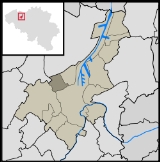
Mariakerke is a village in the Belgian province of East-Flanders. It is part of the urban area of the province's capital city Ghent
. Its population is of 11,883 people (2007).
and Bruges
. The west side is Mariakerke center. The east side of Mariakerke is known as Kolegem
. Because of the hundreds of years of separation, both halves developed their own unique atmosphere.
Mariakerke obtained the status of independent village in 1793, after which a bridge was constructed to connect both halves of the village. The bridge has been destroyed several times during war, which makes that the actual bridge was put up in 1964.
Besides the bridge, Mariakerke only had one main road which connected the village with the city of Ghent. This road was very important for the village, and still exists today under the name "Brugse Steenweg".
Later in the 18th century, a trade route was constructed from Ghent to Eeklo
, and Mariakerke became a stop along this important road. Nowadays the road is better known as the N9 (Belgium)|N9, one of Ghent's most busy avenues. This new street had a significant impact on the 18th century Mariakerke.
The people from Mariakerke became more involved in the city life of Ghent once the industrial era had begun. A lot of villagers found a job at the many factories of Ghent, and a lot of rich industrials constructed castles and mansions in the rural Mariakerke. These castles can still be visited today, and add a special atmosphere to the village.
Mariakerke finally lost its rural character after World War II
. A lot of city people moved to the country side, and Mariakerke witnessed a real population boom. In the 1970s, the city of Ghent started expanding again, slowly but surely absorbing the village of Mariakerke into its urban borders. 1976 saw the fusion of Mariakerke with Ghent, and ever since it has been part of the urban area of Ghent
.
Ghent
Ghent is a city and a municipality located in the Flemish region of Belgium. It is the capital and biggest city of the East Flanders province. The city started as a settlement at the confluence of the Rivers Scheldt and Lys and in the Middle Ages became one of the largest and richest cities of...
. Its population is of 11,883 people (2007).
History
In the 17th century, Mariakerke was divided in two because of the construction of the "Brugse Vaart", a canal that connects the cities of GhentGhent
Ghent is a city and a municipality located in the Flemish region of Belgium. It is the capital and biggest city of the East Flanders province. The city started as a settlement at the confluence of the Rivers Scheldt and Lys and in the Middle Ages became one of the largest and richest cities of...
and Bruges
Bruges
Bruges is the capital and largest city of the province of West Flanders in the Flemish Region of Belgium. It is located in the northwest of the country....
. The west side is Mariakerke center. The east side of Mariakerke is known as Kolegem
Kolegem
Kolegem is the eastern part of Mariakerke. Mariakerke is part of the city Ghent .Kolegem is separated from the rest of Mariakerke by a canal named Brugse Vaart, a canal between Ghent and Bruges....
. Because of the hundreds of years of separation, both halves developed their own unique atmosphere.
Mariakerke obtained the status of independent village in 1793, after which a bridge was constructed to connect both halves of the village. The bridge has been destroyed several times during war, which makes that the actual bridge was put up in 1964.
Besides the bridge, Mariakerke only had one main road which connected the village with the city of Ghent. This road was very important for the village, and still exists today under the name "Brugse Steenweg".
Later in the 18th century, a trade route was constructed from Ghent to Eeklo
Eeklo
Eeklo is a Belgian municipality in the Flemish province of East Flanders. The municipality only comprises the city of Eeklo proper. The name Eeklo comes from the contraction of “eke” and “lo”, two Old German words meaning “oak” and “sparse woods”....
, and Mariakerke became a stop along this important road. Nowadays the road is better known as the N9 (Belgium)|N9, one of Ghent's most busy avenues. This new street had a significant impact on the 18th century Mariakerke.
The people from Mariakerke became more involved in the city life of Ghent once the industrial era had begun. A lot of villagers found a job at the many factories of Ghent, and a lot of rich industrials constructed castles and mansions in the rural Mariakerke. These castles can still be visited today, and add a special atmosphere to the village.
Mariakerke finally lost its rural character after World War II
World War II
World War II, or the Second World War , was a global conflict lasting from 1939 to 1945, involving most of the world's nations—including all of the great powers—eventually forming two opposing military alliances: the Allies and the Axis...
. A lot of city people moved to the country side, and Mariakerke witnessed a real population boom. In the 1970s, the city of Ghent started expanding again, slowly but surely absorbing the village of Mariakerke into its urban borders. 1976 saw the fusion of Mariakerke with Ghent, and ever since it has been part of the urban area of Ghent
Ghent
Ghent is a city and a municipality located in the Flemish region of Belgium. It is the capital and biggest city of the East Flanders province. The city started as a settlement at the confluence of the Rivers Scheldt and Lys and in the Middle Ages became one of the largest and richest cities of...
.
Castles
- Castle Claeys-Bouüaert
- Castle de Hemptine
- Castle ter beken
- Castle Kervyn d'oudt Mooregem
- Castle van Tieghem de ten Berghe
- White castleWhite Castle- Castles :* The White Castle, East Lothian, once a hill fort in the Lammermuir Hills, East Lothian, Scotland, a district today known as Nunraw* The White Castle , an 11th-century castle in Wales- Food and drink :* White Castle , a U.S...
or Henry Story - Castle les Cygnes