
All Topics  
Marginal cost

 
Marginal Cost

   Email Print
   Bookmark   Link


Marginal cost


In economics
Economics

File:Ballard Farmers' Market - vegetables.jpgEconomics is the Social sciences that studies the Production theory basics, Distribution , and Consumption of Good and Service ....
 and finance
Finance

The field of finance refers to the concepts of time, money and risk and how they are interrelated. Banks are the main facilitators of funding through the provision of credit, although private equity, mutual funds, hedge funds, and other organizations have become important....
, marginal cost is the change in total cost
Total cost

In economics, and cost accounting, total cost describes the total economic cost of production and is made up of variable cost, which vary according to the quantity of a good produced and include inputs such as labor and raw materials, plus fixed cost, which are independent of the quantity of a good produced and include inputs that cannot...
 that arises when the quantity produced changes by one unit. It is the cost of producing one more unit of a good. Mathematically, the marginal cost (MC) function is expressed as the first derivative
Derivative

In calculus, a branch of mathematics, the derivative is a measure of how a function changes as its input changes. Loosely speaking, a derivative can be thought of as how much a quantity is changing at a given point....
 of the total cost
Total cost

In economics, and cost accounting, total cost describes the total economic cost of production and is made up of variable cost, which vary according to the quantity of a good produced and include inputs such as labor and raw materials, plus fixed cost, which are independent of the quantity of a good produced and include inputs that cannot...
 (TC) function with respect to quantity (Q). Note that the marginal cost may change with volume, and so at each level of production, the marginal cost is the cost of the next unit produced.


Discussion
Ask a question about 'Marginal cost'
Start a new discussion about 'Marginal cost'
Answer questions from other users
Full Discussion Forum


Encyclopedia


In economics
Economics

File:Ballard Farmers' Market - vegetables.jpgEconomics is the Social sciences that studies the Production theory basics, Distribution , and Consumption of Good and Service ....
 and finance
Finance

The field of finance refers to the concepts of time, money and risk and how they are interrelated. Banks are the main facilitators of funding through the provision of credit, although private equity, mutual funds, hedge funds, and other organizations have become important....
, marginal cost is the change in total cost
Total cost

In economics, and cost accounting, total cost describes the total economic cost of production and is made up of variable cost, which vary according to the quantity of a good produced and include inputs such as labor and raw materials, plus fixed cost, which are independent of the quantity of a good produced and include inputs that cannot...
 that arises when the quantity produced changes by one unit. It is the cost of producing one more unit of a good. Mathematically, the marginal cost (MC) function is expressed as the first derivative
Derivative

In calculus, a branch of mathematics, the derivative is a measure of how a function changes as its input changes. Loosely speaking, a derivative can be thought of as how much a quantity is changing at a given point....
 of the total cost
Total cost

In economics, and cost accounting, total cost describes the total economic cost of production and is made up of variable cost, which vary according to the quantity of a good produced and include inputs such as labor and raw materials, plus fixed cost, which are independent of the quantity of a good produced and include inputs that cannot...
 (TC) function with respect to quantity (Q). Note that the marginal cost may change with volume, and so at each level of production, the marginal cost is the cost of the next unit produced.
Marginalcost


In general terms, marginal cost at each level of production includes any additional costs required to produce the next unit. If producing additional vehicles requires, for example, building a new factory, the marginal cost of those extra vehicles includes the cost of the new factory. In practice, the analysis is segregated into short and long-run cases, and over the longest run, all costs are marginal. At each level of production and time period being considered, marginal costs include all costs which vary with the level of production, and other costs are considered fixed costs.

A number of other factors can affect marginal cost and its applicability to real world problems. Some of these may be considered market failures. These may include information asymmetries
Information asymmetry

In economics and contract theory, information asymmetry deals with the study of decisions in transactions where one party has more or better information than the other....
, the presence of negative or positive externalities
Externality

In economics, an externality or spillover is a positive or negative impact on a party not directly involved in an economic transaction. In such a case, prices do not reflect the full costs or benefits in production or consumption of a product or service....
, transaction costs, price discrimination
Price discrimination

Price discrimination exists when sales of identical good or Service are transacted at different prices from the same provider. In a theoretical market with perfect information, no transaction costs or prohibition on secondary exchange to prevent arbitrage, price discrimination can only be a feature of monopoly and oligopoly markets, where...
 and others.

Cost functions and relationship to average cost

In the simplest case, the total cost function and its derivative are expressed as follows, where Q represents the production quantity, VC represents variable costs, FC represents fixed costs and TC represents total costs.

Since (by definition) fixed costs do not vary with production quantity, it drops out of the equation when it is differentiated. The important conclusion is that marginal cost is not related to fixed costs. This can be compared with average total cost or ATC, which is the total cost divided by the number of units produced and does include fixed costs.

For discrete calculation without calculus, marginal cost equals the change in total (or variable) cost that comes with each additional unit produced. For instance, suppose the total cost of making 1 shoe is $30 and the total cost of making 2 shoes is $40. The marginal cost of producing the second shoe is $40 - $30 = $10.

Economies of scale

Production may be subject to economies of scale
Economies of scale

Economies of scale, in microeconomics, are the cost advantages that a business obtains due to expansion. They are factors that cause a producer?s average cost per unit to fall as output rises....
 (or diseconomies of scale
Diseconomies of scale

Diseconomies of scale are the forces that cause larger businesss to produce Product and Service at increased average costs. They are less well known than what economics have long understood as "economies of scale", the forces which enable larger firms to produce goods and services at reduced Average cost....
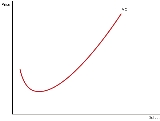
). Increasing returns to scale are said to exist if additional units can be produced for less than the previous unit, that is, average cost is falling. This can only occur if average cost at any given level of production is higher than the marginal cost. Conversely, there may be levels of production where marginal cost is higher than average cost, and average cost will rise for each unit of production after that point. This type of production function is generally known as diminishing marginal productivity: at low levels of production, productivity
Productivity

Productivity in economics refers to metrics and measures of output from production processes, per unit of input. Labor productivity, for example, is typically measured as a ratio of output per labor-hour, an input....
 gains are easy and marginal costs falling, but productivity gains become smaller as production increases; eventually, marginal costs rise because increasing output (with existing capital, labour or organization) becomes more expensive. For this generic case, minimum average cost occurs at the point where average cost and marginal cost are equal (when plotted, the two curves intersect); this point will not be at the minimum for marginal cost if fixed costs are greater than zero.


marginal cost


Short and long run costs and economies of scale

A textbook distinction is made between short-run and long-run marginal cost. The former takes as unchanged, for example, the capital equipment and overhead of the producer, any change in its production involving only changes in the inputs of labour, materials and energy. The latter allows all inputs, including capital items (plant, equipment, buildings) to vary.

A long-run cost function describes the cost of production as a function of output assuming that all inputs are obtained at current prices, that current technology is employed, and everything is being built new from scratch. In view of the durability of many capital items this textbook concept is less useful than one which allows for some scrapping of existing capital items or the acquisition of new capital items to be used with the existing stock of capital items acquired in the past. Long-run marginal cost then means the additional cost or the cost saving per unit of additional or reduced production, including the expenditure on additional capital goods or any saving from disposing of existing capital goods. Note that marginal cost upwards and marginal cost downwards may differ, in contrast with marginal cost according to the less useful textbook concept.

Economies of scale are said to exist when marginal cost according to the textbook concept falls as a function of output and is less than the average cost
Average cost

In economics, average cost is equal to total cost divided by the number of goods produced . It is also equal to the sum of average variable costs plus average fixed costs ....
 per unit. This means that the average cost of production from a larger new built-from-scratch installation falls below that from a smaller new built-from-scratch installation. Under the more useful concept, with an existing capital stock, it is necessary to distinguish those costs which vary with output from accounting costs which will also include the interest and depreciation on that existing capital stock, which may be of a different type from what can currently be acquired in past years at past prices. The concept of economies of scale then does not apply.

Externalities

Externalities are costs (or benefits) that are not borne by the parties to the economic transaction
Transaction

A transaction is an agreement, communication, or movement carried out between separate entities or objects, often involving the exchange of items of value, such as information, goods, services and money....
. A producer may, for example, pollute
Pollution

Pollution is the introduction of contaminants into an environment that causes instability, disorder, harm or discomfort to the ecosystem i.e. physical systems or living organisms ....
 the environment, and others may bear those costs. A consumer may consume a good which produces benefits for society, such as education; because the individual does not receive all of the benefits, he may consume less than efficiency would suggest. Alternatively, an individual may be a smoker or alcoholic and impose costs on others. In these cases, production or consumption of the good in question may differ from the optimum level.

Negative externalities of production

Much of the time, private and social costs do not diverge from one another, but at times social costs may be either greater or less than private costs. When marginal social costs of production are greater than that of the private cost function, we see the occurrence of a negative externality of production. Productive processes that result in pollution
Pollution

Pollution is the introduction of contaminants into an environment that causes instability, disorder, harm or discomfort to the ecosystem i.e. physical systems or living organisms ....
 are a textbook example of production that creates negative externalities.

Such externalities are a result of firms externalising their costs onto a third party in order to reduce their own total cost. As a result of externalising such costs we see that members of society will be negatively affected by such behaviour of the firm. In this case, we see that an increased cost of production on society creates a social cost curve that depicts a greater cost than the private cost curve.

In an equilibrium state we see that markets creating negative externalities of production will overproduce that good. As a result, the socially optimal production level would be lower than that observed.

Positive externalities of production

When marginal social costs of production are less than that of the private cost function, we see the occurrence of a positive externality of production. Production of public good
Public good

In economics, a public good is a Good that is rivalry ed and excludability. This means, respectively, that consumption of the good by one individual does not reduce availability of the good for consumption by others; and that no one can be effectively excluded from using the good....
s are a textbook example of production that create positive externalities. An example of such a public good, which creates a divergence in social and private costs, includes the production of education
Education

File:Inukshuk Monterrey 1.jpgEducation can be seen as a product or a process and considered in a broad sense or a technical sense. According to philosophy of education George F....
. It is often seen that education is a positive for any whole society, as well as a positive for those directly involved in the market.

Examining the relevant diagram we see that such production creates a social cost curve that is less than that of the private curve. In an equilibrium state we see that markets creating positive externalities of production will under produce that good. As a result, the socially optimal production level would be greater than that observed.

Social costs


Of great importance in the theory of marginal cost is the distinction between the marginal private and social costs. The marginal private cost shows the cost associated to the firm in question. It is the marginal private cost that is used by business decision makers in their profit maximization goals, and by individuals in their purchasing and consumption choices. Marginal social cost is similar to private cost in that it includes the cost functions of private enterprise but also that of society as a whole, including parties that have no direct association with the private costs of production. It incorporates all negative and positive externalities, of both production and consumption.

Hence, when deciding whether or how much to buy, buyers take account of the cost to society of their actions if private and social marginal cost coincide. The equality of price with social marginal cost, by aligning the interest of the buyer with the interest of the community as a whole is a necessary condition for economically efficient resource allocation.

Other cost definitions

  • Fixed cost
    Fixed cost

    In economics, fixed costs are business expenses that are not dependent on the activities of the business They tend to be time-related, such as salaries or rents being paid per month....
    s
    are costs which do not vary with output, for example, rent. In the long run all costs can be considered variable.
  • Variable cost
    Variable cost

    Variable costs are expenses that change in proportion to the activity of a business. In other words, variable cost is the sum of marginal costs....
     also known as, operating costs, prime costs, on costs and direct costs, are costs which vary directly with the level of output, for example, labour, fuel, power and cost of raw material.
  • Social costs of production
    Social cost

    In economics social cost is defined as the sum of private cost and externality costs. Economic theorists ascribe individual decision-making to a calculation costs and benefits....
     are costs incurred by society, as a whole, resulting from private production.
  • Average total cost is the total cost divided by the quantity of output.
  • Average fixed cost
    Average fixed cost

    Average fixed cost is an economics term used to describe the total fixed costs divided by the quantity of units produced.Average fixed cost is a per-unit measure of fixed costs....
     is the fixed cost divided by the quantity of output.
  • Average variable cost
    Average variable cost

    Average variable cost is an economics term to describe a firms variable costs divided by the quantity of total units of output.Where:* TVC = Total Variable Cost...
     are variable costs divided by the quantity of output.


See also

  • cost
    Cost

    In economics, business, retail, and accounting, a cost is the value of money that has been used up to produce something, and hence is not available for use anymore....
  • marginal concepts
    Marginal concepts

    In economics, marginal concepts are associated with a specific change in the quantity used of a Good or Service , as opposed to some notion of the over-all significance of that class of good or service, or of some total quantity thereof....
  • Marginal revenue
    Marginal revenue

    In microeconomics, Marginal Revenue is the extra revenue that an additional unit of product will bring. It is the additional income from selling one more unit of a good; sometimes equal to price....
  • Marginal product of labor
    Marginal product of labor

    In economics, the marginal product of labor also known as MPL or MPN is the change in output from hiring one additional unit of labor....
  • externality
    Externality

    In economics, an externality or spillover is a positive or negative impact on a party not directly involved in an economic transaction. In such a case, prices do not reflect the full costs or benefits in production or consumption of a product or service....
  • merit good
    Merit good

    A merit good in economics is a Good which is judged that an individual or society should have on the basis of a norm other than respecting consumer preferences....
    s
  • Cost-Volume-Profit Analysis
    Cost-Volume-Profit Analysis

    Cost-Volume-Profit Analysis , in managerial economics is a form of cost accounting. It is a simplified model, useful for elementary instruction and for short-run decisions....
  • Marginal costing decisions:
  1. Accepting an additional order
  2. Dropping a product
  3. Selecting production with limiting factor
    Limiting factor

    A limiting factor or limiting resource is a factor that controls a process, such as organism growth or species population, size, or distribution....
    s
  4. (In house) make or buy
    Outsourcing

    Outsourcing is subcontracting a process, such as product design or manufacturing, to a third-party company. The decision to outsource is often made in the interest of lowering firm or making better use of time and energy costs, redirecting or conserving energy directed at the core competence of a particular business, or to make more efficient...
    .
  • Differential costing
  • Break even analysis
    Break even analysis

    ----The breakeven for a product is the point where total revenue received equals the total costs associated with the sale of the product . A break-even point is typically calculated in order for businesses to determine if it would be profitable to sell a proposed product, as opposed to attempting to modify an existing product instead so it can be...