
All Topics  
Many-worlds interpretation


   Email Print
   Bookmark   Link


Many-worlds interpretation


The many-worlds interpretation is an interpretation of quantum mechanics
Interpretation of quantum mechanics

An interpretation of quantum mechanics is a statement which attempts to explain how quantum mechanics informs our understanding of nature. Although quantum mechanics has received thorough experimental testing, many of these experiments are open to different interpretations....
.

It is also known as MWI, the relative state formulation, theory of the universal wavefunction, parallel universes, many-universes interpretation or just many worlds.

Many-worlds denies the objective reality
Philosophical realism

Contemporary philosophical realism is the belief in a reality that is completely ontologically independent of our conceptual schemes, linguistic practices, beliefs, etc....
 of wavefunction collapse
Wavefunction collapse

In quantum mechanics, wave function collapse is the process by which a wave function, initially in a Quantum superposition of different eigenstates, appears to reduce to a single one of the states after interaction with the external world....
, instead explaining the subjective appearance
Phenomenalism

In epistemology and the philosophy of perception, phenomenalism is the view that physical objects do not exist as things in themselves but only as perceptual phenomena or sensory stimuli situated in time and in space....
 of wavefunction collapse
Wavefunction collapse

In quantum mechanics, wave function collapse is the process by which a wave function, initially in a Quantum superposition of different eigenstates, appears to reduce to a single one of the states after interaction with the external world....
 with the mechanism of quantum decoherence
Quantum decoherence

In quantum mechanics, quantum decoherence is the mechanism by which quantum systems interact with their environments to exhibit probabilistically additive behavior....
. Many-worlds claims to resolve all of the correlation paradoxes of quantum theory
Quantum mechanics

Quantum mechanics is a set of principles underlying the most fundamental known description of all physical systems at the microscopic scale . Notable amongst these principles are both a dual wave-like and particle-like behavior of matter and radiation, and prediction of probabilities in situations where classical physics predicts certaintie...
, such as the EPR paradox
EPR paradox

In quantum mechanics, the EPR paradox is a thought experiment which challenged long-held ideas about the relation between the observed values of physical quantities and the values that can be accounted for by a physical theory....
, since every possible
Probability

Probability, or wikt:chance, is a way of expressing knowledge or belief that an Event will occur or has occurred. In mathematics the concept has been given an exact meaning in probability theory, that is used extensively in such areas of study as mathematics, statistics, finance, gambling, science, and philosophy to draw conclusions about t...
 outcome to every event
Spacetime

In physics, spacetime is any mathematical model that combines space and Time in physics into a single continuum . Spacetime is usually interpreted with space being Three-dimensional space and time playing the role of a fourth dimension that is of a different sort than the spatial dimensions....
 defines or exists in its own "history" or "world." In layman's terms, this means that there is a very large, perhaps infinite, number of universes and that everything that could possibly happen, or could possibly have happened, in our universe (but doesn't) does happen in some other universe(s).

Proponents argue that MWI reconciles how we can perceive non-deterministic
Determinism

Determinism is the philosophy proposition that every event, including human cognition and behavior, decision and action, is causality determined by an unbroken chain of prior occurrences. With numerous historical debates, many varieties and philosophical positions on the subject of determinism exist from traditions throughout...
 events (such as the random decay of a radioactive
Radioactive decay

Radioactive decay is the process in which an unstable atomic nucleus loses energy by emitting ionizing particles and radiation. This decay, or loss of energy, results in an atom of one type, called the parent nuclide transforming to an atom of a different type, called the daughter nuclide....
 atom
Atom

|-! bgcolor=gray | Properties|-||}The atom is a basic unit of matter consisting of a dense, central atomic nucleus surrounded by a electron cloud of electric charge electrons....
) with the deterministic equations of quantum physics.


Discussion
Ask a question about 'Many-worlds interpretation'
Start a new discussion about 'Many-worlds interpretation'
Answer questions from other users
Full Discussion Forum


Encyclopedia


The many-worlds interpretation is an interpretation of quantum mechanics
Interpretation of quantum mechanics

An interpretation of quantum mechanics is a statement which attempts to explain how quantum mechanics informs our understanding of nature. Although quantum mechanics has received thorough experimental testing, many of these experiments are open to different interpretations....
.

It is also known as MWI, the relative state formulation, theory of the universal wavefunction, parallel universes, many-universes interpretation or just many worlds.

Many-worlds denies the objective reality
Philosophical realism

Contemporary philosophical realism is the belief in a reality that is completely ontologically independent of our conceptual schemes, linguistic practices, beliefs, etc....
 of wavefunction collapse
Wavefunction collapse

In quantum mechanics, wave function collapse is the process by which a wave function, initially in a Quantum superposition of different eigenstates, appears to reduce to a single one of the states after interaction with the external world....
, instead explaining the subjective appearance
Phenomenalism

In epistemology and the philosophy of perception, phenomenalism is the view that physical objects do not exist as things in themselves but only as perceptual phenomena or sensory stimuli situated in time and in space....
 of wavefunction collapse
Wavefunction collapse

In quantum mechanics, wave function collapse is the process by which a wave function, initially in a Quantum superposition of different eigenstates, appears to reduce to a single one of the states after interaction with the external world....
 with the mechanism of quantum decoherence
Quantum decoherence

In quantum mechanics, quantum decoherence is the mechanism by which quantum systems interact with their environments to exhibit probabilistically additive behavior....
. Many-worlds claims to resolve all of the correlation paradoxes of quantum theory
Quantum mechanics

Quantum mechanics is a set of principles underlying the most fundamental known description of all physical systems at the microscopic scale . Notable amongst these principles are both a dual wave-like and particle-like behavior of matter and radiation, and prediction of probabilities in situations where classical physics predicts certaintie...
, such as the EPR paradox
EPR paradox

In quantum mechanics, the EPR paradox is a thought experiment which challenged long-held ideas about the relation between the observed values of physical quantities and the values that can be accounted for by a physical theory....
, since every possible
Probability

Probability, or wikt:chance, is a way of expressing knowledge or belief that an Event will occur or has occurred. In mathematics the concept has been given an exact meaning in probability theory, that is used extensively in such areas of study as mathematics, statistics, finance, gambling, science, and philosophy to draw conclusions about t...
 outcome to every event
Spacetime

In physics, spacetime is any mathematical model that combines space and Time in physics into a single continuum . Spacetime is usually interpreted with space being Three-dimensional space and time playing the role of a fourth dimension that is of a different sort than the spatial dimensions....
 defines or exists in its own "history" or "world." In layman's terms, this means that there is a very large, perhaps infinite, number of universes and that everything that could possibly happen, or could possibly have happened, in our universe (but doesn't) does happen in some other universe(s).

Proponents argue that MWI reconciles how we can perceive non-deterministic
Determinism

Determinism is the philosophy proposition that every event, including human cognition and behavior, decision and action, is causality determined by an unbroken chain of prior occurrences. With numerous historical debates, many varieties and philosophical positions on the subject of determinism exist from traditions throughout...
 events (such as the random decay of a radioactive
Radioactive decay

Radioactive decay is the process in which an unstable atomic nucleus loses energy by emitting ionizing particles and radiation. This decay, or loss of energy, results in an atom of one type, called the parent nuclide transforming to an atom of a different type, called the daughter nuclide....
 atom
Atom

|-! bgcolor=gray | Properties|-||}The atom is a basic unit of matter consisting of a dense, central atomic nucleus surrounded by a electron cloud of electric charge electrons....
) with the deterministic equations of quantum physics. Prior to many worlds this had been viewed as a single "world-line". Many-worlds rather views it as a many-branched tree where every possible quantum event is realised.

The relative state formulation is due to Hugh Everett
Hugh Everett

Hugh Everett III was an American physicist who first proposed the many-worlds interpretation of quantum physics, which he called his "relative state" formulation....
 who formulated it in 1957. Later, this formulation was popularized and renamed many worlds by Bryce Seligman DeWitt in the 1960s and '70s. The decoherence approach to interpreting quantum theory has been further explored and developed becoming quite popular, taken as a class overall. MWI is one of many Multiverse
Multiverse

The multiverse is the hypothetical set of multiple possible universes that together comprise all of reality.Multiverse may also refer to:...
 hypotheses in physics
Physics

Physics is the natural science which examines basic concepts such as energy, force, and spacetime and all that derives from these, such as mass, charge, matter and its Motion ....
 and philosophy
Philosophy

Philosophy is the study of general problems concerning matters such as existence, knowledge, truth, beauty, justice, validity, mind, and language....
. It is currently considered a mainstream interpretation along with the other decoherence interpretations and the Copenhagen interpretation
Copenhagen interpretation

The Copenhagen interpretation is an Interpretations of quantum mechanics of quantum mechanics. A key feature of quantum mechanics is that the state of every Elementary particle is described by a wavefunction, which is a mathematical representation used to calculate the probability for it to be found in a location, or state of motion....
.

The many worlds interpretation has, controversially, been seen by some as offering the possibility of deriving the Born rule
Born rule

The Born rule is a Physical law of quantum mechanics which gives the probability that a measurement on a quantum system will yield a given result....
 and the appearance of quantum probabilities from simpler assumptions. In fact, this was first attempted by Everett and DeWitt in the 1950s. In a September 2007 conference David Wallace reported on what is claimed to be a proof by Deutsch
David Deutsch

David Elieser Deutsch Fellow of the Royal Society#Fellowship is a physicist at the University of Oxford. He is a non-stipendiary Visiting Professor in the Department of Atomic and Laser Physics at the Centre for Quantum Computation, Clarendon Laboratory....
 and himself of the Born Rule
Born rule

The Born rule is a Physical law of quantum mechanics which gives the probability that a measurement on a quantum system will yield a given result....
 starting from Everettian
Hugh Everett

Hugh Everett III was an American physicist who first proposed the many-worlds interpretation of quantum physics, which he called his "relative state" formulation....
 assumptions. The status of these arguments remains highly controversial, but it is fair to say that some theoretical physicists have taken them as supporting the case for parallel universes.

Outline


Although several versions of MWI have been proposed since Hugh Everett
Hugh Everett

Hugh Everett III was an American physicist who first proposed the many-worlds interpretation of quantum physics, which he called his "relative state" formulation....
's original work, they all contain one key idea: the equations of physics that model the time evolution of systems without embedded observers are sufficient for modelling systems which do contain observers; in particular there is no observation-triggered wavefunction collapse
Wavefunction collapse

In quantum mechanics, wave function collapse is the process by which a wave function, initially in a Quantum superposition of different eigenstates, appears to reduce to a single one of the states after interaction with the external world....
 which the Copenhagen interpretation
Copenhagen interpretation

The Copenhagen interpretation is an Interpretations of quantum mechanics of quantum mechanics. A key feature of quantum mechanics is that the state of every Elementary particle is described by a wavefunction, which is a mathematical representation used to calculate the probability for it to be found in a location, or state of motion....
 proposes. Provided the theory is linear
Linear

The word linear comes from the Latin word linearis, which means created by lines.In mathematics, a linear map or function f is a function which satisfies the following two properties......
 with respect to the wavefunction, the exact form of the quantum
Quantum

In physics, a quantum is an indivisible entity of a quantity that has the same units as the Planck constant and is related to both energy and momentum of elementary particles of matter and of photons and other bosons....
 dynamics modelled, be it the non-relativistic Schrödinger equation
Schrödinger equation

In physics, especially quantum mechanics, the Schr?dinger equation is an equation that describes how the quantum state of a physical system changes in time....
, relativistic quantum field theory or some form of quantum gravity
Quantum gravity

Quantum gravity is the field of theoretical physics attempting to unify quantum mechanics, which describes three of the Fundamental interaction , with general relativity, the theory of the fourth fundamental force: Gravitation....
 or string theory
String theory

String theory is a developing branch of theoretical physics that combines quantum mechanics and general relativity into a quantum gravity. The String s of string theory are one-dimensional oscillating lines, but they are no longer considered fundamental to the theory, which can be formulated in terms of points or surfaces too....
, does not alter the validity of MWI since MWI is a metatheory
Metatheory

A metatheory or meta-theory is a theory which concerns itself with another theory or theories. As such its generalization may be called a theory of theories....
 applicable to all linear quantum theories
Quantum theory

Quantum theory may mean:In science:* Old quantum theory under the Bohr model* Quantum mechanics, an umbrella term sometimes for all of quantum physics, but sometimes for just non-relativistic theories...
, and there is no experimental evidence for any non-linearity of the wavefunction in physics. MWI's main conclusion is that the universe (or multiverse
Multiverse

The multiverse is the hypothetical set of multiple possible universes that together comprise all of reality.Multiverse may also refer to:...
 in this context) is composed of a quantum superposition
Quantum superposition

Quantum superposition is the fundamental law of quantum mechanics. It defines the allowed state space of a quantum mechanical system.In Probability theory, every possible event has a non-negative real number between zero and one associated to it, the probability, which gives the chance that it happens....
 of very many, possibly infinitely many, increasingly divergent, non-communicating parallel universes or quantum worlds.

The idea of MWI originated in Everett's Princeton
Princeton University

Princeton University is a private university university located in Princeton, New Jersey, New Jersey, United States. The school is one of the eight universities of the Ivy League and has the largest per-student Financial endowment in the world....
 Ph.D.
Doctor of Philosophy

Doctor of Philosophy, abbreviated Ph.D. or PhD for the Latin , meaning "teacher of philosophy", is an postgraduate academic degree awarded by University....
 thesis "The Theory of the Universal Wavefunction", developed under his thesis advisor John Archibald Wheeler
John Archibald Wheeler

John Archibald Wheeler was an eminent United States theoretical physicist. One of the later collaborators of Albert Einstein, he tried to achieve Einstein's vision of a unified field theory....
, a shorter summary of which was published in 1957 entitled "Relative State Formulation of Quantum Mechanics" (Wheeler contributed the title "relative state"; Everett originally called his approach the "Correlation Interpretation", although in Everett's usage the term correlation is what is now called quantum entanglement
Quantum entanglement

Quantum entanglement is a possible property of a quantum state of a system of two or more Physical bodys in which the quantum states of the constituting objects are linked together so that one object can no longer be adequately described without full mention of its counterpart ? even though the individual objects may be nonlocality....
). The phrase "many worlds" is due to Bryce DeWitt
Bryce DeWitt

Bryce Seligman DeWitt was a theoretical physicist renown for advancing gravity and field theories. He systematically approached the quantization of general relativity, in particular, developed canonical quantum gravity and manifestly covariant methods that use the heat kernel....
, who was responsible for the wider popularisation of Everett's theory, which had been largely ignored for the first decade after publication. DeWitt's phrase "many-worlds" has become so much more popular than Everett's "Universal Wavefunction" or Everett-Wheeler's "Relative State Formulation" that many forget that this is only a difference of terminology; the content of all three papers is the same.

The many-worlds interpretation shares many similarities with later, other "post-Everett" interpretations of quantum mechanics which also use decoherence to explain the process of measurement or wavefunction collapse. MWI treats the other histories or worlds as real since it regards the universal wavefunction
Universal wavefunction

The Universal Wavefunction or Universal Wave Function is a term introduced by Hugh Everett in his Princeton PhD Thesis, entitled The Theory of the Universal Wave Function and forms a core concept in the relative state or many-worlds interpretation of quantum mechanics....
 as the "basic physical entity" or "the fundamental entity, obeying at all times a deterministic wave equation". The other decoherent interpretations, such as many histories
Many histories

Many histories may refer to:* The many worlds interpretation of quantum theory* The consistent histories interpretation of quantum theory* The sum over histories or path integral formulation of quantum theory...
, consistent histories
Consistent histories

In quantum mechanics, the consistent histories approach is intended to give a modern interpretation of quantum mechanics, generalising the conventional Copenhagen interpretation and providing a natural interpretation of quantum cosmology....
, the Existential Interpretation etc, either regard the extra quantum worlds as metaphorical in some sense, or are agnostic
Agnosticism

Agnosticism is the philosophy view that the logical value of certain claims ? particularly metaphysics claims regarding theology, afterlife or the existence of deity, ghosts, or even ultimate reality ? is unknown or, depending on the form of agnosticism, inherently impossible to prove or disprove....
 about their reality; it is sometimes hard to distinguish between the different varieties. MWI is distinguished by two qualities: it assumes realism
Philosophical realism

Contemporary philosophical realism is the belief in a reality that is completely ontologically independent of our conceptual schemes, linguistic practices, beliefs, etc....
, which it assigns to the wavefunction, and it has the minimal formal structure possible, rejecting any hidden variables
Hidden variables

Hidden variables may refer to:* In physics, Hidden variable theories are a class of theories trying to explain away the statistical nature of quantum mechanics....
, quantum potential, any form of a collapse postulate (i.e. Copenhagenism
Copenhagen interpretation

The Copenhagen interpretation is an Interpretations of quantum mechanics of quantum mechanics. A key feature of quantum mechanics is that the state of every Elementary particle is described by a wavefunction, which is a mathematical representation used to calculate the probability for it to be found in a location, or state of motion....
) or mental postulates (such as the many-minds interpretation
Many-minds interpretation

The many-minds interpretation of quantum mechanics extends the many-worlds interpretation by proposing that the distinction between worlds should be made at the level of the mind of an individual observer....
 makes).

Many worlds is often referred to as a theory
Theory

For a more detailed account of theories as expressed in formal language as they are studied in mathematical logic see Theory A theory, in the general sense of the word, is an analytic structure designed to explain a set of observations....
, rather than just an interpretation, by those who propose that many worlds can make testable predictions (such as David Deutsch
David Deutsch

David Elieser Deutsch Fellow of the Royal Society#Fellowship is a physicist at the University of Oxford. He is a non-stipendiary Visiting Professor in the Department of Atomic and Laser Physics at the Centre for Quantum Computation, Clarendon Laboratory....
) or is falsifiable (such as Everett) or that all the other, non-MWI, are inconsistent, illogical or unscientific in their handling of measurements; Hugh Everett
Hugh Everett

Hugh Everett III was an American physicist who first proposed the many-worlds interpretation of quantum physics, which he called his "relative state" formulation....
 argued that his formulation was a metatheory
Metatheory

A metatheory or meta-theory is a theory which concerns itself with another theory or theories. As such its generalization may be called a theory of theories....
, since it made statements about other interpretations of quantum theory; that it was the "only completely coherent approach to explaining both the contents of quantum mechanics and the appearance of the world".

Wavefunction collapse and the problem of interpretation


As with the other interpretations of quantum mechanics, the many-worlds interpretation is motivated by behavior that can be illustrated by the double-slit experiment
Double-slit experiment

The double-slit experiment in quantum mechanics is an experiment that demonstrates the inseparability of the wave and Elementary particle natures of light and other quantum particles....
. When particles of light
Photon

In physics, the photon is an elementary particle, the quantum of the electromagnetic field and the basic unit of light and all other forms of electromagnetic radiation....
 (or anything else) are passed through the double slit, a calculation assuming wave-like behavior of light is needed to identify where the particles are likely to be observed. Yet when the particles are observed in this experiment, they appear as particles (i.e. at definite places) and not as non-localized waves.

The Copenhagen interpretation
Copenhagen interpretation

The Copenhagen interpretation is an Interpretations of quantum mechanics of quantum mechanics. A key feature of quantum mechanics is that the state of every Elementary particle is described by a wavefunction, which is a mathematical representation used to calculate the probability for it to be found in a location, or state of motion....
 of quantum mechanics proposed a process of "collapse
Wavefunction collapse

In quantum mechanics, wave function collapse is the process by which a wave function, initially in a Quantum superposition of different eigenstates, appears to reduce to a single one of the states after interaction with the external world....
" in which an indeterminate quantum system would probabilistically collapse down onto, or select, just one determinate outcome to "explain" this phenomenon of observation. Wavefunction collapse was widely regarded as artificial and ad-hoc, so an alternative interpretation in which the behavior of measurement could be understood from more fundamental physical principles was considered desirable.

Everett's Ph.D. work provided such an alternative interpretation. Everett noted that for a composite system (for example that formed by a particle interacting with a measuring apparatus, or more generally by a subject (the "observer") observing an object (the "observed" system) the statement that a subsystem (i.e. the observer or the observed) has a well-defined state is meaningless -- in modern parlance the subsystem states have become entangled
Quantum entanglement

Quantum entanglement is a possible property of a quantum state of a system of two or more Physical bodys in which the quantum states of the constituting objects are linked together so that one object can no longer be adequately described without full mention of its counterpart ? even though the individual objects may be nonlocality....
 -- we can only specify the state of one subsystem relative to the state of the other subsystem, i.e. the state of the observer and the observed are correlated. This led Everett to derive from the unitary, deterministic dynamics alone (i.e. without assuming wavefunction collapse) the notion of a relativity of states of one subsystem relative to another.

Everett noticed that the unitary, deterministic dynamics alone decreed that after an observation is made each element of the quantum superposition
Quantum superposition

Quantum superposition is the fundamental law of quantum mechanics. It defines the allowed state space of a quantum mechanical system.In Probability theory, every possible event has a non-negative real number between zero and one associated to it, the probability, which gives the chance that it happens....
 of the combined subject-object wavefunction contains two relative states: a "collapsed" object state and an associated observer who has observed the same collapsed outcome; what the observer sees and the state of the object are correlated. The subsequent evolution of each pair of relative subject-object states proceeds with complete indifference as to the presence or absence of the other elements, as if wavefunction collapse has occurred, which has the consequence that later observations are always consistent with the earlier observations. Thus the appearance of the object's wavefunction's collapse has emerged from the unitary, deterministic theory itself. (This answered Einstein's early criticism of quantum theory, that the theory should define what is observed, not for the observables to define the theory .)

Since Everett stopped doing research in theoretical physics shortly after obtaining his Ph.D., much of the elaboration of his ideas was carried out by other researchers and forms the basis of much of the decoherent
Quantum decoherence

In quantum mechanics, quantum decoherence is the mechanism by which quantum systems interact with their environments to exhibit probabilistically additive behavior....
 approach to quantum measurement.

Advantages


  • MWI removes the observer-dependent role in the quantum measurement process by replacing wavefunction collapse
    Wavefunction collapse

    In quantum mechanics, wave function collapse is the process by which a wave function, initially in a Quantum superposition of different eigenstates, appears to reduce to a single one of the states after interaction with the external world....
     with quantum decoherence
    Quantum decoherence

    In quantum mechanics, quantum decoherence is the mechanism by which quantum systems interact with their environments to exhibit probabilistically additive behavior....
    . Since the role of the observer lies at the heart of most if not all "quantum paradoxes," this automatically resolves a number of problems; see for example Schrödinger's cat
    Schrödinger's cat

    Schr?dinger's cat is a thought experiment, often described as a paradox, devised by Austrian physicist Erwin Schr?dinger in 1935. It illustrates what he saw as the problem of the Copenhagen interpretation of quantum mechanics being applied to everyday objects....
     thought-experiment, the EPR paradox
    EPR paradox

    In quantum mechanics, the EPR paradox is a thought experiment which challenged long-held ideas about the relation between the observed values of physical quantities and the values that can be accounted for by a physical theory....
    , von Neumann
    John von Neumann

    John von Neumann was a Hungarian American mathematician who made major contributions to a vast range of fields, including set theory, functional analysis, quantum mechanics, ergodic theory, continuous geometry, economics and game theory, computer science, numerical analysis, hydrodynamics , and statistics, as well as many other mathematical...
    's "boundary problem" and even wave-particle duality. Quantum cosmology
    Quantum cosmology

    In theoretical physics, quantum physical cosmology is a field attempting to study the effect of quantum mechanics on the creation of the universe, or its early evolution, especially just after the Big Bang....
     also becomes intelligible, since there is no need anymore for an observer outside of the universe.
  • MWI allows quantum mechanics to become a realist
    Philosophical realism

    Contemporary philosophical realism is the belief in a reality that is completely ontologically independent of our conceptual schemes, linguistic practices, beliefs, etc....
    , deterministic, local theory making it more akin to classical physics
    Classical physics

    Classical physics is a general term used to describe the branches of physics based on principles developed before the rise of general theory of relativity and Quantum mechanics, usually including special theory of relativity....
     (including the theory of relativity
    Theory of relativity

    File:spacetime curvature.pngThe theory of relativity, or simply relativity, generally refers specifically to two theories of Albert Einstein: special relativity and general relativity....
    ), at the expense of losing counterfactual definiteness
    Counterfactual definiteness

    In some interpretations of quantum mechanics, Counterfactual definiteness is the ability to speak meaningfully about the definiteness of the results of measurements, even if they were not performed....
    .


  • MWI (or other, broader multiverse
    Multiverse (science)

    The multiverse is the hypothetical set of multiple possible universes that together comprise all of reality. The different universes within the multiverse are sometimes called parallel universes....
     considerations) provides a context for the anthropic principle
    Anthropic principle

    In physics and cosmology, the anthropic principle is the collective name for several ways of asserting that physical and chemistry theories, especially astrophysics and cosmology, need to take into account that there is life on Earth, and that one form of that life, Homo sapiens, has attained sapience....
     which may provide an explanation for the fine-tuned universe
    Fine-tuned universe

    The fine-tuned Universe is the idea that the conditions that allow life in the Universe can only occur when certain universal physical constants lie within a very narrow range, so that if any of several fundamental constants were only slightly different the universe would be unlikely to be conducive to the establishment and development of mat...
    .
  • MWI, being a decoherent
    Quantum decoherence

    In quantum mechanics, quantum decoherence is the mechanism by which quantum systems interact with their environments to exhibit probabilistically additive behavior....
     formulation, is axiomatically more streamlined than the Copenhagen
    Copenhagen interpretation

    The Copenhagen interpretation is an Interpretations of quantum mechanics of quantum mechanics. A key feature of quantum mechanics is that the state of every Elementary particle is described by a wavefunction, which is a mathematical representation used to calculate the probability for it to be found in a location, or state of motion....
     and other collapse
    Wavefunction collapse

    In quantum mechanics, wave function collapse is the process by which a wave function, initially in a Quantum superposition of different eigenstates, appears to reduce to a single one of the states after interaction with the external world....
     interpretations; and thus favoured under certain interpretations of Ockham's razor. Of course there are other decoherent interpretations that also possess this advantage with respect to the collapse interpretations.


Objections


  • The many worlds interpretation is very vague about the ways to determine when splitting happens, and nowadays usually the criterion is that the two branches have decohered
    Quantum decoherence

    In quantum mechanics, quantum decoherence is the mechanism by which quantum systems interact with their environments to exhibit probabilistically additive behavior....
    . However, present day understanding of decoherence does not allow a completely precise, self contained way to say when the two branches have decohered/"do not interact", and hence many worlds interpretation remains arbitrary. This is the main objection opponents of this interpretation raise, saying that it is not clear what is precisely meant by branching, and point to lack of self contained criterion specifying branching to be described.
MWI response: the decoherence or "splitting" or "branching" is complete when the measurement is complete. In Dirac notation
Bra-ket notation

Bra-ket notation is a standard notation for describing quantum states in the theory of quantum mechanics composed of bracket and vertical bars....
 a measurement is complete when:
where O[i] represents the observer having detected the object system in the i-th state. Before the measurement has started the observer states are identical; after the measurement is complete the observer states are orthonormal
Orthonormality

In linear algebra, two vector space in an inner product space are orthonormal if they are orthogonality and both of Unit vector length. A set of vectors form an orthonormal set if all vectors in the set are mutually orthogonal and all of unit length....
. Thus a measurement defines the branching process: the branching is as well- or ill- defined as the measurement is. Thus branching is complete when the measurement is complete. Since the role of the observer and measurement per se plays no special role in MWI (measurements are handled as all other interactions are) there is no need for a precise definition of what an observer or a measurement is -- just as in Newtonian physics
Classical mechanics

Classical mechanics is used for describing the motion of macroscopic objects, from projectiles to parts of machinery, as well as astronomical objects, such as spacecraft, planets, stars, and galaxies....
 no precise definition of either an observer or a measurement was required or expected. In all circumstances the universal wavefunction
Universal wavefunction

The Universal Wavefunction or Universal Wave Function is a term introduced by Hugh Everett in his Princeton PhD Thesis, entitled The Theory of the Universal Wave Function and forms a core concept in the relative state or many-worlds interpretation of quantum mechanics....
 is still available to give a complete description of reality. Objections response: the MWI response states no special role nor need for precise definition of measurement in MWI, yet uses the word "measurement" in part of its main argument. MWI response: "measurements" are treated a subclass of interactions, which induce subject-object correlations in the combined wavefunction. There is nothing special about measurements (they don't trigger any wave function collapse, for example); they are just another unitary
Unitarity (physics)

In quantum physics, unitarity means that the sum of probabilities of all possible outcome of any event is always 1. This is necessary for the theory to be consistent....
 time development process. Also, it is a common misconception to think that branches are completely separate. In Everett's formulation, they may in principle quantum interfere with each other in the future, although this requires all "memory" of the earlier branching event to be lost, so no observer ever sees another branch of reality. Fundamentally, any arguments based on the definition of "branching" or "decoherence" are simply based on a misunderstanding of MWI.

  • There is circularity in Everett's measurement theory. Under the assumptions made by Everett, there are no 'good observations' as defined by him, and since his analysis of the observational process depends on the latter, it is void of any meaning. The concept of a 'good observation' is the projection postulate in disguise and Everett's analysis simply derives this postulate by having assumed it, without any discussion. Talk of probability in Everett presumes the existence of a preferred basis to identify measurement outcomes for the probabilities to range over. But the existence of a preferred basis can only be established by the process of decoherence, which is itself probabilistic.
MWI response: Everett's treatment of observations / measurements covers both idealised good measurements and the more general bad or approximate cases. Thus it is legitimate to analyse probability in terms of measurement; no circularity is present.

  • We cannot be sure that the universe is a quantum multiverse until we have a theory of everything
    Theory of everything

    The theory of everything is a putative theory of theoretical physics that fully explains and links together all known physical phenomena. Initially, the term was used with an ironic connotation to refer to various overgeneralized theories....
     and, in particular, a successful theory of quantum gravity
    Quantum gravity

    Quantum gravity is the field of theoretical physics attempting to unify quantum mechanics, which describes three of the Fundamental interaction , with general relativity, the theory of the fourth fundamental force: Gravitation....
    . If the final theory of everything is non-linear
    Linear

    The word linear comes from the Latin word linearis, which means created by lines.In mathematics, a linear map or function f is a function which satisfies the following two properties......
     with respect to wavefunctions then many-worlds would be invalid.


MWI response: all accepted quantum theories
Quantum theory

Quantum theory may mean:In science:* Old quantum theory under the Bohr model* Quantum mechanics, an umbrella term sometimes for all of quantum physics, but sometimes for just non-relativistic theories...
 of fundamental physics are linear with respect to the wavefunction. Whilst quantum gravity or string theory
String theory

String theory is a developing branch of theoretical physics that combines quantum mechanics and general relativity into a quantum gravity. The String s of string theory are one-dimensional oscillating lines, but they are no longer considered fundamental to the theory, which can be formulated in terms of points or surfaces too....
 may be non-linear in this respect there is no evidence to indicate this at the moment.

  • Conservation of energy: Conservation of energy
    Conservation of energy

    The law of conservation of energy states that the total amount of energy in an isolated system remains constant. A consequence of this law is that energy cannot be created or destroyed....
     is grossly violated if every instant infinite amounts of new matter are generated.


MWI response: Conservation of energy is not violated since the energy of each branch has to be weighted by its probability, according to the standard formula for the conservation of energy in quantum theory. This results in the total energy of the multiverse being conserved.

  • Occam's Razor
    Occam's razor

    Occam's razor, also Ockham's razor, is a principle attributed to the 14th-century English logician and Franciscan friar, William of Ockham....
     rules against a plethora of unobservable universes - Occam would prefer the one universe Copenhagen Interpretation
    Copenhagen interpretation

    The Copenhagen interpretation is an Interpretations of quantum mechanics of quantum mechanics. A key feature of quantum mechanics is that the state of every Elementary particle is described by a wavefunction, which is a mathematical representation used to calculate the probability for it to be found in a location, or state of motion....
    .
MWI response: Occam's razor actually is a constraint on the complexity of physical theory, not on the number of universes. MWI is a simpler theory since it has fewer postulates. See the "advantages" section.

  • Unphysical universes: If a state is a superposition of two states Psi(A) and Psi(B), i.e. Psi = (a.Psi(A) + b.Psi(B)), i.e. weighted by coefficients a and b, then if b << a, what principle allows a universe with vanishingly small probability b to be instantiated on an equal footing with the much more probable one with probability a? This seems to throw away the information in the probability amplitudes. Such a theory makes little sense.


MWI response: The magnitude of the coefficients provides the weighting that makes the branches or universes "unequal", as Everett and others have shown, leading the emergence of the conventional probabilistic rules
Born rule

The Born rule is a Physical law of quantum mechanics which gives the probability that a measurement on a quantum system will yield a given result....
.

  • Violation of Relativity: MWI splitting is instant and total: this may conflict with relativity, as an alien in the Andromeda galaxy can't know I collapse an electron over here before she collapses hers there: the relativity of simultaneity
    Simultaneity

    Simultaneity is the properties of two Spacetime#Basic conceptss happening at the same time in at least one reference frame.The noun Simult means a supernatural coincidence, two or more divinely inspired events that occur at or near the same period of time that are related to each other in both noticeable and unnoticeable characteristi...
     says we can't say which electron collapsed first - so which one spilts off another universe first? This leads to a hopeless muddle with everyone splitting differently. Note: EPR
    EPR

    EPR may refer to:In organizations:*Ej?rcito Popular Republicano, the volunteer armed forces of the Second Spanish Republic during the Spanish Civil War...
     is not a get-out here, as the alien's and my electrons need never have been part of the same quantum, i.e. entangled.


MWI response: the splitting can be regarded and causal and relativistic, spreading at, or below, the speed of light (e.g. we are not split by Schrödinger's cat
Schrödinger's cat

Schr?dinger's cat is a thought experiment, often described as a paradox, devised by Austrian physicist Erwin Schr?dinger in 1935. It illustrates what he saw as the problem of the Copenhagen interpretation of quantum mechanics being applied to everyday objects....
 until we look in the box).

Brief overview


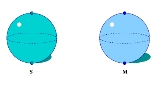
In Everett's formulation, a measuring apparatus M and an object system S form a composite system, each of which prior to measurement exists in well-defined (but time-dependent) states. Measurement is regarded as causing M and S to interact. After S interacts with M, it is no longer possible to describe either system by an independent state. According to Everett, the only meaningful descriptions of each system are relative states: for example the relative state of S given the state of M or the relative state of M given the state of S.
Many Worlds Bloch
In DeWitt's formulation, the state of S after a sequence of measurements is given by a quantum superposition of states, each one corresponding to an alternative measurement history of S.

For example, consider the smallest possible truly quantum system S, as shown in the illustration. This describes for instance, the spin-state of an electron. Considering a specific axis (say the z-axis) the north pole represents spin "up" and the south pole, spin "down". The superposition states of the system are described by (the surface of) a sphere called the Bloch sphere
Bloch sphere

In quantum mechanics, the Bloch sphere is a geometrical representation of the pure state space of a two-level system named after the physicist Felix Bloch....
. To perform a measurement on S, it is made to interact with another similar system M. After the interaction, the combined system is described by a state that ranges over a six-dimensional space (the reason for the number six is explained in the article on the Bloch sphere). This six-dimensional object can also be regarded as a quantum superposition of two "alternative histories" of the original system S, one in which "up" was observed and the other in which "down" was observed. Each subsequent binary measurement (that is interaction with a system M) causes a similar split in the history tree. Thus after three measurements, the system can be regarded as a quantum superposition of 8= 2 × 2 × 2 copies of the original system S.

The accepted terminology is somewhat misleading because it is incorrect to regard the universe as splitting at certain times; at any given instant there is one state in one universe.
Splittings 1

Relative state


The goal of the relative-state formalism, as originally proposed by Everett in his 1957 doctoral dissertation, was to interpret the effect of external observation entirely within the mathematical framework developed by Paul Dirac
Paul Dirac

Paul Adrien Maurice Dirac, Order of Merit , Royal Society was a United Kingdom theoretical physicist. Dirac made fundamental contributions to the early development of both quantum mechanics and quantum electrodynamics....
, von Neumann and others, discarding altogether the ad-hoc mechanism of wave function collapse. Since Everett's original work, there have appeared a number of similar formalisms in the literature. One such idea is discussed in the next section.

The relative-state interpretation makes two assumptions. The first is that the wavefunction is not simply a description of the object's state, but that it actually is entirely equivalent to the object, a claim it has in common with some other interpretations. The second is that observation or measurement has no special role, unlike in the Copenhagen interpretation
Copenhagen interpretation

The Copenhagen interpretation is an Interpretations of quantum mechanics of quantum mechanics. A key feature of quantum mechanics is that the state of every Elementary particle is described by a wavefunction, which is a mathematical representation used to calculate the probability for it to be found in a location, or state of motion....
 which considers the wavefunction collapse as a special kind of event which occurs as a result of observation.

The many-worlds interpretation is DeWitt's popularisation of Everett's work, who had referred to the combined observer-object system as being split by an observation, each split corresponding to the different or multiple possible outcomes of an observation. These splits generate a possible tree as shown in the graphic below. Subsequently DeWitt introduced the term "world" to describe a complete measurement history of an observer, which corresponds roughly to a single branch of that tree. Note that "splitting" in this sense, is hardly new or even quantum mechanical. The idea of a space of complete alternative histories had already been used in the theory of probability since the mid 1930s for instance to model Brownian motion
Brownian motion

Brownian motion is the seemingly random movement of particles suspended in a liquid or gas or the mathematical model used to describe such random movements, often called a particle theory....
. Under the many-worlds interpretation, the Schrödinger equation
Schrödinger equation

In physics, especially quantum mechanics, the Schr?dinger equation is an equation that describes how the quantum state of a physical system changes in time....
, or relativistic analog, holds all the time everywhere. An observation or measurement of an object by an observer is modeled by applying the wave equation to the entire system comprising the observer and the object. One consequence is that every observation can be thought of as causing the combined observer-object's wavefunction to change into a quantum superposition of two or more non-interacting branches, or split into many "worlds". Since many observation-like events have happened, and are constantly happening, there are an enormous and growing number of simultaneously existing states.

If a system is composed of two or more subsystems, the system's state will be a superposition of products of the subsystems' states. Once the subsystems interact, their states are no longer independent. Each product of subsystem states in the overall superposition evolves over time independently of other products. The subsystems states have become correlated or entangled
Quantum entanglement

Quantum entanglement is a possible property of a quantum state of a system of two or more Physical bodys in which the quantum states of the constituting objects are linked together so that one object can no longer be adequately described without full mention of its counterpart ? even though the individual objects may be nonlocality....
 and it is no longer possible to consider them independent of one another. In Everett's terminology each subsystem state was now correlated with its relative state, since each subsystem must now be considered relative to the other subsystems with which it has interacted.

Comparative properties and experimental support


One of the salient properties of the many-worlds interpretation is that observation does not require an exceptional construct (such as wave function collapse) to explain it. Many physicists, however, dislike the implication that there are infinitely many non-observable alternate universes.

, there are no practical experiments that distinguish between Many-Worlds and Copenhagen. There may be cosmological, observational evidence.

Copenhagen interpretation


In the Copenhagen interpretation, the mathematics of quantum mechanics allows one to predict probabilities
Probability

Probability, or wikt:chance, is a way of expressing knowledge or belief that an Event will occur or has occurred. In mathematics the concept has been given an exact meaning in probability theory, that is used extensively in such areas of study as mathematics, statistics, finance, gambling, science, and philosophy to draw conclusions about t...
 for the occurrence of various events. In the many-worlds interpretation, all these events occur simultaneously. What meaning should be given to these probability calculations? And why do we observe, in our history, that the events with a higher computed probability seem to have occurred more often? One answer to these questions is to say that there is a probability measure on the space of all possible universes, where a possible universe is a complete path in the tree of branching universes. This is indeed what the calculations give. Then we should expect to find ourselves in a universe with a relatively high probability rather than a relatively low probability: even though all outcomes of an experiment occur, they do not occur in an equal way. As an interpretation which (like other interpretations) is consistent with the equations, it is hard to find testable predictions of MWI.

Quantum suicide


There is a rather more dramatic test than the one outlined above for people prepared to put their lives on the line: use a machine which kills them if a random quantum decay happens. If MWI is true, they will still be alive in the world where the decay didn't happen and would feel no interruption in their stream of consciousness. By repeating this process a number of times, their continued consciousness would be arbitrarily unlikely unless MWI was true, when they would be alive in all the worlds where the random decay was on their side. From their viewpoint they would be immune to this death process. Clearly, if MWI does not hold, they would be dead in the one world. Other people would generally just see them die and would not be able to benefit from the result of this experiment. See Quantum suicide
Quantum suicide

In quantum mechanics, quantum suicide was a thought experiment. It was independently published in 1987 by Hans Moravec and in 1988 by Bruno Marchal, and further developed by Max Tegmark in 1998....
.

Universe and false vacuum


Some Cosmologists argue that the universe
Universe

The universe is defined as everything that physically exists: the entirety of space and time, all forms of matter, energy and momentum, and the physical laws and physical constants that govern them....
 is in a false vacuum state
False vacuum

In quantum field theory, a false vacuum is a metastable sector of space which appears to be a vacuum state but is unstable to instanton effects which may quantum tunnelling to a lower energy state....
. There is also the claim that the universe should have already experienced quantum tunnelling
Quantum tunnelling

In quantum mechanics, wave-mechanical tunneling is an evanescent wave that occurs because the behaviour of particles is governed by Schroedinger equation....
 to a true vacuum state
Vacuum state

In quantum field theory, the vacuum state is the quantum state with the lowest possible energy. Generally, it contains no physical particles. The term "zero-point field" is sometimes used as a synonym for the vacuum state of an individual quantized field....
. This has not happened. That may increase the probability that many-worlds is true.

Many-minds


The many-worlds interpretation should not be confused with the many-minds
Many-minds interpretation

The many-minds interpretation of quantum mechanics extends the many-worlds interpretation by proposing that the distinction between worlds should be made at the level of the mind of an individual observer....
 interpretation which postulates that it is only the observers' minds that split instead of the whole world.

Axiomatics


The existence of many worlds in superposition is not accomplished by introducing some new axiom
Axiom

In traditional logic, an axiom or postulate is a proposition that is not proved or demonstrated but considered to be either self-evidence, or subject to necessary decision....
 to quantum mechanics, but on the contrary by removing the axiom of the probabilistic collapse
Wavefunction collapse

In quantum mechanics, wave function collapse is the process by which a wave function, initially in a Quantum superposition of different eigenstates, appears to reduce to a single one of the states after interaction with the external world....
 of the wave packet: All the possible consistent states of the measured system and the measuring apparatus (including the observer) are present in a physically real quantum superposition
Quantum superposition

Quantum superposition is the fundamental law of quantum mechanics. It defines the allowed state space of a quantum mechanical system.In Probability theory, every possible event has a non-negative real number between zero and one associated to it, the probability, which gives the chance that it happens....
, not just formally mathematical superposition, as in other interpretations. (Such a superposition of consistent state combinations of different systems is called an entangled state.)

Hartle showed that in Everett's relative-state theory, Born's probability law
Born rule

The Born rule is a Physical law of quantum mechanics which gives the probability that a measurement on a quantum system will yield a given result....


The probability of an observable
Observable

In physics, particularly in quantum physics, a system observable is a property of the State that can be determined by some sequence of physical operational definition....
  to have the value in a normalized state is the absolute square of the eigenvalue component of the state corresponding to the eigenvalue a:


no longer has to be considered an axiom or postulate. It can rather be derived from the other axioms of quantum mechanics. All that has to be assumed is that if the state is an eigenstate of the observable , then the result of the measurement is certain. This means that a second axiom of quantum mechanics can be removed. Hartle's derivation only works in a theory (like Everett's) that does not cut away ("collapse") any superposition components of the wave function. In other interpretations it is not comprehensible why the absolute square is used and not some other arbitrary, more complicated expression of the eigenvalue component say, the square root or some polynomial of its norm.

As a consequence Everett's interpretation or metatheory is an alternative formulation of quantum theory
Quantum mechanics

Quantum mechanics is a set of principles underlying the most fundamental known description of all physical systems at the microscopic scale . Notable amongst these principles are both a dual wave-like and particle-like behavior of matter and radiation, and prediction of probabilities in situations where classical physics predicts certaintie...
 requiring fewer axioms than previously required and thus favoured by interpretations of the "Occam's razor
Occam's razor

Occam's razor, also Ockham's razor, is a principle attributed to the 14th-century English logician and Franciscan friar, William of Ockham....
" heuristic that emphasize simplicity of the mathematical or logical structure of a theory (as opposed to interpretations that emphasize a minimal number of hypothesized entities or some other aspect).

One might argue that postulating the existence of many worlds is some kind of axiomatic assumption, but each world is merely an element in the quantum superposition
Quantum superposition

Quantum superposition is the fundamental law of quantum mechanics. It defines the allowed state space of a quantum mechanical system.In Probability theory, every possible event has a non-negative real number between zero and one associated to it, the probability, which gives the chance that it happens....
 of the universal wavefunction
Universal wavefunction

The Universal Wavefunction or Universal Wave Function is a term introduced by Hugh Everett in his Princeton PhD Thesis, entitled The Theory of the Universal Wave Function and forms a core concept in the relative state or many-worlds interpretation of quantum mechanics....
; quantum superposition
Quantum superposition

Quantum superposition is the fundamental law of quantum mechanics. It defines the allowed state space of a quantum mechanical system.In Probability theory, every possible event has a non-negative real number between zero and one associated to it, the probability, which gives the chance that it happens....
s are a common and indispensable part of all interpretations of quantum theory
Quantum mechanics

Quantum mechanics is a set of principles underlying the most fundamental known description of all physical systems at the microscopic scale . Notable amongst these principles are both a dual wave-like and particle-like behavior of matter and radiation, and prediction of probabilities in situations where classical physics predicts certaintie...
, as is most clearly illustrated in the path integral formulation
Path integral formulation

The path integral formulation of quantum mechanics is a description of quantum theory which generalizes the action of classical mechanics. It replaces the classical notion of a single, unique trajectory for a system with a sum, or functional integral, over an infinity of possible trajectories to compute a probability amplitude....
 of quantum mechanics. Even the simple reflection of a photon from a mirror becomes amazingly convoluted when looked at from this perspective, as the photon follows all paths instead of just following the incident and reflected rays, and destructively interferes with itself on all paths save the classical. Everett's theory just considers it a real phenomenon in nature and applies it to macroscopic
Macroscopic

Macroscopic is a word commonly used to describe physics objects that are measurement and observation by the naked eye. When applied to phenomena and abstract objects, it describes existence in the world as we perceive it....
 systems in the same way as it is conventionally applied to microscopic
Microscopic

Microscopic is a term used to describe objects smaller than those that can easily be seen by the naked eye and which require a lens or microscope to see them clearly....
 systems.

Example


MWI describes measurements as a formation of an entangled state which is a perfectly linear process (in terms of quantum superposition
Quantum superposition

Quantum superposition is the fundamental law of quantum mechanics. It defines the allowed state space of a quantum mechanical system.In Probability theory, every possible event has a non-negative real number between zero and one associated to it, the probability, which gives the chance that it happens....
s) without any collapse of the wave function. For illustration, consider a Stern-Gerlach experiment and an electron or a silver atom passing this apparatus with a spin polarization in the x direction and thus a superposition of a spin up and a spin down state in z-direction. As a measuring apparatus, take a tracking chamber or another nonabsorbing particle detector; let the electron pass the apparatus and reach the same site in the end on either way so that except for the z-spin polarization the state of the electron is finally the same regardless of the path taken (see The Feynman Lectures on Physics
The Feynman Lectures on Physics

The Feynman Lectures on Physics is a 1964 physics textbook by Richard Feynman, Robert B. Leighton and Matthew Sands, based upon the lectures given by Feynman to undergraduate students at the California Institute of Technology in 1961?63....
 for a detailed discussion of such a setup). Before the measurement, the state of the electron and the measuring apparatus is:

The state is factorizable into a tensor factor for the electron and another factor for the measurement apparatus. After the measurement, the state is:

The state is no longer factorizable -- regardless of the vector basis chosen. As an illustration, understand that the following state is factorizable:

since it can be written as

(which might be not so obvious if another vector basis is chosen for the states).

The state of the above experiment is decomposed into a sum of two so-called entangled states ("worlds") both of which will have their individual history without any interaction between the two due to the physical linearity of quantum mechanics (the superposition principle
Superposition principle

In physics and systems theory, the superposition principle, also known as superposition property, states that, for all linear systems,So that if input A produces response X and input B produces response Y then input produces response ....
): All processes in nature are linear and correspond to linear operators acting on each superposition component individually without any notice of the other components being present.

This would also be true for two non-entangled superposed states, but the latter can be detected by interference which is not possible for different entangled states (without reversing the entanglement first): Different entangled states cannot interfere; interactions with other systems will only result in a further entanglement of them as well. In the example above, the state of a Schrödinger cat
Schrödinger's cat

Schr?dinger's cat is a thought experiment, often described as a paradox, devised by Austrian physicist Erwin Schr?dinger in 1935. It illustrates what he saw as the problem of the Copenhagen interpretation of quantum mechanics being applied to everyday objects....
 watching the scene will be factorizable in the beginning (before watching)

but not in the end:

This example also shows that it's not the whole world that is split up into "many worlds", but only the part of the world that is entangled with the considered quantum event. This splitting tends to extend by interactions and can be visualised by a zipper or a DNA molecule which are in a similar way not completely opened instantaneously but gradually, element by element.

Imaginative readers will even see the zipper structure and the extending splitting in the formula:

If a system state is entangled with many other degrees of freedom (such as those in amplifiers, photographs, heat, sound, computer memory circuits, neurons, paper documents) in an experiment, this amounts to a thermodynamically
Thermodynamics

In physics, thermodynamics is the study of the conversion of heat energy into different forms of energy ; different energy conversions into heat energy; and its relation to macroscopic variables such as temperature, pressure, and volume....
 irreversible
process which is constituted of many small individually reversible processes at the atomic or subatomic level as is generally the case for thermodynamic irreversibility in classical or quantum statistical mechanics. Thus there is -- for thermodynamic reasons -- no way for an observer to completely reverse the entanglement and thus observe the other worlds by doing interference experiments on them. On the other hand, for small systems with few degrees of freedom this is feasible, as long as the investigated aspect of the system remains unentangled with the rest of the world.

The MWI thus solves the measurement problem
Measurement problem

The measurement problem in quantum mechanics is the unresolved problem of how wavefunction collapse occurs. The inability to observe this process directly has given rise to different interpretations of quantum mechanics, and poses a key set of questions that each interpretation must answer....
 of quantum mechanics by reducing measurements to cascades of entanglements.

The formation of an entangled state is a linear operation in terms of quantum superposition
Quantum superposition

Quantum superposition is the fundamental law of quantum mechanics. It defines the allowed state space of a quantum mechanical system.In Probability theory, every possible event has a non-negative real number between zero and one associated to it, the probability, which gives the chance that it happens....
s. Consider for example the vector basis

and the non-entangled initial state

The linear (and unitary and thus reversible) operation (in terms of quantum superposition
Quantum superposition

Quantum superposition is the fundamental law of quantum mechanics. It defines the allowed state space of a quantum mechanical system.In Probability theory, every possible event has a non-negative real number between zero and one associated to it, the probability, which gives the chance that it happens....
s) corresponding to the matrix

(in the above vector basis) will result in the entangled state

Partial trace and relative state


The state transformation of a quantum system resulting from measurement, such as the double slit experiment discussed above, can be easily described mathematically in a way that is consistent with most mathematical formalisms
Mathematical formulation of quantum mechanics

The mathematical formulation of quantum mechanics is the body of mathematical formalisms which permits a rigorous description of quantum mechanics....
. We will present one such description, also called reduced state, based on the partial trace
Partial trace

In linear algebra and functional analysis, the partial trace is a generalization of the trace . Whereas the trace is a scalar valued function on operators, the partial trace is an operator-valued function....
 concept, which by a process of iteration, leads to a kind of branching many worlds formalism. It is then a short step from this many worlds formalism to a many worlds interpretation.

For definiteness, let us assume that system is actually a particle such as an electron. The discussion of reduced state and many worlds is no different in this case than if we considered any other physical system, including an "observer system". In what follows, we need to consider not only pure states for the system, but more generally mixed states
Density matrix

In quantum mechanics, a density matrix is a self-adjoint positive-semidefinite matrix, , of trace class one, that describes the statistical state of a quantum system....
; these are described by certain linear operators on the Hilbert space
Hilbert space

The mathematics concept of a Hilbert space, named after David Hilbert, generalizes the notion of Euclidean space. It extends the methods of vector algebra from the two-dimensional plane and three-dimensional space to infinite-dimensional spaces....
 H. Indeed, as the various measurement scenarios point out, the set of pure states is not closed under measurement. Mathematically, density matrices are statistical mixtures of pure states. Operationally
Operational definition

Operational definition is a demonstration of a process — such as a variable, terminology, or object — relative in terms of the specific process or set of Formal verification used to determine its presence and quantity....
 a mixed state can be identified to a statistical ensemble resulting from a specific lab preparation process.

Decohered states as relative states


Suppose we have an ensemble of particles, prepared in such a way that its state S is pure. This means that there is a unit vector in H (unique up to
Up to

In mathematics, the phrase "up to xxxx" indicates that members of an equivalence class are to be regarded as a single entity for some purpose. "xxxx" describes a property or process which transforms an element into one from the same equivalence class, i.e....
 phase) such that S is the projection operator given in bra-ket notation by

Now consider an experimental setup to determine whether the particle has a particular property: For example the property could be that the location of the particle is in some region A of space. The experimental setup can be regarded either as a measurement of an observable or as a filter. As a measurement, it measures the observable Q which takes the value 1 if the particle is found in A and 0 otherwise. As a filter, it filters in those particles in the ensemble which have the stated property of being in A and filtering out the others.

Mathematically, a property is given by a self-adjoint projection E on the Hilbert space H: Applying the filter to an ensemble of particles, some of the particles of the ensemble are filtered in, and others are filtered out. Now it can be shown that the operation of the filter "collapses" the pure state in the following sense: it prepares a new mixed state given by the density operator

where F = 1 - E.

To see this, note that as a result of the measurement, the state of the particle immediately after the measurement is in an eigenvector of Q, that is one of the two pure states

with respective probabilities

The mathematical way of presenting this mixed state is by taking the following convex combination
Convex combination

A convex combination is a linear combination of point where all coefficients are non-negative and sum up to 1. All possible convex combinations will be within the convex hull of the given points....
 of pure states:

which is the operator S1 above.

Remark. The use of the word collapse in this context is somewhat different that its use in explanations of the Copenhagen interpretation. In this discussion we are not referring to collapse or transformation of a wave into something else, but rather the transformation of a pure state into a mixed one.

The considerations so far, are completely standard in most formalisms of quantum mechanics. Now consider a "branched" system whose underlying Hilbert space is

where H2 is a two-dimensional Hilbert space with basis vectors and . The branched space can be regarded as a composite system consisting of the original system (which is now a subsystem) together with a non-interacting ancillary single qubit
Qubit

A quantum bit or qubit is a unit of quantum information. That information is described by a Quantum state in a Two-state quantum system, which is formally equivalent to a two-dimensional vector space over the complex numbers....
 system. In the branched system, consider the entangled state

We can express this state in density matrix format as . This multiplies out to:

The partial trace
Partial trace

In linear algebra and functional analysis, the partial trace is a generalization of the trace . Whereas the trace is a scalar valued function on operators, the partial trace is an operator-valued function....
 of this mixed state is obtained by summing the operator coefficients of and in the above expression. This results in a mixed state on H. In fact, this mixed state is identical to the "post filtering" mixed state S1 above.

To summarize, we have mathematically described the effect of the filter for a particle in a pure state ? in the following way:

  • The original state is augmented with the ancillary qubit system.


  • The pure state of the original system is replaced with a pure entangled state of the augmented system and


  • The post-filter state of the system is the partial trace of the entangled state of the augmented system.


Multiple branching


In the course of a system's lifetime we expect many such filtering events to occur. At each such event, a branching occurs. In order for this to be consistent with the branching structure as depicted in the illustration above, we must show that if a filtering event occurs in one path from the root node of the tree, then we may assume it occurs in all branches. This shows that the tree is highly symmetric, that is for each node n of the tree, the shape of the tree does not change by interchanging the subtrees immediately below that node n.

In order to show this branching uniformity property, note that the same calculation carries through even if original state S is mixed. Indeed, the post filtered state will be the density operator:

The state S1 is the partial trace of

This means that to each subsequent measurement (or branching) along one of the paths from the root of the tree to a leaf node corresponds to a homologous branching along every path. This guarantees the symmetry of the many-worlds tree relative to flipping child nodes of each node.

General quantum operations


In the previous two sections, we have represented measurement operations on quantum systems in terms of relative states. In fact there is a wider class of operations which should be considered: these are called quantum operation
Quantum operation

In quantum mechanics, a quantum operation is a mathematical formalism used to describe a broad class of transformations that a quantum mechanical system can undergo....
s. Considered as operations on density operators on the system Hilbert space H, these have the following form:

where I is a finite or countably infinite index set. The operators Fi are called Kraus operators.

Theorem. Let

Then

Moreover, the mapping V defined by

is such that

If ? is a trace-preserving quantum operation, then V is an isometric linear map

where the Hilbert direct sum is taken over copies of H indexed by elements of I. We can consider such maps F as imbeddings. In particular:

Corollary. Any trace-preserving quantum operation is the composition of an isometric imbedding and a partial trace.

This suggests that the many worlds formalism can account for this very general class of transformations in exactly the same way that it does for simple measurements.

Branching


In general we can show the uniform branching property of the tree as follows: If

and

where

and

then a calculation shows

This also shows that in between the measurements given by proper (that is, non-unitary) quantum operations, one can interpolate arbitrary unitary evolution.

Quantum probabilities explained by continuous branching


Dr. David Deutsch along with Oxford colleagues have demonstrated mathematically that the bush-like branching structure created by the universe splitting into parallel versions of itself can explain the probabilistic nature of quantum outcomes. In the New Scientist
New Scientist

New Scientist is a liberal weekly international science magazine and website covering recent developments in science and technology for a general English language-speaking audience....
 article on the discovery, Andy Albrecht, a physicist at the University of California at Davis, is quoted as saying "This work will go down as one of the most important developments in the history of science." Deutsch and his Oxford colleagues are thus seen to apparently bolster March - May '07 internet postings of Dr. David Anacker (to physics cognoscenti including Lisa Randall, Lee Smolin, David Deutsch, G. T'Hooft, S. Glashow, S. Weinberg, M. Kaku, L. Susskind, et.al.) via earlier establishing agreement between predictive statistics of the Everett and Copenhagen interpretations.

Acceptance among physicists


There is a wide range of claims that are considered "many worlds" interpretations. It is often claimed by those who do not believe in MWI that Everett himself was not entirely clear as to what he believed; however MWI adherents believe they fully understand Everett's meaning as implying the literal existence of the other worlds. Additionally some MWI adherents point to Everett's reported belief in quantum immortality, which they also take to require belief in the reality of all the many worlds represented by the components of the uncollapsed universal wavefunction
Universal wavefunction

The Universal Wavefunction or Universal Wave Function is a term introduced by Hugh Everett in his Princeton PhD Thesis, entitled The Theory of the Universal Wave Function and forms a core concept in the relative state or many-worlds interpretation of quantum mechanics....
.

"Many worlds"-like interpretations are now considered fairly mainstream within the quantum physics community. For example, a poll of 72 leading physicists conducted by the American researcher David Raub in 1995 and published in the French periodical Sciences et Avenir in January 1998 recorded that nearly 60% thought many worlds interpretation was "true". Max Tegmark
Max Tegmark

Max Tegmark is a Sweden-United States physical cosmology. Tegmark is an Associate Professor at the Massachusetts Institute of Technology where he belongs to the scientific directorate of the Foundational Questions Institute....
 also reports the result of a poll taken at a 1997 quantum mechanics workshop. According to Tegmark, "The many worlds interpretation (MWI) scored second, comfortably ahead of the consistent histories
Consistent histories

In quantum mechanics, the consistent histories approach is intended to give a modern interpretation of quantum mechanics, generalising the conventional Copenhagen interpretation and providing a natural interpretation of quantum cosmology....
 and Bohm interpretations
Bohm interpretation

The Bohm or Bohmian interpretation of quantum mechanics, which Bohm called the causal, or later, the ontological interpretation, is an interpretation of quantum mechanics postulated by David Bohm in 1952 as an alternative to the standard Copenhagen interpretation....
." Other such polls have been taken at other conferences: see for instance Michael Nielsen
Michael Nielsen

Michael Aaron Nielsen is a writer living just outside Toronto, Canada. Before, he was an academic in physics. He worked at the Los Alamos National Laboratory, as the Richard Chace Tolman Prize Fellow at Caltech, was Foundation Professor of Quantum Information Science and a Federation Fellow at the University of Queensland, and a Senior Facul...
's blog report on one such poll. Nielsen remarks that it appeared most of the conference attendees "thought the poll was a waste of time". MWI sceptics (for instance Asher Peres
Asher Peres

Asher Peres was an List of Israelis physicist, considered a pioneer in quantum information theory. According to his autobiography, he was born in Beaulieu-sur-Dordogne in France, where his father, a Polish electrical engineer, had found work laying down power lines....
) argue that polls regarding the acceptance of a particular interpretation within the scientific community, such as those mentioned above, cannot be used as evidence
Argumentum ad populum

An argumentum ad populum , in logic, is a logical fallacy that concludes a proposition to be true because many or all people believe it; it alleges that "If many believe so, it is so."...
 supporting a specific interpretation's validity. However, others note that science is a group activity (for instance, peer review
Peer review

Peer review is the process of subjecting an author's Scholarly method work, research, or ideas to the scrutiny of others who are experts in the same field....
) and that polls are a systematic way of revealing the thinking of the scientific community.

A 2005 minor poll on the Interpretation of Quantum Mechanics workshop at the Institute for Quantum Computing University of Waterloo produced contrary results, with the MWI as the least favored.

One of MWI's strongest advocates is David Deutsch
David Deutsch

David Elieser Deutsch Fellow of the Royal Society#Fellowship is a physicist at the University of Oxford. He is a non-stipendiary Visiting Professor in the Department of Atomic and Laser Physics at the Centre for Quantum Computation, Clarendon Laboratory....
. According to Deutsch, the single photon interference pattern observed in the double slit experiment can be explained by interference of photons in multiple universes. Viewed in this way, the single photon interference experiment is indistinguishable from the multiple photon interference experiment. In a more practical vein, in one of the earliest papers on quantum computing, he suggested that parallelism that results from the validity of MWI could lead to "a method by which certain probabilistic tasks can be performed faster by a universal quantum computer than by any classical restriction of it". Deutsch has also proposed that when reversible computers become conscious that MWI will be testable (at least against "naive" Copenhagenism) via the reversible observation of spin.

Asher Peres
Asher Peres

Asher Peres was an List of Israelis physicist, considered a pioneer in quantum information theory. According to his autobiography, he was born in Beaulieu-sur-Dordogne in France, where his father, a Polish electrical engineer, had found work laying down power lines....
 was an outspoken critic of MWI, for example in a section in his 1993 textbook with the title Everett's interpretation and other bizarre theories. In fact, Peres questioned whether MWI is really an "interpretation" or even if interpretations of quantum mechanics are needed at all. Indeed, the many-worlds interpretation can be regarded as a purely formal transformation, which adds nothing to the instrumentalist (i.e. statistical) rules of the quantum mechanics
Quantum mechanics

Quantum mechanics is a set of principles underlying the most fundamental known description of all physical systems at the microscopic scale . Notable amongst these principles are both a dual wave-like and particle-like behavior of matter and radiation, and prediction of probabilities in situations where classical physics predicts certaintie...
. Perhaps more significantly, Peres seems to suggest that positing the existence of an infinite number of non-communicating parallel universe
Parallel universe

Parallel universe may refer to:* Multiverse, the hypothetical set of multiple possible universes* Many-worlds interpretation, of quantum physics...
s is highly suspect as it violates those interpretations of Occam's Razor
Occam's razor

Occam's razor, also Ockham's razor, is a principle attributed to the 14th-century English logician and Franciscan friar, William of Ockham....
 that seek to minimize the number of hypothesized entities. Proponents of MWI argue precisely the opposite, by applying Occam's Razor to the set of assumptions rather than multiplicity of universes. In Max Tegmark
Max Tegmark

Max Tegmark is a Sweden-United States physical cosmology. Tegmark is an Associate Professor at the Massachusetts Institute of Technology where he belongs to the scientific directorate of the Foundational Questions Institute....
's formulation, the alternative to many worlds is the undesirable "many words", an allusion
Allusion

An allusion is a figure of speech that makes a reference to, or representation of, a place, event, literary work, mythology, or work of art, either directly or by implication....
 to the complexity of von Neumann's collapse postulate).

MWI is considered by some to be unfalsifiable and hence unscientific because the multiple parallel universe
Parallel universe

Parallel universe may refer to:* Multiverse, the hypothetical set of multiple possible universes* Many-worlds interpretation, of quantum physics...
s are non-communicating, in the sense that no information can be passed between them. Others claim MWI is directly testable. Everett regarded MWI as falsifiable since any test that falsifies conventional quantum theory
Quantum theory

Quantum theory may mean:In science:* Old quantum theory under the Bohr model* Quantum mechanics, an umbrella term sometimes for all of quantum physics, but sometimes for just non-relativistic theories...
 would also falsify MWI.

According to Martin Gardner
Martin Gardner

Martin Gardner is a popular American mathematics and science writer specializing in recreational mathematics, but with interests encompassing magic , pseudoscience, literature , philosophy, scientific skepticism, and religion....
 MWI has two different interpretations: real or unreal, and claims that Stephen Hawking
Stephen Hawking

Stephen William Hawking Companion of Honour, Commander of the British Empire, Fellow of the Royal Society, Fellow of the Royal Society of Arts, Doctor of Philosophy is a British Theoretical physics....
 and Steve Weinberg favour the unreal interpretation. Gardner also claims that the interpretation favoured by the majority of physicists is that the other worlds are not real in the same way as our world is real, whereas the "realist" view is supported by MWI experts David Deutsch
David Deutsch

David Elieser Deutsch Fellow of the Royal Society#Fellowship is a physicist at the University of Oxford. He is a non-stipendiary Visiting Professor in the Department of Atomic and Laser Physics at the Centre for Quantum Computation, Clarendon Laboratory....
 and Bryce DeWitt
Bryce DeWitt

Bryce Seligman DeWitt was a theoretical physicist renown for advancing gravity and field theories. He systematically approached the quantization of general relativity, in particular, developed canonical quantum gravity and manifestly covariant methods that use the heat kernel....
. However Stephen Hawking
Stephen Hawking

Stephen William Hawking Companion of Honour, Commander of the British Empire, Fellow of the Royal Society, Fellow of the Royal Society of Arts, Doctor of Philosophy is a British Theoretical physics....
 is on record as a saying that the other worlds are as real as ours and Tipler
Frank J. Tipler

Frank Jennings Tipler III is a mathematical physics and a professor in the departments of mathematics and physics at Tulane University in New Orleans, Louisiana....
 reports Hawking
Stephen Hawking

Stephen William Hawking Companion of Honour, Commander of the British Empire, Fellow of the Royal Society, Fellow of the Royal Society of Arts, Doctor of Philosophy is a British Theoretical physics....
 saying that MWI is "trivially true" (scientific jargon for "obviously true") if quantum theory applies to all reality. Roger Penrose
Roger Penrose

Sir Roger Penrose, Order of Merit , Royal Society is an English mathematical physicist and Emeritus Rouse Ball Professor of Mathematics at the Mathematical Institute, University of Oxford and Emeritus Fellow of Wadham College....
 agrees with Hawking that QM applied to the universe implies MW, although he considers the current lack of a successful theory of quantum gravity
Quantum gravity

Quantum gravity is the field of theoretical physics attempting to unify quantum mechanics, which describes three of the Fundamental interaction , with general relativity, the theory of the fourth fundamental force: Gravitation....
 negates the claimed universality of conventional QM.

Speculative implications


Speculative physics deals with questions also discussed in science fiction.

Choice and travel


Under the Many-Worlds interpretation, every choice a person makes results in the creation of two or more 'new' universes: one for each 'option' in a given choice. Question: is it possible that all of the universes necessary to accommodate every possible choice (most likely an infinite amount of universes) were already created at the same instant as our own? Does the existence of any single universe necessitate the existence of an infinite number of others? Price gives evidence for both sides to the speculation. On the one hand he says that quantum effects rarely or never affect human decisions. On the other hand he says that all possible decisions are realized in some worlds.

It is further speculated that it might be possible to move 'between' these universes, of which there would be an infinite number or a very large finite number. Price believes that travel between worlds is impossible.

Quantum suicide


It has been claimed that there is an experiment that would clearly differentiate between the many-worlds interpretation and other interpretations of quantum mechanics. It involves a quantum suicide
Quantum suicide

In quantum mechanics, quantum suicide was a thought experiment. It was independently published in 1987 by Hans Moravec and in 1988 by Bruno Marchal, and further developed by Max Tegmark in 1998....
 machine and an experimenter willing to risk death. However, at best, this would only decide the issue for the experimenter; bystanders would learn nothing. The flip side of quantum suicide is quantum immortality.

Another speculation is that the separate worlds remain weakly coupled (e.g. by gravity) permitting "communication between parallel universes". This requires that gravity be a classical force and not quantized.

The many-worlds interpretation has some similarity to modal realism
Modal realism

Modal realism is the view, notably propounded by David Lewis , that all possible worlds are as real as the actual world. It is based on the following tenets: possible worlds existence; possible worlds are not different in kind from the actual world; possible worlds are Reduction entity; the term actual in actual world is indexicality...
 in philosophy
Philosophy

Philosophy is the study of general problems concerning matters such as existence, knowledge, truth, beauty, justice, validity, mind, and language....
, which is the view that the possible world
Possible world

In philosophy and logic, the concept of possible worlds is used to express modal logic. In philosophy, the term "modality" covers such notions as "possibility", "necessity", and "contingency"....
s used to interpret modal claims actually exist. Unlike philosophy, however, in quantum mechanics counterfactual alternatives can influence the results of experiments, as in the Elitzur-Vaidman bomb-testing problem
Elitzur-Vaidman bomb-testing problem

In physics, the Elitzur-Vaidman bomb-testing problem is a thought experiment in quantum mechanics, first proposed by Avshalom Elitzur and Lev Vaidman in 1993....
 or the Quantum Zeno effect
Quantum Zeno effect

The quantum Zeno effect is a name coined by George Sudarshan and Baidyanaith Misra of the University of Texas at Austin in 1977 in their analysis of the situation in which an unstable particle, if observed continuously, will never decay....
.

Time travel


The many-worlds interpretation could be one possible way to resolve the paradoxes that one would expect to arise if time travel
Time travel

Time travel is the concept of moving between different moments in time in a manner analogous to moving between different points in space, either sending objects backwards in time to a moment before the present, or sending objects forward from the present to the future without the need to experience the intervening period ....
 turns out to be permitted by physics (permitting closed timelike curves and thus violating causality
Causality

Causality denotes a necessary relationship between one event and another event which is the direct consequence of the first.While this informal understanding suffices in everyday use, the Philosophy analysis of how best to characterize causality extends over millennia....
). Entering the past would itself be a quantum event causing branching, and therefore the timeline accessed by the time traveller simply would be another timeline of many. In that sense, it would make the Novikov self-consistency principle
Novikov self-consistency principle

The Novikov self-consistency principle, also known as the Novikov self-consistency conjecture, is a principle developed by Dr. Igor Dmitriyevich Novikov in the mid-1980s to solve the problem of paradoxes in time travel, which is theoretically permitted in certain solutions of general relativity ....
 unnecessary.

Many worlds in literature and science fiction


The many-worlds interpretation (and the somewhat related concept of possible worlds
Possible Worlds

Possible Worlds may refer to:* Possible worlds, a concept in philosophy* Possible Worlds , by John Mighton** Possible Worlds , by Robert Lepage, based on the Mighton play...
) have been associated to numerous themes in literature
Literature

Literature is the art of written works. Literally translated, the word means "acquaintance with letters" . In Western culture the most basic written literary types include fiction and non-fiction....
, art
Art

Art is the process or product of deliberately arranging elements in a way that appeals to the senses or emotions. It encompasses a diverse range of human activities, creations, and modes of expression, including music and literature....
 and science fiction
Science fiction

Science fiction is a broad genre of fiction that often involves speculations based on current or future science or technology. Science fiction is found in books, art, television, films, games, theatre, and other media....
.

Some of these stories or films violate fundamental principles of causality and relativity, and are extremely misleading since the information-theoretic
Information theory

Information theory is a branch of applied mathematics and electrical engineering involving the quantification of information. Historically, information theory was developed by Claude E....
 structure of the path space of multiple universes (that is information flow between different paths) is very likely extraordinarily complex. Also see Michael Clive Price's FAQ referenced in the external links section below where these issues (and other similar ones) are dealt with more decisively.

Another kind of popular illustration of many worlds splittings, which does not involve information flow between paths, or information flow backwards in time considers alternate outcomes of historical events. According to many worlds, most of the historical speculations entertained within the alternate history genre are realised in parallel universes.

See also


  • Fabric of Reality
  • Interpretation of quantum mechanics
    Interpretation of quantum mechanics

    An interpretation of quantum mechanics is a statement which attempts to explain how quantum mechanics informs our understanding of nature. Although quantum mechanics has received thorough experimental testing, many of these experiments are open to different interpretations....
  • Many-minds interpretation
    Many-minds interpretation

    The many-minds interpretation of quantum mechanics extends the many-worlds interpretation by proposing that the distinction between worlds should be made at the level of the mind of an individual observer....
  • Multiverse
    Multiverse (science)

    The multiverse is the hypothetical set of multiple possible universes that together comprise all of reality. The different universes within the multiverse are sometimes called parallel universes....
  • Multiple histories
    Multiple histories

    The concept of multiple histories is closely related to the many-worlds interpretation of quantum mechanics. In the same way that the many-worlds interpretation regard possible futures as having a real existence of their own, the theory of multiple histories reverses this in time to regard the many possible past histories of a given event as...
  • Quantum decoherence
    Quantum decoherence

    In quantum mechanics, quantum decoherence is the mechanism by which quantum systems interact with their environments to exhibit probabilistically additive behavior....
  • Quantum immortality - a thought experiment.
  • Garden of Forking Paths


Further reading

  • Jeffrey A. Barrett, The Quantum Mechanics of Minds and Worlds, Oxford University Press, Oxford, 1999.
  • Julian Brown, Minds, Machines, and the Multiverse, Simon & Schuster, 2000, ISBN 0-684-81481-1
  • Asher Peres
    Asher Peres

    Asher Peres was an List of Israelis physicist, considered a pioneer in quantum information theory. According to his autobiography, he was born in Beaulieu-sur-Dordogne in France, where his father, a Polish electrical engineer, had found work laying down power lines....
    , Quantum Theory: Concepts and Methods, Kluwer, Dordrecht, 1993.
  • Mark A. Rubin, Locality in the Everett Interpretation of Heisenberg-Picture Quantum Mechanics, Foundations of Physics Letters, 14, (2001) , pp. 301-322,
  • David Wallace, Harvey R. Brown
    Harvey Brown (philosopher)

    Harvey R. Brown, is a Philosophy of physics. He is a Reader in Philosophy at the University of Oxford and a Fellow of Wolfson College, Oxford....
    , Solving the measurement problem: de Broglie-Bohm loses out to Everett, Foundations of Physics,
  • David Wallace, Worlds in the Everett Interpretation, Studies in the History and Philosophy of Modern Physics, 33, (2002), pp. 637-661,
  • Paul C.W. Davies, Other Worlds, (1980) ISBN 0-460-04400-1
  • John A. Wheeler and Wojciech Hubert Zurek (eds), Quantum Theory and Measurement, Princeton University Press
    Princeton University Press

    The Princeton University Press is an independent Academic publishing with close connections to Princeton University. Its mission is to disseminate scholarship within academia and society at large....
    , (1983), ISBN 0-691-08316-9
  • James P. Hogan
    James P. Hogan (writer)

    James Patrick Hogan is a United Kingdom science fiction author....
    , The Proteus Operation, Science Fiction involving the Many-Worlds Interpretation, time travel and World War 2 history., baen; Reissue edition (August 1, 1996) ISBN-10: 0671877577
  • Frank J. Tipler
    Frank J. Tipler

    Frank Jennings Tipler III is a mathematical physics and a professor in the departments of mathematics and physics at Tulane University in New Orleans, Louisiana....
    , Testing Many-Worlds Quantum Theory By Measuring Pattern Convergence Rates,


External links

  • - Jeffrey A. Barrett's article on Everett's formulation of quantum mechanics in the Stanford Encyclopedia of Philosophy
    Stanford Encyclopedia of Philosophy

    The Stanford Encyclopedia of Philosophy is a Open access online encyclopedia of philosophy maintained by Stanford University. The SEP was initially developed with U.S....
    .
  • - Lev Vaidman
    Lev Vaidman

    Lev Vaidman is an Israeli physicist working at Tel Aviv University, Israel. He is noted for the Elitzur-Vaidman bomb-testing problem in quantum mechanics....
    's article on the many worlds interpretation of quantum mechanics in the Stanford Encyclopedia of Philosophy
    Stanford Encyclopedia of Philosophy

    The Stanford Encyclopedia of Philosophy is a Open access online encyclopedia of philosophy maintained by Stanford University. The SEP was initially developed with U.S....
    .
  • -- a clear FAQ-style presentation of the theory.
  • - a description for the lay reader with links.
  • according to R. F. Streater
    Ray Streater

    Ray F. Streater is a United Kingdom physics, and professor emeritus of Applied Mathematics at King's College London. He is best known for co-authoring a text on quantum field theory, the 2000 "PCT, Spin and Statistics and All That."...
  • at Perimeter Institute
.