


Mahadharmaraksita

Encyclopedia
Yona
"Yona" is a Pali word used in ancient India to designate Greek speakers. Its equivalent in Sanskrit, Malayalam, Kannada, Telugu and Tamil is the word "Yavana" and "Jobonan/Jubonan" in Bengali...
", lit. "Ionia
Ionia
Ionia is an ancient region of central coastal Anatolia in present-day Turkey, the region nearest İzmir, which was historically Smyrna. It consisted of the northernmost territories of the Ionian League of Greek settlements...
n") Buddhist master, who lived during the 2nd century BCE during the reign of the Indo-Greek king Menander
Menander I
Menander I Soter "The Saviour" was one of the rulers of the Indo-Greek Kingdom from either 165 or 155 BC to 130 BC ....
.
In the Mahavamsa
Mahavamsa
The Mahavamsa is a historical poem written in the Pali language, of the kings of Sri Lanka...
, a key Pali
Páli
- External links :* *...
historical text, he is recorded as having travelled from “Alasandra” (thought to be Alexandria of the Caucasus
Alexandria of the Caucasus
Alexandria on the Caucasus was a colony of Alexander the Great...
, around 150 kilometers north of today's Kabul
Kabul
Kabul , spelt Caubul in some classic literatures, is the capital and largest city of Afghanistan. It is also the capital of the Kabul Province, located in the eastern section of Afghanistan...
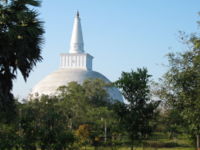
, or possibly Alexandria of the Arachosians), with 30,000 monks for the dedication ceremony of the Maha Thupa ("Great stupa
Stupa
A stupa is a mound-like structure containing Buddhist relics, typically the remains of Buddha, used by Buddhists as a place of worship....
") at Anuradhapura
Anuradhapura
Anuradhapura, , is one of the ancient capitals of Sri Lanka, famous for its well-preserved ruins of ancient Lankan civilization.The city, now a UNESCO World Heritage Site, lies 205 km north of the current capital Colombo in Sri Lanka's North Central Province, on the banks of the historic...
in Sri Lanka
Sri Lanka
Sri Lanka, officially the Democratic Socialist Republic of Sri Lanka is a country off the southern coast of the Indian subcontinent. Known until 1972 as Ceylon , Sri Lanka is an island surrounded by the Indian Ocean, the Gulf of Mannar and the Palk Strait, and lies in the vicinity of India and the...
, when it was completed shortly after the death of the Sri Lankan king Dutthagamani Abhaya (r. 161- 137 BCE).
The Mahamvasa lists the congregations that visited Sri Lanka for the dedication of the Maha Thupa, explaining that:
- "From Alasanda the city of the YonaYona"Yona" is a Pali word used in ancient India to designate Greek speakers. Its equivalent in Sanskrit, Malayalam, Kannada, Telugu and Tamil is the word "Yavana" and "Jobonan/Jubonan" in Bengali...
s came the thera (elder) Yona Mahadhammarakkhita with thirty thousand bhikkhuBhikkhuA Bhikkhu or Bhikṣu is an ordained male Buddhist monastic. A female monastic is called a Bhikkhuni Nepali: ). The life of Bhikkhus and Bhikkhunis is governed by a set of rules called the patimokkha within the vinaya's framework of monastic discipline...
s." (MahavamsaMahavamsaThe Mahavamsa is a historical poem written in the Pali language, of the kings of Sri Lanka...
, XXIX)
This reference is seen as having several implications regarding the role of the Greeks in the Buddhist community at that time:
- Alexandria of the CaucasusAlexandria of the CaucasusAlexandria on the Caucasus was a colony of Alexander the Great...
or Alexandria of the Arachosians, cities under the control of the Greek king Menander, had a Buddhist monk population of possibly as many as 30,000, indicating a flourishing Buddhist culture under the Greeks. - The head of this Buddhist community was a Greek (Yona) Buddhist elder whose religious name was Mahadhammarakkhita ("Great protector of the Dharma), indicating the direct involvement of Greeks in the development of the faith, in the northwestern part of the Indian subcontinent.
- They were able to travel unhindered south as far as Sri Lanka, indicating some kind of stable political situation along the west coast of the Indian subcontinent, especially at a time when the Sunga Empire in the east was persecuting Buddhists.
It is also separately established through another text, the Milinda Panha
Milinda Panha
The Milinda Panha is a Buddhist text which dates from approximately 100 BCE. It is included in the Burmese edition of the Pali Canon of Theravada Buddhism as a book of the Khuddaka Nikaya, however, it does not appear in the Thai or Sri Lankan versions.It purports to record a dialogue in which the...
, and archeological evidence that Menander
Menander I
Menander I Soter "The Saviour" was one of the rulers of the Indo-Greek Kingdom from either 165 or 155 BC to 130 BC ....
himself ruled a vast empire in northern India, and that he became a Buddhist arhat. According to Buddhist tradition he was a great benefactor of the Buddhist faith, on a par with Ashoka
Ashoka
Ashok Maurya or Ashoka , popularly known as Ashoka the Great, was an Indian emperor of the Maurya Dynasty who ruled almost all of the Indian subcontinent from ca. 269 BC to 232 BC. One of India's greatest emperors, Ashoka reigned over most of present-day India after a number of military conquests...
or the Kushan Kanishka
Kanishka
Kanishka ) was an emperor of the Kushan Empire, ruling an empire extending from Bactria to large parts of northern India in the 2nd century of the common era, and famous for his military, political, and spiritual achievements...
.
These elements tend to indicate the importance of Buddhism within Greek communities in northwestern India, and the prominent role Greeks probably played in developing the Buddhist faith during its first few formative centuries.
See also
- DharmaraksitaDharmaraksitaFor the teacher of Atisha, see Dharmarakshita .Dharmarakṣita , or Dhammarakkhita , was one of the missionaries sent by the Mauryan emperor Ashoka to proselytize the Buddhist faith. He is described as being a Greek For the teacher of Atisha, see Dharmarakshita (Sumatran).Dharmarakṣita (Sanskrit),...
- Greco-Buddhist monasticismGreco-Buddhist monasticismThe role of Greek Buddhist monks in the development of the Buddhist faith under the patronage of emperor Ashoka around 260 BCE, and then during the reign of Menander is described in the Mahavamsa, an important non-canonical Theravada Buddhist historical text compiled in Sri Lanka in the 6th century...
- Edicts of AshokaEdicts of AshokaThe Edicts of Ashoka are a collection of 33 inscriptions on the Pillars of Ashoka, as well as boulders and cave walls, made by the Emperor Ashoka of the Mauryan dynasty during his reign from 269 BCE to 231 BCE. These inscriptions are dispersed throughout the areas of modern-day Bangladesh, India,...
- Greco-BuddhismGreco-BuddhismGreco-Buddhism, sometimes spelled Graeco-Buddhism, refers to the cultural syncretism between Hellenistic culture and Buddhism, which developed between the 4th century BCE and the 5th century CE in the area covered by the Indian sub-continent, and modern Afghanistan, Pakistan and north-western...
- History of BuddhismHistory of BuddhismThe History of Buddhism spans the 6th century BCE to the present, starting with the birth of Buddha Siddhartha Gautama on the Indian subcontinent, in what is now Lumbini, Nepal. This makes it one of the oldest religions practiced today. The religion evolved as it spread from the northeastern region...