The MV
Lake Illawarra was a HandysizeAlthough there is no official definition in terms of exact tonnages, Handysize most usually refers to a dry bulk vessel with deadweight of about 15,000–35,000 tons...
bulk carrierA bulk carrier, bulk freighter, or bulker is a merchant ship specially designed to transport unpackaged bulk cargo, such as grains, coal, ore, and cement in its cargo holds. Since the first specialized bulk carrier was built in 1852, economic forces have fueled the development of these ships,...
of 7,274 tons in the service of the shipping company Australian National LinesThe Australian National Line was an Australian Government owned coastal shipping line that operated in Australia between 1956 and 1998, when the naming rights were bought by French shipping line CMA CGM.-Corporate history:...
, which famously caused the Tasman Bridge disasterThe Tasman Bridge disaster occurred on the evening of 5 January 1975, in Hobart, the capital city of Australia's island state of Tasmania, when a bulk ore carrier travelling up the Derwent River collided with several pylons of the Tasman Bridge, causing a large section of the bridge deck to...
when it dramatically collided with pylon 19 of HobartHobart is the state capital and most populous city of the Australian island state of Tasmania. Founded in 1803 as a penal colony, Hobart is Australia's second oldest capital city after Sydney. In 2008, the city had a greater area population of approximately 209,287...
's giant high concrete arch style Tasman BridgeThe Tasman Bridge is a five-lane bridge crossing the Derwent River, near the CBD of Hobart, Tasmania.The bridge has a total length of 1,395 metres . It provides the main traffic route from the CBD to the eastern shore - particularly Hobart International Airport and Bellerive Oval...
on the evening of 5 January, 1975 at 9.27pm.
The Lake Illawarra was an ore carrier, and at the time of its collision was loaded with
zinc concentrateZinc concentrate is a semi-processed intermediate product used in the production of zinc metal and zinc alloys, which is the result of a flotation process after the zinc ore has been mined and milled...
, her destination being the Electrolytic Zinc Company works at Risdon, later to become Pasminco and now
ZinifexZinifex was an Australian company which operates two zinc and lead mines, three zinc refineries and a lead smelter. It was created following the insolvency of Pasminco in 2002, taking on Pasminco operations. In 2008 it merged with Oxiana Limited to form OZ Minerals.-History:Zinifex was the...
ZincZinc , also known as spelter, is a metallic chemical element; it has the symbol Zn and atomic number 30. It is the first element in group 12 of the periodic table. Zinc is, in some respects, chemically similar to magnesium, because its ion is of similar size and its only common oxidation state is +2...
refineryA refinery is a production facility composed of a group of chemical engineering unit processes and unit operations refining certain materials or converting raw material into products of value.-Types of refineries:Different types of refineries are as follows:...
, located a couple of kilometres up the
Derwent RiverThe Derwent is a river in Tasmania, Australia. It was named after the River Derwent, Cumbria by British Commodore John Hayes who explored it in 1793. The name is Brythonic Celtic for "valley thick with oaks"....
from the bridge.
Just before the impact, Captain Boleslaw Pelc realised as he passed
Rosny PointRosny is a suburb of the City of Clarence, part of the greater Hobart area, Tasmania, Australia. It is located on the eastern shore of the Derwent River, between the suburbs of Montagu Bay and Rosny Park, approximately 4 kilometres from Hobart's centre. Rosny is the residential part of its...
that he was off course, and travelling too fast.
Discussion
Ask a question about 'MV Lake Illawarra'
Start a new discussion about 'MV Lake Illawarra'
Answer questions from other users
|
The MV
Lake Illawarra was a HandysizeAlthough there is no official definition in terms of exact tonnages, Handysize most usually refers to a dry bulk vessel with deadweight of about 15,000–35,000 tons...
bulk carrierA bulk carrier, bulk freighter, or bulker is a merchant ship specially designed to transport unpackaged bulk cargo, such as grains, coal, ore, and cement in its cargo holds. Since the first specialized bulk carrier was built in 1852, economic forces have fueled the development of these ships,...
of 7,274 tons in the service of the shipping company Australian National LinesThe Australian National Line was an Australian Government owned coastal shipping line that operated in Australia between 1956 and 1998, when the naming rights were bought by French shipping line CMA CGM.-Corporate history:...
, which famously caused the Tasman Bridge disasterThe Tasman Bridge disaster occurred on the evening of 5 January 1975, in Hobart, the capital city of Australia's island state of Tasmania, when a bulk ore carrier travelling up the Derwent River collided with several pylons of the Tasman Bridge, causing a large section of the bridge deck to...
when it dramatically collided with pylon 19 of HobartHobart is the state capital and most populous city of the Australian island state of Tasmania. Founded in 1803 as a penal colony, Hobart is Australia's second oldest capital city after Sydney. In 2008, the city had a greater area population of approximately 209,287...
's giant high concrete arch style Tasman BridgeThe Tasman Bridge is a five-lane bridge crossing the Derwent River, near the CBD of Hobart, Tasmania.The bridge has a total length of 1,395 metres . It provides the main traffic route from the CBD to the eastern shore - particularly Hobart International Airport and Bellerive Oval...
on the evening of 5 January, 1975 at 9.27pm.
The Lake Illawarra was an ore carrier, and at the time of its collision was loaded with
zinc concentrateZinc concentrate is a semi-processed intermediate product used in the production of zinc metal and zinc alloys, which is the result of a flotation process after the zinc ore has been mined and milled...
, her destination being the Electrolytic Zinc Company works at Risdon, later to become Pasminco and now
ZinifexZinifex was an Australian company which operates two zinc and lead mines, three zinc refineries and a lead smelter. It was created following the insolvency of Pasminco in 2002, taking on Pasminco operations. In 2008 it merged with Oxiana Limited to form OZ Minerals.-History:Zinifex was the...
ZincZinc , also known as spelter, is a metallic chemical element; it has the symbol Zn and atomic number 30. It is the first element in group 12 of the periodic table. Zinc is, in some respects, chemically similar to magnesium, because its ion is of similar size and its only common oxidation state is +2...
refineryA refinery is a production facility composed of a group of chemical engineering unit processes and unit operations refining certain materials or converting raw material into products of value.-Types of refineries:Different types of refineries are as follows:...
, located a couple of kilometres up the
Derwent RiverThe Derwent is a river in Tasmania, Australia. It was named after the River Derwent, Cumbria by British Commodore John Hayes who explored it in 1793. The name is Brythonic Celtic for "valley thick with oaks"....
from the bridge.
Just before the impact, Captain Boleslaw Pelc realised as he passed
Rosny PointRosny is a suburb of the City of Clarence, part of the greater Hobart area, Tasmania, Australia. It is located on the eastern shore of the Derwent River, between the suburbs of Montagu Bay and Rosny Park, approximately 4 kilometres from Hobart's centre. Rosny is the residential part of its...
that he was off course, and travelling too fast. He tried to adjust the course, but only managed to bring the bows too far to the
portPort is the nautical term that refers to the left side of a ship, as perceived by a person on board the ship and facing towards the bow . The port side of a vessel is indicated with a red navigation light at night.The term is also used on aircraft, spacecraft, and analogous...
(left) and facing the western shore. He urgently counter-corrected, but could not make the opening. Realising he was headed for a collision, he threw her into a full reverse, but the torque from her propeller caused the ship to slide in a broadside movement. She smashed into the 18th and 19th pylons.
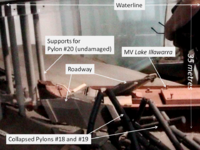
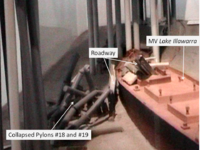
The collision brought down the two support pylons and a 127 metre (417 ft) section of steel and concrete. There was evening traffic on the bridge, and although no vehicles were on the section that fell, four cars drove off the gap, with five people killed. Two cars stopped on the edge, their occupants able to escape. The section of four-lane highway landed on the ship's deck, sinking her in of water to the south of the bridge, and resulting in another seven deaths. Illawarra
and the debris pile was deemed unsafe to move; the ship's oil was pumped out, and the bow was removed at a later date. The wreck is deep enough to avoid being a navigational hazard, although movement caused by tides is considered enough of a threat to the bridge to be monitored closely with electronic sensors.
The Illawarra
was capable of passing underneath the bridge's central navigation span, but the captain instead attempted to pass through one of the eastern spans, due to a combination of strong tidal currents and inattention.
The subsequent Court of Marine Inquiry found that Captain Pelc had not handled the Lake Illawarra in a proper and seamanlike manner, and suspended his master's certificate for six months. A pilot service was introduced in response to the Court's findings.
External links