


Lotus position

Encyclopedia

History of India
The history of India begins with evidence of human activity of Homo sapiens as long as 75,000 years ago, or with earlier hominids including Homo erectus from about 500,000 years ago. The Indus Valley Civilization, which spread and flourished in the northwestern part of the Indian subcontinent from...
, in which the feet are placed on the opposing thighs. It is an established posture, commonly used for meditation, in the Hindu Yoga
Yoga
Yoga is a physical, mental, and spiritual discipline, originating in ancient India. The goal of yoga, or of the person practicing yoga, is the attainment of a state of perfect spiritual insight and tranquility while meditating on Supersoul...
and Buddhist contemplative
Buddhism
Buddhism is a religion and philosophy encompassing a variety of traditions, beliefs and practices, largely based on teachings attributed to Siddhartha Gautama, commonly known as the Buddha . The Buddha lived and taught in the northeastern Indian subcontinent some time between the 6th and 4th...
traditions. The position is said to resemble a lotus
Nelumbo nucifera
Nelumbo nucifera, known by a number of names including Indian Lotus, Sacred Lotus, Bean of India, or simply Lotus, is a plant in the monogeneric family Nelumbonaceae...
, to encourage breathing proper to associated meditative practice, and to foster physical stability.
Shiva
Shiva
Shiva is a major Hindu deity, and is the destroyer god or transformer among the Trimurti, the Hindu Trinity of the primary aspects of the divine. God Shiva is a yogi who has notice of everything that happens in the world and is the main aspect of life. Yet one with great power lives a life of a...
, the meditating ascetic god of Hinduism
Hinduism
Hinduism is the predominant and indigenous religious tradition of the Indian Subcontinent. Hinduism is known to its followers as , amongst many other expressions...
, and Siddhartha Gautama, the founder of Buddhism
Buddhism
Buddhism is a religion and philosophy encompassing a variety of traditions, beliefs and practices, largely based on teachings attributed to Siddhartha Gautama, commonly known as the Buddha . The Buddha lived and taught in the northeastern Indian subcontinent some time between the 6th and 4th...
, have been depicted in the lotus position.
Etymology
Padmāsana means "Lotus throne" and is also a term for actual thrones, often decorated with lotus foliage motifs, on which figures in art sit. In BaliBali
Bali is an Indonesian island located in the westernmost end of the Lesser Sunda Islands, lying between Java to the west and Lombok to the east...
nese Hinduism
Hinduism
Hinduism is the predominant and indigenous religious tradition of the Indian Subcontinent. Hinduism is known to its followers as , amongst many other expressions...
, a prominent feature of temples is a special form of padmasana shrine, with empty thrones mounted on a column, for deities, especially Acintya
Acintya
Acintya, also Atintya , also Tunggal is the supreme god of Hinduism as practiced in Indonesia , and most of all in the island of Bali, equivalent to the concept of Brahman...
.
In Chinese Buddhism, the lotus position is also called the "vajra
Vajra
Vajra is a Sanskrit word meaning both thunderbolt and diamond...
position" (Skt. vajrāsana, Ch. 金剛座 jīngāngzuò). The traditions of Tibetan Buddhism
Tibetan Buddhism
Tibetan Buddhism is the body of Buddhist religious doctrine and institutions characteristic of Tibet and certain regions of the Himalayas, including northern Nepal, Bhutan, and India . It is the state religion of Bhutan...
also refer to the lotus position as the "vajra position." In this context, the meaning of the term is different from the Hatha Yoga position that has the same name vajrāsana.
Position
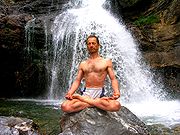
From a seated posture, one foot is placed on top of the opposite thigh with sole facing upward and heel close to the abdomen. The other foot is then placed on the opposite thigh in a symmetrical way.The knees are in contact with the ground. The torso is placed in balance and alignment such that the spinal column supports it with minimal muscular effort. The torso is centered above the hips. To relax the head and neck, the jaw is allowed to fall towards the neck and the back of the neck to lengthen. The shoulders move backwards and the ribcage lifts. The tongue rests on the roof of the mouth. The hands may rest on the knees in chin or jnana mudra
Mudra
A mudrā is a symbolic or ritual gesture in Hinduism and Buddhism. While some mudrās involve the entire body, most are performed with the hands and fingers...
. The arms are relaxed with the elbows slightly bent.
The eyes may be closed, the body relaxed, with awareness of the overall posture. Adjustments are made until balance and alignment are experienced. Alignment that creates relaxation is indicative of a suitable posture for the asana. The posture should be natural and comfortable, without any sharp pains.
In most cases, a cushion (zafu
Zafu
A zafu is a round cushion. Although also a utilitarian accessory, it is most well known for its use in zazen Zen meditation.-Name:...
) or mat (zabuton
Zabuton
A zabuton is a Japanese cushion for sitting. The zabuton is generally used when sitting on the floor, and may also be used when sitting on a chair. Ordinarily any place in Japan where seating is on the floor will be provided with zabuton, for sitting comfort...
) is necessary in order to achieve this balance. One sits on the forward edge of the cushion or mat in order to incline one's pelvis forward, making it possible to center the spine and provide the necessary support. Only the most flexible people can achieve this asana without a support under their pelvis (and The Dalai Lama has explicitly advised against doing so).
Contra-indications
Those without sufficient flexibility to place both knees on the ground when in full lotus position should not use it, as it strains the knees and lower back of such people. Other meditation asanas are indicated until sufficient flexibility has been developed to sit comfortably in the Lotus. SciaticaSciatica
Sciatica is a set of symptoms including pain that may be caused by general compression or irritation of one of five spinal nerve roots that give rise to each sciatic nerve, or by compression or irritation of the left or right or both sciatic nerves. The pain is felt in the lower back, buttock, or...
, sacral
Sacrum
In vertebrate anatomy the sacrum is a large, triangular bone at the base of the spine and at the upper and back part of the pelvic cavity, where it is inserted like a wedge between the two hip bones. Its upper part connects with the last lumbar vertebra, and bottom part with the coccyx...
infections and weak or injured knees are contra-indications to attempting the posture.
Benefits
The Lotus position is adopted to allow the body to be held completely steady for long periods of time. As the body is steadied the mind becomes calm, the first step towards meditation. The posture applies pressure to the lower spine which may facilitate relaxation. The breath can slow down, muscular tension decrease and blood pressure subside. The coccygeal and sacral nerves are toned as the normally large blood flow to the legs is redirected to the abdominal region. Digestion may also be improved.External links
- Guide by Muho, abbot of Antaiji Zen Monastery http://antaiji.dogen-zen.de/eng/adult35.shtml, 2003
- Padmāsana (पद्मासन) with detail explanation
- Detailed non-commercial article with references, updated 24.06.2006: http://www.yogameditation.com/articles/issues_of_bindu/bindu_8/the_lotus_pose