


Los Angeles and Salt Lake Railroad

Encyclopedia
The Los Angeles and Salt Lake Railroad was a rail company that completed and operated a railway line between its namesake cities, via Las Vegas, Nevada
. Incorporated in Utah
in 1901 as the San Pedro, Los Angeles and Salt Lake Railroad, the line was largely the brainchild of William Andrews Clark
, a Montana
mining baron and United States Senator. Clark enlisted the help of Utah's U.S. Senator Thomas Kearns
, mining magnate and newspaper man, to ensure the success of the line through Utah. Construction of the railroad's main line was completed in 1905. Company shareholders adopted the LA&SL name in 1916. The railway was also known by its official nickname, "The Salt Lake Route," and was sometimes informally referred to as "The Clark Road." The tracks are still in use by the modern Union Pacific Railroad
, as the Calliente and Lynndyl Subdivision
s.
began constructing trackage southward from Salt Lake City
. The Utah Southern, controlled by the much larger Union Pacific Railroad
(UP), built a line to a station known as Juab, Utah in 1879. From there, a second UP subsidiary known as the Utah Southern Railroad Extension took up the work, completing trackage as far as Milford, Utah
in 1880. By the end of the century, these and other lines had been absorbed into the Oregon Short Line Railroad
, a far larger UP subsidiary.
Work on extending the Milford line southward began by 1889, but no tracks were actually laid due to financial issues. Construction resumed in 1899, however, when the route was completed as far as the Utah-Nevada border. Substantial grading work also took place in Nevada, and the UP's stated intent was to continue expanding the line all the way to southern California.
Another player entered the scene in 1900, however, when William Andrews Clark acquired the struggling Los Angeles Terminal Railway
with an eye to extending the line northeast to Salt Lake. The railroad was reincorporated in 1901 as the San Pedro, Los Angeles & Salt Lake Railroad and Clark announced plans to construct a line between Salt Lake and southern California. Clark assembled a variety of political and financial supporters to assist in the project, both in California and Utah; in contrast, the competing Union Pacific Railroad and its formidable leader E. H. Harriman
stood in opposition to Clark's plan.
Clark's forces began construction work in Nevada, along the existing UP grade, and a brief "railroad war" ensued before Clark and the UP called a truce in 1903. Their agreement called for Clark's railroad to acquire the existing UP trackage south of Salt Lake City; in turn, the UP received a 50% ownership interest in Clark's railroad. Construction of the remaining line proceeded rapidly, and the complete Salt Lake-Los Angeles line was opened on May 1, 1905. In California, Clark negotiated a trackage rights
agreement allowing his new line to use the existing Atchison, Topeka and Santa Fe Railway
route over Cajon Pass
, in lieu of constructing its own tracks across the pass.
On April 16, 1916, the railroad's stockholders voted to remove "San Pedro" from the corporation's name, a reflection of the fact that the former town of San Pedro had been consolidated with the city of Los Angeles in 1909. The LA&SL operated independently until April 27, 1921, when the UP agreed to acquire Clark's half-interest in the railroad. From that point on, the LA&SL lines were operated as an integral part of the UP system, although the LA&SL corporation continued to exist on paper until January 1, 1988. The former LA&SL main line remains an integral part of the UP network today as the Calliente and Lynndyl Subdivisions.
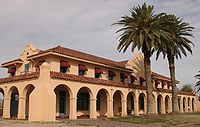
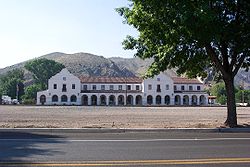 Following standard railroad practice, the LA&SL designated a series of locations along its route as "division points" -- bases for the railroad's operational and maintenance activities. Traveling southwestward from Salt Lake, the railroad's division point towns were Lynndyl, Utah
; Milford; Caliente, Nevada
; Las Vegas; Yermo, California
; and San Bernardino, California
. The railway also maintained a substantial presence in the remote town of Kelso, California
. Nearly the entire route of the railroad traversed rugged and largely unpopulated desert terrain. There were no major population centers between the railroad's endpoints until the city of Las Vegas began its rapid growth in the mid-twentieth century.
The LA&SL was known for its depot
buildings, many of which were large and imposing structures designed in the Mission Revival architectural style. The largest such depot, at Milford, was razed in 1979, but landmark LA&SL stations in Caliente
and Kelso
survive today. Several smaller Mission Revival depots erected by the railroad still exist in southern California, as well. At least two of the railroad's smaller stations, at Lund
and Black Rock, Utah
, were designed by the noted architect Gilbert Stanley Underwood
. The Salt Lake City depot
was built in the French Renaissance style and is a landmark in that city.
Las Vegas, Nevada
Las Vegas is the most populous city in the U.S. state of Nevada and is also the county seat of Clark County, Nevada. Las Vegas is an internationally renowned major resort city for gambling, shopping, and fine dining. The city bills itself as The Entertainment Capital of the World, and is famous...
. Incorporated in Utah
Utah
Utah is a state in the Western United States. It was the 45th state to join the Union, on January 4, 1896. Approximately 80% of Utah's 2,763,885 people live along the Wasatch Front, centering on Salt Lake City. This leaves vast expanses of the state nearly uninhabited, making the population the...
in 1901 as the San Pedro, Los Angeles and Salt Lake Railroad, the line was largely the brainchild of William Andrews Clark
William Andrews Clark
William Andrews Clark, Sr. was an American politician and entrepreneur, involved with mining, banking, and railroads.-Biography:...
, a Montana
Montana
Montana is a state in the Western United States. The western third of Montana contains numerous mountain ranges. Smaller, "island ranges" are found in the central third of the state, for a total of 77 named ranges of the Rocky Mountains. This geographical fact is reflected in the state's name,...
mining baron and United States Senator. Clark enlisted the help of Utah's U.S. Senator Thomas Kearns
Thomas Kearns
Thomas Kearns was a mining, banking, railroad and newspaper magnate. He was elected United States Senator from Utah from 1901 to 1905.- Immigration and mining :...
, mining magnate and newspaper man, to ensure the success of the line through Utah. Construction of the railroad's main line was completed in 1905. Company shareholders adopted the LA&SL name in 1916. The railway was also known by its official nickname, "The Salt Lake Route," and was sometimes informally referred to as "The Clark Road." The tracks are still in use by the modern Union Pacific Railroad
Union Pacific Railroad
The Union Pacific Railroad , headquartered in Omaha, Nebraska, is the largest railroad network in the United States. James R. Young is president, CEO and Chairman....
, as the Calliente and Lynndyl Subdivision
Lynndyl Subdivision
The Lynndyl Subdivision is a rail line owned and operated by the Union Pacific Railroad in the U.S. state of Utah, running from Salt Lake City southwest to Milford, where the Caliente Subdivision continues towards Los Angeles...
s.
History
The development of the railway line that later became the LA&SL began in 1871, when the Utah Southern RailroadUtah Southern Railroad (1871–1881)
The Utah Southern Railroad was built by the Mormons between Salt Lake City and York , and acquired by the Union Pacific Railroad in 1875.-External links:* , Utah History Encyclopedia, University of Utah...
began constructing trackage southward from Salt Lake City
Salt Lake City, Utah
Salt Lake City is the capital and the most populous city of the U.S. state of Utah. The name of the city is often shortened to Salt Lake or SLC. With a population of 186,440 as of the 2010 Census, the city lies in the Salt Lake City metropolitan area, which has a total population of 1,124,197...
. The Utah Southern, controlled by the much larger Union Pacific Railroad
Union Pacific Railroad
The Union Pacific Railroad , headquartered in Omaha, Nebraska, is the largest railroad network in the United States. James R. Young is president, CEO and Chairman....
(UP), built a line to a station known as Juab, Utah in 1879. From there, a second UP subsidiary known as the Utah Southern Railroad Extension took up the work, completing trackage as far as Milford, Utah
Milford, Utah
Milford is a city in Beaver County, Utah, United States. The population was 1,420 at the 2010 census.-History:Although there were ranches in the area in the 1870s, Milford did not come into being until the arrival of the San Pedro, Los Angeles and Salt Lake Railroad in 1880.-Milford Flat...
in 1880. By the end of the century, these and other lines had been absorbed into the Oregon Short Line Railroad
Oregon Short Line Railroad
The Oregon Short Line Railroad was a railroad in the U.S. states of Wyoming, Idaho, Utah, Montana and Oregon. The line was as organized the Oregon Short Line Railway in 1881 as a subsidiary of Union Pacific Railway. Union Pacific intended the line to be the shortest route from Wyoming to Oregon...
, a far larger UP subsidiary.
Work on extending the Milford line southward began by 1889, but no tracks were actually laid due to financial issues. Construction resumed in 1899, however, when the route was completed as far as the Utah-Nevada border. Substantial grading work also took place in Nevada, and the UP's stated intent was to continue expanding the line all the way to southern California.
Another player entered the scene in 1900, however, when William Andrews Clark acquired the struggling Los Angeles Terminal Railway
Los Angeles Terminal Railway
The Los Angeles Terminal Railway, earlier known as the Pasadena Railway, and unofficially as the Altadena Railway, was a small terminal railroad line that was constructed between Altadena and Pasadena, California in the late 1880s. It was a byproduct of a land boom period and a victim of the land...
with an eye to extending the line northeast to Salt Lake. The railroad was reincorporated in 1901 as the San Pedro, Los Angeles & Salt Lake Railroad and Clark announced plans to construct a line between Salt Lake and southern California. Clark assembled a variety of political and financial supporters to assist in the project, both in California and Utah; in contrast, the competing Union Pacific Railroad and its formidable leader E. H. Harriman
E. H. Harriman
Edward Henry Harriman was an American railroad executive.-Early years:Harriman was born in Hempstead, New York, the son of Orlando Harriman, an Episcopal clergyman, and Cornelia Neilson...
stood in opposition to Clark's plan.
Clark's forces began construction work in Nevada, along the existing UP grade, and a brief "railroad war" ensued before Clark and the UP called a truce in 1903. Their agreement called for Clark's railroad to acquire the existing UP trackage south of Salt Lake City; in turn, the UP received a 50% ownership interest in Clark's railroad. Construction of the remaining line proceeded rapidly, and the complete Salt Lake-Los Angeles line was opened on May 1, 1905. In California, Clark negotiated a trackage rights
Trackage rights
Trackage rights , running rights or running powers is an agreement whereby a railway company has the right to run its trains on tracks owned by another railway company....
agreement allowing his new line to use the existing Atchison, Topeka and Santa Fe Railway
Atchison, Topeka and Santa Fe Railway
The Atchison, Topeka and Santa Fe Railway , often abbreviated as Santa Fe, was one of the larger railroads in the United States. The company was first chartered in February 1859...
route over Cajon Pass
Cajon Pass
Cajon Pass is a moderate-elevation mountain pass between the San Bernardino Mountains and the San Gabriel Mountains in Southern California in the United States. It was created by the movements of the San Andreas Fault...
, in lieu of constructing its own tracks across the pass.
On April 16, 1916, the railroad's stockholders voted to remove "San Pedro" from the corporation's name, a reflection of the fact that the former town of San Pedro had been consolidated with the city of Los Angeles in 1909. The LA&SL operated independently until April 27, 1921, when the UP agreed to acquire Clark's half-interest in the railroad. From that point on, the LA&SL lines were operated as an integral part of the UP system, although the LA&SL corporation continued to exist on paper until January 1, 1988. The former LA&SL main line remains an integral part of the UP network today as the Calliente and Lynndyl Subdivisions.
Route and stations
Lynndyl, Utah
Lynndyl is a town in Millard County, Utah, United States. The population was 134 at the 2000 census.-Geography:Lynndyl is located at ....
; Milford; Caliente, Nevada
Caliente, Nevada
Caliente , formerly known as Culverwell and Calientes is a town in Lincoln County, Nevada, United States. Its elevation is 4,300 feet . The population was 1,123 at the 2000 census...
; Las Vegas; Yermo, California
Yermo, California
Yermo is a town in San Bernardino County, California. Its name is derived from the Spanish word for wilderness. It is located 13 miles east of Barstow in the Mojave Desert on Interstate 15, just south of the Calico Mountains...
; and San Bernardino, California
San Bernardino, California
San Bernardino is a city located in the Riverside-San Bernardino metropolitan area , and serves as the county seat of San Bernardino County, California, United States...
. The railway also maintained a substantial presence in the remote town of Kelso, California
Kelso, California
Kelso is a ghost town and defunct railroad depot in the Mojave National Preserve in San Bernardino County, California, USA. It was named after a railroad worker who won a contest to have the town named after him...
. Nearly the entire route of the railroad traversed rugged and largely unpopulated desert terrain. There were no major population centers between the railroad's endpoints until the city of Las Vegas began its rapid growth in the mid-twentieth century.
The LA&SL was known for its depot
Train station
A train station, also called a railroad station or railway station and often shortened to just station,"Station" is commonly understood to mean "train station" unless otherwise qualified. This is evident from dictionary entries e.g...
buildings, many of which were large and imposing structures designed in the Mission Revival architectural style. The largest such depot, at Milford, was razed in 1979, but landmark LA&SL stations in Caliente
Caliente Railroad Depot
Caliente Railroad Depot is a historic Mission Revival Style railway station, located in Caliente, Lincoln County, Nevada. The Depot is listed on the National Register of Historic Places, and is Nevada Historical Marker number 249.-History:...
and Kelso
Kelso Depot, Restaurant and Employees Hotel
The Kelso Depot, Restaurant and Employees Hotel or Kelso Depot, now also the Mojave National Preserve Visitors Center, is located in the Mojave Desert within the National Park Service Mojave National Preserve, on Kelbaker Road in Kelso, California, between Baker and Interstate 15 to the north and...
survive today. Several smaller Mission Revival depots erected by the railroad still exist in southern California, as well. At least two of the railroad's smaller stations, at Lund
Lund, Utah
Lund is a small unincorporated village located in the Escalante Valley of northwestern Iron County, Utah, United States, about 35 miles northwest of Cedar City. The town, established in the early twentieth century, was a station stop on the Los Angeles and Salt Lake Railroad , and was a community...
and Black Rock, Utah
Black Rock, Millard County, Utah
Black Rock was a small, unincorporated village located in southern Millard County, Utah, about 20 miles north of Milford. The town was a station stop on the Los Angeles and Salt Lake Railroad , and was a community center for a small number of early twentieth century homesteaders and ranchers. A...
, were designed by the noted architect Gilbert Stanley Underwood
Gilbert Stanley Underwood
Gilbert Stanley Underwood was an American architect best known for his National Park lodges. Born in 1890, Underwood received his B.A. from Yale in 1920 and a M.A. from Harvard in 1923. After opening an office in Los Angeles that year, he became associated with Daniel Ray Hull of the National...
. The Salt Lake City depot
Salt Lake City Union Pacific Depot
The Salt Lake City Union Pacific Depot is a spacious building on the western edge of downtown Salt Lake City, Utah. Built from 1908 to 1909, it harkens back to a more prosperous era in the history of American railroad travel...
was built in the French Renaissance style and is a landmark in that city.