

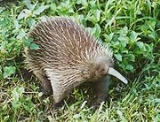
Long-beaked echidna

Encyclopedia
The long-beaked echidnas make up one of the two genera
(genus Zaglossus) of echidna
s, spiny monotreme
s that lives in New Guinea
. There are three living species
and two extinct species in this genus. Echidnas are one of the two types of mammals that lay eggs.
Genus
In biology, a genus is a low-level taxonomic rank used in the biological classification of living and fossil organisms, which is an example of definition by genus and differentia...
(genus Zaglossus) of echidna
Echidna
Echidnas , also known as spiny anteaters, belong to the family Tachyglossidae in the monotreme order of egg-laying mammals. There are four extant species, which, together with the platypus, are the only surviving members of that order and are the only extant mammals that lay eggs...
s, spiny monotreme
Monotreme
Monotremes are mammals that lay eggs instead of giving birth to live young like marsupials and placental mammals...
s that lives in New Guinea
New Guinea
New Guinea is the world's second largest island, after Greenland, covering a land area of 786,000 km2. Located in the southwest Pacific Ocean, it lies geographically to the east of the Malay Archipelago, with which it is sometimes included as part of a greater Indo-Australian Archipelago...
. There are three living species
Species
In biology, a species is one of the basic units of biological classification and a taxonomic rank. A species is often defined as a group of organisms capable of interbreeding and producing fertile offspring. While in many cases this definition is adequate, more precise or differing measures are...
and two extinct species in this genus. Echidnas are one of the two types of mammals that lay eggs.
Zaglossus attenboroughi
- Habitat: regions of New GuineaNew GuineaNew Guinea is the world's second largest island, after Greenland, covering a land area of 786,000 km2. Located in the southwest Pacific Ocean, it lies geographically to the east of the Malay Archipelago, with which it is sometimes included as part of a greater Indo-Australian Archipelago...
at higher elevation than highland forests - Era: the present
- Endangered
Zaglossus bartoni
- Habitat: on the central cordillera between the Paniai LakesPaniai LakesThe Paniai Lakes, originally known as the Wissel lakes, consist of the three large, freshwater lakes Paniai, Tigi, and Tage. They are located in the central highlands of West Papua province, Indonesia...
and the Nanneau Range, as well as the Huon Peninsula - Era: the present
- Endangered
Zaglossus bruijni
- Habitat: highland forests of New GuineaNew GuineaNew Guinea is the world's second largest island, after Greenland, covering a land area of 786,000 km2. Located in the southwest Pacific Ocean, it lies geographically to the east of the Malay Archipelago, with which it is sometimes included as part of a greater Indo-Australian Archipelago...
- Era: the present
- Endangered
†Zaglossus hacketti
- Habitat: Western AustraliaWestern AustraliaWestern Australia is a state of Australia, occupying the entire western third of the Australian continent. It is bounded by the Indian Ocean to the north and west, the Great Australian Bight and Indian Ocean to the south, the Northern Territory to the north-east and South Australia to the south-east...
- Era: Upper PleistocenePleistoceneThe Pleistocene is the epoch from 2,588,000 to 11,700 years BP that spans the world's recent period of repeated glaciations. The name pleistocene is derived from the Greek and ....
- Fossil
- This species is known only from a few bones. At a metre long, it was huge for an echidna and for monotremeMonotremeMonotremes are mammals that lay eggs instead of giving birth to live young like marsupials and placental mammals...
s in general.
†Zaglossus robustus
- Habitat: TasmaniaTasmaniaTasmania is an Australian island and state. It is south of the continent, separated by Bass Strait. The state includes the island of Tasmania—the 26th largest island in the world—and the surrounding islands. The state has a population of 507,626 , of whom almost half reside in the greater Hobart...
- Era: PleistocenePleistoceneThe Pleistocene is the epoch from 2,588,000 to 11,700 years BP that spans the world's recent period of repeated glaciations. The name pleistocene is derived from the Greek and ....
- Fossil
- This species is known from a fossil skull about 65 cm long.
- It had many spikes along its back to protect it from its predators and used them as a weapon.
External links
- EDGE of Existence (Zaglossus spp.) – Saving the World's most Evolutionarily Distinct and Globally Endangered (EDGE) species
- ARKive – images and movies of the long-beaked echidna (Zaglossus spp.)
- A summary, including references, on animalinfo.org