

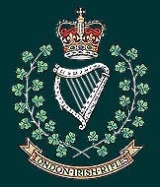
London Irish Rifles

Encyclopedia
The London Irish Rifles (LIR) is now known more formally known as "D (London Irish Rifles) Company, London Regiment
" and is a volunteer Rifle Regiment with a distinguished history. They are based on Flodden Road in Camberwell, and on Hammersmith Road in Hammersmith.
During the Second Boer War
, the Battalion
sent eight officers
and 200 private soldiers for active service. One officer won the Distinguished Service Order
(DSO) and another member gained seven bars to his South Africa Medal. In recognition of their service, the London Irish were granted their first Battle Honour of "South Africa, 1900-1902".
In 1908, the London Irish were transferred to the Territorial Force and renamed the "18th (County of London) Battalion, the London Regiment (London Irish Rifles)".
, the LIR raised 3 Battalions, and the first Battalion to be sent to France in 1915 was sent into action at Festubert in May.
In the Battle of Loos
, the 1st Battalion LIR once again distinguished themselves. While storming across No-Man's Land to capture the enemy trenches, Sgt. Edwards, the Captain of the football team, kicked a football
along in front of the troops. This earned the LIR their second Battle Honour—"Loos, 1915" and the football is still preserved in the Regimental Museum. To this day, the memory of Sgt. Frank Edwards
is commemorated on Loos Sunday.
, the London Irish were raised as two Battalions, the 1st leaving England in 1942 to serve in Iraq
and Italy
, the 2nd serving later in North Africa and Italy. A company of the 1st Battalion was notably involved in the Battle of Graveney Marsh
, the last ground combat between a foreign invading force and British troops that happened on British mainland soil. This action took place in Kent in September 1940.
The LIR moved from their historic home, Duke of York's Barracks, Chelsea to Flodden Road, Camberwell
in 2000. In 2007 they opened a detachment for 13 Platoon at the TA Centre on Hammersmith Road in Hammersmith.
s to the Balkans
, and also during the early stages of the Iraq (Second Gulf War) in the spring of 2003. They contributed troops to the wider London Regiment
deployment of two composite companies (Cambrai and Messines) in Iraq in 2004, and also to Somme Company, which participated on operations in the Afghanistan
as part of wider NATO operations in that country.
The LIR train on Tuesday evenings at the TA Center on Flodden Road in Camberwell.
On 4 October 2008, the LIR were given the freedom of the Royal Borough of Kensington and Chelsea
in a ceremony at the Town Hall Kensington. This followed a march, with bayonets fixed, and review along Kensington High Street
.
(which was worn by all Irish regiments later, although the LIR were the first to adopt it) was characterised by being sloped to the left instead of the right—a distinction maintained today between the Royal Irish Regiment (the sponsor Regiment of the LIR) being sloped on the right and the LIR and Liverpool Irish
being sloped on the left.
The "sloping" difference was because the bonnets, which were based on the Balmoral of the time, were so big, and sloping fashions of the time were so "rakish", that Riflemen needed to slope to the left in order to see down the sights of the rifle.
2RUR (Royal Ulster Rifles) also sloped to the left.
The LIR sloped to the right whilst part of the Royal Irish Rangers, but reverted to type after the amalgamation or the RIR and the UDR. They are also unique in being the only British Army unit to wear their headdress with the cap badge positioned between the right eye and the right ear - all other units wear theirs with their insignia over the left.
London Regiment
The London Regiment is a Territorial Army regiment in the British Army. It was first formed in 1908 in order to regiment the various Volunteer Force battalions in the newly formed County of London, each battalion having a distinctive uniform. The Volunteer Force was merged with the Yeomanry in 1908...
" and is a volunteer Rifle Regiment with a distinguished history. They are based on Flodden Road in Camberwell, and on Hammersmith Road in Hammersmith.
Victorian Era
The London Irish Rifles were originally formed in 1859 during the Victorian Volunteer Movement as the "28th Middlesex (London Irish) Rifle Volunteer Corps".During the Second Boer War
Second Boer War
The Second Boer War was fought from 11 October 1899 until 31 May 1902 between the British Empire and the Afrikaans-speaking Dutch settlers of two independent Boer republics, the South African Republic and the Orange Free State...
, the Battalion
Battalion
A battalion is a military unit of around 300–1,200 soldiers usually consisting of between two and seven companies and typically commanded by either a Lieutenant Colonel or a Colonel...
sent eight officers
Officer (armed forces)
An officer is a member of an armed force or uniformed service who holds a position of authority. Commissioned officers derive authority directly from a sovereign power and, as such, hold a commission charging them with the duties and responsibilities of a specific office or position...
and 200 private soldiers for active service. One officer won the Distinguished Service Order
Distinguished Service Order
The Distinguished Service Order is a military decoration of the United Kingdom, and formerly of other parts of the British Commonwealth and Empire, awarded for meritorious or distinguished service by officers of the armed forces during wartime, typically in actual combat.Instituted on 6 September...
(DSO) and another member gained seven bars to his South Africa Medal. In recognition of their service, the London Irish were granted their first Battle Honour of "South Africa, 1900-1902".
In 1908, the London Irish were transferred to the Territorial Force and renamed the "18th (County of London) Battalion, the London Regiment (London Irish Rifles)".
First World War
During the First World WarWorld War I
World War I , which was predominantly called the World War or the Great War from its occurrence until 1939, and the First World War or World War I thereafter, was a major war centred in Europe that began on 28 July 1914 and lasted until 11 November 1918...
, the LIR raised 3 Battalions, and the first Battalion to be sent to France in 1915 was sent into action at Festubert in May.
In the Battle of Loos
Battle of Loos
The Battle of Loos was one of the major British offensives mounted on the Western Front in 1915 during World War I. It marked the first time the British used poison gas during the war, and is also famous for the fact that it witnessed the first large-scale use of 'new' or Kitchener's Army...
, the 1st Battalion LIR once again distinguished themselves. While storming across No-Man's Land to capture the enemy trenches, Sgt. Edwards, the Captain of the football team, kicked a football
Football (ball)
A football is an inflated ball used to play one of the various sports known as football.The first balls were made of natural materials, such as an inflated pig bladder, sometimes inside a leather cover...
along in front of the troops. This earned the LIR their second Battle Honour—"Loos, 1915" and the football is still preserved in the Regimental Museum. To this day, the memory of Sgt. Frank Edwards
Frank Edwards (soldier)
Frank Edwards , also known as The Footballer of Loos, was a rifleman with London Irish Rifles during the Battle of Loos. He is distinguished for leading the London Irish across No-Man's Land to storm enemy trenches kicking a football ahead of the troops...
is commemorated on Loos Sunday.
Inter War
In 1937, the London Regiment was disbanded and the LIR became known as "London Irish Rifles, The Royal Ulster Rifles".Second World War
In 1939, in response to the requirements of Second World WarWorld War II
World War II, or the Second World War , was a global conflict lasting from 1939 to 1945, involving most of the world's nations—including all of the great powers—eventually forming two opposing military alliances: the Allies and the Axis...
, the London Irish were raised as two Battalions, the 1st leaving England in 1942 to serve in Iraq
Iraq
Iraq ; officially the Republic of Iraq is a country in Western Asia spanning most of the northwestern end of the Zagros mountain range, the eastern part of the Syrian Desert and the northern part of the Arabian Desert....
and Italy
Italy
Italy , officially the Italian Republic languages]] under the European Charter for Regional or Minority Languages. In each of these, Italy's official name is as follows:;;;;;;;;), is a unitary parliamentary republic in South-Central Europe. To the north it borders France, Switzerland, Austria and...
, the 2nd serving later in North Africa and Italy. A company of the 1st Battalion was notably involved in the Battle of Graveney Marsh
Battle of Graveney Marsh
The Battle of Graveney Marsh, which occurred on the night of 27 September 1940 in Kent, England, was the last action involving a foreign invading force to take place on mainland British soil...
, the last ground combat between a foreign invading force and British troops that happened on British mainland soil. This action took place in Kent in September 1940.
Post war
After the war, the Battalion re-formed as a Battalion of the Royal Ulster Rifles. In 1967, with the disbanding of the London Regiment, The three Irish Regular Infantry Regiments had combined to form The Royal Irish Rangers, and the LIR became D Company (London Irish Rifles), 4th Battalion The Royal Irish Rangers, remaining so until the re-formation of The London Regiment. The Royal Irish Rangers later amalgamated with the Ulster Defence Regiment to form the Royal Irish Regiment, with the Northern Irish Territorial Army (TA) company remaining as Rangers.The LIR moved from their historic home, Duke of York's Barracks, Chelsea to Flodden Road, Camberwell
Camberwell
Camberwell is a district of south London, England, and forms part of the London Borough of Southwark. It is a built-up inner city district located southeast of Charing Cross. To the west it has a boundary with the London Borough of Lambeth.-Toponymy:...
in 2000. In 2007 they opened a detachment for 13 Platoon at the TA Centre on Hammersmith Road in Hammersmith.
Today
The serving TA soldiers are reserve volunteers who train evenings and weekends and for a two week Battle Camp each year. They are proud to have sent soldierSoldier
A soldier is a member of the land component of national armed forces; whereas a soldier hired for service in a foreign army would be termed a mercenary...
s to the Balkans
Balkans
The Balkans is a geopolitical and cultural region of southeastern Europe...
, and also during the early stages of the Iraq (Second Gulf War) in the spring of 2003. They contributed troops to the wider London Regiment
London Regiment
The London Regiment is a Territorial Army regiment in the British Army. It was first formed in 1908 in order to regiment the various Volunteer Force battalions in the newly formed County of London, each battalion having a distinctive uniform. The Volunteer Force was merged with the Yeomanry in 1908...
deployment of two composite companies (Cambrai and Messines) in Iraq in 2004, and also to Somme Company, which participated on operations in the Afghanistan
War in Afghanistan (2001–present)
The War in Afghanistan began on October 7, 2001, as the armed forces of the United States of America, the United Kingdom, Australia, and the Afghan United Front launched Operation Enduring Freedom...
as part of wider NATO operations in that country.
The LIR train on Tuesday evenings at the TA Center on Flodden Road in Camberwell.
On 4 October 2008, the LIR were given the freedom of the Royal Borough of Kensington and Chelsea
Royal Borough of Kensington and Chelsea
The Royal Borough of Kensington and Chelsea is a central London borough of Royal borough status. After the City of Westminster, it is the wealthiest borough in England....
in a ceremony at the Town Hall Kensington. This followed a march, with bayonets fixed, and review along Kensington High Street
Kensington High Street
Kensington High Street is the main shopping street in Kensington, west London. The area is identified in the London Plan as one of 35 major centres in Greater London....
.
Dress
Their distinctive piper-green head-dress, the CaubeenCaubeen
The caubeen is an Irish beret. It was formerly worn by peasants; however, it has since been adopted as the headdress of the Irish regiments of the British and Commonwealth armies, where its formal name is the "Bonnet, Irish, Green".-Name:...
(which was worn by all Irish regiments later, although the LIR were the first to adopt it) was characterised by being sloped to the left instead of the right—a distinction maintained today between the Royal Irish Regiment (the sponsor Regiment of the LIR) being sloped on the right and the LIR and Liverpool Irish
Liverpool Irish
The Liverpool Irish is a unit of the British Territorial Army, raised in 1860 as a volunteer corps of infantry. Conversion to an anti-aircraft regiment occurred in 1947, but the regimental status of the Liverpool Irish ceased in 1955 upon reduction to a battery...
being sloped on the left.
The "sloping" difference was because the bonnets, which were based on the Balmoral of the time, were so big, and sloping fashions of the time were so "rakish", that Riflemen needed to slope to the left in order to see down the sights of the rifle.
2RUR (Royal Ulster Rifles) also sloped to the left.
The LIR sloped to the right whilst part of the Royal Irish Rangers, but reverted to type after the amalgamation or the RIR and the UDR. They are also unique in being the only British Army unit to wear their headdress with the cap badge positioned between the right eye and the right ear - all other units wear theirs with their insignia over the left.
See also
- Irish regiment
- Irish GuardsIrish GuardsThe Irish Guards , part of the Guards Division, is a Foot Guards regiment of the British Army.Along with the Royal Irish Regiment, it is one of the two Irish regiments remaining in the British Army. The Irish Guards recruit in Northern Ireland and the Irish neighbourhoods of major British cities...
- Royal Irish Regiment
- London RegimentLondon RegimentThe London Regiment is a Territorial Army regiment in the British Army. It was first formed in 1908 in order to regiment the various Volunteer Force battalions in the newly formed County of London, each battalion having a distinctive uniform. The Volunteer Force was merged with the Yeomanry in 1908...
External links
- Irish Brigade The Story of the 38th (Irish) Brigade in the 2nd World War Contains the roll of honour of all those in the 2nd Battalion of the London Irish Rifles who died in the Irish Brigade's campaigns. The site also contains The London Irish Rifles at War A History of the Battalions of the London Irish Rifles in World War II and the War Diaries of the 2nd Battalion of the London Irish Rifles in 1944.
- D (London Irish) Company - The London Regiment
- London Irish Rifles Regimental Association
- London Irish Rifles Museum