

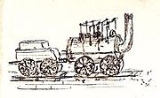
Locomotion No 1

Encyclopedia
Locomotion No. 1 is an early British steam locomotive
. Built by George
and Robert Stephenson
's company Robert Stephenson and Company
in 1825, it hauled the first train on the Stockton and Darlington Railway
on 27 September 1825.
. A pair of yokes above them transmitted the power downwards, through pairs of connecting rod
s. It was one of the first locomotive
s to use coupling rod
s rather than chains or gears to link its 0-4-0
wheel arrangement together. Otherwise it shows little innovation as a locomotive, other than being one of the most original engines, predating so called more advanced locomotives. and is more historically interesting for the railway on which it ran.
In 1828 the boiler exploded
, killing the driver. With advances in design such as those incorporated into Stephenson's Rocket
, Locomotion became obsolete very quickly. It was rebuilt and remained in service until 1841 when it was turned into a stationary engine
.
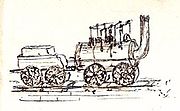 In 1857 it was preserved. Locomotion No. 1 was on display in Alfred Kitching's
workshop
near Hopetown Carriage Works
from 1857 to the 1880s. From 1892 to 1975 it was on display along with Derwent
on one of the platforms at Darlington's main station, Bank Top
. The locomotive is now on display at the Darlington Railway Centre and Museum
, located in the same building as Darlington's North Road railway station
, on long-term loan from the National Railway Museum
. It is now part of the National Collection. There is a working replica of the locomotive at Beamish Museum
.
Steam locomotive
A steam locomotive is a railway locomotive that produces its power through a steam engine. These locomotives are fueled by burning some combustible material, usually coal, wood or oil, to produce steam in a boiler, which drives the steam engine...
. Built by George
George Stephenson
George Stephenson was an English civil engineer and mechanical engineer who built the first public railway line in the world to use steam locomotives...
and Robert Stephenson
Robert Stephenson
Robert Stephenson FRS was an English civil engineer. He was the only son of George Stephenson, the famed locomotive builder and railway engineer; many of the achievements popularly credited to his father were actually the joint efforts of father and son.-Early life :He was born on the 16th of...
's company Robert Stephenson and Company
Robert Stephenson and Company
Robert Stephenson and Company was a locomotive manufacturing company founded in 1823. It was the first company set up specifically to build railway engines.- Foundation and early success :...
in 1825, it hauled the first train on the Stockton and Darlington Railway
Stockton and Darlington Railway
The Stockton and Darlington Railway , which opened in 1825, was the world's first publicly subscribed passenger railway. It was 26 miles long, and was built in north-eastern England between Witton Park and Stockton-on-Tees via Darlington, and connected to several collieries near Shildon...
on 27 September 1825.
Design
Locomotion used all the improvements that Stephenson had pioneered in the Killingworth locomotives. It used high-pressure steam from a centre-flue boiler, with a steam-blast in the chimney, to drive two vertical cylindersCylinder (engine)
A cylinder is the central working part of a reciprocating engine or pump, the space in which a piston travels. Multiple cylinders are commonly arranged side by side in a bank, or engine block, which is typically cast from aluminum or cast iron before receiving precision machine work...
. A pair of yokes above them transmitted the power downwards, through pairs of connecting rod
Connecting rod
In a reciprocating piston engine, the connecting rod or conrod connects the piston to the crank or crankshaft. Together with the crank, they form a simple mechanism that converts linear motion into rotating motion....
s. It was one of the first locomotive
Locomotive
A locomotive is a railway vehicle that provides the motive power for a train. The word originates from the Latin loco – "from a place", ablative of locus, "place" + Medieval Latin motivus, "causing motion", and is a shortened form of the term locomotive engine, first used in the early 19th...
s to use coupling rod
Coupling rod
right|thumb|connecting rod and coupling rods attached to a small locomotive driving wheelA coupling rod or side rod connects the driving wheels of a locomotive. Steam locomotives in particular usually have them, but some diesel and electric locomotives, especially older ones and shunters, also have...
s rather than chains or gears to link its 0-4-0
0-4-0
Under the Whyte notation for the classification of steam locomotives, 0-4-0 represents one of the simplest possible types, that with two axles and four coupled wheels, all of which are driven...
wheel arrangement together. Otherwise it shows little innovation as a locomotive, other than being one of the most original engines, predating so called more advanced locomotives. and is more historically interesting for the railway on which it ran.
In 1828 the boiler exploded
Boiler explosion
A boiler explosion is a catastrophic failure of a boiler. As seen today, boiler explosions are of two kinds. One kind is over-pressure in the pressure parts of the steam and water sides. The second kind is explosion in the furnace. Boiler explosions of pressure parts are particularly associated...
, killing the driver. With advances in design such as those incorporated into Stephenson's Rocket
Stephenson's Rocket
Stephenson's Rocket was an early steam locomotive of 0-2-2 wheel arrangement, built in Newcastle Upon Tyne at the Forth Street Works of Robert Stephenson and Company in 1829.- Design innovations :...
, Locomotion became obsolete very quickly. It was rebuilt and remained in service until 1841 when it was turned into a stationary engine
Stationary engine
A stationary engine is an engine whose framework does not move. It is normally used not to propel a vehicle but to drive a piece of immobile equipment such as a pump or power tool. They may be powered by steam; or oil-burning or internal combustion engines....
.
Preservation
William and Alfred Kitching
William and Alfred Kitching built steam locomotives at Darlington, England, in the 19th century. It is believed that their workshop was on, or near, the site of Hopetown Carriage Works.-Preservation:...
workshop
Workshop
A workshop is a room or building which provides both the area and tools that may be required for the manufacture or repair of manufactured goods...
near Hopetown Carriage Works
Hopetown Carriage Works
Hopetown Carriage Works, built in 1853 by Joseph Sparkes in Darlington, County Durham), England, was a workshop of the world's first publicly subscribed passenger railway, the 1825-63 Stockton and Darlington Railway, and also of the subsequent railway companies into which the SD&R was absorbed....
from 1857 to the 1880s. From 1892 to 1975 it was on display along with Derwent
Derwent (locomotive)
Derwent is an 0-6-0 steam locomotive built in 1845 by William and Alfred Kitching for the Stockton and Darlington Railway . It is preserved at Darlington Railway Centre and Museum.-Design:...
on one of the platforms at Darlington's main station, Bank Top
Darlington railway station
Darlington railway station, also known as Darlington Bank Top, is the main railway station for the town of Darlington, in the ceremonial county of County Durham, England. The station is located on the East Coast Main Line north of London Kings Cross....
. The locomotive is now on display at the Darlington Railway Centre and Museum
Darlington Railway Centre and Museum
Darlington Railway Centre and Museum, also known as Head of Steam, is located on the 1825 route of the Stockton and Darlington Railway which was the world's first steam powered passenger railway. Run by Darlington Borough Council the museum is located in the northern suburbs of Darlington in the...
, located in the same building as Darlington's North Road railway station
North Road railway station
North Road railway station serves the northern areas of Darlington and parts of southern County Durham, England. The station is on the Bishop Auckland branch of the Tees Valley Line and is operated by Northern Rail which provides all passenger train services on this line...
, on long-term loan from the National Railway Museum
National Railway Museum
The National Railway Museum is a museum in York forming part of the British National Museum of Science and Industry and telling the story of rail transport in Britain and its impact on society. It has won many awards, including the European Museum of the Year Award in 2001...
. It is now part of the National Collection. There is a working replica of the locomotive at Beamish Museum
Beamish Museum
Beamish, The North of England Open Air Museum is an open-air museum located at Beamish, near the town of Stanley, County Durham, England. The museum's guiding principle is to preserve an example of everyday life in urban and rural North East England at the climax of industrialisation in the early...
.