
All Topics  
Loch Ness Monster

 
Loch Ness Monster

   Email Print
   Bookmark   Link


Loch Ness Monster


The Loch Ness Monster is a creature alleged to inhabit Loch Ness
Loch Ness

Loch Ness is a large, deep, freshwater loch in the Scottish Highlands extending for approximately 37 km southwest of Inverness. Its surface is 15.8 metres above sea level....
 in the Scottish Highlands
Scottish Highlands

The Scottish Highlands include the rugged and mountainous regions of Scotland north and west of the Highland Boundary Fault, although the exact boundaries are not clearly defined, particularly to the east....
. It is similar to other supposed lake monster
Lake monster

Lake monster or loch monster is the name given to large unknown animals which have reportedly been sighted in, and/or are believed to dwell in fresh waters, although their existence has never been confirmed scientifically....
s in Scotland
Scotland

conventional_long_name = ScotlandAlba|common_name= Scotland|image_flag = Flag of Scotland.svg|flag_width = 130px...
 and elsewhere, though its description varies from one account to the next. Popular interest and belief in the animal has fluctuated since it was brought to the world's attention in 1933. Evidence of its existence is largely anecdotal, with minimal and much disputed photographic material and sonar
Sonar

Sonar is a technique that uses sound propagation to navigation, communicate with or detect other vessels. There are two kinds of sonar: active and passive....
 readings.


Discussion
Ask a question about 'Loch Ness Monster'
Start a new discussion about 'Loch Ness Monster'
Answer questions from other users
Full Discussion Forum


Recent Posts


Encyclopedia


The Loch Ness Monster is a creature alleged to inhabit Loch Ness
Loch Ness

Loch Ness is a large, deep, freshwater loch in the Scottish Highlands extending for approximately 37 km southwest of Inverness. Its surface is 15.8 metres above sea level....
 in the Scottish Highlands
Scottish Highlands

The Scottish Highlands include the rugged and mountainous regions of Scotland north and west of the Highland Boundary Fault, although the exact boundaries are not clearly defined, particularly to the east....
. It is similar to other supposed lake monster
Lake monster

Lake monster or loch monster is the name given to large unknown animals which have reportedly been sighted in, and/or are believed to dwell in fresh waters, although their existence has never been confirmed scientifically....
s in Scotland
Scotland

conventional_long_name = ScotlandAlba|common_name= Scotland|image_flag = Flag of Scotland.svg|flag_width = 130px...
 and elsewhere, though its description varies from one account to the next. Popular interest and belief in the animal has fluctuated since it was brought to the world's attention in 1933. Evidence of its existence is largely anecdotal, with minimal and much disputed photographic material and sonar
Sonar

Sonar is a technique that uses sound propagation to navigation, communicate with or detect other vessels. There are two kinds of sonar: active and passive....
 readings. The scientific community regards the Loch Ness Monster as a modern-day myth, and explains sightings as a mix of hoaxes and wishful thinking. Despite this, it remains one of the most famous examples of cryptozoology
Cryptozoology

Cryptozoology is a pseudoscience focused on the search for animals which are considered to be fictional or otherwise nonexistent by mainstream biology....
. The legendary monster has been affectionately referred to by the diminutive
Diminutive

In language structure, a diminutive, or diminutive form, is a formation of a word used to convey a slight degree of the root meaning, smallness of the object or quality named, encapsulation, intimacy, or endearment....
 Nessie since the 1950s.

Origins

The term "monster" was reportedly coined on 2 May 1933 by Alex Campbell, the water bailiff
Water bailiff

A water bailiff is a law enforcement officer responsible for the policing of bodies of water, such as a river, lake or coast. The position has existed in many jurisdictions throughout history....
 for Loch Ness and a part-time journalist, in a report in the Inverness Courier.. On 4 August 1933, the Courier published as a full news item the claim of a London man, George Spicer, that a few weeks earlier while motoring around the Loch, he and his wife had seen "the nearest approach to a dragon or pre-historic animal that I have ever seen in my life", trundling across the road toward the Loch carrying "an animal" in its mouth. Other letters began appearing in the Courier, often anonymously, with claims of land or water sightings, either on the writer's part or on the parts of family, acquaintances or stories they remembered being told. These stories soon reached the national (and later the international) press, which talked of a "monster fish", "sea serpent", or "dragon", eventually settling on "Loch Ness Monster". On 6 December 1933 the first purported photograph of the monster, taken by Hugh Gray, was published, and shortly after the creature received official notice when the Secretary of State for Scotland
Secretary of State for Scotland

The Secretary of State for Scotland is the principal Political minister of Her Majesty's Government in the United Kingdom with responsibilities for Scotland....
 ordered the police to prevent any attacks on it. In 1934, interest was further sparked by what is known as The Surgeon's Photograph. In the same year R. T. Gould published a book, the first of many which describe the author's personal investigation and collected record of additional reports pre-dating the summer of 1933. Other authors made claims that sightings of the monster went as far back as the 6th century (see below).

History


Saint Columba

The earliest report of a monster associated with the vicinity of Loch Ness appears in the Life of St. Columba by Adomnán, written sometime during the 7th century. According to Adomnán, writing about a century after the events he described, the Irish monk Saint Columba
Columba

Early life in IrelandColumba was born to Fedlimid and Eithne of the Cenel Conaill in Gartan, near Lough Gartan, County Donegal, in Ireland. On his father's side he was great-great-grandson of Niall of the Nine Hostages, an High King of Ireland of the 5th century....
 was staying in the land of the Picts
Picts

The Picts were a confederation of tribes in what was later to become eastern and northern Scotland from Roman Empire times until the 10th century....
 with his companions when he came across the locals burying a man by the River Ness
River Ness

The River Ness is a river flowing from Loch Ness in Scotland, north to Inverness and the Moray Firth.See also*Rivers of Scotland...
. They explained that the man had been swimming the river when he was attacked by a "water beast" that had mauled him and drug him under. They tried to rescue him in a boat, but were able only to drag up his corpse. Hearing this, Columba stunned the Picts by sending his follower Luigne moccu Min to swim across the river. The beast came after him, but Columba made the sign of the cross
Sign of the cross

The Sign of the Cross is a ritual hand motion made by members of most but not all branches of Christianity. It may be accompanied by the trinitarian formula....
 and commanded: "Go no further. Do not touch the man. Go back at once." The beast immediately halted as if it had been "pulled back with ropes" and fled in terror, and both Columba's men and the pagan Picts praised God for the miracle.

Believers in the Loch Ness Monster often point to this story, which notably takes place on the River Ness rather than the loch itself, as evidence for the creature's existence as early as the 6th century. However, skeptics question the narrative's reliability, noting that water-beast stories were extremely common in medieval saints' Lives; as such, Adomnán's tale is likely a recycling of a common motif attached to a local landmark. According to the skeptics, Adomnán's story may be independent of the modern Loch Ness Monster legend entirely, only becoming attached to it in retrospect by believers seeking to bolster their claims. Additionally, in an article for Cryptozoology, A. C. Thomas notes that even if there were some truth to the story, it could be explained rationally as an encounter with a walrus
Walrus

The walrus is a large pinniped marine mammal with a discontinuous circumpolar distribution in the Arctic Ocean and sub-Arctic seas of the Northern Hemisphere....
 or similar creature that had gotten up the river.

Spicers (1933)

Modern interest in the monster was sparked by the 22 July 1933 sighting, when George Spicer and his wife saw 'a most extraordinary form of animal' cross the road in front of their car. They described the creature as having a large body (about high and long), and long, narrow neck, slightly thicker than an elephant's trunk and as long as the ten- to twelve-feet (3.0–3.7 m) width of the road; the neck had a number of undulations in it. They saw no limbs, possibly because of a dip in the road obscuring the animal's lower portion. It lurched across the road towards the loch away, leaving only a trail of broken undergrowth in its wake.

In August 1933 a motorcyclist named Arthur Grant claimed to have nearly hit the creature while approaching Abriachan on the north-eastern shore, at about 1 am on a moonlit night. Grant claimed that he saw a small head attached to a long neck, and that the creature saw him and crossed the road back into the loch. Grant said he dismounted and followed it to the loch, but only saw ripples. However some believe this story was intended as a humorous explanation of a motorcycle accident.

In another 1933 sighting, a young maidservant named Margaret Munro supposedly observed the creature for about 20 minutes. She claimed it was about 6:30 am on 5 June, when she spotted it on shore from about . She described it as having elephant-like skin, a long neck, a small head and two short forelegs or flippers. The sighting apparently ended when the creature re-entered the water.

Sporadic land sightings continued until 1963, when a poor-quality film of the creature was made from a distance of several miles.

C.B. Farrel (1943)

In May 1943, C. B. Farrel of the Royal Observer Corps
Royal Observer Corps

The Royal Observer Corps was a civil defence organisation operating in the United Kingdom between 29 October 1925 and 31 December 1995, when the Corps' civilian volunteers were stood down....
 was supposedly distracted from his duties by a Nessie sighting. He claimed to have been about away from a large-eyed, 'finned' creature, which had a twenty- to thirty-foot (6–9 m) long body, and a neck that protruded about 4-5 feet (1.2-1.5 m) out of the water.

Sonar contact (1954)

In December 1954 a strange sonar contact was made by the fishing boat Rival III. The vessel's crew observed sonar readings of a large object keeping pace with the boat at a depth of . It was detected travelling for half a mile (800 m) in this manner, before contact was lost, but then found again later. Many sonar attempts had been made previously, but most were either inconclusive or negative.

Photographs and films


The 'Surgeon's Photograph' (1934)

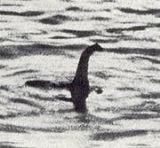
Lochnessmonster
One of the most iconic images of Nessie is known as the 'Surgeon's Photograph', which many formerly considered to be good evidence of the monster. Its importance lies in the fact that it was the only photographic evidence of a “head and neck” – all the others are humps or disturbances. The image was revealed as a hoax in 1994.

Supposedly taken by Robert Kenneth Wilson, a London gynaecologist, it was published in the Daily Mail
Daily Mail

The Daily Mail is a United Kingdom newspaper, currently published in a tabloid format. First published in 1896 by Alfred Harmsworth, 1st Viscount Northcliffe, it is the United Kingdom's second biggest-selling daily newspaper after The Sun ....
 on 21 April 1934. Wilson's refusal to have his name associated with the photograph led to its being called "Surgeon's Photograph". The photo is often cropped to make the monster seem huge, while the original uncropped shot shows the other end of the loch and the monster in the centre. The ripples on the photo fit the size and circular pattern of small ripples as opposed to large waves when photographed up close. Analyses of the original uncropped image have fostered further doubt. A year before the hoax was revealed, the makers of Discovery Communications
Discovery Communications

Discovery Communications, Inc. is an United States global media and entertainment company that was launched in 1985 and began as a single channel, Discovery Channel....
's documentary Loch Ness Discovered did an analysis of the uncropped image and found a white object evident in every version of the photo, implying that it was on the negative. "It seems to be the source of ripples in the water, almost as if the object was towed by something", the narrator said. "But science cannot rule out it was just a blemish on the negative", he continued. Additionally, analysis of the full photograph revealed the object to be quite small, only about 60 to 90 centimetre
Centimetre

A centimetre is a Units of measurement of length in the metric system, equal to one hundredth of a metre, which is the current International System of Units SI base unit of length....
s (two to three ft) long.

In 1979 it was claimed to be a picture of an elephant
Elephant

Elephants are large land mammals of the order Proboscidea and the family Elephantidae. There are three living species: the African Bush Elephant, the African Forest Elephant and the Asian Elephant ....
 (see below). Other sceptics in the 1980s argued the photo was that of an otter
Otter

Otters are semi-aquatic fish-eating mammals. The otter Rank Lutrinae forms part of the Family Mustelidae, which also includes weasels, polecats, badgers, as well as others....
 or a diving bird
Bird

Birds are wing, Bipedalismal, endothermic , vertebrate animals that lay egg . There are around 10,000 living species, making them the most numerous tetrapod vertebrates....
, but after Christian Spurling's confession most agree it was what Spurling claimed - a toy submarine with a sculpted head attached. The details of how it was done have been given in a book. Essentially, it was a toy submarine with a head and neck made of plastic wood, built by Christian Spurling, the son-in-law of Marmaduke Wetherell, a big game hunter who had been publicly ridiculed in the Daily Mail
Daily Mail

The Daily Mail is a United Kingdom newspaper, currently published in a tabloid format. First published in 1896 by Alfred Harmsworth, 1st Viscount Northcliffe, it is the United Kingdom's second biggest-selling daily newspaper after The Sun ....
, the newspaper that employed him. Spurling claimed that to get revenge, Marmaduke Wetherell committed the hoax, with the help of Chris Spurling (a sculpture specialist), his son Ian Marmaduke, who bought the material for the fake Nessie, and Maurice Chambers (an insurance agent), who would call to ask surgeon Robert Kenneth Wilson to offer the pictures to the Daily Mail. The hoax story is disputed by Henry Bauer
Henry Bauer

Henry H. Bauer is an emeritus professor of chemistry and science studies, and emeritus dean of the College of Arts and Sciences at Virginia Polytechnic Institute and State University ....
, who claims this debunking is evidence of bias, and asks why the perpetrators did not reveal their plot earlier to embarrass the newspaper. He also claimed that plastic wood did not exist in 1934, although it was a popular DIY and modelling material in the early 1930s.

Alastair Boyd, one of the researchers who uncovered the hoax, argues the Loch Ness Monster is real, and that the hoaxed Surgeon's Photo is not cause enough to dismiss eyewitness reports and other evidence.

Taylor film (1938)

In 1938, G.E. Taylor, a South African tourist, filmed something in the loch for three minutes on 16 mm colour film, which is now in the possession of Dr. Maurice Burton. However, Burton has refused to show the film to Loch Ness investigators (such as Peter Costello
Peter Costello (author)

Peter Costello is a Dublin-born author, historian and biographer. He attended the University of Michigan. He has written biographies of James Joyce, Flann O'Brien and Jules Verne....
 or the Loch Ness Investigation Bureau). A single frame was published in his book The Elusive Monster; before he retired. Dr. Roy P. Mackal
Roy Mackal

Roy P. Mackal is a retired University of Chicago biology best known to the general public for his interest in the Loch Ness Monster and other cryptozoology entities....
, a biologist and cryptozoologist, declared the frame to be "positive evidence". Later, it was shown also to the National Institute of Oceanography, now known as the Southampton Oceanographic Centre. It was agreed by the experts that the film clearly showed an ordinary inanimate object floating in the Loch.

Dinsdale film (1960)

In 1960, aeronautical engineer Tim Dinsdale
Tim Dinsdale

Timothy Dinsdale, Royal Aeronautical Society was famous as a seeker of the Loch Ness Monster. He attended The King's School, Worcester, served in the Royal Air Force and worked as an aeronautical engineer....
 filmed a hump crossing the water in a powerful wake unlike that of a boat. JARIC
JARIC

JARIC - The National Imagery Exploitation Centre, part of the Intelligence Collection Group within United Kingdom Defence Intelligence Staff, is a photographic interpretation and intelligence centre based at RAF Brampton near Huntingdon in Cambridgeshire....
 declared that the object was "probably animate". Others were sceptical, saying that the "hump" cannot be ruled out as being a boat, and claimed that when the contrast is increased a man can be clearly seen in a boat.

In 1993 Discovery Communications
Discovery Communications

Discovery Communications, Inc. is an United States global media and entertainment company that was launched in 1985 and began as a single channel, Discovery Channel....
 made a documentary called Loch Ness Discovered that featured a digital enhancement of the Dinsdale film. A computer expert who enhanced the film noticed a shadow in the negative which was not very obvious in the positive. By enhancing and overlaying frames, he found what appeared to be the rear body, the rear flippers, and 1-2 additional humps of a plesiosaur-like body. He said that: "Before I saw the film, I thought the Loch Ness Monster was a load of rubbish. Having done the enhancement, I'm not so sure". Some have countered this finding by saying that the angle of the film from the horizontal along with sun's angle on that day made shadows underwater unlikely. Believers (and some nonbelievers) claim the shape could have been undisturbed water that was only coincidentally shaped like a plesiosaur's rear end. But the same source also says that there might be a smaller object (hump or head) in front of the hump causing this. Nonetheless, the enhancement did show a smaller second hump and possibly a third hump.

Holmes video (2007)

On 26 May 2007, Gordon Holmes, a 55-year-old lab technician, captured video of what he said was "this jet black thing, about long, moving fairly fast in the water." Adrian Shine, a marine biologist at the Loch Ness 2000 centre in Drumnadrochit, has watched the video and plans to analyze it. Shine also described the footage as among "the best footage [he has] ever seen." BBC Scotland broadcast the video on 29 May 2007. STV
STV

STV is the brand used by both ITV licensees in Northern and Central Scotland, formerly known as Grampian Television and Scottish Television respectively....
 News' North Tonight aired the footage on 28 May 2007 and interviewed Holmes. In this feature, Adrian Shine of the Loch Ness Centre was also interviewed and suggested that the footage in fact showed an otter, seal or water bird.

Holmes's credibility has been doubted by an article on the Cryptomundo website, which states that he has a history of reporting sightings of cryptozoological
Cryptozoology

Cryptozoology is a pseudoscience focused on the search for animals which are considered to be fictional or otherwise nonexistent by mainstream biology....
 creatures, and sells a self-published book and DVD claiming evidence for fairies
Fairy

A fairy is a type of mythological being or legendary creature, a form of spirit, often described as spirit#Metaphysical and metaphorical uses, supernatural or preternatural....
. His video also has no other objects by which to discern size. The Monster Quest
Monster Quest

Monster Quest is a weekly American documentary television series that premiered on October 31, 2007 on History Channel. The program deals with the search for various cryptozoology creatures and paranormal entities reportedly witnessed around the world....
 team investigated this video as well, in their TV episode 'Death Of Loch Ness' where they examine the evidence that Nessie has died as well as other photos.

Searches for the monster


Sir Edward Mountain Expedition 1934

Having read the book by Gould, Edward Mountain decided to finance a proper watch in which 20 men with binoculars and cameras were positioned around the Loch from 9 a.m. to 6 p.m., starting 13 July 1934 and running for five weeks. Some 21 photographs were taken, though none was considered conclusive. Captain James Fraser was employed as a supervisor, and remained by the Loch afterwards, taking cine film (which is now lost) on 15 September 1934. When viewed by zoologists and professors of natural history it was concluded that it showed a seal, possibly a grey seal.

Loch Ness Phenomena Investigation Bureau (1962-1972)

The Loch Ness Phenomena Investigation Bureau (LNPIB) was a UK-based society formed in 1962 "to study Loch Ness to identify the creature known as the Loch Ness Monster or determine the causes of reports of it." It later shortened the name to Loch Ness Investigation Bureau (LNIB). It closed in 1972. The society had an annual subscription which covered administration. Its main activity was for groups of self-funded volunteers to watch the loch from various vantage points, equipped with cine cameras with telescopic lenses. Its founders included MP David James
David James (politician)

David Pelham James, Order of the British Empire, Distinguished Service Cross was a United Kingdom Conservative Party politician, author and adventurer....
 and naturalist Peter Scott
Peter Scott

Sir Peter Markham Scott, Order of the Companions of Honour, Order of the British Empire, Distinguished Service Cross , Royal Society, Zoological Society, was a United Kingdom ornithologist, conservationist, Painting, naval officer and sportsman....
. From 1965 to 1972 it had a caravan camp and main watching platform at Achnahannet
Achnahannet

Achnahannet is a hamlet located northwest of Dunain Bridge, in Grantown-on-Spey, in Morayshire, Scotland and is in the Scotland council area of Highland Council area....
, and sent observers to other locations up and down the loch. According to the 1969 Annual Report of the Bureau, it had 1,030 members, of whom 588 were from the UK. Its directors were listed as Norman Collins
Norman Collins

Norman Collins born 3 October 1907 was a United Kingdom writer, and later a radio and television executive, who became one of the major figures behind the establishment of the ITV network in the UK....
 (Chairman), Lord Craigmyle, Prof. Roy P. Mackal
Roy Mackal

Roy P. Mackal is a retired University of Chicago biology best known to the general public for his interest in the Loch Ness Monster and other cryptozoology entities....
, Richard Fitter
R.S.R. Fitter

Richard Sidney Richmond Fitter was a United Kingdom naturalist and author. He was an expert on Wildflowers and the author of several guides for amateur natural historys....
, David James, MP
David James (politician)

David Pelham James, Order of the British Empire, Distinguished Service Cross was a United Kingdom Conservative Party politician, author and adventurer....
, and Peter Scott
Peter Scott

Sir Peter Markham Scott, Order of the Companions of Honour, Order of the British Empire, Distinguished Service Cross , Royal Society, Zoological Society, was a United Kingdom ornithologist, conservationist, Painting, naval officer and sportsman....
.

The LNPIB sonar study (1967-1968)

Professor DG Tucker, chairman of the Department of Electronic and Electrical Engineering at the University of Birmingham
University of Birmingham

The University of Birmingham is a United Kingdom 'Red brick universities' university located in the city of Birmingham, England. Founded in Edgbaston in 1900 as a successor to Mason Science College, and with origins dating back to the 1825 Birmingham Medical School, it was the first of the so-called Red brick universities to receive a Royal...
, England, volunteered his services as a sonar
Sonar

Sonar is a technique that uses sound propagation to navigation, communicate with or detect other vessels. There are two kinds of sonar: active and passive....
 developer and expert at Loch Ness in 1968. The gesture was part of a larger effort helmed by the LNPIB from 1967-1968 and involved collaboration between volunteers and professionals in various fields. Tucker had chosen Loch Ness as the test site for a prototype sonar transducer with a maximum range of 800 metres (2600 ft). The device was fixed underwater at Temple Pier in Urquhart Bay and directed towards the opposite shore, effectively drawing an acoustic 'net' across the width of Ness through which no moving object could pass undetected. During the two-week trial in August, multiple animate targets six metres (20 ft) in length were identified ascending from and diving to the loch bottom. Analysis of diving profiles ruled out air-breathers because the targets never surfaced or moved shallower than midwater. A brief press release by LNPIB and associates touched on the sonar data and drew to a close the 1968 effort:

Andrew Carroll's sonar study (1969)

In 1969 Andrew Carroll, field researcher for the New York Aquarium
New York Aquarium

The New York Aquarium first opened on December 10, 1896, at Castle Garden in Battery Park, making it the oldest continually operating Public aquarium in the United States....
 in New York City, proposed a mobile sonar scan operation at Loch Ness. The project was funded by the Griffis foundation (named for Nixon Griffis, then a director of the aquarium). This was the tail-end (and most successful portion) of the LNPIB's 1969 effort involving submersible
Submersible

A submersible is a type of underwater vessel with limited mobility which is typically transported to its area of operation by a surface vessel or large submarine....
s with biopsy
Biopsy

A biopsy is a medical test involving the removal of Cell_s or Biological tissues for examination. It is the removal of tissue from a living subject to determine the presence or extent of a disease....
 harpoons. The trawling scan, in Carroll's research launch Rangitea, took place in October. One sweep of the loch made contact with a strong, animate echo for nearly three minutes just north of Foyers. The identity of the contact remains a mystery. Later analysis determined that the intensity of the returning echo was twice as great as that expected from a pilot whale
Pilot whale

The pilot whale is either of two species of cetacean in the genus Globicephala. The genus is part of the oceanic dolphin family although their behaviour is closer to that of the larger whales....
. Calculations placed the contact's length at .

Submersible investigations

Earlier submersible work had yielded dismal results. Under the sponsorship of World Book Encyclopedia
World Book Encyclopedia

File:World Book Encyclopedia logo.pngThe World Book Encyclopedia, published in the United States, is self-described as the "the number-one selling print encyclopedia in the world." The encyclopedia is designed to cover major areas of knowledge, however it shows particular strength in some fields....
, pilot Dan Taylor deployed the Viperfish at Loch Ness on 1 June 1969. His dives were plagued by technical problems and produced no new data. The Deep Star III built by General Dynamics
General Dynamics

General Dynamics Corporation is a defense conglomerate formed by mergers and divestitures, and as of 2008 it is the fifth largest defense contractor in the world....
 and an unnamed two-man submersible built by Westinghouse
Northrop Grumman Electronic Systems

Northrop Grumman Electronic Systems was created by Northrop Grumman acquisition of Westinghouse Electronic Systems Group in 1996. The Electronic Systems sector is a leading designer, developer, and manufacturer of a wide variety of advanced defense electronics and systems....
 were scheduled to sail but never did. It was only when the Pisces arrived at Ness that the LNPIB obtained new data. Owned by Vickers, Ltd.
Vickers Shipbuilding and Engineering Ltd

Vickers Shipbuilding and Engineering, Ltd was a shipbuilding based at Barrow-in-Furness, Cumbria in northwest England that built warships and armaments....
, the submersible had been rented out to produce a Sherlock Holmes film
The Private Life of Sherlock Holmes

The Private Life of Sherlock Holmes is a 1970 film directed and produced by Billy Wilder; he also shared writing credit with his longtime collaborator I.A.L....
 featuring a dummy Loch Ness Monster. When the dummy monster broke loose from the Pisces during filming and sank to the bottom of the loch, Vickers executives capitalized on the loss and 'monster fever' by allowing the sub to do a bit of exploring. During one of these excursions, the Pisces picked up a large moving object on sonar 200 feet (60 m) ahead and above the bottom of the loch. Slowly the pilot closed to half that distance but the echo moved rapidly out of sonar range and disappeared.

"Big Expedition" of 1970

During the so-called "Big Expedition" of 1970, Roy Mackal
Roy Mackal

Roy P. Mackal is a retired University of Chicago biology best known to the general public for his interest in the Loch Ness Monster and other cryptozoology entities....
, a biologist who taught for 20 years at the University of Chicago
University of Chicago

The University of Chicago is a private university located principally in the Hyde Park, Chicago neighborhood of Chicago. Although an older university by the same name existed prior to its founding, the modern University of Chicago credits its founding to the oil magnate John D....
, devised a system of hydrophone
Hydrophone

A hydrophone is a microphone designed to be used underwater for recording or listening to underwater sound. Most hydrophones are based on a piezoelectric transducer that generates electricity when subjected to a pressure change....
s (underwater microphones) and deployed them at intervals throughout the loch. In early August a hydrophone assembly was lowered into Urquhart Bay and anchored in 700 feet (215 m) of water. Two hydrophones were secured at depths of 300 and . After two nights of recording, the tape (sealed inside a 44 imperial gallon (55 US gal/200 L) steel drum along with the system's other sensitive components) was retrieved and played before an excited LNPIB. "Bird-like chirps" had been recorded, and the intensity of the chirps on the deep hydrophone suggested they had been produced at greater depth. In October "knocks" and "clicks" were recorded by another hydrophone in Urquhart Bay, indicative of echolocation
Animal echolocation

Echolocation, also called biosonar, is the biological sonar used by several animals such as dolphins, shrews, most bats, and most whales....
. These sounds were followed by a "turbulent swishing" suggestive of the tail locomotion of a large aquatic animal. The knocks, clicks and resultant swishing were believed to be the sounds of an animal echo-locating prey before moving in for the kill. The noises stopped whenever craft passed along the surface of the loch near the hydrophone -- and resumed once the craft reached a safe distance. In previous experiments, it was observed that call intensities were greatest at depths less than . Members of the LNPIB decided to attempt communication with the animals producing the calls by playing back previously recorded calls into the water and listening via hydrophone for results, which varied greatly. At times the calling patterns or intensities changed, but sometimes there was no change at all. Mackal noted that there was no similarity between the recordings and the hundreds of known sounds produced by aquatic animals. "More specifically," he said, "competent authorities state that none of the known forms of life in the loch has the anatomical capabilities of producing such calls."

Robert Rines's studies (1972, 1975 and 2001)

In the early 1970s, a group of people led by Robert H. Rines
Robert H. Rines

Robert H. Rines is a United States lawyer, inventor, researcher, and composer....
 obtained some underwater photographs. Two were rather vague images, perhaps of a rhomboid flipper (though others have dismissed the image as air bubbles or a fish fin). The alleged flipper was photographed in different positions, indicating movement. On the basis of these photographs, British naturalist Peter Scott
Peter Scott

Sir Peter Markham Scott, Order of the Companions of Honour, Order of the British Empire, Distinguished Service Cross , Royal Society, Zoological Society, was a United Kingdom ornithologist, conservationist, Painting, naval officer and sportsman....
 announced in 1975 that the scientific name of the monster would henceforth be Nessiteras rhombopteryx (Greek for "The Ness monster with diamond-shaped fin"). Scott intended that this would enable Nessie to be added to a British register of officially protected wildlife. Scottish politician Nicholas Fairbairn
Nicholas Fairbairn

Sir Nicholas Hardwick Fairbairn, Queen's Counsel was a United Kingdom Politician.He was the Scottish Conservative Party Member of Parliament for Kinross and Western Perthshire , elected in 1974 and 1979, and Perth , elected 1983, 1987, and 1992....
 pointed out that the name was an anagram
Anagram

An anagram is a type of word play, the result of rearranging the letters of a word or phrase to produce a new word or phrase, using all the original letters exactly once; e.g., orchestra = carthorse, Eleven plus two = Twelve plus one, A decimal point = I'm a dot in place....
 for "Monster hoax by Sir Peter S".

The underwater photos were reportedly obtained by painstakingly examining the loch depths with sonar for unusual underwater activity. A submersible camera with an affixed, high-powered light (necessary for penetrating Loch Ness' notorious murk) was deployed to record images below the surface. Several of the photographs, despite their obviously murky quality, did indeed seem to show an animal resembling a plesiosaur
Plesiosaur

Plesiosaurs were carnivore aquatic reptiles. After their discovery, they were somewhat fancifully said to have resembled , although they had no shell....
 in various positions and lightings. One photograph appeared to show the head, neck and upper torso of a plesiosaur-like animal. A rarely publicized photograph depicted two plesiosaur-like bodies. Another photo seemed to depict a horned "gargoyle head", consistent to that of several sightings of the monster. Some believe the latter to be a tree stump found during Operation Deepscan.

A few close-ups of what is to be the creature's supposed diamond-shaped fin were taken in different positions, as though the creature was moving. But the "flipper photograph" has been highly retouched from the original image. The Museum of Hoaxes
Museum of Hoaxes

The Museum of Hoaxes is a website created by Alex Boese in 1997 in San Diego, California as a resource for reporting and discussing hoaxes and urban legends, both past and present....
 shows the original unenhanced photo. Charlie Wyckoff claimed that someone retouched the photo to superimpose the flipper, and that the original enhancement showed a much smaller flipper. No one is exactly sure how the original came to be enhanced in this way.

In 2001, the Robert Rines' Academy of Applied Science videoed a powerful V-shaped wake traversing the still water on a calm day. The AAS also videotaped an object on the floor of the loch resembling a carcass, found marine clam-shells and a fungus not normally found in fresh water lakes, which they suggest gives some connection to the sea and a possible entry for Nessie.

In 2008, Rines expressed his fear that the monster may have become extinct
Extinction

In biology and ecology, extinction is the death of every member of a species or group of taxon. The moment of extinction is generally considered to be the death of the last individual of that species ....
 as a result of global warming
Global warming

Global warming is the increase in the Instrumental temperature record of the Earth's near-surface air and the oceans since the mid-twentieth century and its projected continuation....
, citing the lack of significant sonar readings and a decline in eyewitness accounts. Rines plans one one last expedition to look for remains of the monster before he gets too old.

Operation Deep Scan (1987)

In 1987, Operation Deepscan took place - the biggest sonar exploration of Loch Ness. Boats equipped with sonar were deployed across the whole width of the lake and they simultaneously sent out acoustic waves. BBC News reported that the scientists had made sonar contact with a large unidentified object of unusual size and strength. The researchers decided to return to the same spot and re-scan the area. After analysing the SONAR images, it seemed to point to debris at the bottom of the lake, although three of the pictures were of moving debris. Shine speculates that they could be seals that got into the lake, since they would be of about the same magnitude as the objects detected.

Discovery Loch Ness (1993)

In 1993 Discovery Communications
Discovery Communications

Discovery Communications, Inc. is an United States global media and entertainment company that was launched in 1985 and began as a single channel, Discovery Channel....
 began to research the ecology of the loch. The study did not focus entirely on the monster, but on the loch's nematode
Nematode

The "roundworms" or "nematodes" are the most diverse phylum of body cavity, and one of the most diverse of all animals. Nematode species are very difficult to distinguish; over 80,000 have been described, of which over 15,000 are parasite....
s (of which a new species was discovered) and fish. Expecting to find a small fish population, the researchers caught twenty fish in one catch, increasing previous estimates of the loch's fish population about ninefold.

Using sonar, the team encountered a kind of underwater disturbance (called a seiche
Seiche

A seiche is a standing wave in an enclosed or partially enclosed body of water. Seiches and seiche-related phenomena have been observed on lakes, Reservoir s, swimming pools, bays and seas....
) due to stored energy (such as from a wind) causing an imbalance between the loch's warmer and colder layers (known as the thermocline
Thermocline

The thermocline is a thin but distinct layer in a large body of fluid , in which temperature changes more rapidly with depth than it does in the layers above or below....
). While reviewing printouts of the event the next day, they found what appeared to be three sonar contacts, each followed by a powerful wake. These events were later shown on a program called Loch Ness Discovered, in conjunction with analyses and enhancements of the 1960 Dinsdale Film, the Surgeon's Photo, and the Rines Flipper Photo.

GUST expedition (2001)

A controversial expedition by the Global Underwater Search Team (GUST) was conducted with advanced sonar equipment to search for the creature. One night, a small sonar contact moved on the screen. On another occasion, a vague disturbance was captured on film. The expedition was shown on a program called Loch Ness Monster: Search for the Truth.

Explanations

A variety of explanations have been postulated over the years to account for sightings of the Loch Ness Monster. These may be categorized as: misidentifications of common animals; misidentifications of inanimate objects or effects; reinterpretations of traditional Scottish folklore; hoax
Hoax

A hoax is a deliberate attempt to dupe, deceive or deception an audience into believing, or accepting, that something is real, when in fact it is not; or that something is true, when in fact it is false....
es; and exotic species of large animals.

Misidentification of common animals


Bird wakes
There are wake sightings that occur when the loch is dead calm with no boat nearby. A bartender named David Munro claims to have witnessed a wake which he believed to be a creature zigzagging, diving and reappearing. (There were 26 other witnesses from a nearby car park.) Some sightings describe the onset of a V-shaped wake, as if there were something underwater. Moreover, many wake sightings describe something not conforming to the shape of a boat. Under dead calm conditions, a creature too small to be visible to the naked eye can leave a clear v-shaped wake. In particular, a group of swimming birds can give a wake and the appearance of an object. A group of birds can leave the water and then land again, giving a sequence of wakes like an object breaking the surface, which Dick Raynor says is a possible explanation for his film.

Eel
A giant eel
European eel

The European eel, Anguilla anguilla, is a snake-like, facultatively fish migration fish, which can reach in exceptional cases a length of 1? m, but is normally much smaller, about 60?80 cm, and rarely more than 1 m....
 was actually one of the first suggestions made. Eels are found in Loch Ness, and an unusually large eel would fit many sightings. This has been described as a conservative explanation. Eels are not known to protrude swanlike from the water and thus would not account for the head and neck sightings. Dinsdale dismissed the proposal because eels move in a side-to-side undulation. On May 2, 2001: Two conger eel
European conger

The European conger, Conger conger, is a conger of the family Congridae, found in the eastern Atlantic from Norway and Iceland to Senegal, and also in the Mediterranean and Black Sea, at depths down to 1170 m....
s were found on the shore of the loch, but since conger eels are saltwater animals and Loch Ness is a freshwater body of water, it is believed that they were put there to be seen as "Mini-Nessies".

Elephant
In a 1979 article, California biologist Dennis Power and geographer Donald Johnson claimed that the Surgeon's Photograph was in fact the top of the head, extended trunk and flared nostrils of a swimming elephant, probably photographed elsewhere and claimed to be from Loch Ness. In 2006, palaeontologist and artist Neil Clark similarly suggested that travelling circuses might have allowed elephants to refresh themselves in the loch and that the trunk could therefore be the head and neck, with the elephant's head and back providing the humps. In support of this he provided a painting.

Resident animals
When viewed through a telescope or binoculars with no outside reference, it is difficult to judge the size of an object in the water. Loch Ness has resident otters and pictures of them are given by Binns, which could be misinterpreted. Likewise he gives pictures of deer swimming in Loch Ness, and birds which could be taken as a "head and neck" sighting.

Seals
A number of photographs and a video have now been taken which confirm that seals have been present in the loch, for up to months at a time. In 1934 the Sir Edward Mountain expedition
Loch Ness Monster

The Loch Ness Monster is a creature alleged to inhabit Loch Ness in the Scottish Highlands. It is similar to other supposed lake monsters in Scotland and elsewhere, though its description varies from one account to the next....
 analysed film taken the same year and concluded that the monster was a species of seal
Pinniped

Pinnipeds or fin-footed mammals are a widely distributed and diverse group of semi-aquatic marine mammals comprising the families Odobenidae , Otariidae , and Phocidae ....
, which was reported in a national newspaper as "Loch Ness Riddle Solved - Official". A long-necked seal was advocated by Peter Costello
Peter Costello (author)

Peter Costello is a Dublin-born author, historian and biographer. He attended the University of Michigan. He has written biographies of James Joyce, Flann O'Brien and Jules Verne....
 for Nessie and for other reputed lake monsters. R.T. Gould wrote "A grey seal has a long and surprisingly extensible neck; it swims with a paddling action; its colour fits the bill; and there is nothing surprising in its being seen on the shore of the loch, or crossing a road." This explanation would cover sightings of lake monsters on land, during which the creature supposedly waddled into the lake upon being startled, in the manner of seals. Seals could also account for sonar traces which act as animate objects. Against this, it has been argued that all known species of pinniped
Pinniped

Pinnipeds or fin-footed mammals are a widely distributed and diverse group of semi-aquatic marine mammals comprising the families Odobenidae , Otariidae , and Phocidae ....
s are usually visible on land during daylight hours to sunbathe, something that Nessie is not known to do. However seals have been observed and photographed in Loch Ness and the sightings are sufficiently infrequent to allow for occasional visiting animals rather than a permanent colony.

Misidentifications of inanimate objects or effects


Trees
In 1933 the Daily Mirror showed a picture with the following caption 'This queerly-shaped tree-trunk, washed ashore at Foyers
Foyers

Foyers is the name of a village in the Highland Local government in Scotland Council areas of Scotland of Scotland, lying on the east shore of Loch Ness....
 may, it is thought, be responsible for the reported appearance of a "Monster"'. (Foyers is on Loch Ness.)

In a 1982 series of articles for New Scientist
New Scientist

New Scientist is a liberal weekly international science magazine and website covering recent developments in science and technology for a general English language-speaking audience....
, Dr Maurice Burton proposed that sightings of Nessie and similar creatures could actually be fermenting logs of Scots pine
Scots Pine

The Scots Pine is a species of pine native to Europe and Asia, ranging from Ireland, Great Britain and Portugal in the west, east to eastern Siberia, south to the Caucasus Mountains, and as far north as S?pmi ....
 rising to the surface of the loch's cold waters. Initially, a rotting log could not release gases caused by decay, because of high levels of resin
Resin

Resin is a hydrocarbon secretion of many plants, particularly Pinophyta. It is valued for its chemical constituents and uses, such as varnishes and adhesives, as an important source of raw materials for organic synthesis, or for incense and perfume....
 sealing in the gas. Eventually, the gas pressure would rupture a resin seal at one end of the log, propelling it through the water -- and sometimes to the surface. Burton claimed that the shape of tree logs with their attendant branch stumps closely resemble various descriptions of the monster.

Four Scottish lochs are very deep, including Morar
Loch Morar

Loch Morar is a freshwater loch in Morar, Lochaber, Highland , Scotland. It is the fifth largest loch in Scotland, with a surface area of . It is also the deepest freshwater body in the British Isles, with a maximum depth of ....
, Ness and Lomond
Loch Lomond

Loch Lomond , is a freshwater Scotland loch, lying on the Highland Boundary Fault. It is the largest lake in mainland Britain, by surface area, and contains many islands, including Inchmurrin, the largest fresh water island in the British Isles....
. Only the lochs with pinewoods on their shores have monster legends; Loch Lomond — with no pinewoods — does not. Gaseous emissions and surfactants resulting from the decay of the logs can cause the foamy wake reported in some sightings. Indeed, beached pine logs showing evidence of deep-water fermentation have been found. On the other hand, there are believers who assert that some lakes do have reports of monsters, despite an absence of pinewoods; a notable example would be the Irish
Ireland

Ireland is the List of islands by area in Europe, and the twentieth-largest island in the world. It lies to the north-west of continental Europe and is surrounded by hundreds of islands and islet....
 lough
Lough

A lough is a body of water and is either:* A lake.* A sea lough, which may be a fjord, estuary, bay, or sea inlet.It can also be used as a surname, with various pronunciations: law, loch, low, lowe, loth, loff....
 monsters.

Seiches and wakes
Lochnessurquhart
Loch Ness, because of its long, straight shape, is subject to some unusual occurrences affecting its surface. A seiche
Seiche

A seiche is a standing wave in an enclosed or partially enclosed body of water. Seiches and seiche-related phenomena have been observed on lakes, Reservoir s, swimming pools, bays and seas....
 is a large, regular oscillation of a lake, caused by a water reverting to its natural level after being blown to one end of the lake. The impetus from this reversion continues to the lake's windward end and then reverts back. In Loch Ness, the process occurs every 31.5 minutes.

Boat wake
Wake

A wake is the region of turbulence immediately to the rear of a solid body caused by the flow of air or water around the body.In fluid dynamics, a wake is the region of separated flow downstream of a solid body moving relative to the fluid, caused by the flow of liquid around the body....
s can also produce strange effects in the loch. As a wake spreads and divides from a boat passing the centre of the loch, it hits both sides almost simultaneously and deflects back to meet again in the middle. The movements interact to produce standing waves that are much larger than the original wake, and can have a humped appearance. By the time this occurs, the boat has passed and the unusual waves are all that can be seen.

Optical effects
Wind conditions can give a slightly choppy and thus matt appearance to the water, with occasional calm patches appearing as dark ovals (reflecting the mountains) from the shore, which can appear as humps to visitors unfamiliar with the lake. In 1979, Lehn showed that atmospheric refraction
Refraction

Refraction is the change in direction of a wave due to a change in its speed. This is most commonly observed when a wave passes from one optical medium to another....
 could distort the shape and size of objects and animals, and later showed a photograph of a rock mirage
Mirage

A mirage is a naturally occurring optical phenomenon in which light rays are bent to produce a displaced image of distant objects or the sky. The word comes to English via the French language mirage, from the Latin mirare, meaning "to look at, to wonder at"....
 on Lake Winnipeg
Lake Winnipeg

Lake Winnipeg is a very large lake in central North America, in the Provinces and territories of Canada of Manitoba, Canada, about north of the city of Winnipeg, Manitoba....
 which could represent a head and neck.

Seismic gas
The Italian geologist Luigi Piccardi has proposed geological explanations for some ancient legends and myths. He pointed out that in the earliest recorded sighting of a creature, the Life of St. Columba, the creature's emergence was accompanied "cum ingenti fremitu" (with very loud roaring). The Loch Ness is located along the Great Glen Fault
Great Glen Fault

The Great Glen Fault is a long geological fault that runs through its namesake the Great Glen in Scotland. However, the fault is actually much longer and over 400 million years old....
, and this could be a description of an earthquake. Furthermore, in many sightings, the report consists of nothing more than a large disturbance on the surface of the water. This could be caused by a release of gas from through the fault, although it could easily be mistaken for a large animal swimming just below the surface.

Folklore

Loch Ness Monster
According to the Swedish
Sweden

Sweden , officially the Kingdom of Sweden , is a Nordic countries on the Scandinavian Peninsula in Northern Europe. Sweden has land borders with Norway to the west and Finland to the northeast, and it is connected to Denmark by the ?resund Bridge in the south....
 naturalist
Natural history

Natural history is the scientific research of plants or animals, leaning more towards the observational than experimental methods of study, and encompasses more research that is published in magazines than in academic journals....
 and author Bengt Sjögren (1980), present day beliefs in lake monster
Lake monster

Lake monster or loch monster is the name given to large unknown animals which have reportedly been sighted in, and/or are believed to dwell in fresh waters, although their existence has never been confirmed scientifically....
s such as Nessie are associated with the old legends of kelpie
Kelpie

The kelpie is a supernatural water horse from Celtic folklore that is believed to haunt the rivers and lochs of Scotland and Ireland....
s. He claims that the accounts of loch monsters have changed over the ages, originally describing creatures with a horse
Horse

The horse is a hoofed mammal, a subspecies of one of seven extant species of the family Equidae. The horse has evolution of the horse over the past 45 to 55 million years from a small multi-toed creature into the large, odd-toed ungulate animal of today....
-like appearance; they claimed that the "kelpie" would come out of the lake and turn into a horse. When a tired traveller would get on the back of the kelpie, it would gallop into the loch and devour its prey. This myth successfully kept children away from the loch, as was its purpose. Sjögren concludes that the kelpie legends have developed into current descriptions of lake monsters, reflecting modern awareness of plesiosaur
Plesiosaur

Plesiosaurs were carnivore aquatic reptiles. After their discovery, they were somewhat fancifully said to have resembled , although they had no shell....
s. In other words, the kelpie of folklore
Folklore

Folklore is the body of expressive culture, including tales, music, dance, legends, oral history, proverbs, jokes, superstitions, customs, and so forth within a particular population comprising the traditions of that culture, subculture, or group ....
 has been transformed into a more "realistic" and "contemporary" notion of the creature. Believers counter that long-dead witnesses could only compare the creature to that with which they were familiar, and they were not familiar with plesiosaurs.

Specific mention of the kelpie as a water horse in Loch Ness was given in a Scottish newspaper in 1879, and was commemorated in the title of a book Project Water Horse by Tim Dinsdale
Tim Dinsdale

Timothy Dinsdale, Royal Aeronautical Society was famous as a seeker of the Loch Ness Monster. He attended The King's School, Worcester, served in the Royal Air Force and worked as an aeronautical engineer....
.

Hoaxes

The Loch Ness monster phenomenon has seen several attempts to hoax the public, some of which were very successful. Other hoaxes were revealed rather quickly by the perpetrators, or exposed after diligent research. A few examples are mentioned below. In the 1930s, a big game hunter named Marmaduke Wetherell went to Loch Ness to look for the Loch Ness Monster. He claimed to have found some footprints but when the footprints were sent to scientists for analysis, they turned out to be hippopotamus
Hippopotamus

The hippopotamus or hippo is a large, mostly herbivore African mammal, one of only two Extant taxon species in the scientific classification Hippopotamidae ....
 footprints. A prankster had used a hippopotamus foot umbrella stand to make the footprints.

On July 2, 2003: Gerald McSorely found a fossil supposedly belonging to Nessie when he tripped and fell into the lake. After examination, it became clear that the fossil wasn't from Loch Ness and that it had been planted there.

In 2004, a documentary team for television channel Five, using special effects experts from movies, tried to make people believe there was something in the loch. They constructed an animatronic model of a plesiosaur
Plesiosaur

Plesiosaurs were carnivore aquatic reptiles. After their discovery, they were somewhat fancifully said to have resembled , although they had no shell....
, and dubbed it "Lucy". Despite setbacks, such as Lucy falling to the bottom of the loch, about 600 sightings were reported in the places they conducted the hoaxes.

In 2005, two students claimed to have found a huge tooth embedded in the body of a deer on the loch shore. They publicised the find widely, even setting up a website, but expert analysis soon revealed that the "tooth" was the antler of a muntjac
Muntjac

Muntjac are deer of the genus Muntiacus, also known as Barking Deer. Muntjac are the oldest known deer, appearing 15-35 million years ago, with remains found in Miocene deposits in France and Germany....
. The Loch Ness tooth was a publicity stunt to promote a horror novel by Steve Alten
Steve Alten

Steve Alten is an United States science fiction author. He is best known for his Meg series, a set of novels positing the survival of large Megalodon sharks....
 titled, The Loch.

Exotic species of large animals


Plesiosaur
In 1933 the suggestion was made that the monster "bears a striking resemblance to the supposedly extinct plesiosaur
Plesiosaur

Plesiosaurs were carnivore aquatic reptiles. After their discovery, they were somewhat fancifully said to have resembled , although they had no shell....
", a long-necked aquatic reptile that went extinct
Extinction

In biology and ecology, extinction is the death of every member of a species or group of taxon. The moment of extinction is generally considered to be the death of the last individual of that species ....
 during the Cretaceous–Tertiary extinction event. At the time this was a popular explanation. The following arguments have been put against it:

  • Plesiosaurs were probably cold-blooded reptiles requiring warm tropical waters, while the average temperature of Loch Ness is only about 5.5 °C (42 °F). Even if the plesiosaurs were warm-blooded, they would require a food supply beyond that of Loch Ness to maintain the level of activity necessary for warm-blooded animals.
  • In October 2006, the New Scientist
    New Scientist

    New Scientist is a liberal weekly international science magazine and website covering recent developments in science and technology for a general English language-speaking audience....
     headlined an article "Why the Loch Ness Monster is no plesiosaur" because Leslie Noč of the Sedgwick Museum
    Sedgwick Museum of Earth Sciences

    The Sedgwick Museum of Earth Sciences, opened in 1904, is the geology museum of the University of Cambridge in England. The Sedgwick has a collection of more than 1 million Rock , Mineral and Fossil....
     in Cambridge
    Cambridge

    The city status in the United Kingdom of Cambridge is a College town and the administrative centre of the county of Cambridgeshire, England. It lies about 50 miles north of London....
     reported, "The osteology of the neck makes it absolutely certain that the plesiosaur could not lift its head up swan-like out of the water". However, this does not rule out the reports where a head and neck was not seen.
  • The loch is only about 10,000 years old, dating to the end of the last ice age. Prior to that date, the loch was frozen solid for about 20,000 years.
  • If creatures similar to plesiosaurs lived in the waters of the Loch Ness, they would be seen very frequently as they would have to surface several times a day to breathe.


In response to these criticisms, proponents such as Tim Dinsdale
Tim Dinsdale

Timothy Dinsdale, Royal Aeronautical Society was famous as a seeker of the Loch Ness Monster. He attended The King's School, Worcester, served in the Royal Air Force and worked as an aeronautical engineer....
, Peter Scott
Peter Scott

Sir Peter Markham Scott, Order of the Companions of Honour, Order of the British Empire, Distinguished Service Cross , Royal Society, Zoological Society, was a United Kingdom ornithologist, conservationist, Painting, naval officer and sportsman....
 and Roy Mackal
Roy Mackal

Roy P. Mackal is a retired University of Chicago biology best known to the general public for his interest in the Loch Ness Monster and other cryptozoology entities....
 postulate a marine creature which has become trapped and has evolved either from a plesiosaur or to the shape of a plesiosaur by convergent evolution
Convergent evolution

Convergent evolution describes the acquisition of the same biological trait in unrelated lineages.The wing is a classic example of convergent evolution in action....
.

Amphibian
R. T. Gould suggested something like a long-necked newt
Newt

A newt is a salamander that lives in the water as an adult. Newts occur in the Pleurodelinae subfamily , found in North America, Europe and Asia....
 and Roy Mackal
Roy Mackal

Roy P. Mackal is a retired University of Chicago biology best known to the general public for his interest in the Loch Ness Monster and other cryptozoology entities....
 discussed this possibility, giving it the highest score (88%) in his list of possible candidates.

Invertebrate
In 1968 Frank Holiday proposed that Nessie and other lake monsters such as Morag
Morag (loch monster)

Morag or M?rag is a lake monster reported to live in Loch Morar, Scotland. After Nessie herself, it is among the best known of Scotland's legendary monsters....
 could be explained by a giant invertebrate
Invertebrate

An invertebrate is an animal lacking a vertebral column. The group includes 98% of all animal species ? all animals except those in the Chordate subphylum vertebrate ....
, and cited the extinct Tullimonstrum as an example of the shape. He says this provides an explanation for land sightings and for the variable back shape, and relates it to the medieval description of dragon
Dragon

File:Ukiyo-e dragon 2.jpgThe dragon is a legendary creature with serpentine shape or otherwise reptilian traits that features in the mythology of many cultures....
s as "worms". Mackal considered this, but found it less convincing than eel, amphibian or plesiosaur types of animal.

Popular culture


See also

  • Bear Lake Monster
    Bear Lake Monster

    The Bear Lake monster is a mythological lake monster appearing in local folk-lore near Bear Lake , on the Utah-Idaho border.The myth originally grew from articles written in the 19th by Joseph C....
  • Bunyip
    Bunyip

    The bunyip is a Mythology animal from Australian folklore. Various accounts and explanations of bunyips have been given across Australia since the early days of the colonies....
  • Champ (legend)
    Champ (legend)

    Champ or Champy, is the name given to a reputed lake monster living in Lake Champlain, a natural freshwater lake in North America, partially situated across the United States-Canadian Border in the Canadian province of Quebec....
  • Chessie (sea monster)
    Chessie (sea monster)

    Chessie is a legendary sea monster said to live in the midst of the Chesapeake Bay. Over the years there have been many alleged sightings of a serpent-like creature with flippers as part of its body....
  • Gaasyendietha
    Gaasyendietha

    Gaasyendietha, according to Seneca nation mythology, is a dragon that dwells in the deep areas of rivers and lakes of Canada, especially Lake Ontario....
  • Lake monster
    Lake monster

    Lake monster or loch monster is the name given to large unknown animals which have reportedly been sighted in, and/or are believed to dwell in fresh waters, although their existence has never been confirmed scientifically....
  • Lake Tianchi Monster
    Lake Tianchi Monster

    Lake Tianchi Monster is the name given to what is said to be a lake monster that lives in Heaven Lake located in the peak of Baekdu Mountain within the Baekdudaegan and Changbai Mountains mountain ranges encompassing Jilin Province of China and Ryanggang Province of North Korea....
  • Lake Van Monster
    Lake Van Monster

    The Lake Van Monster was not reported until 1995 in Lake Van, a large alkaline lake in Eastern Turkey. There are now more than 1,000 people claiming to have witnessed the beast which is reported to measure around fifteen meters long with spikes on its back and appears similar to a Plesiosaur or Ichthyosaurus....
  • Leviathan
    Leviathan

    Leviathan , , is a Bible sea creature referred to in the Old Testament .The word leviathan has become synonymous with any large sea monster or creature....
  • Manipogo
    Manipogo

    Manipogo is the name given to the lake monster reported to live in Lake Manitoba, Manitoba, Canada. Sightings of this serpent like sea monster have been going on since roughly 1908....
  • Mokele-mbembe
    Mokčlé-mbčmbé

    Mok?l?-mb?mb?: meaning "one who stops the flow of rivers" in the Lingala language, is the name given to a large water dwelling cryptid found in legends and folklore of the Congo River basin....
  • Morag
    Morag (loch monster)

    Morag or M?rag is a lake monster reported to live in Loch Morar, Scotland. After Nessie herself, it is among the best known of Scotland's legendary monsters....
  • Nahuel Huapi Lake Monster
  • Ogopogo
    Ogopogo

    Ogopogo or Naitaka is the name given to a lake monster reported to live in Okanagan Lake, in British Columbia, Canada....
  • Sea monster
    Sea monster

    Sea monsters are sea-dwelling legendary creatures, often believed to be of immense size.Marine monsters can take many forms, including sea dragons, sea serpents, or multi-armed beasts; they can be slimy or scaly, often spouting jets of water....
  • Lourdes effect
    Lourdes effect

    The term Lourdes effect has been coined by the renown Belgian philosopher of science and skeptic Etienne Vermeersch to account for the fact that some supernatural powers seem to have a sort of resistance to manifesting themselves in a completely unambiguous fashion....
  • Tulpa
    Tulpa

    Tulpa is a Vajrayana, Bonpo and Tibetan Buddhist upaya concept, discipline and teaching tool. The term was first rendered into English as 'Thoughtform' by Evans-Wentz :...


Books

  • Gould, R. T., The Loch Ness Monster and Others, London, Geoffrey Bles, 1934 and paperback, Lyle Stuart, 1976, ISBN 0806505559
  • Whyte, Constance, More Than a Legend: The Story of the Loch Ness Monster, London, Hamish Hamilton, 1957
  • Dinsdale, Tim, Loch Ness Monster, London, Routledge & Kegan Paul, 1961, SBN 7100 1279 9
  • Burton, Maurice, The Elusive Monster: An Analysis of the Evidence from Loch Ness, London, Rupert Hart-Davis, 1961
  • Holiday, F. W., The Great Orm of Loch Ness, London, Faber & Faber, 1968, SBN 571 08473 7
  • Mackal, Roy P., The Monsters of Loch Ness, London, Futura, 1976, ISBN 0 8600 7381 5
  • Binns, Ronald, The Loch Ness Mystery Solved, Great Britain, Open Books, 1983, ISBN 0 7291 0139 8 and Star Books, 1984, ISBN 0-352-31487-7


External links