


Lew Lehr

Encyclopedia
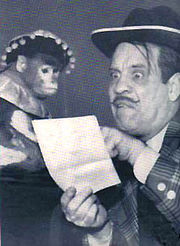
Born in Philadelphia, Pennsylvania
Philadelphia, Pennsylvania
Philadelphia is the largest city in the Commonwealth of Pennsylvania and the county seat of Philadelphia County, with which it is coterminous. The city is located in the Northeastern United States along the Delaware and Schuylkill rivers. It is the fifth-most-populous city in the United States,...
, Lehr appeared in vaudeville
Vaudeville
Vaudeville was a theatrical genre of variety entertainment in the United States and Canada from the early 1880s until the early 1930s. Each performance was made up of a series of separate, unrelated acts grouped together on a common bill...
and musical theater. In the early 1930s, he entered the short film business, notable for creating his Dribble Puss Parade film shorts. He was credited with at least 300 humorous newsreel
Newsreel
A newsreel was a form of short documentary film prevalent in the first half of the 20th century, regularly released in a public presentation place and containing filmed news stories and items of topical interest. It was a source of news, current affairs and entertainment for millions of moviegoers...
inserts and short films for over 25 years beginning in 1932.
Radio
Lehr began making radio guest appearances during the late 1930s. In addition to broadcasts with Ben BernieBen Bernie
Ben Bernie , born Bernard Anzelevitz, was an American jazz violinist and radio personality, often introduced as The Old Maestro. He was noted for his showmanship and memorable bits of snappy dialogue....
, he was one of the quizmasters on Detect and Collect (1935-36), filled in for Will Rogers in 1935 on Gulf Oil Headliners and took part in An Irving Berlin Tribute (1938). He was heard on You Asked for It (June 9, 1944), was a regular on the Camel Comedy Caravan
Camel Caravan
Camel Caravan was a musical variety radio program, sponsored by Camel cigarettes, that aired on NBC Radio and CBS Radio from 1933 to 1954...
of the early 1940s and later was one of the panelists on the 1947 revival of Stop Me If You've Heard This One
Stop Me If You've Heard This One
Stop Me If You've Heard This One was a comedy radio series, created by the actor-humorist Cal Tinney and sponsored by Quaker Oats. Hosted by Milton Berle, it aired Saturday evenings at 8:30pm on NBC beginning October 7, 1939.-Production history:The premise was that listeners received prizes for...
.
Between 1937 and 1948, he was caricatured in six Warner Bros. animated cartoons
Looney Tunes
Looney Tunes is a Warner Bros. animated cartoon series. It preceded the Merrie Melodies series and was Warner Bros.'s first animated theatrical series. Since its first official release, 1930's Sinkin' in the Bathtub, the series has become a worldwide media franchise, spawning several television...
: "She Was An Acrobat's Daughter" (1937), "Porky in Egypt" (1938), "The Sour Puss" (1940), "Russian Rhapsody" (1944), "Herr Meets Hare" (1945) and "Scaredy Cat
Scaredy Cat
Scaredy Cat is a 1948 Merrie Melodies cartoon, directed by Chuck Jones and produced and released by Warner Bros. Pictures. It was the first of three Jones cartoons which placed Porky Pig and Sylvester the cat in a spooky setting where only Sylvester was aware of the danger - the other two films...
" (1948). This caricature later appeared in the fall 2001 South Park
South Park
South Park is an American animated television series created by Trey Parker and Matt Stone for the Comedy Central television network. Intended for mature audiences, the show has become famous for its crude language, surreal, satirical, and dark humor that lampoons a wide range of topics...
episode spoofing wartime Warner Bros. cartoons, Osama bin Laden Has Farty Pants
Osama Bin Laden Has Farty Pants
"Osama bin Laden Has Farty Pants" is the ninth episode of the fifth season of the animated television series South Park, and the 74th episode of the series overall. It originally aired on Comedy Central in the United States on November 7, 2001; and is notable as the first episode to air after the...
.
Books
His books included Lew Lehr's Cookbook for Men (1949) and Stop Me If You've Heard This One (PermabooksPermabooks
Permabooks was a paperback division of Doubleday, established by Doubleday in 1948. Although published by Doubleday's Garden City Publishing Company in Garden City, Long Island, the Permabooks editorial office was located at 14 West 49th Street in Manhattan....
, 1949).
Lehr died in Brookline, Massachusetts
Brookline, Massachusetts
Brookline is a town in Norfolk County, Massachusetts, United States, which borders on the cities of Boston and Newton. As of the 2010 census, the population of the town was 58,732.-Etymology:...
in 1950.