
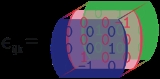
The
Levi-Civita symbol, also called the
permutationIn mathematics, the notion of permutation is used with several slightly different meanings, all related to the act of permuting objects or values. Informally, a permutation of a set of objects is an arrangement of those objects into a particular order...
symbol,
antisymmetric symbol, or
alternating symbol, is a
mathematicalMathematics is the study of quantity, space, structure, and change. Mathematicians seek out patterns and formulate new conjectures. Mathematicians resolve the truth or falsity of conjectures by mathematical proofs, which are arguments sufficient to convince other mathematicians of their validity...
symbol used in particular in tensor calculus. It is named after the
ItalianThe Italian people are an ethnic group that share a common Italian culture, ancestry and speak the Italian language as a mother tongue. Within Italy, Italians are defined by citizenship, regardless of ancestry or country of residence , and are distinguished from people...
mathematician and physicist
Tullio Levi-CivitaTullio Levi-Civita, FRS was an Italian mathematician, most famous for his work on absolute differential calculus and its applications to the theory of relativity, but who also made significant contributions in other areas. He was a pupil of Gregorio Ricci-Curbastro, the inventor of tensor calculus...
.
Definition
In three dimensions, the Levi-Civita symbol is defined as follows:

i.e.

is 1 if (
i,
j,
k) is an
even permutationIn mathematics, when X is a finite set of at least two elements, the permutations of X fall into two classes of equal size: the even permutations and the odd permutations...
of (1,2,3), −1 if it is an odd permutation, and 0 if any index is repeated.
The formula for the three dimensional Levi-Civita symbol is:

The formula in four dimensions is:
For example, in
linear algebraLinear algebra is a branch of mathematics that studies vector spaces, also called linear spaces, along with linear functions that input one vector and output another. Such functions are called linear maps and can be represented by matrices if a basis is given. Thus matrix theory is often...
, the
determinantIn linear algebra, the determinant is a value associated with a square matrix. It can be computed from the entries of the matrix by a specific arithmetic expression, while other ways to determine its value exist as well...
of a 3×3 matrix A can be written
(and similarly for a square matrix of general size, see below)
and the
cross productIn mathematics, the cross product, vector product, or Gibbs vector product is a binary operation on two vectors in three-dimensional space. It results in a vector which is perpendicular to both of the vectors being multiplied and normal to the plane containing them...
of two vectors can be written as a determinant:

or more simply:
According to the
Einstein notationIn mathematics, especially in applications of linear algebra to physics, the Einstein notation or Einstein summation convention is a notational convention useful when dealing with coordinate formulae...
, the summation symbols may be omitted.
The
tensorTensors are geometric objects that describe linear relations between vectors, scalars, and other tensors. Elementary examples include the dot product, the cross product, and linear maps. Vectors and scalars themselves are also tensors. A tensor can be represented as a multi-dimensional array of...
whose components in an
orthonormal basisIn mathematics, particularly linear algebra, an orthonormal basis for inner product space V with finite dimension is a basis for V whose vectors are orthonormal. For example, the standard basis for a Euclidean space Rn is an orthonormal basis, where the relevant inner product is the dot product of...
are given by the Levi-Civita symbol (a tensor of covariant rank n) is sometimes called the
permutation tensor. It is actually a
pseudotensorIn physics and mathematics, a pseudotensor is usually a quantity that transforms like a tensor under an orientation preserving coordinate transformation , but gains an additional sign flip under an orientation reversing coordinate transformation In physics and mathematics, a pseudotensor is usually...
because under an orthogonal transformation of jacobian determinant −1 (i.e., a rotation composed with a reflection), it acquires a minus sign. Because the Levi-Civita symbol is a pseudotensor, the result of taking a cross product is a
pseudovectorIn physics and mathematics, a pseudovector is a quantity that transforms like a vector under a proper rotation, but gains an additional sign flip under an improper rotation such as a reflection. Geometrically it is the opposite, of equal magnitude but in the opposite direction, of its mirror image...
, not a vector.
Note that under a general coordinate change, the components of the permutation tensor get multiplied by the jacobian of the transformation matrix. This implies that in coordinate frames different from the one in which the tensor was defined, its components can differ from those of the Levi-Civita symbol by an overall factor. If the frame is orthonormal, the factor will be ±1 depending on whether the orientation of the frame is the same or not.
Relation to Kronecker delta
The Levi-Civita symbol is related to the
Kronecker delta. In three dimensions, the relationship is given by the following equations:
-
-

("contracted epsilon identity")
In Einstein notationIn mathematics, especially in applications of linear algebra to physics, the Einstein notation or Einstein summation convention is a notational convention useful when dealing with coordinate formulae...
, the duplication of the i index implies the sum on i. The previous is then denoted: 

Generalization to n dimensions
The Levi-Civita symbol can be generalized to higher dimensions:
Thus, it is the sign of the permutationIn mathematics, when X is a finite set of at least two elements, the permutations of X fall into two classes of equal size: the even permutations and the odd permutations...
in the case of a permutation, and zero otherwise.
Some generalized formulae are:
where n is the dimension (rank), and
where G(n) is the Barnes G-functionIn mathematics, the Barnes G-function G is a function that is an extension of superfactorials to the complex numbers. It is related to the Gamma function, the K-function and the Glaisher-Kinkelin constant, and was named after mathematician Ernest William Barnes...
.
For any n, the property
follows from the facts that (a) every permutation is either even or odd, (b) (+1)2 = (-1)2 = 1, and (c) the permutations of any n-element set number exactly n!.
In index-free tensor notation, the Levi-Civita symbol is replaced by the concept of the Hodge dualIn mathematics, the Hodge star operator or Hodge dual is a significant linear map introduced in general by W. V. D. Hodge. It is defined on the exterior algebra of a finite-dimensional oriented inner product space.-Dimensions and algebra:...
.
In general, for n dimensions, one can write the product of two Levi-Civita symbols as:
.
Properties
(in these examples, superscripts should be considered equivalent with subscripts)
1. In two dimensions, when all
are in
,
-

2. In three dimensions, when all
are in
-

3. In n dimensions, when all
are in
:
-

Proofs
For equation 1, both sides are antisymmetricThe word antisymmetric refers to a change to an opposite quantity when another quantity is symmetrically changed. This concept is related to that of Symmetry and Asymmetry. The difference between these three concepts can be simply illustrated with Latin letters. The character "A" is symmetric about...
with respect of
and
. We therefore only need to consider the case
and
. By substitution, we see that the equation holds for
, i.e., for
and
. (Both sides are then one). Since the equation is antisymmetric in
and
, any set of values for these can be reduced to the above case (which holds). The equation thus holds for all values of
and
. Using equation 1, we have for equation 2
-
-
.
Here we used the Einstein summation convention with
going from
to
. Equation 3 follows similarly from equation 2. To establish equation 4, let us first observe that both sides vanish when
. Indeed, if
, then one can not choose
and
such that both permutation symbols on the left are nonzero. Then, with
fixed, there are only two ways to choose
and
from the remaining two indices. For any such indices, we have
(no summation), and the result follows. Property (5) follows since
and for any distinct indices
in
, we have
(no summation).
Examples
1. The determinant of an
matrix
can be written as
-

where each
should be summed over 
Equivalently, it may be written as
-

where now each
and each
should be summed over
.
2. If
and
are vectors in
(represented in some right hand oriented orthonormal basis), then the
th component of their cross product equals
-

For instance, the first component of
is
. From the above expression for the cross product, it is clear that
. Further, if
is a vector like
and
, then the triple scalar product equals
-

From this expression, it can be seen that the triple scalar product is antisymmetric when exchanging any adjacent arguments. For example,
.
3. Suppose
is a vector field defined on some open set of
with Cartesian coordinates
. Then the
th component of the curl of
equals
-

Notation
A shorthand notation for anti-symmetrization is denoted by a pair of square brackets. For example, in arbitrary dimensions, for a rank 2 covariant tensor M,
and for a rank 3 covariant tensor T,
In three dimensions, these are equivalent to

While in four dimensions, these are equivalent to

More generally, in n dimensions
Tensor density
In any arbitrary curvilinear coordinate system and even in the absence of a metric on the manifold, the Levi-Civita symbol as defined above may be considered to be a tensor densityIn differential geometry, a tensor density or relative tensor is a generalization of the tensor concept. A tensor density transforms as a tensor when passing from one coordinate system to another , except that it is additionally multiplied or weighted by a power of the Jacobian determinant of the...
field in two different ways. It may be regarded as a contravariant tensor density of weight +1 or as a covariant tensor density of weight -1. In four dimensions,
Notice that the value, and in particular the sign, does not change.
Ordinary tensor
In the presence of a metric tensorIn the mathematical field of differential geometry, a metric tensor is a type of function defined on a manifold which takes as input a pair of tangent vectors v and w and produces a real number g in a way that generalizes many of the familiar properties of the dot product of vectors in Euclidean...
field, one may define an ordinary contravariant tensor field which agrees with the Levi-Civita symbol at each event whenever the coordinate system is such that the metric is orthonormal at that event. Similarly, one may also define an ordinary covariant tensor field which agrees with the Levi-Civita symbol at each event whenever the coordinate system is such that the metric is orthonormal at that event. These ordinary tensor fields should not be confused with each other, nor should they be confused with the tensor density fields mentioned above. One of these ordinary tensor fields may be converted to the other by raising or lowering the indices with the metric as is usual, but a minus sign is needed if the metric signatureThe signature of a metric tensor is the number of positive and negative eigenvalues of the metric. That is, the corresponding real symmetric matrix is diagonalised, and the diagonal entries of each sign counted...
contains an odd number of negatives. For example, in Minkowski spaceIn physics and mathematics, Minkowski space or Minkowski spacetime is the mathematical setting in which Einstein's theory of special relativity is most conveniently formulated...
(the four dimensional spacetime of special relativitySpecial relativity is the physical theory of measurement in an inertial frame of reference proposed in 1905 by Albert Einstein in the paper "On the Electrodynamics of Moving Bodies".It generalizes Galileo's...
)

Notice the minus sign.