

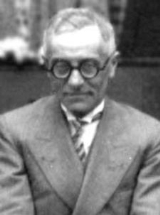
Tullio Levi-Civita

Encyclopedia
Tullio Levi-Civita, FRS (29 March 1873 — 29 December 1941; ˈleːvi ˈtʃiːvita) was an Italian
mathematician
, most famous for his work on absolute differential calculus (tensor calculus) and its applications to the theory of relativity
, but who also made significant contributions in other areas. He was a pupil of Gregorio Ricci-Curbastro
, the inventor of tensor calculus. His work included foundational papers in both pure and applied mathematics, celestial mechanics
(notably on the three-body problem
) and hydrodynamics.
, Levi-Civita was the son of Giacomo Levi-Civita, a lawyer and former senator
. He graduated in 1892 from the University of Padua
Faculty of Mathematics. In 1894 he earned a teaching diploma after which he was appointed to the Pavia Faculty of Science teacher's college. In 1898 he was appointed to the Padua Chair of Rational Mechanics where he met and, in 1914, married Libera Trevisani, one of his pupils. He remained in his position at Padua until 1918, when he was appointed to the Chair of Higher Analysis at the University of Rome
; in another two years he was appointed to the Chair of Mechanics there.
In 1900 he and Ricci-Curbastro published the theory of tensor
s in Méthodes de calcul différentiel absolu et leurs applications, which Albert Einstein
used as a resource to master the tensor calculus, a critical tool in Einstein's development of the theory of general relativity
. Levi-Civita's series of papers on the problem of a static gravitational field
were also discussed in his 1915–1917 correspondence with Einstein. The correspondence was initiated by Levi-Civita, as he found mathematical errors in Einstein's use of tensor calculus to explain theory of relativity. Levi-Civita methodically kept all of Einstein's replies to him, and even though Einstein hadn't kept Levi-Civita's, the entire correspondence could be re-constructed from Levi-Civita's archive. It's evident from these letters that, after numerous letters, the two men had grown to respect each other. In one of the letters, regarding Levi-Civita's new work, Einstein wrote "I admire the elegance of your method of computation; it must be nice to ride through these fields upon the horse of true mathematics while the like of us have to make our way laboriously on foot". In 1933 Levi-Civita contributed to Paul Dirac
's equations in quantum mechanics
as well.
His textbook on tensor calculus, The Absolute Differential Calculus (originally a set of lecture notes in Italian co-authored with Ricci-Curbastro), remains one of the standard texts more than a century after its first publication, with several translations available.
The 1938 race laws enacted by the Italian Fascist government deprived Levi-Civita of his professorship and of his membership of all scientific societies. Isolated from the scientific world, he died in his apartment in Rome in 1941.
Among his Ph.D. students were Octav Onicescu
and Gheorghe Vrânceanu
.
Later on, when asked what he liked best about Italy, Einstein said "spaghetti and Levi-Civita".
. He developed the Levi-Civita field
, a system of numbers that includes infinitesimal
quantities.
The Royal Society
awarded him the Sylvester Medal
in 1922 and elected him as a fellow in 1930. He became an honorary member of the London Mathematical Society
, of the Royal Society of Edinburgh
, and of the Edinburgh Mathematical Society
, following his participation in their colloquium in 1930 at the University of St Andrews
. He was also a member of the Accademia dei Lincei
and the Pontifical Academy of Sciences
.
Like Vito Volterra
, being Jewish and an anti-fascist, he was expelled from the Academy in his country.
Italy
Italy , officially the Italian Republic languages]] under the European Charter for Regional or Minority Languages. In each of these, Italy's official name is as follows:;;;;;;;;), is a unitary parliamentary republic in South-Central Europe. To the north it borders France, Switzerland, Austria and...
mathematician
Mathematician
A mathematician is a person whose primary area of study is the field of mathematics. Mathematicians are concerned with quantity, structure, space, and change....
, most famous for his work on absolute differential calculus (tensor calculus) and its applications to the theory of relativity
Theory of relativity
The theory of relativity, or simply relativity, encompasses two theories of Albert Einstein: special relativity and general relativity. However, the word relativity is sometimes used in reference to Galilean invariance....
, but who also made significant contributions in other areas. He was a pupil of Gregorio Ricci-Curbastro
Gregorio Ricci-Curbastro
Gregorio Ricci-Curbastro was an Italian mathematician. He was born at Lugo di Romagna. He is most famous as the inventor of the tensor calculus but published important work in many fields....
, the inventor of tensor calculus. His work included foundational papers in both pure and applied mathematics, celestial mechanics
Celestial mechanics
Celestial mechanics is the branch of astronomy that deals with the motions of celestial objects. The field applies principles of physics, historically classical mechanics, to astronomical objects such as stars and planets to produce ephemeris data. Orbital mechanics is a subfield which focuses on...
(notably on the three-body problem
Three-body problem
Three-body problem has two distinguishable meanings in physics and classical mechanics:# In its traditional sense the three-body problem is the problem of taking an initial set of data that specifies the positions, masses and velocities of three bodies for some particular point in time and then...
) and hydrodynamics.
Biography
Born into an Italian Jewish family in PaduaPadua
Padua is a city and comune in the Veneto, northern Italy. It is the capital of the province of Padua and the economic and communications hub of the area. Padua's population is 212,500 . The city is sometimes included, with Venice and Treviso, in the Padua-Treviso-Venice Metropolitan Area, having...
, Levi-Civita was the son of Giacomo Levi-Civita, a lawyer and former senator
Italian Senate
The Senate of the Republic is the upper house of the Italian Parliament. It was established in its current form on 8 May 1948, but previously existed during the Kingdom of Italy as Senato del Regno , itself a continuation of the Senato Subalpino of Sardinia-Piedmont established on 8 May 1848...
. He graduated in 1892 from the University of Padua
University of Padua
The University of Padua is a premier Italian university located in the city of Padua, Italy. The University of Padua was founded in 1222 as a school of law and was one of the most prominent universities in early modern Europe. It is among the earliest universities of the world and the second...
Faculty of Mathematics. In 1894 he earned a teaching diploma after which he was appointed to the Pavia Faculty of Science teacher's college. In 1898 he was appointed to the Padua Chair of Rational Mechanics where he met and, in 1914, married Libera Trevisani, one of his pupils. He remained in his position at Padua until 1918, when he was appointed to the Chair of Higher Analysis at the University of Rome
University of Rome La Sapienza
The Sapienza University of Rome, officially Sapienza – Università di Roma, formerly known as Università degli studi di Roma "La Sapienza", is a coeducational, autonomous state university in Rome, Italy...
; in another two years he was appointed to the Chair of Mechanics there.
In 1900 he and Ricci-Curbastro published the theory of tensor
Tensor
Tensors are geometric objects that describe linear relations between vectors, scalars, and other tensors. Elementary examples include the dot product, the cross product, and linear maps. Vectors and scalars themselves are also tensors. A tensor can be represented as a multi-dimensional array of...
s in Méthodes de calcul différentiel absolu et leurs applications, which Albert Einstein
Albert Einstein
Albert Einstein was a German-born theoretical physicist who developed the theory of general relativity, effecting a revolution in physics. For this achievement, Einstein is often regarded as the father of modern physics and one of the most prolific intellects in human history...
used as a resource to master the tensor calculus, a critical tool in Einstein's development of the theory of general relativity
General relativity
General relativity or the general theory of relativity is the geometric theory of gravitation published by Albert Einstein in 1916. It is the current description of gravitation in modern physics...
. Levi-Civita's series of papers on the problem of a static gravitational field
Gravitational field
The gravitational field is a model used in physics to explain the existence of gravity. In its original concept, gravity was a force between point masses...
were also discussed in his 1915–1917 correspondence with Einstein. The correspondence was initiated by Levi-Civita, as he found mathematical errors in Einstein's use of tensor calculus to explain theory of relativity. Levi-Civita methodically kept all of Einstein's replies to him, and even though Einstein hadn't kept Levi-Civita's, the entire correspondence could be re-constructed from Levi-Civita's archive. It's evident from these letters that, after numerous letters, the two men had grown to respect each other. In one of the letters, regarding Levi-Civita's new work, Einstein wrote "I admire the elegance of your method of computation; it must be nice to ride through these fields upon the horse of true mathematics while the like of us have to make our way laboriously on foot". In 1933 Levi-Civita contributed to Paul Dirac
Paul Dirac
Paul Adrien Maurice Dirac, OM, FRS was an English theoretical physicist who made fundamental contributions to the early development of both quantum mechanics and quantum electrodynamics...
's equations in quantum mechanics
Quantum mechanics
Quantum mechanics, also known as quantum physics or quantum theory, is a branch of physics providing a mathematical description of much of the dual particle-like and wave-like behavior and interactions of energy and matter. It departs from classical mechanics primarily at the atomic and subatomic...
as well.
His textbook on tensor calculus, The Absolute Differential Calculus (originally a set of lecture notes in Italian co-authored with Ricci-Curbastro), remains one of the standard texts more than a century after its first publication, with several translations available.
The 1938 race laws enacted by the Italian Fascist government deprived Levi-Civita of his professorship and of his membership of all scientific societies. Isolated from the scientific world, he died in his apartment in Rome in 1941.
Among his Ph.D. students were Octav Onicescu
Octav Onicescu
Octav Onicescu was a Romanian mathematician, member of the Romanian Academy, and founder of the Romanian school of probability theory and statistics.-Biography:...
and Gheorghe Vrânceanu
Gheorghe Vranceanu
Gheorghe Vrânceanu was a Romanian mathematician, best known for his work in differential geometry and topology....
.
Later on, when asked what he liked best about Italy, Einstein said "spaghetti and Levi-Civita".
Other studies and honors
Analytic dynamics was another aspect of Levi-Civita's studies: many of his articles examine the three body problem. He wrote articles on hydrodynamics and on systems of differential equations. He is credited with improvements to the Cauchy–Kowalevski theorem, on which he wrote a book in 1931. In 1933, he contributed to work on the Dirac equationDirac equation
The Dirac equation is a relativistic quantum mechanical wave equation formulated by British physicist Paul Dirac in 1928. It provided a description of elementary spin-½ particles, such as electrons, consistent with both the principles of quantum mechanics and the theory of special relativity, and...
. He developed the Levi-Civita field
Levi-Civita field
In mathematics, the Levi-Civita field, named after Tullio Levi-Civita, is a non-Archimedean ordered field, i.e., a system of numbers containing infinite and infinitesimal quantities...
, a system of numbers that includes infinitesimal
Infinitesimal
Infinitesimals have been used to express the idea of objects so small that there is no way to see them or to measure them. The word infinitesimal comes from a 17th century Modern Latin coinage infinitesimus, which originally referred to the "infinite-th" item in a series.In common speech, an...
quantities.
The Royal Society
Royal Society
The Royal Society of London for Improving Natural Knowledge, known simply as the Royal Society, is a learned society for science, and is possibly the oldest such society in existence. Founded in November 1660, it was granted a Royal Charter by King Charles II as the "Royal Society of London"...
awarded him the Sylvester Medal
Sylvester Medal
The Sylvester Medal is a bronze medal awarded by the Royal Society for the encouragement of mathematical research, and accompanied by a £1,000 prize...
in 1922 and elected him as a fellow in 1930. He became an honorary member of the London Mathematical Society
London Mathematical Society
-See also:* American Mathematical Society* Edinburgh Mathematical Society* European Mathematical Society* List of Mathematical Societies* Council for the Mathematical Sciences* BCS-FACS Specialist Group-External links:* * *...
, of the Royal Society of Edinburgh
Royal Society of Edinburgh
The Royal Society of Edinburgh is Scotland's national academy of science and letters. It is a registered charity, operating on a wholly independent and non-party-political basis and providing public benefit throughout Scotland...
, and of the Edinburgh Mathematical Society
Edinburgh Mathematical Society
The Edinburgh Mathematical Society is the leading mathematical society in Scotland.The Society was founded in 1883 by a group of Edinburgh schoolteachers and academics, on the initiative of A. Y. Fraser and A. J. G. Barclay, teachers at George Watson's College and Cargill Gilston Knott, who was the...
, following his participation in their colloquium in 1930 at the University of St Andrews
University of St Andrews
The University of St Andrews, informally referred to as "St Andrews", is the oldest university in Scotland and the third oldest in the English-speaking world after Oxford and Cambridge. The university is situated in the town of St Andrews, Fife, on the east coast of Scotland. It was founded between...
. He was also a member of the Accademia dei Lincei
Accademia dei Lincei
The Accademia dei Lincei, , is an Italian science academy, located at the Palazzo Corsini on the Via della Lungara in Rome, Italy....
and the Pontifical Academy of Sciences
Pontifical Academy of Sciences
The Pontifical Academy of Sciences is a scientific academy of the Vatican, founded in 1936 by Pope Pius XI. It is placed under the protection of the reigning Supreme Pontiff. Its aim is to promote the progress of the mathematical, physical and natural sciences and the study of related...
.
Like Vito Volterra
Vito Volterra
Vito Volterra was an Italian mathematician and physicist, known for his contributions to mathematical biology and integral equations....
, being Jewish and an anti-fascist, he was expelled from the Academy in his country.
Writings
- Tullio Levi-Civita and Ugo Amaldi Lezioni di meccanica razionale (Bologna: N. Zanichelli, 1923)
- Tullio Levi-Civita and Enrico Persico Fondamenti di meccanica relativistica ( Bologna : N. Zanichelli, 1928)
- Tullio Levi-Civita Lezioni di calcolo differenziale assoluto (1925)
- Tullio Levi-Civita Caratteristiche e propagazione ondosa
- Tullio Levi-Civita Questioni di meccanica classica e relativistica ( Bologna, N. Zanichelli, 1924)
- Tullio Levi Problème des N Corps en relativité générale (Gauthier-Villars, Paris, 1950, Mémorial des sciences mathématiques ISSN: 0025-9187)
- Tullio Levi-Civita and Ugo Amaldi Nozioni di balistica esterna