

Legal death

Encyclopedia
- This article is about the legal status of a moribund patient under medical examination. For declarations of death on a missing person see Death in absentiaDeath in absentiaDeath in absentia is a legal declaration that a person is deceased in the absence of remains attributable to that person...
. The article about usurpation-through-declaration-of-death is Association of the DeadAssociation of the DeadThe Uttar Pradesh Association of Dead People is a northern Indian pressure group that seeks to reclaim the legal rights of those falsely listed by the government as being dead....
.
Legal death is a legal pronouncement by a qualified person that further medical care is not appropriate and that a patient should be considered dead under the law. The specific criteria used to pronounce legal death are variable and often depend on certain circumstances in order to pronounce a person legally dead. Controversy is often encountered due to the conflicts between moral and ethical values.
The increasing demand for organs for organ transplantation is a major focus of concern due to the increasing technological advances in medical equipment
Medical equipment
Medical equipment is designed to aid in the diagnosis, monitoring or treatment of medical conditions.-Types:There are several basic types:* Diagnostic equipment includes medical imaging machines, used to aid in diagnosis...
. These advances are causing further questions on the actual definition of death
Death
Death is the permanent termination of the biological functions that sustain a living organism. Phenomena which commonly bring about death include old age, predation, malnutrition, disease, and accidents or trauma resulting in terminal injury....
. With so many questions revolving around the issues of legal death, declaring a person legally dead in many cases becomes far more than just a medical concern as it involves ethical concerns as well.
Organ transplants
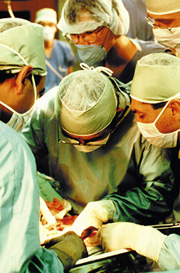
In the article Education and Debate written by Robert Francis, the ethical debate concerning the elective ventilation of an unconscious patient is discussed and by many standards is found to be unlawful. Francis states, "There is a distinction between the rights in respect of a dead body and a living patient." According to the law, it is permitted to remove organs from a body after death assuming that the statutory requirements are complied with. But the ethical concern comes into question whenever a patient is unable to give consent to receive medical treatment. At what point can medical treatment be withheld from a patient without their consent?
In the case of a patient who is unable to give permission for medical treatment, treatment can be given to the patient if it is in his or her best interests. This permission of medical treatment comes from the legal doctrine of necessity, which states that it is lawful to intervene in the affairs of another person without their consent, granted that the intervention is intended for that person’s benefit. In many cases, however, treatment is unable to cure the patient’s condition, and consequently, according to judicial suggestions, "a doctor has a duty to discontinue the artificial prolongation of life where this ceases to have any therapeutic point". According to this principle, elective ventilation of an unconscious dying patient is not justified because they are being medically treated, not by their consent or for their own benefit (as the principle states), but instead for the sole reason of preserving the organs for donation.
Paragraph 22, of the 1983 Code of Practice, makes it clear that in regard to continuing medical practice on the patient, "[Treatment] must be for the patient’s benefit." By keeping the patient alive it is not the patient who is benefiting, but rather the person receiving the organ donation. However, medical procedures can be given to an unconscious dying patient only with valid consent. In a case where a child under the age of 16 is found unconscious and dying, valid consent may be given by the parents of the child to authorize medical treatment. But, once again, this treatment may not be granted to the child if it is found that it is not in his or her best interests. In regards to medical procedures being rendered lawful to an unconscious adult, authority cannot be granted by relatives or any other person, but instead is left up to the principle of whether or not it is in their best interest to receive further medical treatment.
Overall, there are many issues to consider taking into account in the debate of ethical values clashing with modern science. Where some say let the patient die due to the inability to cure or help them, others plead to keep them living either in desperate hopes of improvement, or in order to preserve their organs for future donation.
Brain death
One of the scenarios in which legal death is usually pronounced is when a person is considered brain deadBrain death
Brain death is the irreversible end of all brain activity due to total necrosis of the cerebral neurons following loss of brain oxygenation. It should not be confused with a persistent vegetative state...
. Brain death is considered an irreversible coma
Coma
In medicine, a coma is a state of unconsciousness, lasting more than 6 hours in which a person cannot be awakened, fails to respond normally to painful stimuli, light or sound, lacks a normal sleep-wake cycle and does not initiate voluntary actions. A person in a state of coma is described as...
. A patient is diagnosed as brain dead when there is no detectable brain activity. In the United States
United States
The United States of America is a federal constitutional republic comprising fifty states and a federal district...
, brain death is legal in every state with exceptions for New York
New York
New York is a state in the Northeastern region of the United States. It is the nation's third most populous state. New York is bordered by New Jersey and Pennsylvania to the south, and by Connecticut, Massachusetts and Vermont to the east...
and New Jersey
New Jersey
New Jersey is a state in the Northeastern and Middle Atlantic regions of the United States. , its population was 8,791,894. It is bordered on the north and east by the state of New York, on the southeast and south by the Atlantic Ocean, on the west by Pennsylvania and on the southwest by Delaware...
, which require that that a person’s lung
Lung
The lung is the essential respiration organ in many air-breathing animals, including most tetrapods, a few fish and a few snails. In mammals and the more complex life forms, the two lungs are located near the backbone on either side of the heart...
s and heart
Heart
The heart is a myogenic muscular organ found in all animals with a circulatory system , that is responsible for pumping blood throughout the blood vessels by repeated, rhythmic contractions...
must also have stopped before it can be declared they are really dead. Brain death is not the same as a vegetative state
Persistent vegetative state
A persistent vegetative state is a disorder of consciousness in which patients with severe brain damage are in a state of partial arousal rather than true awareness. It is a diagnosis of some uncertainty in that it deals with a syndrome. After four weeks in a vegetative state , the patient is...
, but the two are often confused. A vegetative state is when a person can seem to be awake, have their eyes open, yet they are not aware of anything and their brains are not functioning. A lot of families will argue that their loved one moves, or is responding to them. It is common for younger patients to be able to live a very long time in a vegetative state, and if kept alive by artificial means, “these patients typically die of pneumonia, urinary tract infections, or sepsis related to skin breakdown.” Well known younger patients who were diagnosed as PVS are Terri Schiavo
Terri Schiavo case
The Terri Schiavo case was a legal battle in the United States between the legal guardians and the parents of Teresa Marie "Terri" Schiavo that lasted from 1998 to 2005...
, Nancy Cruzan
Nancy Cruzan
Nancy Beth Cruzan was a figure in the right-to-die movement. After an automobile accident left her in a persistent vegetative state, her family petitioned in courts for three years, as far as the U.S. Supreme Court , to have her feeding tube removed...
, and Karen Ann Quinlan
Karen Ann Quinlan
Karen Ann Quinlan was an important figure in the history of the right to die controversy in the United States....
. All three of these women were in a vegetative state and never regained consciousness. In each case, loved ones of the patients went to court in order for their family member to be allowed to die without being kept alive by artificial nutrition
Nutrition
Nutrition is the provision, to cells and organisms, of the materials necessary to support life. Many common health problems can be prevented or alleviated with a healthy diet....
. These cases are related to the controversial right to die
Right to die
The right to die is the ethical or institutional entitlement of the individual to commit suicide or to undergo voluntary euthanasia. Possession of this right is often understood to mean that a person with a terminal illness should be allowed to commit suicide or assisted suicide or to decline...
.
With time the definition of legal death has been reexamined and altered as our technology advances. The definition of death used to include only cessation of heart and lungs but now after further development it has been altered so that it can include permanent and irreversible brain failure. By June 1987, 39 states had also adopted this law into action to include brain death. Changing the definition will always bring up new ethical concerns; especially when it involves organ transplants.
Cryonics
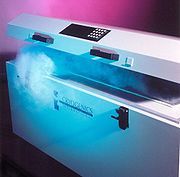
Cryonics
Cryonics is the low-temperature preservation of humans and animals who can no longer be sustained by contemporary medicine, with the hope that healing and resuscitation may be possible in the future. Cryopreservation of people or large animals is not reversible with current technology...
is the practice of storing those beyond the reach of today's medicine at very low temperature
Temperature
Temperature is a physical property of matter that quantitatively expresses the common notions of hot and cold. Objects of low temperature are cold, while various degrees of higher temperatures are referred to as warm or hot...
s in the hope that future medicine is able to revive and cure them. Such revival is yet to be demonstrated, and as a result cryonics is not a recognised medical procedure and so can only take place after legal death. Cryonics advocates distinguish legal death from the state of information-theoretic death, the point at which the information in the brain that makes up personality and memory is destroyed by the process of death; the purpose of cryonics practice is to delay information-theoretic death until revival becomes possible.
Moral and ethical issues
Death is a universal but incompletely understood phenomenon, with strong connections to religious, spiritual and ethical beliefs. There have been cases of people believed dead who (with or without assistance) later recovered, or whose body was capable of continued function. Accordingly the question of when a person is to be considered "dead" for legal or other purposes can be a lot more controversial and complex than it seems.Well known ethical questions include determining the point where organ removal for donation
Organ donation
Organ donation is the donation of biological tissue or an organ of the human body, from a living or dead person to a living recipient in need of a transplantation. Transplantable organs and tissues are removed in a surgical procedure following a determination, based on the donor's medical and...
can take place, when medical care should be withdrawn (or a person kept alive who appears unable to ever recover from coma
Coma
In medicine, a coma is a state of unconsciousness, lasting more than 6 hours in which a person cannot be awakened, fails to respond normally to painful stimuli, light or sound, lacks a normal sleep-wake cycle and does not initiate voluntary actions. A person in a state of coma is described as...
), and when a person should be considered "dead" in the eyes of the law. In rare cases a patient has been declared legally dead who is later found to be alive. Misdiagnosis of death is also a possibility and has been recorded in medical discussions. In cases of babies born without a brain cortex
Cerebral cortex
The cerebral cortex is a sheet of neural tissue that is outermost to the cerebrum of the mammalian brain. It plays a key role in memory, attention, perceptual awareness, thought, language, and consciousness. It is constituted of up to six horizontal layers, each of which has a different...
(known as anencephaly
Anencephaly
Anencephaly is a cephalic disorder that results from a neural tube defect that occurs when the cephalic end of the neural tube fails to close, usually between the 23rd and 26th day of pregnancy, resulting in the absence of a major portion of the brain, skull, and scalp...
and with a life expectancy of hours or days) a similar question arises regarding the point at which the healthy organs may be used to help other babies. Because of these uncertainties, legal process may be needed to determine case-by-case whether an individual is to be considered "dead".
Separate ethical arguments relate to the societal resources consumed in preserving bodily life for people who may never recover, to the occasions when the wishes of the patient (or their representatives or family) differ from legal or medical views, since in many contexts the wishes of an individual or their representatives are given weight in medical matters (for example the case of Jesse Koochin
Jesse Koochin
Jesse Koochin was a 6-year-old boy from Utah who became the center of a legal battle between his parents, Steve and Gayle Koochin, and Primary Children's Medical Center in Salt Lake City....
), and religious or spiritual beliefs.
As might be expected, a wide range of views exist. Religions, cultures, societies, and philosophers, may each differ on their views related to these questions. Some notable views include:
- Religion - Among world religions, CatholicismCatholicismCatholicism is a broad term for the body of the Catholic faith, its theologies and doctrines, its liturgical, ethical, spiritual, and behavioral characteristics, as well as a religious people as a whole....
takes a markedly strong stance against directly intending to cause the death of any innocent human person, whether by direct provocation, such as by a lethal injection, or by withholding or withdrawing ordinary means of life support or treatment, such as a feeding tube. This need not include the withdrawing or withholding of extraordinary means of life support or treatment, such as CPR or a ventilator. This has led to legal and cultural controversy in such cases as CruzanNancy CruzanNancy Beth Cruzan was a figure in the right-to-die movement. After an automobile accident left her in a persistent vegetative state, her family petitioned in courts for three years, as far as the U.S. Supreme Court , to have her feeding tube removed...
, SchiavoTerri Schiavo caseThe Terri Schiavo case was a legal battle in the United States between the legal guardians and the parents of Teresa Marie "Terri" Schiavo that lasted from 1998 to 2005...
, and QuinlanKaren Ann QuinlanKaren Ann Quinlan was an important figure in the history of the right to die controversy in the United States....
.
See also
- Brain deathBrain deathBrain death is the irreversible end of all brain activity due to total necrosis of the cerebral neurons following loss of brain oxygenation. It should not be confused with a persistent vegetative state...
- Clinical deathClinical deathClinical death is the medical term for cessation of blood circulation and breathing, the two necessary criteria to sustain life. It occurs when the heart stops beating in a regular rhythm, a condition called cardiac arrest. The term is also sometimes used in resuscitation research.Stopped blood...
- DeathDeathDeath is the permanent termination of the biological functions that sustain a living organism. Phenomena which commonly bring about death include old age, predation, malnutrition, disease, and accidents or trauma resulting in terminal injury....
- Organ transplantOrgan transplantOrgan transplantation is the moving of an organ from one body to another or from a donor site on the patient's own body, for the purpose of replacing the recipient's damaged or absent organ. The emerging field of regenerative medicine is allowing scientists and engineers to create organs to be...
- Motl Brody
- Association of the DeadAssociation of the DeadThe Uttar Pradesh Association of Dead People is a northern Indian pressure group that seeks to reclaim the legal rights of those falsely listed by the government as being dead....