


Clitellum

Encyclopedia
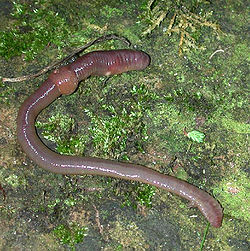
The clitellum is a thickened gland
Gland
A gland is an organ in an animal's body that synthesizes a substance for release of substances such as hormones or breast milk, often into the bloodstream or into cavities inside the body or its outer surface .- Types :...
ular section of the body wall in earthworm
Earthworm
Earthworm is the common name for the largest members of Oligochaeta in the phylum Annelida. In classical systems they were placed in the order Opisthopora, on the basis of the male pores opening posterior to the female pores, even though the internal male segments are anterior to the female...
s and leeches, that secretes a viscid sac in which the eggs are deposited. It is present about 2 centimetre (0.78740157480315 in) behind the anterior end of the body (around 14th, 15th and 16th segments).
A clitellum is part of the reproductive system of clitellates, a subgroup of annelids which contains oligochaetes (earthworms) and hirudineans (leeches). The clitellum is a thick, saddle-like, ring found in the epidermis (skin) of the worm, usually with a light colored pigment. To form a cocoon for its eggs, the clitellum secretes a viscous fluid. This organ is used in sexual reproduction of some annelids. The clitellum becomes apparent in mature annelids but may be hard to locate visually in younger annelids. In leeches, it appears seasonally. Its color is usually slightly lighter than that of the body of the annelid. Occasionally, living segments of the worm will be shed with the clitellum.