

Lavolta

Encyclopedia
Renaissance dance
Renaissance dances belong to the broad group of historical dances.During the Renaissance period, there was a distinction between country dances and court dances. Court dances required the dancers to have been trained and were often for display and entertainment, whereas country dances could be...
for couples
Partner dance
Partner dances are dances whose basic choreography involves coordinated dancing of two partners, as opposed to individuals dancing alone or individually in a non-coordinated manner, and as opposed to groups of people dancing simultaneously in a coordinated manner.In the year 1023 the German poet...
from the later Renaissance
Renaissance
The Renaissance was a cultural movement that spanned roughly the 14th to the 17th century, beginning in Italy in the Late Middle Ages and later spreading to the rest of Europe. The term is also used more loosely to refer to the historical era, but since the changes of the Renaissance were not...
. This dance was associated with the galliard
Galliard
The galliard was a form of Renaissance dance and music popular all over Europe in the 16th century. It is mentioned in dance manuals from England, France, Spain, Germany and Italy, among others....
and done to the same kind of music. Its main figure consisted of a turn and lift in a sort of closed position
Closed position
In partner dancing, closed position is a category of positions in which partners hold each other while facing at least approximately toward each other....
, which could be done either to the right or to the left. It is also called La volta, Volta, Volte. Spelling variants include la volta and levolto; its name is la volte in French
French language
French is a Romance language spoken as a first language in France, the Romandy region in Switzerland, Wallonia and Brussels in Belgium, Monaco, the regions of Quebec and Acadia in Canada, and by various communities elsewhere. Second-language speakers of French are distributed throughout many parts...
and la volta in Italian
Italian language
Italian is a Romance language spoken mainly in Europe: Italy, Switzerland, San Marino, Vatican City, by minorities in Malta, Monaco, Croatia, Slovenia, France, Libya, Eritrea, and Somalia, and by immigrant communities in the Americas and Australia...
.
Description
Detailed instructions for lavoltas were written by Thoinot ArbeauThoinot Arbeau
Thoinot Arbeau is the anagrammatic pen name of French cleric Jehan Tabourot . Tabourot is most famous for his Orchésographie, a study of late sixteenth-century French Renaissance social dance...
; some brief notes appear in MS Douce 280. These instructions are open to some interpretation, but seem to indicate something like the following.
The dance begins with a galliard
Galliard
The galliard was a form of Renaissance dance and music popular all over Europe in the 16th century. It is mentioned in dance manuals from England, France, Spain, Germany and Italy, among others....
. Then the couple makes a transition to a closed position. The leader (the man, according to period custom) lets go of his partner's hand and takes hold of her below her busk
Busk
A busk is the rigid element of a corset placed at the centre front.In stays, the corsets worn between the fifteenth and eighteenth centuries, the busk was intended to keep the front of the corset straight and upright. It was made of wood, ivory, or bone slipped into a pocket and tied in place with...
with one hand, and places the other hand on her back above the far hip. The follower places her near hand on top of her partner's near shoulder. Now the leader is facing his partner while she faces to one side; both will do the turn with forward steps, and both step with the same foot at the same time.
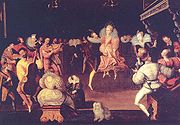
The turn begins with a small step, springing onto the outside foot and lifting the inside foot forward. On the second beat there is a longer step, stepping smoothly onto the inside foot and staying close to the ground. During this step the follower poises herself for a spring, and just after it she springs up into the air. The leader lifts her with his hands, then holds her up with his hands and with the thigh of his free leg under her thighs. He lets her down to land on both feet on the last beat of the measure. The couple makes an approximate 3/4 turn during each measure. The turn is repeated ad lib for several measures, and then the galliard is resumed in an open position.
Relations to other dances
It is sometimes hypothesized that the lavolta was the direct ancestor of the waltzWaltz
The waltz is a ballroom and folk dance in time, performed primarily in closed position.- History :There are several references to a sliding or gliding dance,- a waltz, from the 16th century including the representations of the printer H.S. Beheim...
. Anyone who knows how to do a waltz turn may see from the above instructions (or from Thoinot Arbeau
Thoinot Arbeau
Thoinot Arbeau is the anagrammatic pen name of French cleric Jehan Tabourot . Tabourot is most famous for his Orchésographie, a study of late sixteenth-century French Renaissance social dance...
's instructions) that the dances are fundamentally different. The lavolta is more similar to the polska
Polska (dance)
The polska is a family of music and dance forms shared by the Nordic countries: called polsk in Denmark, polska in Sweden and Finland and by several names in Norway in different regions and/or for different variants - including pols, rundom, springleik, and springar...
, though there again the differences remain large. The most that might reasonably be assumed is that the development of either the waltz or the polska might have been influenced in some way by the lavolta.