

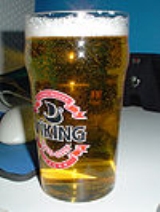
Lager

Encyclopedia
Lager is a type of beer
made from malted barley that is brewed
and stored at low temperatures. There are many types of lager; pale lager
is the most widely-consumed and commercially available style of beer in the world; Pilsner, Bock
, Dortmunder Export
and Märzen are all styles of lager. There are also dark lagers, such as Dunkel
and Schwarzbier
.
claimed to have discovered that Saccharomyces eubayanus
, a yeast native to Patagonia
is responsible for creating the hybrid yeast used to make lager.
in the Export
or Pilsner styles. The flavor of these lighter lagers is usually mild, and the producers often recommend that the beers be served refrigerated. However, the examples of lager beers produced worldwide vary greatly in flavor, color, and composition.
In colour, helles represent the lightest lager at as pale a colour as 6 EBC. The darkest are Baltic porters, which can be as dark as 400 EBC; darker German lagers are often referred to as Dunkel
s.
The organism most often associated with lager brewing is Saccharomyces pastorianus
, a close relative of Saccharomyces cerevisiae
.
In strength, lagers represent some of the world's most alcoholic beers. The very strongest lagers often fall into the German-originated doppelbock style, with the strongest of these, the commercially-produced Samichlaus, reaching 14% ABV.
, at a lower price than a formulation using an all-malt grain bill. Not always used to reduce prices, adjuncts may actually cost more than malt in many cases.
-coloured lager with a well attenuated body and noble hop bitterness. The brewing process for this beer developed in the mid 19th century when Gabriel Sedlmayr took pale ale
brewing techniques back to the Spaten Brewery in Germany
and applied it to existing lagering brewing methods. This approach was picked up by other brewers, most notably Josef Groll
who produced Pilsner Urquell
. The resulting pale coloured, lean and stable beers were very successful and gradually spread around the globe to become the most common form of beer consumed in the world today.
The main elements of the lagering method used by Sedlmayr and Groll are still used today, and depend on a slow acting yeast
that ferments at a low temperature while being stored. Indeed, the German
term '' means 'storage'. While first marketed as '' in Austria and Germany, the term is now quite uncommon in the German speaking countries where today one would simply ask for '' (pale lager), '' (dark lager) or specific varieties, particularly those with a distinctive character such as .
concentrations of 4.5% to 6% by volume, dunkels are weaker than Doppelbocks, another traditional dark Bavarian beer. Dunkels were the original style of the Bavarian villages and countryside. Schwarzbier
, a much darker, almost black beer with a chocolate or liquorice-like flavour, similar to stout, is mainly brewed in Saxony
and Thuringia
.
Vienna lager was developed by brewer Anton Dreher
in Vienna
in 1841. Austrian brewers who emigrated to Mexico
in the late 19th century took the style with them. Vienna lager is a reddish-brown or copper-colored beer with medium body and slight malt
sweetness. The malt aroma and flavor may have a toasted character.
Beer
Beer is the world's most widely consumed andprobably oldest alcoholic beverage; it is the third most popular drink overall, after water and tea. It is produced by the brewing and fermentation of sugars, mainly derived from malted cereal grains, most commonly malted barley and malted wheat...
made from malted barley that is brewed
Brewing
Brewing is the production of beer through steeping a starch source in water and then fermenting with yeast. Brewing has taken place since around the 6th millennium BCE, and archeological evidence suggests that this technique was used in ancient Egypt...
and stored at low temperatures. There are many types of lager; pale lager
Pale lager
Pale lager is a very pale to golden-coloured beer with a well attenuated body and a varying degree of noble hop bitterness. The brewing process for this beer developed in the mid 19th century when Gabriel Sedlmayr took pale ale brewing techniques back to the Spaten Brewery in Germany and applied it...
is the most widely-consumed and commercially available style of beer in the world; Pilsner, Bock
Bock
Bock is a strong lager of German origin. Several substyles exist, including maibock or helles bock, a paler, more hopped version generally made for consumption at spring festivals; doppelbock, a stronger and maltier version; and eisbock, a much stronger version made by partially freezing the beer...
, Dortmunder Export
Dortmunder Export
Dortmunder Export or Dortmunder is a pale lager that originated in the then industrial city of Dortmund in Germany. Originally brewed by Dortmunder Union in 1873, this soft pilsner style beer became very popular with industrial workers, and was responsible for Dortmunder Union becoming Germany's...
and Märzen are all styles of lager. There are also dark lagers, such as Dunkel
Dunkel
Dunkel, or Dunkles, is a dark German beer. Dunkel is the German word meaning dark, and dunkel beers typically range in colour from amber to dark reddish brown. They are characterized by their smooth malty flavour....
and Schwarzbier
Schwarzbier
, or "black beer", is a German dark lager beer. It has an opaque, black colour and a full, chocolatey or coffee flavour. Although they share some similar flavours they are milder tasting and less bitter than British stouts or porters, owing to the use of lager rather than ale yeast and no roasted...
.
History of lager brewing
While cold storage of beer, "lagering," in caves for example, was a common practice throughout the medieval period, bottom-fermenting yeast seems to have emerged as a hybridization in the early 1400s. However, in 2011 an international team of researchers writing in the Proceedings of the National Academy of SciencesProceedings of the National Academy of Sciences
The Proceedings of the National Academy of Sciences of the United States of America, usually referred to as PNAS, is the official journal of the United States National Academy of Sciences...
claimed to have discovered that Saccharomyces eubayanus
Saccharomyces eubayanus
Saccharomyces eubayanus, a type of yeast, is a likely parent of the lager brewing yeast, Saccharomyces pastorianus.Lager is a type of beer created from malted barley and brewed at low temperatures, originally in Bavaria. S...
, a yeast native to Patagonia
Patagonia
Patagonia is a region located in Argentina and Chile, integrating the southernmost section of the Andes mountains to the southwest towards the Pacific ocean and from the east of the cordillera to the valleys it follows south through Colorado River towards Carmen de Patagones in the Atlantic Ocean...
is responsible for creating the hybrid yeast used to make lager.
Characteristics
The average lager in worldwide production is a pale lagerPale lager
Pale lager is a very pale to golden-coloured beer with a well attenuated body and a varying degree of noble hop bitterness. The brewing process for this beer developed in the mid 19th century when Gabriel Sedlmayr took pale ale brewing techniques back to the Spaten Brewery in Germany and applied it...
in the Export
Dortmunder Export
Dortmunder Export or Dortmunder is a pale lager that originated in the then industrial city of Dortmund in Germany. Originally brewed by Dortmunder Union in 1873, this soft pilsner style beer became very popular with industrial workers, and was responsible for Dortmunder Union becoming Germany's...
or Pilsner styles. The flavor of these lighter lagers is usually mild, and the producers often recommend that the beers be served refrigerated. However, the examples of lager beers produced worldwide vary greatly in flavor, color, and composition.
In colour, helles represent the lightest lager at as pale a colour as 6 EBC. The darkest are Baltic porters, which can be as dark as 400 EBC; darker German lagers are often referred to as Dunkel
Dunkel
Dunkel, or Dunkles, is a dark German beer. Dunkel is the German word meaning dark, and dunkel beers typically range in colour from amber to dark reddish brown. They are characterized by their smooth malty flavour....
s.
The organism most often associated with lager brewing is Saccharomyces pastorianus
Saccharomyces pastorianus
Saccharomyces pastorianus is a yeast, used industrially for the production of lager beer. It is a synonym of the yeast species Saccharomyces carlsbergensis, which was originally described in 1883 by Emil Christian Hansen, who was working for the Danish brewery Carlsberg.-Genomics:As S...
, a close relative of Saccharomyces cerevisiae
Saccharomyces cerevisiae
Saccharomyces cerevisiae is a species of yeast. It is perhaps the most useful yeast, having been instrumental to baking and brewing since ancient times. It is believed that it was originally isolated from the skin of grapes...
.
In strength, lagers represent some of the world's most alcoholic beers. The very strongest lagers often fall into the German-originated doppelbock style, with the strongest of these, the commercially-produced Samichlaus, reaching 14% ABV.
Production process
Lagers in certain countries often feature large proportions of adjuncts, usually rice or maize. Adjuncts entered American brewing as a means of thinning out the body of American beers, balancing the large quantities of protein introduced by six-row barley. Adjuncts are often used now in beermaking to introduce a large quantity of sugar, and thereby increase ABVABV
ABV is a three-letter acronym that may refer to:* Alcohol by volume, a measure of the alcohol content of alcoholic drinks* Nnamdi Azikiwe International Airport, Abuja, Nigeria, from its IATA airport code...
, at a lower price than a formulation using an all-malt grain bill. Not always used to reduce prices, adjuncts may actually cost more than malt in many cases.
Pale lager
Pale lager is a very pale to goldenGold (color)
Gold, also called golden, is one of a variety of orange-yellow color blends used to give the impression of the color of the element gold....
-coloured lager with a well attenuated body and noble hop bitterness. The brewing process for this beer developed in the mid 19th century when Gabriel Sedlmayr took pale ale
Pale ale
Pale ale is a beer which uses a warm fermentation and predominantly pale malt. It is one of the world's major beer styles.The higher proportion of pale malts results in a lighter colour. The term "pale ale" was being applied around 1703 for beers made from malts dried with coke, which resulted in a...
brewing techniques back to the Spaten Brewery in Germany
Germany
Germany , officially the Federal Republic of Germany , is a federal parliamentary republic in Europe. The country consists of 16 states while the capital and largest city is Berlin. Germany covers an area of 357,021 km2 and has a largely temperate seasonal climate...
and applied it to existing lagering brewing methods. This approach was picked up by other brewers, most notably Josef Groll
Josef Groll
Josef Groll was a Bavarian brewer, best known for his invention of Pilsener beer.The citizens of Pilsen were no longer satisfied with their top-fermented Oberhefenbier. They publicly emptied several casks of beer in order to draw attention to its low quality and short storage life...
who produced Pilsner Urquell
Pilsner Urquell
Plzeňský Prazdroj , known better by its German name Pilsner Urquell , is a bottom-fermented beer produced since 1842 in Pilsen, part of today's Czech Republic. Pilsner Urquell was the first pilsner beer in the world...
. The resulting pale coloured, lean and stable beers were very successful and gradually spread around the globe to become the most common form of beer consumed in the world today.
The main elements of the lagering method used by Sedlmayr and Groll are still used today, and depend on a slow acting yeast
Saccharomyces pastorianus
Saccharomyces pastorianus is a yeast, used industrially for the production of lager beer. It is a synonym of the yeast species Saccharomyces carlsbergensis, which was originally described in 1883 by Emil Christian Hansen, who was working for the Danish brewery Carlsberg.-Genomics:As S...
that ferments at a low temperature while being stored. Indeed, the German
German language
German is a West Germanic language, related to and classified alongside English and Dutch. With an estimated 90 – 98 million native speakers, German is one of the world's major languages and is the most widely-spoken first language in the European Union....
term '' means 'storage'. While first marketed as '' in Austria and Germany, the term is now quite uncommon in the German speaking countries where today one would simply ask for '' (pale lager), '' (dark lager) or specific varieties, particularly those with a distinctive character such as .
Dark lager
Lagers would likely have been mainly dark until the 1840s; pale lagers were not common until the later part of the 19th century when technological advances made them easier to produce. Dark lagers typically range in colour from amber to dark reddish brown, and may be termed dunkel, schwarzbier, Vienna, tmavé or Baltic porter depending on region or brewing method. Tmavé is Czech for "dark", so is the term for a dark beer in the Czech republic - beers which are so dark as to be black are termed černé pivo, "black beer". Dunkel is German for "dark", so is the term for a dark beer in Germany. With alcoholAlcohol
In chemistry, an alcohol is an organic compound in which the hydroxy functional group is bound to a carbon atom. In particular, this carbon center should be saturated, having single bonds to three other atoms....
concentrations of 4.5% to 6% by volume, dunkels are weaker than Doppelbocks, another traditional dark Bavarian beer. Dunkels were the original style of the Bavarian villages and countryside. Schwarzbier
Schwarzbier
, or "black beer", is a German dark lager beer. It has an opaque, black colour and a full, chocolatey or coffee flavour. Although they share some similar flavours they are milder tasting and less bitter than British stouts or porters, owing to the use of lager rather than ale yeast and no roasted...
, a much darker, almost black beer with a chocolate or liquorice-like flavour, similar to stout, is mainly brewed in Saxony
Saxony
The Free State of Saxony is a landlocked state of Germany, contingent with Brandenburg, Saxony Anhalt, Thuringia, Bavaria, the Czech Republic and Poland. It is the tenth-largest German state in area, with of Germany's sixteen states....
and Thuringia
Thuringia
The Free State of Thuringia is a state of Germany, located in the central part of the country.It has an area of and 2.29 million inhabitants, making it the sixth smallest by area and the fifth smallest by population of Germany's sixteen states....
.
Vienna lager was developed by brewer Anton Dreher
Anton Dreher
Anton Dreher was an Austrian brewer who was an important figure in the development of pale lager....
in Vienna
Vienna
Vienna is the capital and largest city of the Republic of Austria and one of the nine states of Austria. Vienna is Austria's primary city, with a population of about 1.723 million , and is by far the largest city in Austria, as well as its cultural, economic, and political centre...
in 1841. Austrian brewers who emigrated to Mexico
Mexican beer
Beer in Mexico has a long history. While Mesoamerican cultures knew of fermented alcoholic beverages, including a corn beer, long before the Spanish conquest, European style beer brewed with barley was introduced with the Spanish soon after Hernán Cortés’ arrival...
in the late 19th century took the style with them. Vienna lager is a reddish-brown or copper-colored beer with medium body and slight malt
Malt
Malt is germinated cereal grains that have been dried in a process known as "malting". The grains are made to germinate by soaking in water, and are then halted from germinating further by drying with hot air...
sweetness. The malt aroma and flavor may have a toasted character.
See also
- ReinheitsgebotReinheitsgebotThe Reinheitsgebot , sometimes called the "German Beer Purity Law" or the "Bavarian Purity Law" in English, was a regulation concerning the production of beer in Germany. In the original text, the only ingredients that could be used in the production of beer were water, barley and hops...
an influential Bavarian and German brewing law - AleAleAle is a type of beer brewed from malted barley using a warm fermentation with a strain of brewers' yeast. The yeast will ferment the beer quickly, giving it a sweet, full bodied and fruity taste...
another family of beer styles