
All Topics  
LTI system theory


LTI system theory


LTI system theory or linear time-invariant system theory is a theory in the field of electrical engineeringElectrical engineering

Electrical engineering is a professional engineering discipline that deals with the study and application of electricity, e...
, specifically in circuitElectrical network

An electrical network is an interconnection of electrical elements such as resistors, inductors, capacitors, and switches....
s, signal processingFacts About Signal processing

Signal processing is the processing, amplification and interpretation of signals and deals with the analysis and manipulatio...
, and control theoryControl theory Summary

In engineering and mathematics, control theory deals with the behavior of dynamical systems....
, that investigates the response of a linearLinear system

A linear system is a model of a system based on some kind of linear operator....
, time-invariant systemTime-invariant system

A time-invariant system is one whose output does not depend explicitly on time....
 to an arbitrary input signal. Though the standard independent variable is time, it could just as easily be space (as in image processingImage processing

In the broadest sense, image processing is any form of information processing for which both the input and output are images...
 and field theoryClassical field theory

A classical field theory is a physical theory that describes the study of how one or more physical fields interact with matt...
) or some other coordinate. Thus an alternately used term is linear translation-invariant. The term linear shift-invariant is the corresponding concept for a discrete-time|sampled]]) system.

Overview

The defining properties of any linear time-invariant system are, of course, linearity and time invariance:

  • Linearity means that the relationship between the input and the output of the system satisfies the superposition property. If the input to the system is the sum of two component signals:


then the output of the system will be
where and are constants, and is the output resulting from the sole input .
It can be shown that, given this superposition property, the scaling property follows for any rationalRational number

In mathematics, a rational number is a ratio or quotient of two integers, usually written as the vulgar fraction a''/b'...
 scalar. If the output due to input is , then the output due to input    is  


Then, formally, a linear system is a system that exhibits the following property:

If the input of the system is
then the output of the system will be
for any constants and where each is the output resulting from the sole input .


  • Time invariance means that whether we apply an input to the system now or T seconds from now, the output will be identical, except for a time delay of the T seconds. If the output due to input is , then the output due to input is . More specifically, an input affected by a time delay should effect a corresponding time delay in the output, hence time-invariant.


The fundamental result in LTI system theory is that any LTI system can be characterized entirely by a single function called the system's impulse responseImpulse response

* Dirac delta function* Unit impulse function...
. The output of the system is simply the convolutionFacts About Convolution

In mathematics and, in particular, functional analysis, convolution is a mathematical operator which takes two functions f...
 of the input to the system with the system's impulse response. This method of analysis is often called the time domainTime domain Summary

Time domain is a term used to describe the analysis of mathematical functions, or physical signals, with respect to time....
point-of-view. The same result is true of discrete-time linear shift-invariant systems in which signals are discrete-time samples, and convolution is defined on sequences.


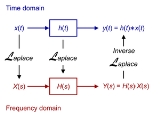
Equivalently, any LTI system can be characterized in the frequency domainFrequency domain

Frequency domain is a term used to describe the analysis of mathematical functions or signals with respect to frequency....
by the system's transfer functionTransfer function

A transfer function is a mathematical representation of the relation between the input and output of a system....
, which is the Laplace transformLaplace transform Overview

In mathematics, the Laplace transform is a powerful technique for analyzing linear time-invariant systems such as electrica...
 of the system's impulse response (or Z transform in the case of discrete-time systems). As a result of the properties of these transforms, the output of the system in the frequency domain is the product of the transfer function and the transform of the input. In other words, convolution in the time domain is equivalent to multiplication in the frequency domain.

For all LTI systems, the eigenfunctionEigenfunction

In mathematics, an eigenfunction of a linear operator A defined on some function space is any non-zero function f in...
s, and the basis functions of the transforms, are complexComplex number Overview

In mathematics, a complex number is a number of the form ...
 exponentialsExponential function

The exponential function is one of the most important functions in mathematics....
. This is, if the input to a system is the complex waveform for some complex amplitude and complex frequency , the output will be some complex constant times the input, say for some new complex amplitude . The ratio is the transfer function at frequency .

Because sinusoidsSine wave

The sine wave or sinusoid is a function that occurs often in mathematics, signal processing, alternating-current power...
 are a sum of complex exponentials with complex-conjugate frequencies, if the input to the system is a sinusoid, then the output of the system will also be a sinusoid, perhaps with a different amplitudeAmplitude

Amplitude is a nonnegative scalar measure of a wave's magnitude of oscillation, that is, magnitude of the maximum disturbanc...
 and a different phasePhase (waves)

Phase is an overloaded word used for:'...
, but always with the same frequency. LTI systems cannot produce frequency components that are not in the input.

LTI system theory is good at describing many important systems. Most LTI systems are considered "easy" to analyze, at least compared to the time-varying and/or nonlinear case. Any system that can be modeled as a linear homogeneous differential equationDifferential equation

In mathematics, a differential equation is an equation in which the derivatives of a function appear as variables....
 with constant coefficients is an LTI system. Examples of such systems are electrical circuitsElectrical network

An electrical network is an interconnection of electrical elements such as resistors, inductors, capacitors, and switches....
 made up of resistorResistor

|- align = "center"||width = "25"|| |- align = "center"...
s, inductorFacts About Inductor

An inductor is a passive electrical device employed in electrical circuits for its property of inductance....
s, and capacitorCapacitor

A capacitor is an electrical device that can store energy in the electric field between a pair of closely spaced conductors....
s (RLC circuits). Ideal spring–mass–damper systems are also LTI systems, and are mathematically equivalent to RLC circuits.

Most LTI system concepts are similar between the continuous-time and discrete-time (linear shift-invariant) cases. In image processing, the time variable is replaced with two space variables, and the notion of time invariance is replaced by two-dimensional shift invariance. When analyzing filter bankFilter bank

A filter bank is an array of band-pass filters that separates the input signal into several components, each one carrying a ...
s and MIMO systems, it is often useful to consider vectorsArray

In computer programming, a group of elements of a specific data type is known as an array, one of the simplest data structures....
 of signals.

A linear system that is not time-invariant can be solved using other approaches such as the Green functionGreen function

Green function might refer to:*Green's function of a differential operator....
 method.

Continuous-time systems


Impulse response and convolution


Let the notation represent the function with variable and constant .

And let the shorter notation represent

A continuous-time system transforms an input function, into an output function,   In general, every value of the output can depend on every value of the input. Representing the transformation operator by , we can write:

Note that unless the transform itself changes with t, the output function is just constant, and the system is uninteresting. (Thus the subscript, t.)  In a typical system, y(t) depends most heavily on the values of x that occurred near time t.

For the special case of the Dirac delta functionDirac delta function

The Dirac delta or Dirac's delta, often referred to as the unit impulse function and introduced by the British theoret...
, the output function is the impulse response:

For a linear system, must satisfy the relations:

and:

The time-invariance requirement is:

In such a system, the impulse response, characterizes the system completely. I.e., for any input function, the output function can be calculated in terms of the input and the impulse response.  To see how that is done, consider the identity:

which is the sifting property of the delta function.

Therefore:

The linearity condition allows this manipulation:

And because of time-invariance, we may write:

Therefore:


which is the familiar convolutionConvolution

In mathematics and, in particular, functional analysis, convolution is a mathematical operator which takes two functions f...
 integral
. The operator can therefore be interpreted as proportional to a weighted average of the function   The weighting function is simply shifted by amount   As changes, the weighting function emphasizes different parts of the input function. Equivalently, the system's response to an impulse at   is a time-reversed copy of the unshifted weighting function. When is zero for all negative   the system is said to be causalCausal system

A causal system is a system with output and internal states that depends only on the current and previous input values....
.

Exponentials as eigenfunctions

An eigenfunctionEigenfunction

In mathematics, an eigenfunction of a linear operator A defined on some function space is any non-zero function f in...
 is a function for which the output of the operator is the same function, just scaled by some amount. In symbols,
,
where f is the eigenfunction and is the eigenvalue, a constant.

The exponential functionExponential function

The exponential function is one of the most important functions in mathematics....
s , where , are eigenfunctionEigenfunction

In mathematics, an eigenfunction of a linear operator A defined on some function space is any non-zero function f in...
s of a linearLinear

The word linear comes from the Latin word linearis, which means created by lines....
, time-invariant operator. A simple proof illustrates this concept.

Suppose the input is . The output of the system with impulse response is then

which is equivalent to the following by the commutative property of convolutionConvolution

In mathematics and, in particular, functional analysis, convolution is a mathematical operator which takes two functions f...


,
where
is dependent only on the parameter s.

So, is an eigenfunctionEigenfunction Overview

In mathematics, an eigenfunction of a linear operator A defined on some function space is any non-zero function f in...
 of an LTI system because the system response is the same as the input times the constant .

Fourier and Laplace transforms

The eigenfunction property of exponentials is very useful for both analysis and insight into LTI systems. The Laplace transformLaplace transform

In mathematics, the Laplace transform is a powerful technique for analyzing linear time-invariant systems such as electrica...


is exactly the way to get the eigenvalues from the impulse response. Of particular interest are pure sinusoids, i.e. exponentials of the form where and . These are generally called complex exponentials even though the argument is purely imaginary. The Fourier transformFourier transform

The Fourier transform, named after Joseph Fourier, is a reversible integral transform of one function into another....
  gives the eigenvalues for pure complex sinusoids. Both of and are called the system function, system response, or transfer function.

The Laplace transform is usually used in the context of one-sided signals, i.e. signals that are zero for all values of t less than some value. Usually, this "start time" is set to zero, for convenience and without loss of generality, with the transform integral being taken from zero to infinity (the transform shown with lower limit of integration of negative infinity is formally known as the bilateral Laplace transform).

The Fourier transform is used for analyzing systems that process signals that are infinite in extent, such as modulated sinusoids, even though it can not be directly applied to input and output signals that are not square integrable. The Laplace transform actually works directly for these signals if they are zero before a start time, even if they are not square integrable, for stable systems. The Fourier transform is often applied to spectra of infinite signals via the Wiener–Khinchin theoremWiener–Khinchin theorem

The Wiener?Khinchin theorem states that the power spectral density of a wide-sense-stationary random process is the Fourier ...
 even when Fourier transforms of the signals do not exist.

Due to the convolution property of both of these transforms, the convolution that gives the output of the system can be transformed to a multiplication in the transform domain, given signals for which the transforms exist

Not only is it often easier to do the transforms, multiplication, and inverse transform than the original convolution, but one can also gain insight into the behavior of the system from the system response. One can look at the modulus of the system function |H(s)| to see whether the input is passed (let through) the system or rejected or attenuated by the system (not let through).

Examples

A simple example of an LTI operator is the derivativeDerivative

In mathematics, the derivative is defined as the instantaneous rate of change of a function....
:

When the Laplace transform of the derivative is taken, it transforms to a simple multiplication by the Laplace variable s.
That the derivative has such a simple Laplace transform partly explains the utility of the transform.

Another simple LTI operator is an averaging operator

.

It is linear because of the linearity of integration

.

It is time invariant too

.

Indeed, can be written as a convolution with the box function .

,

where the box function is

.

Important system properties

Some of the most important properties of a system are causality and stability. Causality is a necessity if the independent variable is time, but not all systems have time as an independent variable. For example, a system that processes still images does not need to be causal. Non-stable systems can be built and can be useful in many circumstances. Even non-realQuadrature filter Overview

In signal processing, a quadrature filter is the analytic signal of a real-valued filter :...
 systems can be built and are very useful in many contexts.
Causality
A system is causal if the output depends only on present and past inputs. A necessary and sufficient condition for causality is

where is the impulse response. It is not possible in general to determine causality from the Laplace transform, because the inverse transform is not unique. When a region of convergence is specified, then causality can be determined.
Stability
A system is bounded-input, bounded-output stable (BIBO stable) if, for every bounded input, the output is finite. Mathematically, if every input satisfying

leads to an output satisfying

(that is, a finite maximum absolute value of implies a finite maximum absolute value of ), then the system is stable. A necessary and sufficient condition is that , the impulse response, is in L1Lp space

In mathematics, the Lp and lp spaces are spaces of p-power integrable functions, and corresponding seque...
 (has a finite L1 norm):

In the frequency domain, the region of convergence must contain the imaginary axis .

As an example, the ideal low-pass filterLow-pass filter Overview

A low-pass filter is a filter that passes low frequencies well, but attenuates frequencies higher than the cutoff frequency...
 with impulse response equal to a sinc functionSinc function

The sinc function, denoted by , has two definitions, sometimes distinguished as the normalized sinc function and unnor...
 is not BIBO stable, because the sinc function does not have a finite L1 norm. Thus, for some bounded input, the output of the ideal low-pass filter is unbounded. In particular, if the input is zero for and equal to a sinusoid at the cut-off frequency for , then the output will be unbounded for all times other than the zero crossings.

Discrete-time systems

Almost everything in continuous-time systems has a counterpart in discrete-time systems.

Discrete-time systems from continuous-time systems

In many contexts, a discrete time (DT) system is really part of a larger continuous time (CT) system. For example, a digital recording system takes an analog sound, digitizes it, possibly processes the digital signals, and plays back an analog sound for people to listen to.

Formally, the DT signals studied are almost always uniformly sampled versions of CT signals. If is a CT signal, then an analog to digital converter will transform it to the DT signal:

where T is the sampling period. It is very important to limit the range of frequencies in the input signal for faithful representation in the DT signal, since then the sampling theorem guarantees that no information about the CT signal is lost. A DT signal can only contain a frequency range of ; other frequencies are aliasedAliasing

In statistics, signal processing, and related disciplines, aliasing is an effect that causes different continuous signals to...
 to the same range.

Impulse response and convolution


Let represent the sequence .

And let the shorter notation represent

A discrete system transforms an input sequence, into an output sequence,   In general, every element of the output can depend on every element of the input. Representing the transformation operator by , we can write:

Note that unless the transform itself changes with n, the output sequence is just constant, and the system is uninteresting. (Thus the subscript, n.)  In a typical system, y[n] depends most heavily on the elements of x whose indices are near n.

For the special case of the Kronecker delta function, the output sequence is the impulse response:

For a linear system, must satisfy the relations:

and:

The time-invariance requirement is:

In such a system, the impulse response, characterizes the system completely. I.e., for any input sequence, the output sequence can be calculated in terms of the input and the impulse response.  To see how that is done, consider the identity:

which is the sifting property of the delta function.

Therefore:

The linearity condition allows this manipulation:

And because of time-invariance, we may write:

Therefore:


which is the familiar discrete convolution formula. The operator can therefore be interpreted as proportional to a weighted average of the function x[k].
The weighting function is h[-k], simply shifted by amount n.  As n changes, the weighting function emphasizes different parts of the input function. Equivalently, the system's response to an impulse at n=0 is a "time" reversed copy of the unshifted weighting function. When h[k] is zero for all negative k, the system is said to be causalCausal system

A causal system is a system with output and internal states that depends only on the current and previous input values....
.

Exponentials as eigenfunctions

An eigenfunctionEigenfunction

In mathematics, an eigenfunction of a linear operator A defined on some function space is any non-zero function f in...
 is a function for which the output of the operator is the same function, just scaled by some amount. In symbols,
,
where f is the eigenfunction and is the eigenvalue, a constant.

The exponential functionExponential function Overview

The exponential function is one of the most important functions in mathematics....
s , where , are eigenfunctionEigenfunction

In mathematics, an eigenfunction of a linear operator A defined on some function space is any non-zero function f in...
s of a linearLinear

The word linear comes from the Latin word linearis, which means created by lines....
, time-invariant operator. is the sampling interval, and . A simple proof illustrates this concept.

Suppose the input is . The output of the system with impulse response is then

which is equivalent to the following by the commutative property of convolutionConvolution

In mathematics and, in particular, functional analysis, convolution is a mathematical operator which takes two functions f...


,
where
is dependent only on the parameter z.

So, is an eigenfunctionEigenfunction

In mathematics, an eigenfunction of a linear operator A defined on some function space is any non-zero function f in...
 of an LTI system because the system response is the same as the input times the constant .

Z and discrete-time Fourier transforms

The eigenfunction property of exponentials is very useful for both analysis and insight into LTI systems. The Z transform
is exactly the way to get the eigenvalues from the impulse response. Of particular interest are pure sinusoids, i.e. exponentials of the form , where . These can also be written as with . These are generally called complex exponentials even though the argument is purely imaginary.
The Discrete-time Fourier transformDiscrete-time Fourier transform

Given a discrete set of real or complex numbers:' , the discrete-time Fourier transform is :'...
 (DTFT)
gives the eigenvalues of pure sinusoids. Both of and are called the system function, system response, or transfer function.

The Z transform is usually used in the context of one-sided signals, i.e. signals that are zero for all values of t less than some value. Usually, this "start time" is set to zero, for convenience and without loss of generality. The Fourier transform is used for analyzing signals that are infinite in extent.

Due to the convolution property of both of these transforms, the convolution that gives the output of the system can be transformed to a multiplication in the transform domain.

Just as with the Laplace transform transfer function in continuous-time system analysis, the Z transform makes it easier to analyze systems and gain insight into their behavior. One can look at the modulus of the system function |H(z)| to see whether the input is passed (let through) by the system, or rejected or attenuated by the system (not let through).

Examples

A simple example of an LTI operator is the delay operator .

When the Z transform of the delay operator is taken, it transforms to a simple multiplication by z-1:

That the delay operator has such a simple Z transform partly explains the utility of the transform.

Another simple LTI operator is an averaging operator

.

It is linear because of the linearity of sums:

.

It is time invariant too:

.

Important system properties

Some of the most important properties of a system are causality and stability. Unlike CT systems, non-causal DT systems can be realized. It is trivial to make an acausal FIRFinite impulse response

A finite impulse response filter is a type of a digital filter....
 system causal by adding delays. It is even possible to make acausal IIR systems (See Vaidyanathan and Chen, 1995). Non-stable systems can be built and can be useful in many circumstances. Even non-realQuadrature filter

In signal processing, a quadrature filter is the analytic signal of a real-valued filter :...
 systems can be built and are very useful in many contexts.
Causality
A system is causal if the output depends only on present and past inputs. A necessary and sufficient condition for causality is

where is the impulse response. It is not possible in general to determine causality from the Z transform, because the inverse transform is not unique. When a region of convergence is specified, then causality can be determined.
Stability
A system is bounded input, bounded output stable (BIBO stable) if, for every bounded input, the output is finite. Mathematically, if

implies that

(that is, if bounded input implies bounded output, in the sense that the maximum absolute values of and are finite), then the system is stable. A necessary and sufficient condition is that , the impulse response, satisfies

In the frequency domain, the region of convergence must contain the unit circle .

See also

  • circulant matrixCirculant matrix

    In linear algebra, a circulant matrix is a special kind of Toeplitz matrix where each row vector is rotated one element to t...
  • frequency responseFrequency response

    Frequency response is the measure of any system's response at the output to a signal of varying frequency at its input....
  • impulse responseImpulse response

    * Dirac delta function* Unit impulse function...
  • system analysisSystem analysis Overview

    ----System analysis is the branch of electrical engineering that characterizes electrical systems and their properties....
  • Green functionGreen function

    Green function might refer to:*Green's function of a diff perator....