

Kegon

Encyclopedia
Kegon is the name of the Japanese
Religion in Japan
Most Japanese people do not exclusively identify themselves as adherents of a single religion; rather, they incorporate elements of various religions in a syncretic fashion known as . Shinbutsu Shūgō officially ended with the Shinto and Buddhism Separation Order of 1886, but continues in practice...
transmission of the Huayan school of Chinese Buddhism.
Huayan studies were founded in Japan when, in 736, the scholar-priest Rōben
Roben
, also known as Ryōben, was a Japanese Buddhist monk of the Kegon sect, and clerical founder of the Tōdai-ji temple in Nara, Japan. He is popularly known as the ....
(良辯 or 良弁) originally a monk of the Hossō
Dharma character school
East Asian Yogācāra refers to the traditions in East Asia which represent the Indian Yogācāra system of thought. It is a school of Buddhism originating in China. In China, it is known as Wéishí-zōng , or Fǎxiàng-zōng...
tradition invited Shinshō (審祥, also in Japanese Shinjō, Chinese
Chinese language
The Chinese language is a language or language family consisting of varieties which are mutually intelligible to varying degrees. Originally the indigenous languages spoken by the Han Chinese in China, it forms one of the branches of Sino-Tibetan family of languages...
Shen-hsiang, Korean
Korean language
Korean is the official language of the country Korea, in both South and North. It is also one of the two official languages in the Yanbian Korean Autonomous Prefecture in People's Republic of China. There are about 78 million Korean speakers worldwide. In the 15th century, a national writing...
Simsang) to give lectures on the Avatamsaka Sutra
Avatamsaka Sutra
The is one of the most influential Mahayana sutras of East Asian Buddhism. The title is rendered in English as Flower Garland Sutra, Flower Adornment Sutra, or Flower Ornament Scripture....
at Kinshōsen-ji (金鐘山寺, also 金鐘寺 Konshu-ji or Kinshō-ji), the origin of later Tōdai-ji
Todai-ji
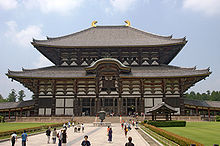
, is a Buddhist temple complex located in the city of Nara, Japan. Its Great Buddha Hall , the largest wooden building in the world, houses the world's largest bronze statue of the Buddha Vairocana, known in Japanese simply as Daibutsu . The temple also serves as the Japanese headquarters of the ...
. When the construction of Tōdai-ji
Todai-ji
, is a Buddhist temple complex located in the city of Nara, Japan. Its Great Buddha Hall , the largest wooden building in the world, houses the world's largest bronze statue of the Buddha Vairocana, known in Japanese simply as Daibutsu . The temple also serves as the Japanese headquarters of the ...
was completed, Rōben entered that temple to formally initiate Kegon as a field of study in Japanese Buddhism, and Kegon-shū would become known as one of the Nanto Rikushū (南都六宗), or The Six Buddhist Sects of Nanto
Nanto
Nanto may refer to:in geography* Nanto, Veneto, an Italian municipality in the Province of Vicenza* Nanto, Toyama , a city in Japan* Nanto , a historical synonym for Nara, Nara, Japan...
(Nara
Nara, Nara
is the capital city of Nara Prefecture in the Kansai region of Japan. The city occupies the northern part of Nara Prefecture, directly bordering Kyoto Prefecture...
). Rōben's disciple Jitchu
Jitchū
was a Buddhist monk in Nara Japan of the Kegon sect, and pupil of Roben. In his later years, Jitchu oversaw the expansion of Todaiji temple, and introduced liturgy and rituals still used today. The most noteworthy of these ceremonies is the Shuni-e repentance ceremony established by Jitchu at the...
continued administration of Tōdai-ji and expanded its prestige through the introduction of imported rituals. Kegon thought would later be popularized by Myōe
Myoe
Myōe was a Japanese Buddhist monk active during the Kamakura period who also went by the name Kōben , and contemporary of Jōkei and Honen. Born into the Yuasa family , allegedly descended from a branch of the Fujiwara clan, he came to be ordained in both the Shingon school of Buddhism and the...
(明惠), who combined its doctrines with those of Vajrayana
Vajrayana
Vajrayāna Buddhism is also known as Tantric Buddhism, Tantrayāna, Mantrayāna, Secret Mantra, Esoteric Buddhism and the Diamond Vehicle...
and Gyōnen (凝然), and is most responsible for the establishment of the Tōdai-ji lineage of Kegon.
Over time, Kegon incorporated esoteric ritual from Shingon Buddhism, with which it shared a cordial relationship.Its practice continues to this day, and includes a few temples overseas.
External links
- (Japanese) 華厳宗大本山 東大寺の公式ホームページ