

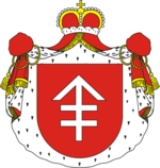
Kazimierz Nestor Sapieha

Encyclopedia
Prince Kazimierz Nestor Sapieha (1757–1798) was a Polish
-Lithuania
n noble (szlachcic).
Kazimierz Sapieha was educated at the Knight School in Warsaw
from 1767 until 1791, and served as Artillery General of Lithuania, from 1773 to 1793. As Deputy from Brzesc Litewski, he participated in the Four-Year Sejm in Warsaw, and became Sejm Marshal from October 6, 1788, until May 29, 1792, and Marshal of the Lithuanian Confederation
.
An early supporter of the magnate
opposition to any liberalization (his uncle Hetman
Franciszek Ksawery Branicki
was its leader), Sapieha changed his position under the influence of Stanisław Małachowski, and became a supporter of reforms, and the May 3rd Constitution. He strongly protested, when King Stanisław August Poniatowski joined the Targowica Confederation
, and this so angered Sapieha, that he decided to leave Poland. After the outbreak of the Kościuszko Uprising
, he returned to his homeland and participated in the rebellion, holding the rank of an Artillery Captain. After the Uprising collapsed, he left Poland again, and spent the rest of his life in exile
. He died 1798 in Vienna
.
Poland
Poland , officially the Republic of Poland , is a country in Central Europe bordered by Germany to the west; the Czech Republic and Slovakia to the south; Ukraine, Belarus and Lithuania to the east; and the Baltic Sea and Kaliningrad Oblast, a Russian exclave, to the north...
-Lithuania
Lithuania
Lithuania , officially the Republic of Lithuania is a country in Northern Europe, the biggest of the three Baltic states. It is situated along the southeastern shore of the Baltic Sea, whereby to the west lie Sweden and Denmark...
n noble (szlachcic).
Kazimierz Sapieha was educated at the Knight School in Warsaw
Warsaw
Warsaw is the capital and largest city of Poland. It is located on the Vistula River, roughly from the Baltic Sea and from the Carpathian Mountains. Its population in 2010 was estimated at 1,716,855 residents with a greater metropolitan area of 2,631,902 residents, making Warsaw the 10th most...
from 1767 until 1791, and served as Artillery General of Lithuania, from 1773 to 1793. As Deputy from Brzesc Litewski, he participated in the Four-Year Sejm in Warsaw, and became Sejm Marshal from October 6, 1788, until May 29, 1792, and Marshal of the Lithuanian Confederation
Confederation
A confederation in modern political terms is a permanent union of political units for common action in relation to other units. Usually created by treaty but often later adopting a common constitution, confederations tend to be established for dealing with critical issues such as defense, foreign...
.
An early supporter of the magnate
Magnate
Magnate, from the Late Latin magnas, a great man, itself from Latin magnus 'great', designates a noble or other man in a high social position, by birth, wealth or other qualities...
opposition to any liberalization (his uncle Hetman
Hetman
Hetman was the title of the second-highest military commander in 15th- to 18th-century Poland and the Grand Duchy of Lithuania, which together, from 1569 to 1795, comprised the Polish-Lithuanian Commonwealth, or Rzeczpospolita....
Franciszek Ksawery Branicki
Franciszek Ksawery Branicki
Count Franciszek Ksawery Branicki was a Polish nobleman of the Korczak coat of arms, magnate and one of the leaders of the Targowica Confederation....
was its leader), Sapieha changed his position under the influence of Stanisław Małachowski, and became a supporter of reforms, and the May 3rd Constitution. He strongly protested, when King Stanisław August Poniatowski joined the Targowica Confederation
Targowica Confederation
The Targowica Confederation was a confederation established by Polish and Lithuanian magnates on 27 April 1792, in Saint Petersburg, with the backing of the Russian Empress Catherine II. The confederation opposed the Polish Constitution of May 3, 1791, which had been adopted by the Great Sejm,...
, and this so angered Sapieha, that he decided to leave Poland. After the outbreak of the Kościuszko Uprising
Kosciuszko Uprising
The Kościuszko Uprising was an uprising against Imperial Russia and the Kingdom of Prussia led by Tadeusz Kościuszko in Poland, Belarus and Lithuania in 1794...
, he returned to his homeland and participated in the rebellion, holding the rank of an Artillery Captain. After the Uprising collapsed, he left Poland again, and spent the rest of his life in exile
Exile
Exile means to be away from one's home , while either being explicitly refused permission to return and/or being threatened with imprisonment or death upon return...
. He died 1798 in Vienna
Vienna
Vienna is the capital and largest city of the Republic of Austria and one of the nine states of Austria. Vienna is Austria's primary city, with a population of about 1.723 million , and is by far the largest city in Austria, as well as its cultural, economic, and political centre...
.
Awards
- Knight of the Order of the White Eagle, awarded on January 1, 1779.