

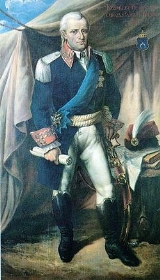
Kazimierz Krasinski

Encyclopedia
| Kazimierz Krasiński | |
| EWLINE |
|
| Noble Family Szlachta The szlachta was a legally privileged noble class with origins in the Kingdom of Poland. It gained considerable institutional privileges during the 1333-1370 reign of Casimir the Great. In 1413, following a series of tentative personal unions between the Grand Duchy of Lithuania and the Kingdom of... |
Krasiński Krasinski Krasiński is a surname of Polish, or generally Slavic, origin.... |
| Coat of Arms Polish heraldry Polish heraldry is a branch of heraldry focused on studying the development of coats of arms in the lands of historical Poland , as well as specifically-Polish traits of heraldry. The term is also used to refer to Polish heraldic system, as opposed to systems used elsewhere, notably in Western Europe... |
Ślepowron |
| Parents | Antoni Krasiński Barbara Zielińska |
| Consorts | Eustachia Potocka Elżbieta Potocka Anna Ossolińska |
| Children | with Anna Ossolińska Jan Wawrzyniec Krasiński Elźbieta Krasińska |
| Date of Birth | 1725 |
| Place of Birth | ? |
| Date of Death | September 25, 1802 |
| Place of Death | ? |
Count Kazimierz Krasiński (1725–1802) was a Polish
Poland
Poland , officially the Republic of Poland , is a country in Central Europe bordered by Germany to the west; the Czech Republic and Slovakia to the south; Ukraine, Belarus and Lithuania to the east; and the Baltic Sea and Kaliningrad Oblast, a Russian exclave, to the north...
noble, politician and patron of art. He was the son of Antoni Krasiński and Barbara Zielińska.
The last Grand Camp Leader of the Crown (since 1763) of the Polish-Lithuanian Commonwealth
Polish-Lithuanian Commonwealth
The Polish–Lithuanian Commonwealth was a dualistic state of Poland and Lithuania ruled by a common monarch. It was the largest and one of the most populous countries of 16th- and 17th‑century Europe with some and a multi-ethnic population of 11 million at its peak in the early 17th century...
. He was Chamberlain
Chamberlain (office)
A chamberlain is an officer in charge of managing a household. In many countries there are ceremonial posts associated with the household of the sovereign....
of King Stanisław Leszczyński and starost of Krasnystaw
Krasnystaw
Krasnystaw is a town in eastern Poland with 19,615 inhabitants . Situated in the Lublin Voivodeship , previously in Chelm Voivodeship . It is the capital of Krasnystaw County....
and Nowe Miasto Korczyn.

Lunéville
Lunéville is a commune in the Meurthe-et-Moselle department in France.It is a sub-prefecture of the department and lies on the Meurthe River.-History:...
.
He was Marshal of the Sejm
Sejm
The Sejm is the lower house of the Polish parliament. The Sejm is made up of 460 deputies, or Poseł in Polish . It is elected by universal ballot and is presided over by a speaker called the Marshal of the Sejm ....
(ordinary) on September 30 - November 9, 1782 in Warsaw
Warsaw
Warsaw is the capital and largest city of Poland. It is located on the Vistula River, roughly from the Baltic Sea and from the Carpathian Mountains. Its population in 2010 was estimated at 1,716,855 residents with a greater metropolitan area of 2,631,902 residents, making Warsaw the 10th most...
.
During the Four-Year Sejm in 1788, he was a member of the Military Commission of the Commonwealth and a supporter of the 3rd May Constitution.
He financed and participated in the Kościuszko Uprising
Kosciuszko Uprising
The Kościuszko Uprising was an uprising against Imperial Russia and the Kingdom of Prussia led by Tadeusz Kościuszko in Poland, Belarus and Lithuania in 1794...
in 1794. After the Partitions of Poland
Partitions of Poland
The Partitions of Poland or Partitions of the Polish–Lithuanian Commonwealth took place in the second half of the 18th century and ended the existence of the Polish–Lithuanian Commonwealth, resulting in the elimination of sovereign Poland for 123 years...
, he patronized Polish independence organisations and financed scientific publications and printing of books.
He was also a benefactor of the church.
Awards
- Knight of the Order of the White Eagle, awarded in 1763.