


Kamiza

Encyclopedia
Japanese language
is a language spoken by over 130 million people in Japan and in Japanese emigrant communities. It is a member of the Japonic language family, which has a number of proposed relationships with other languages, none of which has gained wide acceptance among historical linguists .Japanese is an...
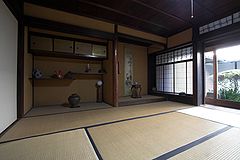
term referring to the "top seat" within a room, meaning the place of honor; the term also applies to the best seats in air-planes, trains, and cars. The antonym, meaning "bottom seat," is shimoza (下座). In a room, the kamiza is the seat or position that is most comfortable, usually furthest from the door -- because this is warmest, and was safest from attack back in the feudal period
History of Japan
The history of Japan encompasses the history of the islands of Japan and the Japanese people, spanning the ancient history of the region to the modern history of Japan as a nation state. Following the last ice age, around 12,000 BC, the rich ecosystem of the Japanese Archipelago fostered human...
. In a traditional washitsu
Washitsu
, meaning "Japanese-style room", is a Japanese term used as an antonym for the term yōshitsu , meaning "Western-style room." Another term for washitsu is nihonma , and the comparative other term for yōshitsu is yōma ....
room it would often be a zabuton
Zabuton
A zabuton is a Japanese cushion for sitting. The zabuton is generally used when sitting on the floor, and may also be used when sitting on a chair. Ordinarily any place in Japan where seating is on the floor will be provided with zabuton, for sitting comfort...
placed so the person sitting there has his back to the tokonoma
Tokonoma
Tokonoma , also referred to simply as toko, is a Japanese term generally referring to a built-in recessed space in a Japanese style reception room, in which items for artistic appreciation are displayed. In English, tokonoma is usually called alcove. The items usually displayed in a tokonoma are...
; the kamiza is the spot closest to the tokonoma or simply farthest from the door in a room lacking a tokonoma. In a Western
Western culture
Western culture, sometimes equated with Western civilization or European civilization, refers to cultures of European origin and is used very broadly to refer to a heritage of social norms, ethical values, traditional customs, religious beliefs, political systems, and specific artifacts and...
-style room it would be a comfortable armchair or sofa, or the head of a table.
The term is general, and does not only apply to Japanese culture.
Choosing a seat
When entering a room in JapanCulture of Japan
The culture of Japan has evolved greatly over the millennia, from the country's prehistoric Jōmon period to its contemporary hybrid culture, which combines influences from Asia, Europe and North America...
on a formal occasion, it is of great importance to assume the correct seating position, and to leave the kamiza free for the most important person present, whether it is a special guest or the person of highest rank. However, if one humbly sits somewhere indicative of lower status and is then encouraged by the host to move to the kamiza, it is acceptable to do so.
In transportation
The best seats in a carČar
Čar is a village in the municipality of Bujanovac, Serbia. According to the 2002 census, the town has a population of 296 people.-References:...
in descending order of rank are: directly behind the driver, behind the front passenger, in the middle of the back seat, front passenger seat, driver.
In air-plane or train
Train
A train is a connected series of vehicles for rail transport that move along a track to transport cargo or passengers from one place to another place. The track usually consists of two rails, but might also be a monorail or maglev guideway.Propulsion for the train is provided by a separate...
passenger seating, the "top seat" is the window-side, followed by the aisle seat and then the middle seat.
In dōjō
The term kamiza may be confused by Japanese martial artsJapanese martial arts
Japanese martial arts refers to the enormous variety of martial arts native to Japan. At least three Japanese terms are often used interchangeably with the English phrase "Japanese martial arts": , literally meaning "martial way", , which has no perfect translation but means something like science,...
practitioners with kamidana
Kamidana
Kamidana , is a miniature Shinto shrine found in many Japanese homes. The kamidana is typically placed high on a wall and contains a wide variety of items related to Shinto-style ceremonies, the most prominent of which is the shintai, most commonly in the form of a small circular mirror, though it...
, a tiny Shinto shrine found in some dōjō
Dojo
A is a Japanese term which literally means "place of the way". Initially, dōjōs were adjunct to temples. The term can refer to a formal training place for any of the Japanese do arts but typically it is considered the formal gathering place for students of any Japanese martial arts style to...
(martial arts training halls).
A kamidana
Kamidana
Kamidana , is a miniature Shinto shrine found in many Japanese homes. The kamidana is typically placed high on a wall and contains a wide variety of items related to Shinto-style ceremonies, the most prominent of which is the shintai, most commonly in the form of a small circular mirror, though it...
may be placed in the kamiza area. The front of the dōjō may also simply be called "front" (正面 shōmen).