
| |
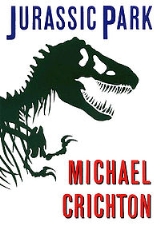
Jurassic Park is a 1990 science fiction novel written by Michael Crichton. Often considered a cautionary tale on unconsidered biological tinkering in the same spirit as Mary Shelley's Frankenstein, it uses the mathematical concept of chaos theory and its philosophical implications to explain the collapse of an amusement park showcasing certain genetically recreated dinosaur species. It was adapted into a blockbuster film in 1993 by director Steven Spielberg. The book's sequel, The Lost World (1995), was also adapted by Spielberg into a film in 1997.
Plot summary The narrative begins by slowly tying together a series of incidents involving strange animal attacks in Costa Rica and on Isla Nublar, the main setting for the story.

Discussion
Ask a question about 'Jurassic Park'
Start a new discussion about 'Jurassic Park'
Answer questions from other users
|
Quotations
A 1993 film, based on the novel.
A novel by Michael Crichton.

Encyclopedia
Jurassic Park is a 1990 science fiction novel written by Michael Crichton. Often considered a cautionary tale on unconsidered biological tinkering in the same spirit as Mary Shelley's Frankenstein, it uses the mathematical concept of chaos theory and its philosophical implications to explain the collapse of an amusement park showcasing certain genetically recreated dinosaur species. It was adapted into a blockbuster film in 1993 by director Steven Spielberg. The book's sequel, The Lost World (1995), was also adapted by Spielberg into a film in 1997.
Plot summary The narrative begins by slowly tying together a series of incidents involving strange animal attacks in Costa Rica and on Isla Nublar, the main setting for the story. Paleontologist Alan Grant and his paleobotanist graduate student Ellie Sattler are abruptly whisked away by billionaire John Hammond (founder and chief executive officer of International Genetic Technologies, or InGen) for a weekend visit to a "biological preserve" he has established on an island 120 miles west off the coast of Costa Rica.
Recent events have spooked Hammond's considerable investors, so, to placate them, he means for Grant and Sattler to act as fresh consultants. They stand in counterbalance to a well-known mathematician and chaos theorist, Ian Malcolm, and a lawyer representing the investors, Donald Gennaro. Both are pessimistic, but Malcolm, having been consulted before the park's creation, is emphatic in his prediction that the park will collapse, as it is an unsustainably simple structure bluntly forced upon a complex system.
Upon arrival the park is revealed to contain cloned dinosaurs, which have been recreated using damaged dinosaur DNA (found in mosquitoes that sucked Saurian blood and were then trapped and preserved in amber). Gaps in the genetic code have been filled in with reptilian, avian, or amphibian DNA. To control the population, all specimens on the island are bred to be female as well as lysine-deficient. Hammond proudly showcases InGen's advances in genetic engineering and shows his guests through the island's vast array of automated systems.
Countering Malcolm's dire predictions with youthful energy, Hammond groups the consultants with his grandchildren, Tim and Alexis "Lex" Murphy. While touring the park with the children, Grant finds a velociraptor eggshell, which seems to prove Malcolm's earlier assertion that the dinosaurs have been breeding against the geneticists' design (the population graphs proudly introduced earlier were naturally distributed, reflecting a breeding population, rather than displaying the distinct pattern that a population reared in batches ought to display).
Malcolm suggests a flaw in their method of analyzing dinosaur populations, in that motion detectors were set to search only for the expected number of creatures in the park and not for any higher number. The park's controllers are reluctant to admit that the park has long been operating beyond their constraints. Malcolm also points out the height distribution of the Procompsognathus forms a Gaussian distribution, the curve of a breeding population.
In the midst of this, the chief programmer of Jurassic Park's controlling software, Dennis Nedry, attempts corporate espionage for Lewis Dodgson, a geneticist and agent of InGen's archrival, Biosyn. By activating a backdoor he wrote into the system, Nedry manages to shut down the park's security systems and quickly steal 30 frozen embryos, two of each of the park's fifteen species. He then attempts to smuggle them out to a contact waiting at the auxiliary dock deep in the park. But his plan goes awry: during a sudden tropical storm Nedry becomes lost and stops his stolen Jeep at a dead end. He exits the Jeep to determine his location. A Dilophosaurus approaches him from afar, blinds him with its poisonous saliva, and then kills him.
Nedry's plan called for him to secretly deliver the embryos and return to the park's control room within fifteen minutes, but without him to quietly patch the system, the park's security is left off, leaving the electrified fences deactivated. Without the barriers to contain them, dinosaurs begin to escape. The adult and juvenile Tyrannosaurus rex attack the guests on tour, destroying the vehicles, killing InGen public relations manager Ed Regis, and leaving Grant and the children lost in the park.
Ian Malcolm is gravely injured during the incident but is soon found by Gennaro and park game warden Robert Muldoon and spends the remainder of the novel slowly dying as, in between lucid lectures and morphine-induced rants, he tries to help those in the main compound understand their predicament and survive.
The park's upper management — engineer and park supervisor John Arnold, chief geneticist Henry Wu, Muldoon, and Hammond — struggle to return power to the park, while the veterinarian, Dr. Harding, takes care of the injured Malcolm. For a time they manage to get the park largely back in order, restoring the computer system by shutting down and restarting the power, resetting the system. Unfortunately, a series of errors on their part soon plunge the park into greater disarray. During their time trying to restore the park to working order, they fail to notice that the system has been running on auxilary power since the restart, which soon runs out, shutting the park down a second time. The viciously intelligent Velociraptors, referred to by characters as "raptors", finally escape. They soon kill Wu and Arnold, and injure Muldoon, Gennaro, and Harding. Finally, Grant and the children slowly make their way back to the central compound, carrying news that several young raptors, bred and raised in the island's wilds, were on board the Anne B, the island's supply ship, when it departed for the mainland.
Grant is able to turn the main power back on, while Ellie distracts the raptors so that they won't get to him. After escaping from several raptors, Grant, Gennaro, Tim, and Lex are able to make it to the control room, where Tim is able to contact the Anne B and tell them to return. The survivors are then able to organize themselves and eventually secure their own lives. Word soon reaches them that the crew of the Anne B has discovered and killed the raptor stowaways.
Gennaro tries to order the island destroyed as a dangerous asset, but Grant rejects his authority, claiming that even though they cannot control the island, they have a responsibility to understand just what happened and how many dinosaurs have already escaped to the mainland. Finally Grant, Sattler, Muldoon, and Gennaro set out into the park to find the wild raptor nests and compare hatched eggs with the island's revised population tally. Cautious in this pursuit, they emerge unharmed. Meanwhile, Hammond, while taking a walk around the park, decides to salvage and restore the park to its original state, but gets injured, then killed and eaten by a pack of compys. Concerning the dinosaurs' breeding, it is eventually revealed that the frog DNA used to fill gaps in certain strands enabled some of the dinosaurs to change sex, as some species of frogs can do.
In the end the island is suddenly and violently demolished by the fictional Costa Rican Air Force (in reality, Costa Rica has no air force, nor any armed forces). It is stated that Malcolm dies and his burial is not permitted (although he is retconned to have survived in the sequel The Lost World). Survivors of the incident are indefinitely detained by the United States and Costa Rican governments. Weeks later, Grant is visited by Dr. Martin Guitierrez, an American doctor, who lives in Costa Rica and has found a Procompsognathus corpse. Guitierrez informs Grant that an unknown pack of animals has been eating crops rich in lysine (the molecule in which the animals were designed to be deficient) and killing livestock as they migrate toward the Costa Rican jungle. He also informs Grant that none of them, with the possible exception of Tim and Lex, are going to be leaving any time soon.
Dinosaurs featured in the novel
Biological issues and accuracy
Scientists have argued that much of the book's content is impossible for various reasons, most notably the suggested means of recovering dinosaur DNA from mosquitoes trapped in fossilized tree sap. While this theory is largely a plot device by Crichton, both novel and movie sparked debate on the feasibility of cloning dinosaurs.
Three arguments why it would not be possible to obtain dinosaurs with this process are summarized thus:
- Dinosaur DNA would be very difficult to correctly sequence without a complete, intact DNA strand for comparison. It would be unlikely to find a complete sequence because DNA is typically unstable outside living organisms (unless it is in the proper buffer).
- Any gaps in the resulting DNA sequence must be filled with dinosaur DNA; using frog DNA as the story suggests would likely produce an organism that varied from the original animal.
- In order to clone a complete DNA sequence, an oocyte from the same organism is required. Since no Mesozoic dinosaurs are alive today, this would be impossible.
- Most important however are the processes of CpG methylation and cytosine deaminization. A common regulatory device in eukaryotic DNA is the process of CpG methylation, where cytosine immediately preceding a guanine on the same stand is methylated. This acts as a molecular flag to control gene expression. The problem is, over time cytosine deaminization can occur. This is where a cytosine loses its amine group which is replaced by a carbonyl group. If the cytosine is un-methylated this will result in uracil, which is not found in DNA so can be assumed to be a de-aminated cytosine. On the other hand, if the cytosine has been methylated then the product of deaminization will be thymine, which is found in DNA so it would be impossible to know which Ts are Ts, and which are de-aminated methyl cytosines.
Furthermore, it is likely that any prehistoric DNA obtained from a fossilized mosquito would have become contaminated with the mosquito's own, again making it problematic to clone an 'accurate' and viable organism.
Crichton appears to have been aware of most if not all of the scientific objections raised, a consequence of his own medical background. Within the novel, Dr. Wu reflects on the nature of his dinosaurs. For Dr. Henry Wu , they are his creations, made from fragments of DNA available, and corrected and changed according to the needs of the client, Mr. Hammond. In this way the animals replicated in this way would have represented a truly towering achievement in the biological sciences - the manufacture of fully synthetic organisms with structures based on theoretical models as opposed to truly observed biology. That the dinosaurs thus manufactured display the characteristics of natural organisms, including responding to environmental pressures (such as the all female population, and lysinergic biochemical pathway degradation) increases the magnitude of the achievement.
A theme expressed throughout the story and its sequel is that of homeothermic (warm-blooded) dinosaurs, a then-recent theory popularized by paleontologist Bob Bakker. While the cinematic adaptation of Jurassic Park used ostrich eggs as vessels to facilitate expression, the novel described "a new plastic with the characteristics of an avian eggshell." The plastic was called 'millipore', invented by an eponymous company subsequently bought by InGen (Millipore Corporation is also the name of a real company that manufactures materials for use in biological sciences, although they are not known to make dinosaur eggshells. That said, Crichton correctly identifies their company as the most likely to produce a suitable material).
Most of the dinosaurs featured in the novel are not from the Jurassic period; they are actually from the Cretaceous period, the last period during which non-avian dinosaurs lived.
Differences from the film adaptation
Universal Studios paid Michael Crichton $2 million for the rights to the novel in 1990, before it was even published. In 1993, the Steven Spielberg-directed film adaptation was released. Many plot points from the novel were changed or dropped. David Koepp wrote the screenplay for the film, with Crichton's assistance.
Crichton also wrote a sequel to Jurassic Park, called The Lost World, which was also made into a film. Jurassic Park III, a film not based on a Crichton book, came out in 2001.
Some significant changes include:
- The book includes several scenes with the Procompsognathus dinosaur. Many of these sequences and references to the dinosaur were dropped from the film adaptation, resulting in significant plot differences.
- The book's opening chapter describes a young American girl vacationing at the shore with her family in Central America getting attacked by Procompsognathus while her parents are not looking. Instead, the film's opening showed the events that are alluded to by the bedridden patient in the book's prologue. This is because the film dropped the Procompsognathus dinosaur and also the entire subplot about dinosaurs escaping from the island; consequently the opening scene, the climax of the book in the Velociraptors' nest, and the scene with Velociraptors on the boat were all deemed useless. The sequence was later recycled as the opening of the film The Lost World: Jurassic Park, with a British family cruising to Isla Sorna instead of the mainland.
- The first Iteration (Crichton titled the book's sections as "iterations") was omitted from the film, meaning all the characters from the Iteration never appeared, most notable Dr. Martin Guitierrez.
- In the novel, Dr. Grant is described as having a love of children. In the film, he initially dislikes children.
- In the novel, unspecified Hadrosaurs are running near Grant, Lex, and Tim, but in the film, they are replaced by Gallimimus. The Hadrosaur stampede, consisting of mostly Parasaurolophus and Corythosaurs, was later used in Jurassic Park III.
- The characteristics of Lex and Tim were different in the film; in the novel, Tim is older and good with computers, although still interested in dinosaurs, while Lex is a young tomboy. In the movie, their roles are switched around, with Lex being older and good with computers, while Tim is a huge Dinosaur fan.
- Dr. Henry Wu and Dr. Gerry Harding both have major roles in the novel which were reduced to cameos in the film.
- The entire sequence involving the pterosaur enclosure is dropped from the film. Like the Procompsognathusisis scenes, this was recycled for usage later in the film series (in Jurassic Park III).
- Another sequence involving Dr. Grant and the children being chased by the Tyrannosaurus Rex down a river on an inflatable raft, was also dropped from the film, However, this river raft sequence became the inspiration for the Jurassic Park River Adventure ride at Universal Studios Hollywood, a ride based on the film. This scene is also included in the video game adaptation for the Sega Genesis.
- In the novel, the tour cars are Toyota Land Cruisers, but in the film they are Ford Explorers. In subsequent material outside the films, the cars are typically referred to as Land Cruisers regardless of their make.
- In the novel, Nedry dies outside the Jeep. In the film the dilophasaurus follows him into the Jeep and kills him there.
- In the novel, Dr. Ellie Sattler disembarks from the tour to tend to a sick Stegosaurus. In the film, a sick Triceratops was used instead.
- The name of the character John Arnold was changed to "Ray Arnold" in the film, possibly to avoid confusion with the character John Hammond.
- In the novel, John Arnold was able to revive the power systems in Jurassic Park by finding the command to restore the original code on Nedry's computer in the main control room; in the film, Muldoon and Sattler had to go to an isolated power shed.
- In the novel, Hammond is killed by compys after being frightened by a recorded Tyrannosaurus roar, falling down a steep hillside and breaking his ankle. In the film, Hammond is among the survivors who escapes the island, returning in the sequel having reformed his ways, seeking to protect the dinosaurs rather than exploit them.
- Donald Gennaro does not go back to the tour cars after tending to the sick stegosaur (a triceratops in the movie) and therefore is not present for the Tyrannosaur attack. Therefore, he does not die, as he does in the film.
- In the novel, John Hammond has more cynical and greedy motivations; in the film, most of Hammond's negative personality traits are given to Donald Gennaro instead.
- In the film adaptation Robert Muldoon, the Game warden, is killed by the Velociraptors, while in the novel he survives the attack by diving into a pipe where the raptors cannot follow. In the film, it is Lex who hides herself in a pipe to escape the Tyrannosaur.
- In the book, Dr. Grant and Dr. Sattler are not romantically involved, as they are in the film.
- In the novel, Dr. Grant learns that some of Jurassic Park's dinosaurs, including Tyrannosaurus, can see only movement. In the novel, he makes his discovery when he freezes during the Tyrannosaur attack on the Land Cruisers, later confirming it after waking up in a tree from which a Hadrosaur is eating. In the movie, he already knows this before arriving on the island (due to fictional palentological theory), immediately warning several other characters to sit still during the Tyrannosaur attack because "their vision is based on movement!". The scene in the tree with the Hadrosaur is reworked, omitting the theory confirmation replacing the Hadrosaur with a Brachiosaur.
- In the novel, several of the survivors take refuge from the Velociraptors in the Safari Lodge, a guest hotel intended for the park's future visitors, and a portion of the plot is centered around reactivating the Lodge's security systems (which include electrified skylights) to prevent the raptors from getting inside. This sequence is completely omitted from the film, replaced with the much smaller-scale situation of reactivating the Visitor Center's electronic door locks to keep the raptors out of the control room.
- The dinosaur species (excluding Procompsognathus, and the non-dinosaurs Pterosaurs) in the novel, Apatosaurus, Microceratops, Othnielia, Styracosaurus, Euoplocephalus, Hypsilophodon, and Maisaura, do not appear in the film adaptation. The only Hadrosaurs observed in the first film are Parasaurolophus. Apatosaurus is replaced by Brachiosaurus, unspecified Hadrosaurs are replaced by Gallimimus, and Stegosaurus was only seen in a tube label, despite being misspelled as Stegasaurus.
- The survivors in the novel are Alan Grant, Ellie Sattler, Lex Murphy, Tim Murphy, Donald Genarro, Robert Muldoon, Dr. Harding, and several workmen. It is implied that Malcolm died, but in the sequel it is revealed he survived, although he was left with lasting injuries. In the film the survivors are Alan Grant, Ellie Sattler, Lex Murphy, Tim Murphy, Ian Malcolm and John Hammond. In the film, Henry Wu and Dr. Harding, along with all the workmen, left before the crises happened.
- The park's computer systems are updated in the movie; the novel called for three Cray X-MP supercomputers to be used for sequencing the dinosaur DNA; in the movie, the 'Mr. DNA' tour Animation reveals that the park uses Thinking Machines supercomputers, specifically eight Connection Machine CM-5s (as revealed by Dennis Nedry) and Silicon Graphics workstations. The supercomputers are not shown to the visitors in the movie, but are visible in the control room scenes, notably the Connection Machine computers, which have red LED panels that blink with usage.
- In the novel, Ellie Sattler comes across a Velociraptor with a genetic mutation that allows it to change the colour of its skin. The device is so minor it is left out of the film, as the Velociraptor in question is juvenile & does not appear again.
- In the novel Tim Murphy is quite skilled in climbing trees but in the film he does not want to climb down until the Land Cruiser starts to fall down the tree.
- The character of Ed Regis is omitted. Parts of his character are present in the film version of Genarro.
- In the novel, the only lethal weapons Muldoon was allowed to have were a pair of rocket launchers (although a shed of nerve gas grenades that Muldoon did not know about was found). In the film he opens a locker full of shotguns and he probably had more, because some of the members of the loading team in the beginning had guns.
Reception
The book became a bestseller and Michael Crichton's signature novel. It was also given good reviews by critics. It became even more famous when the film came out, grossing over $914,691,118.
Further reading
The Science of Jurassic Park and The Lost World. Or How to Build a Dinosaur. Rob DeSalle and David Lindley. BasicBooks, New York, 1997. xxix, 194 pp., illus. $18 or C$25.50. ISBN 0-465-07379-4.
External links
-
- Jurassic Park at IMDb
- at the official Michael Crichton website
- by Harrison Mujica-Jenkins at
-
|