
| |
José Victoriano González-Pérez (March 23, 1887 – May 11, 1927), better known as Juan Gris, was a Spanish painter and sculptor who lived and worked in France most of his life. His works are closely connected to the emergence of an innovative artistic genre—Cubism.
in Madrid, he studied mechanical drawing at the Escuela de Artes y Manufacturas in Madrid from 1902 to 1904, during which time he contributed drawings to local periodicals.

Discussion
Ask a question about 'Juan Gris'
Start a new discussion about 'Juan Gris'
Answer questions from other users
|
Quotations
I try to make concrete that which is abstract.
Response to questionnaire circulated to the Cubists by Amédée Ozenfant and Le Corbusier, editors of L'Esprit Nouveau 5 (February 1921)

Encyclopedia
José Victoriano González-Pérez (March 23, 1887 – May 11, 1927), better known as Juan Gris, was a Spanish painter and sculptor who lived and worked in France most of his life. His works are closely connected to the emergence of an innovative artistic genre—Cubism.
Biography
Born in Madrid, he studied mechanical drawing at the Escuela de Artes y Manufacturas in Madrid from 1902 to 1904, during which time he contributed drawings to local periodicals. From 1904 to 1905 he studied painting with the academic artist José Maria Carbonero. It was probably in 1905 that José González adopted the more distinctive pseudonym Juan Gris.
In 1906 he moved to Paris and became friends with Henri Matisse, Georges Braque, Fernand Léger, and in 1915 he was painted by his friend, Amedeo Modigliani. In Paris, Gris followed the lead of another friend and fellow countryman, Pablo Picasso. Although he submitted darkly humorous illustrations to journals such as Le Rire, L'assiette au beurre, Le Charivari, and Le Cri de Paris, Gris began to paint seriously in 1910, and by 1912 he had developed a personal Cubist style. His portrait of Picasso in 1912 is a significant early Cubist painting done by a painter other than Picasso or Braque. (Although he regarded Picasso as a teacher, Gertrude Stein acknowledged that Gris "was the one person that Picasso would have willingly wiped off the map.")
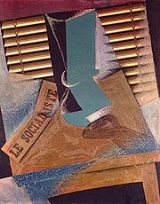
At first Gris painted in the analytic style of Cubism, but after 1913 he began his conversion to synthetic Cubism, of which he became a steadfast interpreter, with extensive use of papier collé. Unlike Picasso and Braque, whose Cubist works were monochromatic, Gris painted with bright harmonious colors in daring, novel combinations in the manner of his friend Matisse.
In 1924, he first designed ballet sets and costumes for Sergei Diaghilev and the famous Ballets Russes.
Gris articulated most of his aesthetic theories during 1924 and 1925. He delivered his definitive lecture, Des possibilités de la peinture, at the Sorbonne in 1924. Major Gris exhibitions took place at the Galerie Simon in Paris and the Galerie Flechtheim in Berlin in 1923, and at the Galerie Flechtheim in Düsseldorf in 1925.
He died in Boulogne-sur-Seine (Paris) in the spring of 1927 at the age of forty, leaving a wife, Josette, and a son, Georges.
Selected works
External links
-
- - Links to Gris' works
- - Extensive list and images of Gris' works
- - Biography and images of Gris' works
-
- See actual exhibitions and related galleries and museums for Juan Gris
|