
All Topics  
Jonas Salk


   Email Print
   Bookmark   Link


Jonas Salk


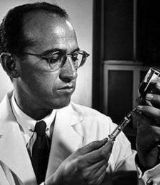
Jonas Salk (October 28, 1914 – June 23, 1995) was an American medical researcher and virologist, best known for his discovery and development of the first safe and effective polio vaccine
Polio vaccine

Two polio vaccines are used throughout the world to combat poliomyelitis . The first was developed by Jonas Salk and first tested in 1952. Announced to the world by Salk on April 12, 1955, it consists of an injected dose of inactivated poliovirus....
. He was born in New York City
New York City

The City of New York is the List of United States cities by population in the United States, while the New York metropolitan area ranks among the List of urban areas by population....
, where his parents were Russian-Jewish immigrants. Although they themselves lacked formal education, they were determined to see their children succeed. During his years at medical school at New York University
New York University

New York University is a private university, nonsectarian, research university in New York City. NYU's main campus is situated in the Greenwich Village section of Manhattan....
, he stood out from his peers not just because of his academic prowess, but because he chose to do medical research instead of becoming a physician.

Until 1955, when the Salk vaccine was introduced, polio was considered the most frightening public health problem of the postwar era.


Discussion
Ask a question about 'Jonas Salk'
Start a new discussion about 'Jonas Salk'
Answer questions from other users
Full Discussion Forum


Recent Posts


Quotations


Each individual has their own telos. Each of us has an art in us, which is what we should express, practice.

Risks, I like to say, always pay off. You learn what to do, or what not to do.

It is courage based on confidence, not daring, and it is confidence based on experience.

On testing his vaccine against polio on himself, his wife, and his three sons (1955-05-09)

As a child I was not interested in science. I was merely interested in things human, the human side of nature, if you like, and I continue to be interested in that. That's what motivates me.

I entered college enrolled as a pre-law student, but I changed to pre-med after I went through some soul searching as to what I would do other than the study of the law.

Some people are constructive, if you like. Others are destructive. It's this diversity in humankind that results in some making positive contributions and some negative contributions. It's necessary to have enough who make positive contributions to overcome the problems of each age.


Encyclopedia


Jonas Salk (October 28, 1914 – June 23, 1995) was an American medical researcher and virologist, best known for his discovery and development of the first safe and effective polio vaccine
Polio vaccine

Two polio vaccines are used throughout the world to combat poliomyelitis . The first was developed by Jonas Salk and first tested in 1952. Announced to the world by Salk on April 12, 1955, it consists of an injected dose of inactivated poliovirus....
. He was born in New York City
New York City

The City of New York is the List of United States cities by population in the United States, while the New York metropolitan area ranks among the List of urban areas by population....
, where his parents were Russian-Jewish immigrants. Although they themselves lacked formal education, they were determined to see their children succeed. During his years at medical school at New York University
New York University

New York University is a private university, nonsectarian, research university in New York City. NYU's main campus is situated in the Greenwich Village section of Manhattan....
, he stood out from his peers not just because of his academic prowess, but because he chose to do medical research instead of becoming a physician.

Until 1955, when the Salk vaccine was introduced, polio was considered the most frightening public health problem of the postwar era. Annual epidemics kept getting worse and victims were usually children. By 1952 it was killing more of them than any other communicable disease with over 57,000 cases reported that year. The "public reaction was to a plague," said historian William O'Neill. "Citizens of urban areas were to be terrified every summer when this frightful visitor returned." As a result, scientists were in a frantic race to find a cure. President Franklin D. Roosevelt
Franklin D. Roosevelt

Franklin Delano Roosevelt , often referred to by his initials FDR, was the List of Presidents of the United States President of the United States....
 was the world's most recognized victim of the disease and founded the institute to fund and create a vaccine.

In 1947, Salk accepted an appointment to the University of Pittsburgh
University of Pittsburgh

The University of Pittsburgh, commonly referred to as Pitt, is a Commonwealth System of Higher Education research university located in Pittsburgh, Pennsylvania, Pennsylvania, United States....
 Medical School. While working there, with the National Foundation for Infantile Paralysis, Salk saw an opportunity to develop a vaccine against polio, and devoted himself to this work for the next eight years. The field tests Salk set up were, according to O'Neill, "the most elaborate program of its kind in history, involving 20,000 physicians and public health officers, 64,000 school personnel, and 220,000 volunteers." When news of the discovery was made public on April 12, 1955, Salk was hailed as a "miracle worker," and the day "almost becoming a national holiday." He further endeared himself to the public by refusing to patent the vaccine, as he had no desire to profit personally from the discovery, but merely wished to see the vaccine disseminated as widely as possible.

In 1963, he founded the Salk Institute for Biological Studies
Salk Institute for Biological Studies

The Salk Institute for Biological Studies is an independent , non-profit, scientific research institute located in La Jolla, California. It was founded in 1960 by Jonas Salk, M.D., the developer of the polio vaccine....
 in La Jolla, California, which is today a center for medical and scientific research. He continued to conduct research and publish books, including Man Unfolding (1972), The Survival of the Wisest (1973), World Population and Human Values: A New Reality (1981), and Anatomy of Reality (1983). Dr. Salk's last years were spent searching for a vaccine against AIDS. He died on June 23, 1995 at the age of 80.

Early life


Jonas Salk was born in New York City
New York City

The City of New York is the List of United States cities by population in the United States, while the New York metropolitan area ranks among the List of urban areas by population....
 on October 28, 1914. His parents were Russian
Russians

The Russian people are an East Slavs ethnic group, primarily living in Russia and neighboring countries.The English language term Russians is used to refer to the citizens of Russia, regardless of their ethnicity ; in Russian language, the demonym Russian is translated as Rossiyanin ....
-Jew
Jew

A Jew is a member of the Jewish people, an ethnoreligious group that traces its ancestry to the Israelites or Hebrews of the Ancient Near East....
ish immigrants, Daniel and Dora Salk. According to historian David Oshinsky
David Oshinsky

David M. Oshinsky is a Pulitzer Prize-winning United States historian; he currently holds the Jack S. Blanton chair in history at the University of Texas at Austin and is a distinguished scholar in residence at New York University....
, Jonas Salk grew up in the "Jewish immigrant culture" of New York City. He had two younger brothers, Lee and Herman, and an uncle, Bruno Salk. The family lived in East Harlem, later moving to the Bronx and eventually settled in Queens.

His father, Daniel, unable to complete grade school in Russia, eventually emigrated to America where he worked in New York's garment district. Lee Salk, in his autobiography, would write of him: "He was something of a Willy Loman character from Death of a Salesman
Death of a Salesman

Death of a Salesman is a 1949 Play by American playwright Arthur Miller and is a classic of American theater. The play ran for 742 performances, directed by Elia Kazan with Lee J....
, beaten down in business but still believing that success would soon be his." Because of his long hours at work he had to leave most of the child-rearing duties to his his wife.

Jonas's mother was also mostly uneducated and likewise had emigrated to the U.S. where she would use her time raising their three sons. According to Jonas, "She wanted to be sure that we all were going to advance in the world. Therefore we were encouraged in our studies and overly protected." She was best remembered for "pushing her three sons relentlessay to excel," writes Oshinsky.

In later years his brother Herman became a veterinarian
Veterinarian

A veterinarian or a veterinary surgeon , often shortened to vet, is a physician for animals and a practitioner of veterinary medicine....
 and Lee became a clinical psychologist.

Education


High school

When he was 12, Salk entered Townsend Harris High School
Townsend Harris High School

Townsend Harris High School is a public magnet school high school for the humanities in the borough of Queens, New York in New York City. Students and alumni often refer to themselves as "Harrisites." Townsend Harris consistently ranks as among the top 100 High Schools in the United States....
, a public school for intellectually gifted students. Named after the founder of City College of New York
City College of New York

The City College of The City University of New York is a senior college of the City University of New York, in New York City. It is also the oldest of the City University's twenty-three institutions of higher learning....
 (CCNY), it was, wrote Oshinsky, "a launching pad for the talented sons of immigrant parents who lacked the money - and pedigree - to attend a top private school." In high school "he was known as a perfectionist... who read everything he could lay his hands on," according to one of his fellow students. Students were generally forced to cram a four-year curriculum into just three. As a result, most dropped out or flunked out, despite the school's motto "study, study, study." Of the students who graduated, however, most would have the grades to enroll in CCNY, noted for being a highly competitive college.

College

Jonas enrolled in City College of New York
City College of New York

The City College of The City University of New York is a senior college of the City University of New York, in New York City. It is also the oldest of the City University's twenty-three institutions of higher learning....
 at the height of the Great Depression
Great Depression

File:International depression.pngThe Great Depression was a worldwide economic Recession starting in most places in 1929 and ending at different times in the 1930s or early 1940s for different countries....
 where he earned a B.S.
Bachelor of Science

A Bachelor of Science is an bachelor's degree academic degree awarded for completed courses that generally last three to five years ....
 degree. Oshinsky writes that "for working-class immigrant families, City College represented the apex of public higher education. Getting in was tough but tuition was free. Competition was intense, but the rules were fairly applied. No one got an advantage based on an accident of birth."

At his mother's urging, he put aside aspirations of becoming a lawyer, and instead concentrated on classes necessary for admission to medical school. However, according to Oshinsky, the faculties at City College were "barely second rate." There were no research laboratories. The library was inadequate. The faculty contained few noted scholars. "What made the place special," he writes, "was the student body that had fought so hard to get there . . . driven by their parents. . . From these ranks, of the 1930s and 1940s, emerged a wealth of intellectual talent, including more Nobel Prize
Nobel Prize

The Nobel Prize , established in the 1895 will of Swedish chemist Alfred Nobel; it was first awarded in Nobel Prize in Physics, Nobel Prize in Chemistry, Nobel Prize in Physiology or Medicine, Nobel Prize in Literature, and Nobel Peace Prize in 1901....
 winners - eight - and PhD recipients than any other public college except the University of California at Berkeley." Salk entered City College at the age of 15, a "common age for a freshman who had skipped multiple grades along the way."

As a child, Salk did not show any interest in medicine or science in general. He says in an interview with the Academy of Achievement
Academy of Achievement

The American Academy of Achievement is a nonprofit organization that seeks to educate and inspire youth. It was founded in 1961 and is headquartered in Washington D.C....
 "As a child I was not interested in science. I was merely interested in things human, the human side of nature, if you like, and I continue to be interested in that. That's what motivates me. And in a way, it's the human dimension that has intrigued me."

Nonetheless, he graduated near the top of his class and was rewarded with a scholarship to the Medical School of New York University.

Medical School


According to Oshinsky, NYU based its modest reputation on famous alumni, such as Walter Reed
Walter Reed

Major Walter Reed, M.D., was a U.S. Army physician who in 1900 led the team which confirmed the theory that yellow fever is transmitted by mosquitoes, rather than by direct contact....
, who helped conquer yellow fever
Yellow fever

Yellow fever is an acute Virus disease. It is an important cause of hemorrhage illness in many African and South American countries despite existence of an effective vaccine....
. Tuition was "comparatively low, better still, it did not discriminate against Jews, ... while most of the surrounding medical schools - Cornell, Columbia
Columbia University

Columbia University in the City of New York , is a private university in the United States and a member of the Ivy League. Columbia's main campus lies in the Morningside Heights, Manhattan neighborhood in the borough of Manhattan, in New York City....
, Pennsylvania
Pennsylvania State University

The Pennsylvania State University is a Commonwealth System of Higher Education, Land-grant university, space grant college public research university located in State College, PA, Pennsylvania, United States....
, and Yale
YALE

RapidMiner is an environment for machine learning and data mining experiments. It allows experiments to be made up of a large number of arbitrarily nestable operators, described in XML files which can easily be created with RapidMiner's graphical user interface....
 - had rigid quotas in place." Yale, for example, accepted 76 applicants, in 1935, out of a pool of 501. Although 200 of the applicants were Jewish, only five got in.

During his years at the Medical School of New York University he stood out from his peers, according to Bookchin, "not just because of his continued academic prowess -- he was Alpha Omega Alpha
Alpha Omega Alpha

The Alpha Omega Alpha Honor Medical Society, commonly called Alpha Omega Alpha and abbreviated AOA or AOA, is a national honor society for medical students, Residency , scientists and physicians in the United States and Canada....
, the Phi Beta Kappa of medical education -- but because he had decided he did not want to practice medicine." Instead, he became absorbed in research, even taking a year off to study biochemistry
Biochemistry

Biochemistry is the study of the chemistry processes in living organisms. It deals with the structure and function of cellular components such as proteins, carbohydrates, lipids, nucleic acids and other biomolecules....
. He later focused more of his studies on bacteriology which had replaced medicine as his primary interest. His said his desire was to help humankind in general rather than single patients. And as Oshinsky writes, "it was the laboratory work, in particular, that gave new direction to his life.

Post-graduate research


During his senior year in medical school he chose a two-month elective to work in the laboratory of Dr. Thomas Francis. Francis had recently joined the faculty of the medical school after working for the Rockefeller Foundation
Rockefeller Foundation

The Rockefeller Foundation is a prominent philanthropic organization and private foundation based at 420 Fifth Avenue, New York City. The preeminent institution established by the six-generation Rockefeller family, it was founded by John D....
, where he had discovered the Type B influenza virus. According to Bookchin, "the two month stint in Francis's lab was Salk's first introduction to the world of virology
Virology

Virology is the study of virus : their structure, classification and evolution, their ways to infect and exploit cell for virus reproduction, the diseases they cause, the techniques to isolate and culture them, and their use in research and therapy....
 - and he was hooked."

After graduating from medical school he began his residency at New York's Mount Sinai Hospital
Mount Sinai Hospital

Mount Sinai Hospital can refer to:*Mount Sinai Hospital, New York*Mount Sinai Hospital *Mount Sinai Medical Center & Miami Heart Institute, Miami, Florida...
, where he again worked in Francis's laboratory. Few hospitals in Manhattan had the status of Mount Sinai, particularly among the city's Jews. Oshinsky interviewed a friend of Salk's, who said, "to intern there was like playing ball for the New York Yankees ... only the top men from the nation's medical schools dared apply. Out of 250 who sought the opportunity, only a dozen were chosen."

According to Oshinsky, "Salk quickly made his mark." Although focused mainly on research, "he showed tremendous skills as a clinician and a surgeon." But it was "his leadership as president of the house staff of interns and residents at Mount Sinai that best defined him to his peers." The key issue for many of them in 1939, for example, was not the fate of the hospital, but rather the future of Europe after Hitler's invasion of Poland
Poland

Poland , officially the Republic of Poland , is a country in Central Europe. Poland is bordered by Germany to the west; the Czech Republic and Slovakia to the south; Ukraine, Belarus and Lithuania to the east; and the Baltic Sea and Kaliningrad Oblast, a Russian Enclave and exclave, to the north....
. In one instance, "several interns responded by wearing badges to signify support for the Allies
Allies

In general, allies are people, groups or nations that have joined together in an association for mutual benefit or to achieve some common purpose....
," but the hospital's director told them to remove them lest they upset some of the patients.

The interns then took the matter to Salk, where he said that "everyone should wear the badge as an act of solidarity." One intern recalled, "Jonas was a very staunch guy. He never took a backward step on that issue or any other issue of principle between us and the hospital." The hospital administrators backed off and there was no further interference from the director.

Research career


At the end of his residency, Salk began applying for permanent research positions. But he discovered that many of the jobs he desired were closed to him due to Jewish quota
Jewish quota

Jewish quota was a percentage that limited the number of Jews in various establishments. In particular, in 19th and 20th centuries some countries had Jewish quotas for higher education, a special case of Numerus clausus....
s, which, according to Bookchin, "prevailed in so much of the medical research establishment. Nor could he apply at Mount Sinai as their policy prevented hiring their own interns. As a last resort, he contacted Dr. Francis for help. But Francis had left NYU a year earlier after accepting an offer to direct the University of Michigan
University of Michigan

The University of Michigan, Ann Arbor, Michigan is a public university research university located in the state of Michigan. It is the state's oldest university and the flagship campus of the University of Michigan, which also includes two regional campuses in University of Michigan-Flint and University of Michigan-Dearborn....
's School of Public Health.

However, "Francis did not let him down," writes Bookchin. "He secured extra grant money and offered Salk a job" working on an army-commissioned project in Michigan to develop an influenza vaccine. He and Francis eventually perfected a vaccine that was soon widely used at army bases, where "Salk had been responsible for discovering and isolating one of the flu strains that was included in the final vaccine.

By 1947, Salk decided to find an institution where he could direct his own laboratory. After three institutions turned him down, he received an offer from William McEllroy, the dean of the University of Pittsburgh Medical Center
University of Pittsburgh Medical Center

The University of Pittsburgh Medical Center is a leading American healthcare provider and institution for medical research. Systemwide, UPMC is a $7 billion non-profit organization that has 48,000 employees, 20 hospitals, 400 outpatient sites and doctors? offices, a 1.2-million-member health insurance division, as well as commercial and inte...
, which included a promise that he would run his own lab. He accepted, and in the fall of that year left Michigan and relocated to Pennsylvania. But the promise was not quite what he expected. After Salk arrived at Pittsburgh, "he discovered that he had been relegated to cramped, unequipped quarters in the basement of the old Municipal Hospital," writes Bookchin. As time went on, however, he began securing grants from the Mellon family
Mellon family

The Mellon family is a wealthy and influential family originally of Pittsburgh, Pennsylvania, Pennsylvania United States and its vicinity. In addition to Mellon Financial they were principally known for their ties to Gulf Oil, Alcoa, and Koppers, as well as their influence on Westinghouse Electric Corporation , H.J....
 and was able to build a working virology laboratory, where he continued his research on flu vaccines.

He was later approached by the director of research at the National Foundation for Infantile Paralysis and asked if he would like to participate on the foundation's polio project, which had earlier been established by President Franklin D. Roosevelt, a victim of polio himself. He quickly accepted the offer saying he "would be happy to work on this important project."

Joining fight against Polio


The worst disease of the postwar era

Polio was a medical oddity that baffled researchers for years. It was first recorded in 1835 and grew steadily more prevalent. It took a long time to learn that the virus was transmitted by fecal matter and secretions of the nose and throat. It entered the victim orally, established itself in the intestines, and then traveled to the brain or spinal cord.

According to American historian William O'Neill, "Paralytic poliomyelitis [its generic name] was, if not the most serious, easily the most frightening public health problem of the postwar era." He noted that the epidemics kept getting worse and its victims were usually children. By 1952 it was killing more of them than any other communicable disease. Of the twenty states that reported the disease back in 1916, there were 27,363 cases. New York alone had 9,023 cases of which 2,448 (28%) resulted in death, and a larger number in paralysis. However, polio did not gain national attention until 1921, when Franklin D. Roosevelt
Franklin D. Roosevelt

Franklin Delano Roosevelt , often referred to by his initials FDR, was the List of Presidents of the United States President of the United States....
, soon to be governor of New York
New York

The State of New York is a U.S. state in the Mid-Atlantic States and Northeastern United States regions of the United States and is the nation's List of U.S....
 and then president of the United States, came down with the disease.

Subsequently, as more states began recording instances of the disease, the numbers of victims grew larger: According to historian James Olson, "during the 1950s, polio reached epidemic proportions. More than 150,000 cases were reported in 1950, and that number jumped to nearly 300,000 in 1952." In some parts of the country, concern assumed almost the dimensions of panic. Olson adds that "parents kept children home from school, avoided parks and swimming pools, and played only in small groups with the closest of friends." Cases usually increased during the summer when children were home from school. "The public reaction was to a plague," noted O'Neill. "Citizens of urban areas were to be terrified every summer when this frightful visitor returned." As a result, Olson points out, "scientists were in a frantic race to find a cure."

The fight begins

The fight against polio did not really get under way until 1938 when the National Foundation for Infantile Paralysis was born. Basil O'Connor
Basil O'Connor

Basil O'Connor was an American lawyer. In co-operation with US-President Franklin D. Roosevelt he started two foundations for the rehabiltation of Poliomyelitis and the research on polio prevention and treatment....
, the former law partner of President Franklin D. Roosevelt, America's most distinguished polio victim, headed it. That same year, the first March of Dimes fundraising program was set up, with radio networks offering free 30-second slots for promotion. Listeners were asked to send in a dime and the White House received 2,680,000 letters within days. As the fear of polio increased each year, funds to combat it increased from $1.8 million to $67 million by 1955. Research continued during those years, but, writes O'Neill, "everything scientists believed about polio at first was wrong, leading them down many blind alleys. . . furthermore, most researchers were experimenting with highly dangerous live vaccines. In one test six children were killed and three left crippled."

"This was the situation when young Jonas Salk, a medical doctor in charge of a virology laboratory at the University of Pittsburgh, decided to use the safer killed virus," writes O'Neill. Despite a general lack of enthusiasm for this approach, O'Connor backed Salk handsomely. After successful tests on laboratory animals, it next had to be tested on human beings. "Who would take the risk?" author Dennis Denenberg asked. "Dr. Jonas Salk did ... along with his wife and children, who also allowed themselves to be human guini pigs." In November, 1953, at a national conference in New York's Waldorf-Astoria Hotel, he said, "I will be personally responsible for the vaccine." He announced that his wife and three sons would be among the first volunteers to be inoculated with his vaccine."

It was critical that he develop the trust of the American public for his experiments and mass tests that would become necessary. An associate of his noted, "That boy really suffers when he sees a paralytic case. You look at him and you see him thinking, 'My God, this can be prevented'."As a result of his preliminary results in 1954, "when polio was destroying more American children than any other communicable disease, Salk's vaccine was ready for field testing."

Field tests The tests Salk set up were, according to O'Neill, "the most elaborate program of its kind in history, involving 20,000 physicians and public health officers, 64,000 school personnel, and 220,000 volunteers." A 1954 Gallup poll
Gallup poll

The Gallup Poll is the division of The Gallup Organization that regularly conducts public opinion polls in the United States and more than 140 countries around the world....
 showed that more Americans knew about the polio field trials than could give the full name of America's President. According to medical author Paul Offit, "more Americans had participated in the funding, development, and testing of the polio vaccine than had participated in the nomination and election of the president." At least one hundred million people had contributed to the March of Dimes, and seven million had donated their time and labor as well. They included fund-raisers, committee workers, and volunteers at clinics and record centers.

Doris Fleischer, a disability historian, noted that O'Connor was willing to take whatever risks necessary to serve the purposes of the foundation. She writes, "When O'Connor realized that success seemed imminent, he allowed the foundation to go into debt to finance the final research required to develop the Salk vaccine. His 'passionate' devotion to this task became almost 'obsessive' when his daughter, a mother of five, told him that she had contracted the illness, saying, 'I've gotten some of your polio.' "

With the hopes of the world upon him, "Salk worked sixteen hours a day, seven days a week, for years...," wrote Denenberg. It had been, Salk later described, "two and a half years of drudgery and hard work." The results of the tests were eventually deemed successful and, O'Neill wrote, "Salk had justified Basil O'Connor's faith."

Discovering a vaccine


Test results announced

On April 12, 1955, Dr. Thomas Francis, Jr.
Thomas Francis, Jr.

Thomas Francis, Jr. was an United States physician, virologist, and epidemiologist.Francis was the first person to isolate influenza virus in America, and in 1940 showed that there are other strains of influenza, and took part in the development of influenza vaccines....
, of the University of Michigan
University of Michigan

The University of Michigan, Ann Arbor, Michigan is a public university research university located in the state of Michigan. It is the state's oldest university and the flagship campus of the University of Michigan, which also includes two regional campuses in University of Michigan-Flint and University of Michigan-Dearborn....
, the monitor of the test results, "declared the vaccine to be safe and effective." The announcement was made at the University of Michigan, exactly 10 years to the day after the death of President Roosevelt
President Roosevelt

President Roosevelt can refer to two different people who were President of the United States:*Theodore Roosevelt, 26th President, 1901 - 1909...
, the world's most famous polio victim. Five hundred people, including 150 press, radio, and television reporters, filled the room; 16 television and newsreel cameras stood on a long platform at the back; and 54,000 physicians, sitting in movie theaters across the country, watched the broadcast on closed-circuit television. Eli Lilly
Eli Lilly

Eli Lilly can refer to:* Eli Lilly and Company, a global pharmaceutical company* Colonel Eli Lilly , founder of Eli Lilly and Company* Eli Lilly , former president of Eli Lilly and Company...
 paid $250,000 to broadcast the event. Americans turned on their radios to hear the details, department stores set up loudspeakers, and judges suspended trials so that everyone in the courtroom could hear. Europeans listened on the Voice of America
Voice of America

Voice of America is the official external Radio broadcasting and television broadcasting service of the Federal government of the United States....
. Paul Offit writes about the event:

"The presentation was numbing, but the results were clear: the vaccine worked. Inside the auditorium Americans tearfully and joyfully embraced the results. By the time Thomas Francis stepped down from the podium, church bells were ringing across the country, factories were observing moments of silence, synagogues and churches were holding prayer meetings, and parents and teachers were weeping. One shopkeeper hung a banner on his window: Thank you, Dr. Salk. 'It was as if a war had ended', one observer recalled."


"The report," wrote the New York Times, was a medical classic." Dr. Francis reported that the vaccinations had been 80 to 90 percent effective on the basis of results in eleven states. Overall, the vaccine was administered to 440,000 children in forty-four states, and the final report required the evaluation of 144,000,000 separate items of information. After the announcement, when asked whether the effectiveness of the vaccine could be improved, Salk said, "Theoretically, the new 1955 vaccines and vaccination procedures may lead to 100 per cent protection from paralysis of all those vaccinated."

The nation celebrates

Within minutes of Francis's declaration that the vaccine was safe and effective, the news of the event was carried coast to coast by wire services and radio and televison newscasts. According to Debbie Bookchin, "across the nation there were spontaneous celebrations: church bells rang, fire whistles whined, and business came to a halt as the news spread. The mayor of New York City interrupted a city council meeting to announce the news, adding, 'I think we are all quite proud that Dr. Salk is a graduate of City College.'" "By the next morning," writes Bookchin, "politicians around the country were falling over themselves trying to figure out ways they could congratulate Salk, with several suggesting special medals and honors be awarded ... In the Eisenhower White House, plans were already afoot to present Salk a special presidential medal designating him "a benefactor of mankind" in a Rose Garden ceremony.

It was also declared "a victory for the whole nation." Jonas Salk became "world famous overnight and was showered with awards," writes O'Neill. The governor of Pennsylvania had a medal struck, and the state legislature gave him a chaired professorship. However, New York City could not get him to accept a ticker tape parade. Instead New York created eight "Jonas Salk Scholarships" for future medical students. He received a Presidential Citation, the nation's first Congress
Congress

A congress is a formal meeting of representatives from different countries , or independent organizations . The term Congress was chosen for the United States Congress to emphasize the status of each state represented there as a self-governing unit....
ional Medal for Distinguished Civilian Service, and a large number of honorary degrees and related honors.

According to O'Neill, "April 12th had almost become a national holiday: people observed moments of silence, rang bells, honked horns, blew factory whistles, fired salutes, kept their red lights red in brief periods of tribute, took the rest of the day off, closed their schools or convoked fervid assemblies therein, drank toasts, hugged children, attended church, smiled at strangers, and forgave enemies."

By July, movie studios were already fighting for the motion-picture rights to his film biography. Twentieth Century-Fox began writing a screenplay and Warner Brothers filed a claim to the title The Triumph of Dr. Jonas Salk shortly after the formal announcement of the vaccine.

Global acceptance and hope


Six months before Salk's announcement, optimism and hope were so widespread that the Polio Fund in the U.S. had already contracted to purchase enough of the Salk vaccine to immunize 9,000,000 children and pregnant women the following year. And around the world, the official news prompted an immediate international rush to vaccinate. Medical historian Debbie Bookchin writes, "Israel
Israel

Israel officially the State of Israel , is a country in the Middle East located on the eastern shore of the Mediterranean Sea. It borders Lebanon in the north, Syria in the northeast, Jordan in the east, and Egypt on the southwest, and contains geographically diverse features within its relatively small area....
 had committed to the Salk vaccine just days before the final report was released, and now Canada
Canada

Canada is a country occupying most of northern North America, extending from the Atlantic Ocean in the east to the Pacific Ocean in the west and northward into the Arctic Ocean....
, Sweden
Sweden

Sweden , officially the Kingdom of Sweden , is a Nordic countries on the Scandinavian Peninsula in Northern Europe. Sweden has land borders with Norway to the west and Finland to the northeast, and it is connected to Denmark by the ?resund Bridge in the south....
, Denmark
Denmark

Denmark is a Scandinavian country in northern Europe and the senior member of the Kingdom of Denmark. It is the southernmost of the Nordic countries....
, Norway
Norway

Norway , officially the Kingdom of Norway, is a constitutional monarchy in Northern Europe that occupies the western portion of the Scandinavian Peninsula....
, West Germany
West Germany

West Germany was the common English name for the Germany , from its formation in May 1949 to German reunification in October 1990, when East Germany was dissolved and its States of Germany became part of the Federal Republic, ending the more than 40-year division of Germany....
, the Netherlands
Netherlands

The Netherlands is a country that is part of the Kingdom of the Netherlands. It is a parliamentary democratic constitutional monarchy. The Netherlands is located in North-West Europe, and bordered by the North Sea to the north and west, Belgium to the south, and Germany to the east....
, Switzerland
Switzerland

Switzerland is a landlocked Swiss Alps country of roughly 7.7 million people in Western Europe with an area of 41,285 km?. Switzerland is a federal republic consisting of 26 states called Cantons of Switzerland....
, and Belgium
Belgium

* A small German-speaking Community of Belgium exists in eastern Wallonia. Belgium's linguistic diversity and related political and cultural conflicts are reflected in the history of Belgium and a complex Communities and regions of Belgium....
 all announced plans to either immediately begin polio immunization campaigns using Salk's vaccine or to gear up to quickly do so. "Overnight," she adds, "Salk had become an international hero and a household name. His vaccine was a modern medical miracle." Because he was the first to prove that a killed-virus could prevent polio, medical historian Paul Offit wrote in 2007 that "for this observation alone, Salk should have been awarded the Nobel Prize
Nobel Prize

The Nobel Prize , established in the 1895 will of Swedish chemist Alfred Nobel; it was first awarded in Nobel Prize in Physics, Nobel Prize in Chemistry, Nobel Prize in Physiology or Medicine, Nobel Prize in Literature, and Nobel Peace Prize in 1901....
.

By the summer of 1957, over two years later, 100,000,000 doses had been distributed throughout the United States and "reported complications following their administration have been remarkably rare," noted the scientists at the International Polio Conference in Geneva. Scientists from other nations reported similar experiences: Denmark, for example, "reported only a few sporadic cases among the 2,500,000 ... who received the vaccine." Australia reported virtually no polio during her past summer season.

Other countries where the vaccine was not yet in use suffered continued epidemics, however. In 1957, Hungary, for example, reported a severe epidemic requiring emergency international assistance. By the first half of the year they had 713 reported cases and a death rate of 6.6%, and the peak infection months of summer were still ahead. Canada sent a shipment of vaccine to Hungary by a refrigerated plane, and Britain and Sweden sent iron lung
Iron lung

An iron lung is a medium size machine that enables a person to respiration when normal muscle control has been lost or the work of breathing exceeds the person's ability....
s. A few years later, during a polio outbreak in Canada, "masked bandits" stole 75,000 Salk vaccine shots from a Montreal university research center.

New medical research projects urged

Just two weeks after the vaccine was announced, Senator Hubert H. Humphrey, Democrat of Minnesota
Minnesota

Minnesota is a U.S. state in the Midwestern United States of the United States. The twelfth largest state by area in the U.S., it is the twenty-first most populous, with just over five million residents....
, urged President Eisenhower "to show the nation's gratitude to Dr. Jonas E. Salk for his new polio vaccine by 'loosening the purse-strings' on Federal medical research." Salk knew it would take time to verify his theories and improve the vaccine. "He still wants to find out a number of things about polio," wrote the New York Times that summer. Questions remained: "How long will the immunity last? Are there any children who cannot be immunized? What improvements can be made?" Beyond that, "he has far bigger goals - 'more in the nature of dreams right now' - involving other diseases."

Over the next few years, while trying to perfect the polio vaccine, Salk had begun working unannounced, on a cure for cancer
Cancer

Cancer is a class of diseases in which a group of cell display uncontrolled growth , invasion , and sometimes metastasis . These three malignant properties of cancers differentiate them from benign tumors, which are self-limited, do not invade or metastasize....
. A 1958 article in the New York Times confirmed "that he had been conducting experiments on cancer patients." The news was leaked after a Pittsburgh newspaper, the Sun-Telegraph, reported that he had been giving injections to children suffering from cancer. Salk stated afterwards, "It is true that we have been conducting experiments in many persons with a variety of cancer and cancer-like conditions ... but we have no treatment for cancer. Our studies are of a strictly exploratory nature..." In 1965, he also said "a vaccine for the common cold
Common cold

Acute viral rhinopharyngitis, or acute coryza, usually known as the common cold, is a highly contagious, virus infectious disease of the upper respiratory system, primarily caused by picornaviruses or coronaviruses....
 is a matter of time and of solving some technical problems."

Final conquest of polio and the Sabin vaccine controversy

Years before the Salk vaccine was officialy announced as safe, Dr. Albert Sabin
Albert Sabin

Albert Bruce Sabin was an United States medical researcher best-known for having developed an oral polio vaccine....
 had also joined in the search for a vaccine, using a live-virus, as opposed to Salk's killed-virus. Sabin, however, had been "openly hostile to Salk." Debbie Bookchin writes that he had been "perhaps accurately guessing that Salk was about to challenge him for ascendancy in the polio world." After one presentation that Salk made to a medical conference, "Sabin mounted a full-scale offensive, engaging in a piecemeal demolition of his presentation." However, the National Foundation "swiftly put its full weight behind Salk. Here, finally, was a polio researcher, they said, who had accomplished something."

By 1962 polio had almost become extinct, with only 910 cases reported that year - down from 37,476 in 1954. "It's a matter of principle," Salk said. "It is not a Salk versus Sabin controversy, a competition between two people. . . I had worked with influenza viruses, helping to establish the efficacy of a killed-virus vaccine. . . I demonstrated that it could be 100 percent effective if the quantity of virus in the vaccine was sufficient." That same year the state of New York
New York

The State of New York is a U.S. state in the Mid-Atlantic States and Northeastern United States regions of the United States and is the nation's List of U.S....
 Health Department recommended "that the Salk vaccine be given preference over the Sabin oral vaccine..."

On October 20, 1998, after eighteen years of using the Sabin vaccine, however, the federal government recommended that children use the Salk vaccine exclusively. Sabin's polio vaccine is no longer available in the United States.

Looking back - Public confusion over which vaccine to use In September of 1962, public health officials in the U.S. and Canada faced a "major dilemma": whether or not to continue using the recently begun Sabin vaccine inoculations, until further studies were conducted, due to reports of polio cases among persons who had received it. The U.S. Surgeon General, Luther Terry, recommended a temporary halt due to sixteen cases of confirmed polio in adults. And "the Canadian Federal Health Department recommended against mass use of the [Sabin] oral vaccine pending further study of its effects." One of the unfortunate results caused by the controversy was that "many authorities have deplored the confusion that has been created in the public mind."

Due to the American Medical Association
American Medical Association

The American Medical Association , founded in 1847 and incorporated 1897, is the largest association of physicians and medical students in the United States....
's (AMA) "obstructive tactics, however, which caused numerous delays," writes O'Neill, the AMA had called for mass vaccinations in early 1962 employing Sabin's vaccine rather than Salk's. However, writes O'Neill, "as live-virus was more dangerous, it caused an unknown number of polio cases . . . [but] the medical establishment seemed not to mind, having gotten its own way at last." But, concludes O'Neill, "polio was conquered all the same, even if not so quickly and safely as it might have been."

In 1980, Salk pointed out the "renewed interest in his killed virus vaccine, particularly in developing countries. "The live virus vaccine is highly effective in developed countries ...," he said, "but in the developing countries, where polio is on the increase, the drawback is that the live virus fails to establish the infection that leads to immunity because of intestinal inhibitors in the population."

Basil O'Connor enters the controversy Two months after the Salk vaccine was announced to the world, in 1955, Basil O'Connor
Basil O'Connor

Basil O'Connor was an American lawyer. In co-operation with US-President Franklin D. Roosevelt he started two foundations for the rehabiltation of Poliomyelitis and the research on polio prevention and treatment....
 found it necessary to respond to critics of the vaccine, especially Dr. Sabin. As the acting president of the National Foundation for Infantile Paralysis, he said, during a news conference before a Congressional group in Washington, that "criticism of the Salk vaccine program by Dr. Albert Sabin of the University of Cincinnati
University of Cincinnati

The University of Cincinnati is a coeducational public university research university in Cincinnati, Ohio, Ohio, part of the University System of Ohio....
 was 'old stuff'." According to the New York Times, "Dr. Sabin recommended at a hearing before a House Investigating subcommittee that Salk inoculations be suspended" until a safer preparation could be perfected. O'Connor responded in a prepared statement: (excerpt)
"He's been using it [criticism] for years. He used it in an attempt to stop the field trials of the Salk vaccine. . . The Salk vaccine is safe and effective and will protect children from paralytic polio to the extent of 60 to 90 percent. . . In the United States, Canada and Denmark, 7,675,000 children have actually received the Salk vaccine with no untoward results. There could be no better proof of its safety than this. No vaccine in the history of the world has ever had such a test for safety. Anyone who would seek to prevent its use for other than unanswerable scientific reasons would be acting neither as a scientist nor as a humanitarian...


"Those who would prevent its use must be prepared to be haunted for life by the crippled bodies of little children who could have been saved from paralysis had they been permitted to receive the Salk vaccine."


However, a year and a half after the Salk vaccine was introduced, a Sabin vaccine had still not yet been tested on humans. Sabin himself said, in October of 1956, that "the Salk vaccine is still the only protection against polio available to the public." He was hoping to be able to start tests on humans by the end of the year or by 1957.

10th anniversary ceremonies

On April 12, 1965, leaders of the Senate and House presented Salk with a joint resolution expressing the nation's gratitude to him, his colleagues in the project and the March of Dimes, which helped to finance the work. President Johnson
President Johnson

President Johnson may refer to*Andrew Johnson, 17th President of the United States, 1865-1869*Lyndon B. Johnson, 36th President of the United States, 1963-1969...
 called him to the White House to congratulate him personally. Dr. Luther Terry, Surgeon General of the United States
Surgeon General of the United States

The Surgeon General of the United States is the operational head of the Public Health Service Commissioned Corps and thus the leading spokesperson on matters of public health in the Federal government of the United States....
 said in a statement marking the anniversary that only 121 cases of polio were reported the previous year, as opposed to more than 28,000 ten years ago. "This represents an historic triumph of preventive medicine - unparalleled in history," Dr. Terry said.

At a luncheon address at the National Press Club
National Press Club

The National Press Club is one of the world's leading professional organizations for journalists. It is located in Washington, D.C. Its membership consists of journalists, former journalists, government information officers, and those considered to be regular Journalism sourcing....
 later, Salk said he foresaw no such dramatic advances in the fights against cancer, heart disease, and mental illness. Among his comments were the following:

"They are tied to aging and to the mechanisms of the body," he said, "and are among the diseases that for the most part arise from internal causes rather than from external causes. ... Now, man himself is bringing about vast and rapid changes in his environment and is, thereby, producing an effect in which it is the environment created by him rather than the environment of nature, that exerts a dominant influence upon his future evolutionary history.


"The transformation that is taking place is a shift from mainly physical diseases to social illnesses. There is a need in the future for a basic science that will underline and help suggest ways that deal much more with man as a whole and man in a social situation. Biology and medicine and life must all somehow be tied together.


"We are far removed from being able to manipulate the genetic code
Genetic code

The genetic code is the set of rules by which information encoded in genetic material is Translation into proteins by living cell s. The code defines a mapping between tri-nucleotide sequences, called codons, and amino acids....
, but science and those in the political area should have a meeting of the minds long before that point is reached... I am arguing for a long term point of view and a profound understanding of the mechanism of living systems."


Becoming a public figure


Celebrity versus privacy

Salk, however, preferred not to have his career as a scientist affected by too much personal attention as he had always tried to remain independent and private in his research and life. But this proved to be impossible. "Young man, a great tragedy has befallen you - you've lost your anonymity," the late television personality Ed Murrow said to Salk shortly after the onslaught of media attention. Author Jon Cohen noted that "Jonas Salk made scientists and journalists alike go goofy. As one of the only living scientists whose face was known the world over, Salk, in the public's eye, had a superstar aura. Airplane pilots would announce that he was on board, and passengers would burst into applause. Hotels routinely would upgrade him into their penthouse suites. A meal at a restaurant inevitably meant an interruption from an admirer. . . and scientists approached him with drop-jawed wonder, as though some of the stardust might rub off."

For the most part, however, Salk was "appalled at the demands on the public figure he has become and resentful of what he considers to be the invasion of his privacy," wrote the New York Times, a few months after his vaccine announcement. The Times article noted that "at 40, the once obscure scientist ... was lifted from his laboratory almost to the level of a folk hero." He received a Presidential citation, a score of awards, four honarary degrees, half a dozen foreign decorations, and letters from thousands of fellow citizens. His alma mater, City College of New York, gave him an honorary degree as Doctor of Laws. But "despite such very nice tributes," the New York Times wrote, "Salk is profoundly disturbed by the torrent of fame that has descended upon him. ... He talks continually about getting out of the limelight and back to his laboratory... because of his genuine distaste for publicity, which he believes is inappropriate for a scientist."

During a 1980 interview, 25 years later, he said, "It's as if I've been a public property ever since, having to respond to external as well as internal impulses. . . It's brought me enormous gratification, opened many opportunities, but at the same time placed many burdens on me. It altered my career, my relationships with colleagues; I am a public figure, no longer one of them."

Maintaining his individuality

"If Salk the scientist sounds austere," wrote the New York Times, "Salk the man is a person of great warmth and tremendous enthusiasm. People who meet him generally like him." A Washington newspaper correspondent commented, "He could sell me the Brooklyn Bridge, and I never bought anything before." Award-winning geneticist Walter Nelson-Rees
Walter Nelson-Rees

Walter Nelson-Rees was a cell culture worker and cytogeneticist who helped expose the problem of cross-contamination of cell lines. Nelson-Rees used chromosome banding to show that many immortal cell lines, previously thought to be unique, were actually HeLa cell lines....
 called him "a renaissance scientist: brilliant, sophisticated, driven . . . a fantastic creature."

He enjoys talking to people he likes, and "he likes a lot of people," wrote the Times. "He talks quickly, articulately, and often in complete paragraphs." And, notes the Times, "He has very little perceptible interest in the things that interest most people - such as making money." That belongs "in the category of mink coats and Cadillacs - unnecessary," he said.

Establishing the Salk Institute


In the years after his discovery, many supporters, in particular the National Foundation, "helped him build his dream of a research complex for the investigation of biological phenomena 'from cell to society'." It was called the Salk Institute for Biological Studies
Salk Institute for Biological Studies

The Salk Institute for Biological Studies is an independent , non-profit, scientific research institute located in La Jolla, California. It was founded in 1960 by Jonas Salk, M.D., the developer of the polio vaccine....
 and opened in 1963 at La Jolla, California, just outside San Diego.

In 1966, Salk described his "ambitious plan for the creation of a kind of Socratic
Socratic

Socratic may refer to:*Socrates*Socratic method*Socratic ...
 academy where the supposedly alienated two cultures of science and humanism will have a favorable atmosphere for cross-fertilization." Author and journalist Howard Taubman
Howard Taubman

Hyman Howard Taubman was an American music critic, theater critic, and author....
 explained:

"Although he is distinctly future-oriented, Dr. Salk has not lost sight of the institute's immediate aim, which is the development and use of the new biology, called molecular
Molecular biology

Molecular biology is the study of biology at a molecule level. The field overlaps with other areas of biology and chemistry, particularly genetics and biochemistry....
 and cellular biology, described as part physics, part chemistry and part biology. The broad-gauged purpose of this science is to understand man's life processes.


"There is talk here of the possibility, once the secret of how the cell is triggered to manufacture antibodies is discovered, that a single vaccine may be developed to protect a child against many common infectious diseases. There is speculation about the power to isolate and perhaps eliminate genetic errors that lead to birth defects.


"Dr. Salk, a creative man himself, hopes that the institute will do its share in probing the wisdom of nature and thus help enlarge the wisdom of man. for the ultimate purpose of science, humanism and the arts, in his judgment, is the freeing of each individual to cultivate his full creativity, in whichever direction it leads. . . As if to prepare for Socratic encounters such as these, the institute's architect, Louis Kahn, has installed blackboards in place of concrete facings on the walls along the walks. "


The New York Times, in a 1980 article celebrating the 25th anniversary of the Salk vaccine, described the current workings at the facility:

"At the institute, a magnificent complex of laboratories and study units set on a bluff overlooking the Pacific, Dr. Salk holds the titles of founding director and resident fellow. His own laboratory group is concerned with the immunologic
Immunology

Immunology is a broad branch of biomedical science science that covers the study of all aspects of the immune system in all organisms. It deals with, among other things, the physiology functioning of the immune system in states of both health and disease; malfunctions of the immune system in immunological disorders ; the physical, chemical an...
 aspects of cancer
Cancer

Cancer is a class of diseases in which a group of cell display uncontrolled growth , invasion , and sometimes metastasis . These three malignant properties of cancers differentiate them from benign tumors, which are self-limited, do not invade or metastasize....
 and the mechanisms of autoimmune disease, such as multiple sclerosis
Multiple sclerosis

Multiple sclerosis is an autoimmune disease in which the immune system attacks the central nervous system, leading to demyelinating disease. Disease onset usually occurs in young adults, and it is more common in females....
, in which the immune system
Immune system

An immune system is a collection of biological processes within an organism that protects against disease by identifying and killing pathogens and tumour cells....
 attacks the body's own tissues.


In an interview about his future hopes at the institute, he said, "In the end, what may have more significance is my creation of the institute and what will come out of it, because of its example as a place for excellence, a creative environment for creative minds."


Beginning in the early 1980s, Salk also engaged in research to develop a vaccine for another, more recent plague, AIDS
AIDS

Acquired immune deficiency syndrome or acquired immunodeficiency syndrome is a disease of the human immune system caused by the HIV ....
. To further this research, he co-founded The Immune Response Corporation with Kevin Kimberlin
Kevin Kimberlin

is chairman of the venture capital firm, , and a founder of several breakthrough companies in technology and healthcare....
, to search for a vaccine, and patented Remune, an immune-based therapy. It has not yet been evaluated by the U.S. Food and Drug Administration
Food and Drug Administration

The U.S. Food and Drug Administration is an Government agency of the United States Department of Health and Human Services and is responsible for regulating and supervising the safety of foods, dietary supplements, Medications, vaccines, Biopharmaceutical, blood transfusion, medical devices, Electromagnetic radiation-emitting devices, veteri...
 (FDA) for use by people living with HIV, however.

Salk died, at age eighty-one, before a sucessful vaccine was found, and although many advances were made in treating AIDS, "the world still waited for the mircacle vaccine the conqueror of polio had sought," wrote historian Alan Axelrod.

Salk's "biophilosophy"

In 1966, the New York Times referred to him as the "Father of Biophilosophy." According to Times journalist and author Howard Taubman
Howard Taubman

Hyman Howard Taubman was an American music critic, theater critic, and author....
, "he never forgets ... there is a vast amount of darkness for man to penetrate. As a biologist, he believes that his science is on the frontier of tremendous new discoveries; and as a philosopher, he is convinced that humanists and artists have joined the scientists to achieve an understanding of man in all his physical, mental and spiritual complexity. Such interchanges might lead, he would hope, to a new and important school of thinkers he would designate as biophilosophers."

Salk describes his "biophilosophy" as the application of a "biological, evolutionary point of view to philosophical, cultural, social and psychological problems." He went into more detail in two of his books, Man's Unfolding, and The Survival of the Wisest. In an interview in 1980, he described his thoughts on the subject, including his feeling that a sharp rise and an expected leveling off in the human population would take place and eventually bring a change in human attitudes:

"I think of biological knowledge as providing useful analogies for understanding human nature. . . People think of biology
Biology

Biology is a branch of the natural sciences concerned with the study of living organisms and their interaction with each other and their environment ....
 in terms of such practical matters as drugs, but its contribution to knowledge about living systems and ourselves will in the future be equally important. . . In the past epoch, man was concerned with death, high mortality; his attitudes were antideath, antidisease," he says. "In the future, his attitudes will be expressed in terms of prolife and prohealth. The past was dominated by death control; in the future, birth control will be more important. These changes we're observing are part of a natural order and to be expected from our capacity to adapt. It's much more important to cooperate and collaborate. We are the co-authors with nature of our destiny."


His definition of a "bio-philosopher" is "Someone who draws upon the scriptures of nature, recognizing that we are the product of the process of evolution, and understands that we have become the process itself, through the emergence and evolution of our consciousness, our awareness, our capacity to imagine and anticipate the future, and to choose from among alternatives."

Personal life


The day after his graduation from medical school, Salk married Donna Lindsay, a master's candidate at the New York College of Social Work. David Oshinsky writes that her father, Elmer Lindsay, "a wealthy Manhattan dentist, viewed Salk as a social inferior, several cuts below Donna's former suitors." Eventually, her father agreed to the marriage on two conditions: first, Salk must wait until he could be listed as an official M.D. on the wedding invitations, and second, he must improve his "rather pedestrian status" by giving himself a middle name."

They had three children: Peter, Darrell, and Jonathan. In 1968, they divorced, and in 1970 Salk married Françoise Gilot
Françoise Gilot

Fran?oise Gilot is a French born painter and author, known for being a companion of Pablo Picasso between 1944 and 1953, who later married vaccine pioneer, American biologist Dr....
, the former mistress of Pablo Picasso
Pablo Picasso

Pablo Diego Jos? Francisco de Paula Juan Nepomuceno Mar?a de los Remedios Cipriano de la Sant?sima Trinidad Ruiz y Picasso was a Spanish people Painting, drawing, and Sculpture....
.

Honors and recognition


  • 1955, one month after the vaccine announcement, he was honored by the State of Pennsylvania, where he was given their "highest award for services" by Governor George M. Leader
    George M. Leader

    George Michael Leader is a former governor of Pennsylvania serving from January 18, 1955 until January 20, 1959. He is a member of the Democratic Party , and a native of York County, Pennsylvania....
    , Meritorious Service Medal
    Meritorious Service Medal

    The Meritorious Service Medal is a senior level military decoration presented to denote acts of non-combat meritorious service worthy of recognition....
    , where the governor added,
"... in recognition of his 'historical medical' discovery. . . Dr. Salk's achievement is meritorious service of the highest magnitude and dimension for the commonwealth, the country and mankind." The governor, who had three children, said that "as a parent he was 'humbly thankful to Dr. Salk,' and as Governor, 'proud to pay him tribute'."
  • 1956, he was awarded the Lasker Award
    Lasker Award

    The Albert Lasker Medical Research Awards have been awarded annually since 1946 to living persons who have made major contributions to medical science....
    .
  • 1958, he was awarded the Bruce Memorial Award.
  • 1975, he was awarded the Jawaharlal Nehru Award
    Jawaharlal Nehru Award

    Jawaharlal Nehru Award for International Understanding is an international award presented by the Government of India founded in 1965. Award is presented "for their outstanding contribution to the promotion of international understanding, goodwill and friendship among peoples of the world"....
     and the Congressional Gold Medal.
  • 1976, the American Humanist Association
    American Humanist Association

    The American Humanist Association is an educational organization in the United States that advances Humanism. It embraces secular, religious, and other manifestations of Humanist philosophy....
     named him Humanist of the Year.
  • 1977, he was awarded the Presidential Medal of Freedom
    Presidential Medal of Freedom

    The Presidential Medal of Freedom is a decoration bestowed by the President of the United States and is, along with theequivalent Congressional Gold Medal bestowed by an act of United States Congress, the highest Civilian decorations of the United States in the United States....
     from President Jimmy Carter
    Jimmy Carter

    James Earl "Jimmy" Carter, Jr. served as the List of Presidents of the United States President of the United States from 1977 to 1981 and was the recipient of the 2002 Nobel Peace Prize....
    , with the following statement accompanying the medal:
"Because of Doctor Jonas E. Salk, our country is free from the cruel epidemics of poliomyelitis that once struck almost yearly. Because of his tireless work, untold hundreds of thousands who might have been crippled are sound in body today. These are Doctor Salk's true honors, and there is no way to add to them. This Medal of Freedom can only express our gratitude, and our deepest thanks."
  • In the late 1950s Salk was elected to the Polio Hall of Fame
    Polio Hall of Fame

    The Polio Hall of Fame consists of a linear grouping of sculptured busts of fifteen scientists and two laymen who made important contributions to the knowledge and treatment of poliomyelitis....
    , which was dedicated in Warm Springs, Georgia
    Warm Springs, Georgia

    Warm Springs is a city in Meriwether County, Georgia, Georgia , United States. The population was 485 at the 2000 census....
     on January 2, 1958.
  • On December 5, 2007, California Governor Arnold Schwarzenegger
    Arnold Schwarzenegger

    Arnold Alois Schwarzenegger is an Austrian-American bodybuilder, actor, businessman, and Politics of the United States, currently serving as the List of Governors of California Governor of California of the state of California....
     and First Lady Maria Shriver
    Maria Shriver

    Maria Owings Shriver is an award-winning United States journalist, author and First Lady of California. She is married to Governor of California Arnold Schwarzenegger, and is a member of the Kennedy family....
     inducted Salk into the California Hall of Fame
    California Hall of Fame

    Conceived by First Lady Maria Shriver, the California Hall of Fame was established with The California Museum for History, Women and the Arts to honor legendary individuals and families who embody California innovative spirit and have made their mark on history....
    , located at The California Museum for History, Women and the Arts
    The California Museum for History, Women and the Arts

    The California Museum for History, Women and the Arts ? home of the California Hall of Fame ? is housed in the State Archives Building in Sacramento, one block from the State Capitol....
    .
  • There are schools in Tulsa, Oklahoma
    Tulsa, Oklahoma

    Tulsa is the second-largest city in the state of Oklahoma and List of United States cities by population in the United States. With an estimated population of 384,037 in 2007, it is the principal municipality of the Tulsa Metropolitan Statistical Area, a region of 905,755 residents projected to reach one million between 2010 and 2012....
    , Bolingbrook, Illinois
    Bolingbrook, Illinois

    Bolingbrook is a large village in Will County, Illinois and DuPage County, Illinois Counties in the U.S. state of Illinois. As of the 2008 special census, the population is 70,834....
    , Levittown, New York
    Levittown, New York

    Levittown, a suburb of New York City, is a Administrative divisions of New York#Hamlet in the Town of Hempstead located on Long Island in Nassau County, New York....
    , Old Bridge, New Jersey & Sacramento, California
    Sacramento, California

    Sacramento is the Capital of the United States U.S. state of California, and the county seat of Sacramento County, California. Located along the Sacramento River and just south of the American River's confluence in California's expansive California Central Valley, it is the seventh-largest city in California.....
     named for him.


Further reading

  • Man Unfolding (1972)
  • Survival of the Wisest (1973)
  • World Population and Human Values: A New Reality (1981)
  • Anatomy of Reality (1983)


External links

  • US Patent 5,256,767 : Vaccine against HIV