
Home      Discussion      Topics      Dictionary      Almanac
Signup       Login
John Henry Cound Brunt

John Henry Cound Brunt

Overview
Captain John Henry Cound Brunt VC
Victoria Cross
The Victoria Cross is the highest military decoration awarded for valour "in the face of the enemy" to members of the armed forces of various Commonwealth countries, and previous British Empire territories....

, MC
Military Cross
The Military Cross is the third-level military decoration awarded to officers and other ranks of the British Armed Forces; and formerly also to officers of other Commonwealth countries....

 (6 December 1922 – 10 December 1944) was an English recipient of the Victoria Cross
Victoria Cross
The Victoria Cross is the highest military decoration awarded for valour "in the face of the enemy" to members of the armed forces of various Commonwealth countries, and previous British Empire territories....

, the most prestigious award for gallantry in the face of the enemy that can be awarded to British and Commonwealth
Commonwealth of Nations
The Commonwealth of Nations, normally referred to as the Commonwealth and formerly known as the British Commonwealth, is an intergovernmental organisation of fifty-four independent member states...

 forces. He served in Italy during the Second World War and was twice decorated for bravery in action before being killed by mortar
Mortar (weapon)
A mortar is an indirect fire weapon that fires explosive projectiles known as bombs at low velocities, short ranges, and high-arcing ballistic trajectories. It is typically muzzle-loading and has a barrel length less than 15 times its caliber....

 fire.
Discussion
Ask a question about 'John Henry Cound Brunt'
Start a new discussion about 'John Henry Cound Brunt'
Answer questions from other users
Full Discussion Forum
 
Unanswered Questions
Encyclopedia
Captain John Henry Cound Brunt VC
Victoria Cross
The Victoria Cross is the highest military decoration awarded for valour "in the face of the enemy" to members of the armed forces of various Commonwealth countries, and previous British Empire territories....

, MC
Military Cross
The Military Cross is the third-level military decoration awarded to officers and other ranks of the British Armed Forces; and formerly also to officers of other Commonwealth countries....

 (6 December 1922 – 10 December 1944) was an English recipient of the Victoria Cross
Victoria Cross
The Victoria Cross is the highest military decoration awarded for valour "in the face of the enemy" to members of the armed forces of various Commonwealth countries, and previous British Empire territories....

, the most prestigious award for gallantry in the face of the enemy that can be awarded to British and Commonwealth
Commonwealth of Nations
The Commonwealth of Nations, normally referred to as the Commonwealth and formerly known as the British Commonwealth, is an intergovernmental organisation of fifty-four independent member states...

 forces. He served in Italy during the Second World War and was twice decorated for bravery in action before being killed by mortar
Mortar (weapon)
A mortar is an indirect fire weapon that fires explosive projectiles known as bombs at low velocities, short ranges, and high-arcing ballistic trajectories. It is typically muzzle-loading and has a barrel length less than 15 times its caliber....

 fire.

As a young man, he had a reputation for mischief and daring, but was always respected due to his consideration for others—traits that continued in his military career and would earn him the respect of his comrades and superiors. The actions that won him the Victoria Cross exemplified this behaviour, as despite being wounded he single-handedly held off enemy troops, allowing his men to reach safety.

Early life


John Henry Cound Brunt was born on Wednesday 6 December 1922, in Priest Weston, Shropshire to Thomas Henry Brunt and Nesta Mary Brunt (née Cound). He had an elder sister named Dorothy (born 13 May 1920) and a younger sister Isobel (born 5 October 1923). When Dorothy was eight, the family moved to a farm near Whittington, Shropshire
Whittington, Shropshire
Whittington is a village in north west Shropshire, England.The civil parish of Whittington has a population of 2,490 as of the 2001 census. The village of Whittington is in the centre of the parish, and two smaller villages, Hindford to the north-east and Babbinswood to the south, are also within...

 where John grew up. As he became older, his fearless nature became more apparent; every week, he read the comic "Tiny Tots", which featured instructions on "How to teach yourself to swim". One day, he asked Dorothy to take him to the Shropshire Canal
Canal
Canals are man-made channels for water. There are two types of canal:#Waterways: navigable transportation canals used for carrying ships and boats shipping goods and conveying people, further subdivided into two kinds:...

 which went through their farmland. Before his sister could stop him, John had taken off all his clothes and jumped into the canal. When they finally arrived home, their mother wanted to know why he had no clothes on, and John responded that he had been teaching himself to swim. As he got older, his daredevil attitude became even more serious; on one occasion, he was found swinging himself along the guttering of a dutch barn
Dutch barn
Dutch barn is the name given to markedly different types of barns in the United States and Canada, and in the United Kingdom. In the United States, Dutch barns represent the oldest and rarest types of barns. There are relatively few—probably less than 600—of these barns still intact...

 sixty feet above the farmyard.

When old enough, John was enrolled at Ellesmere College
Ellesmere College
Ellesmere College is an independent co-educational English independent school located in Ellesmere and based in rural northern Shropshire, England.-History:...

 where his mischievous streak became quickly apparent through pranks and dares; once, while in the sanatorium
Sanatorium
A sanatorium is a medical facility for long-term illness, most typically associated with treatment of tuberculosis before antibiotics...

 with mumps
Mumps
Mumps is a viral disease of the human species, caused by the mumps virus. Before the development of vaccination and the introduction of a vaccine, it was a common childhood disease worldwide...

, he slipped a laxative into the matron's tea. Nevertheless, he is fondly remembered at the school. It was while he was at Ellesmere that he contracted measles
Measles
Measles, also known as rubeola or morbilli, is an infection of the respiratory system caused by a virus, specifically a paramyxovirus of the genus Morbillivirus. Morbilliviruses, like other paramyxoviruses, are enveloped, single-stranded, negative-sense RNA viruses...

, resulting in his need to wear glasses. An enthusiastic sportsman, John played cricket
Cricket
Cricket is a bat-and-ball game played between two teams of 11 players on an oval-shaped field, at the centre of which is a rectangular 22-yard long pitch. One team bats, trying to score as many runs as possible while the other team bowls and fields, trying to dismiss the batsmen and thus limit the...

, hockey
Field hockey
Field Hockey, or Hockey, is a team sport in which a team of players attempts to score goals by hitting, pushing or flicking a ball into an opposing team's goal using sticks...

, rugby
Rugby football
Rugby football is a style of football named after Rugby School in the United Kingdom. It is seen most prominently in two current sports, rugby league and rugby union.-History:...

, water polo
Water polo
Water polo is a team water sport. The playing team consists of six field players and one goalkeeper. The winner of the game is the team that scores more goals. Game play involves swimming, treading water , players passing the ball while being defended by opponents, and scoring by throwing into a...

 and wrestling
Wrestling
Wrestling is a form of grappling type techniques such as clinch fighting, throws and takedowns, joint locks, pins and other grappling holds. A wrestling bout is a physical competition, between two competitors or sparring partners, who attempt to gain and maintain a superior position...

. He was the only pupil at the school to tackle the headmaster while playing rugby, injuring the older man's knee in the process.

In 1934, the Brunt family moved to Paddock Wood
Paddock Wood
Paddock Wood is a small town and civil parish in the Borough of Tunbridge Wells and county of Kent in England, about southwest of Maidstone. At the time of the 2001 census it had a population of 8,263, and is the centre for hop growing in Kent.-History:...

 in Kent and, in his school holidays "Young John" (as he was known in the village) would come home. Although he was still a reckless individual, he was thought of very highly, and helped train the Paddock Wood Home Guard
British Home Guard
The Home Guard was a defence organisation of the British Army during the Second World War...

 between 1940 and 1943, assisted by his father. He spent his last days in Paddock Wood helping with the hop
Hops
Hops are the female flower clusters , of a hop species, Humulus lupulus. They are used primarily as a flavoring and stability agent in beer, to which they impart a bitter, tangy flavor, though hops are also used for various purposes in other beverages and herbal medicine...

 harvest.

Military career


John Brunt joined the army when he left school, training as a Private with the Queen's Own Royal West Kent Regiment in 1941, and got his commission on 2 January 1943 and was posted to North Africa. Although he was commissioned in the Sherwood Foresters
Sherwood Foresters
The Sherwood Foresters was formed during the Childers Reforms in 1881 from the amalgamation of the 45th Regiment of Foot and the 95th Regiment of Foot...

, he never served with them, instead being posted to the 6th Battalion, Royal Lincolnshire Regiment, having become friendly with Captain Alan Money, an officer in the Lincolns, on the boat to Africa.

On 9 September 1943, Brunt's regiment landed at Salerno
Salerno
Salerno is a city and comune in Campania and is the capital of the province of the same name. It is located on the Gulf of Salerno on the Tyrrhenian Sea....

 in Italy and Lieutenant Brunt was given command of No.9 Platoon in A Company. The unit subsequently moved South East to establish a base in a farm near the river Asa.

Military Cross


Between December 1943 and January 1944, Lieutenant John Brunt commanded a Battle Patrol and saw near-constant action. In the early hours of 15 December, they received orders to destroy an enemy post based in some houses 200 yards North of the River Peccia. In efforts to break the enemy line, he crossed and re-crossed the river so many times that the troops took to calling it "Brunt's Brook". After an intense five-minute bombardment, Lieutenant Brunt led a section into an assault. The first two houses contained two enemy soldiers, but it was the third house that provided the most resistance. Using grenades and Tommy guns
Thompson submachine gun
The Thompson is an American submachine gun, invented by John T. Thompson in 1919, that became infamous during the Prohibition era. It was a common sight in the media of the time, being used by both law enforcement officers and criminals...

, they managed to kill eight enemy troops outside the house, as well as those inside, all belonging to the 1st Battalion, 2nd Herman Goering Panzer Grenadier Regiment. After thirty minutes of intense fighting, the patrol withdrew, having had one man killed and six wounded. While the rest of the section pulled back, Lieutenant Brunt remained behind with his Sergeant and a Private to retrieve a wounded soldier. For his actions, he was awarded the Military Cross
Military Cross
The Military Cross is the third-level military decoration awarded to officers and other ranks of the British Armed Forces; and formerly also to officers of other Commonwealth countries....

 (MC).

On 5 January 1944, Lieutenant Brunt was in a sick bed in a rear hospital. He pleaded with doctors to be allowed to leave to take part in an attack, and was given permission, leading his patrol under heavy fire. He was back in the hospital twenty-four hours later with concussion after a piece of shrapnel almost split his helmet, but would have carried on fighting if it had not been for an NCO
Non-commissioned officer
A non-commissioned officer , called a sub-officer in some countries, is a military officer who has not been given a commission...

 who forcibly led him away from the front line. At the end of the campaign, Brunt is said to have commented to his friends, "I've won the M.C., now for the V.C.!"

Victoria Cross


After resting in Syria
Syria
Syria , officially the Syrian Arab Republic , is a country in Western Asia, bordering Lebanon and the Mediterranean Sea to the West, Turkey to the north, Iraq to the east, Jordan to the south, and Israel to the southwest....

 and Egypt
Egypt
Egypt , officially the Arab Republic of Egypt, Arabic: , is a country mainly in North Africa, with the Sinai Peninsula forming a land bridge in Southwest Asia. Egypt is thus a transcontinental country, and a major power in Africa, the Mediterranean Basin, the Middle East and the Muslim world...

, John Brunt returned to Italy on 3 July 1944, having been promoted to temporary Captain
Captain (British Army and Royal Marines)
Captain is a junior officer rank of the British Army and Royal Marines. It ranks above Lieutenant and below Major and has a NATO ranking code of OF-2. The rank is equivalent to a Lieutenant in the Royal Navy and to a Flight Lieutenant in the Royal Air Force...

 and second in command of "D" Company. By early December 1944, the regiment was operating near Ravenna
Ravenna
Ravenna is the capital city of the Province of Ravenna in the Emilia-Romagna region of Italy and the second largest comune in Italy by land area, although, at , it is little more than half the size of the largest comune, Rome...

 fighting German troops who were retreating North through Italy and on the night of 3 December, the regiment began their attack on the town of Faenza
Faenza
Faenza is an Italian city and comune, in the province of Ravenna, Emilia-Romagna, situated 50 km southeast of Bologna.Faenza is noted for its manufacture of majolica ware glazed earthenware pottery, known from the name of the town as "faience"....

. On the evening of 6 December, they took the village of Ragazzina near Faenza, and after heavy fighting the Lincolns had established defensive positions in Faenza itself.

The full citation appeared in a supplement to the London Gazette
London Gazette
The London Gazette is one of the official journals of record of the British government, and the most important among such official journals in the United Kingdom, in which certain statutory notices are required to be published...

 of 6 February 1945:
The next morning, having won the battle and the acclaim of his regiment, Captain Brunt was as eager to return to the offensive, keeping alert for more trouble as breakfast was being prepared for the men, their first meal in 48 hours. He was standing in the doorway of the platoon headquarters, having a mug of tea and chatting with friends, when a stray German mortar bomb landed at his feet, killing him outright. He had celebrated his 22nd birthday just four days before.

He was posthumously awarded the Victoria Cross
Victoria Cross
The Victoria Cross is the highest military decoration awarded for valour "in the face of the enemy" to members of the armed forces of various Commonwealth countries, and previous British Empire territories....

 on 8 February 1945. John Brunt is buried at Faenza War Cemetery in Italy under a Commonwealth War Grave.

Victoria Cross presentation


On Tuesday 18 December 1945, King George VI presented Brunt's MC and VC to his parents at Buckingham Palace
Buckingham Palace
Buckingham Palace, in London, is the principal residence and office of the British monarch. Located in the City of Westminster, the palace is a setting for state occasions and royal hospitality...

. John Brunt's father met Field Marshal
Field Marshal
Field Marshal is a military rank. Traditionally, it is the highest military rank in an army.-Etymology:The origin of the rank of field marshal dates to the early Middle Ages, originally meaning the keeper of the king's horses , from the time of the early Frankish kings.-Usage and hierarchical...

 Harold Alexander at the ceremony and said to him "I expect that you know many men who should have been awarded this medal", to which the General replied "No, because there is always only one who will do the unexpected and that day it was your son."

Legacy


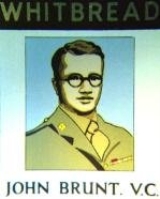
In 1946, John Brunt's sister Dorothy gave birth to a boy which she named John Brunt Miller, in honour of his heroic uncle. On 3 September 1947 the Kent Arms public house in Paddock Wood
Paddock Wood
Paddock Wood is a small town and civil parish in the Borough of Tunbridge Wells and county of Kent in England, about southwest of Maidstone. At the time of the 2001 census it had a population of 8,263, and is the centre for hop growing in Kent.-History:...

, Kent, was named the John Brunt V.C.
John Brunt V.C. (public house)
The John Brunt V.C. is a public house in Paddock Wood in Kent. Originally named The Kent Arms, on 3 September 1947 the pub was formally renamed John Brunt V.C. in honour of an English soldier, John Brunt, who won the Victoria Cross in the Second World War who spent his teenage years in the town...

in his honour. In 1997, the pub changed its name to The Hopping Hooden Horse; after local outrage the original name was restored in 2001. On 17 July 1965 The Victor comic featured a cover story named Brunt V.C., a two-page strip based on the actions that won Brunt the VC. During his military career, he was awarded the Victoria Cross
Victoria Cross
The Victoria Cross is the highest military decoration awarded for valour "in the face of the enemy" to members of the armed forces of various Commonwealth countries, and previous British Empire territories....

, Military Cross
Military Cross
The Military Cross is the third-level military decoration awarded to officers and other ranks of the British Armed Forces; and formerly also to officers of other Commonwealth countries....

, 1939-45 Star, Africa Star
Africa Star
The Africa Star was a campaign medal of the British Commonwealth, awarded for service in the Second World War.The Star was awarded for a minimum of one day service in an operational area of North Africa between 10 June 1940 and 12 May 1943...

, Italy Star
Italy Star
The Italy Star was a campaign medal of the British Commonwealth, awarded for service in World War II.The medal was awarded for operational service in Italy, Greece, Yugoslavia, Pantelleria, the Aegean area and Dodecanese Islands, and Elba at any time between 11 June 1943 and 8 May 1945...

 and the British War Medal 1939–1945, all of which are on display at The Royal Lincolnshire Regiment Museum in Lincoln
Lincoln, Lincolnshire
Lincoln is a cathedral city and county town of Lincolnshire, England.The non-metropolitan district of Lincoln has a population of 85,595; the 2001 census gave the entire area of Lincoln a population of 120,779....

.

External links