
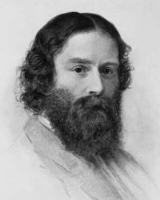
James Russell Lowell was an
AmericanThe United States of America is a federal constitutional republic comprising fifty states and a federal district...
RomanticRomanticism was an artistic, literary and intellectual movement that originated in the second half of the 18th century in Europe, and gained strength in reaction to the Industrial Revolution...
poet, critic, editor, and
diplomatA diplomat is a person appointed by a state to conduct diplomacy with another state or international organization. The main functions of diplomats revolve around the representation and protection of the interests and nationals of the sending state, as well as the promotion of information and...
. He is associated with the
Fireside PoetsThe Fireside Poets were a group of 19th-century American poets from New England.-Overview:...
, a group of
New EnglandNew England is a region in the northeastern corner of the United States consisting of the six states of Maine, New Hampshire, Vermont, Massachusetts, Rhode Island, and Connecticut...
writers who were among the first American poets who rivaled the popularity of British poets. These poets usually used conventional forms and meters in their poetry, making them suitable for families entertaining at their fireside.
Lowell graduated from
Harvard CollegeHarvard College, in Cambridge, Massachusetts, is one of two schools within Harvard University granting undergraduate degrees...
in 1838, despite his reputation as a troublemaker, and went on to earn a law degree from
Harvard Law SchoolHarvard Law School is one of the professional graduate schools of Harvard University. Located in Cambridge, Massachusetts, it is the oldest continually-operating law school in the United States and is home to the largest academic law library in the world. The school is routinely ranked by the U.S...
. He published his first collection of poetry in 1841 and married
Maria WhiteMaria White Lowell was an American poet and abolitionist.-Life and career:Maria was born in Watertown, Massachusetts to a middle-class intellectual family...
in 1844. He and his wife had several children, though only one survived past childhood. The couple soon became involved in the movement to
abolish slaveryAbolitionism is a movement to end slavery.In western Europe and the Americas abolitionism was a movement to end the slave trade and set slaves free. At the behest of Dominican priest Bartolomé de las Casas who was shocked at the treatment of natives in the New World, Spain enacted the first...
, with Lowell using poetry to express his anti-slavery views and taking a job in
Philadelphia, PennsylvaniaPhiladelphia is the largest city in the Commonwealth of Pennsylvania and the county seat of Philadelphia County, with which it is coterminous. The city is located in the Northeastern United States along the Delaware and Schuylkill rivers. It is the fifth-most-populous city in the United States,...
as the editor of an abolitionist newspaper. After moving back to Cambridge, Lowell was one of the founders of a journal called
The Pioneer, which lasted only three issues. He gained notoriety in 1848 with the publication of
A Fable for CriticsA Fable for Critics is a book-length poem by American writer James Russell Lowell, first published anonymously in 1848. The poem made fun of well-known poets and critics of the time and brought notoriety to its author.-Overview:...
, a book-length poem
satirizingSatire is primarily a literary genre or form, although in practice it can also be found in the graphic and performing arts. In satire, vices, follies, abuses, and shortcomings are held up to ridicule, ideally with the intent of shaming individuals, and society itself, into improvement...
contemporary critics and poets. The same year, he published
The Biglow Papers, which increased his fame. He would publish several other poetry collections and essay collections throughout his literary career.
Maria White died in 1853, and Lowell accepted a professorship of languages at Harvard in 1854. He traveled to Europe before officially assuming his role in 1856; he continued to teach there for twenty years. He married his second wife, Frances Dunlap, shortly thereafter in 1857. That year Lowell also became editor of
The Atlantic MonthlyThe Atlantic is an American magazine founded in Boston, Massachusetts, in 1857. It was created as a literary and cultural commentary magazine. It quickly achieved a national reputation, which it held for more than a century. It was important for recognizing and publishing new writers and poets,...
. It was not until 20 years later that Lowell received his first political appointment: the ambassadorship to Spain and, later, to England. He spent his last years in Cambridge, in the same estate where he was born, where he also died in 1891.
Lowell believed that the poet played an important role as a prophet and critic of society. He used poetry for reform, particularly in abolitionism. However, Lowell's commitment to the anti-slavery cause wavered over the years, as did his opinion on African-Americans. Lowell attempted to emulate the true Yankee accent in the dialogue of his characters, particularly in
The Biglow Papers. This depiction of the dialect, as well as Lowell's many satires, were an inspiration to writers like
Mark TwainSamuel Langhorne Clemens , better known by his pen name Mark Twain, was an American author and humorist...
and
H. L. MenckenHenry Louis "H. L." Mencken was an American journalist, essayist, magazine editor, satirist, acerbic critic of American life and culture, and a scholar of American English. Known as the "Sage of Baltimore", he is regarded as one of the most influential American writers and prose stylists of the...
.
Early life
The first of the
Lowell familyThe Lowell family settled on the North Shore at Cape Ann after they arrived in Boston on June 23, 1639. The patriarch, Percival Lowle , described as a "solid citizen of Bristol", determined at the age of 68 that the future was in the New World.Massachusetts Bay Colony Governor John Winthrop needed...
ancestors to come to the United States from Britain was Percival Lowle, who settled in
Newbury, MassachusettsNewbury is a town in Essex County, Massachusetts, United States. The population was 6,666 at the 2010 census. Newbury includes the villages of Old Town , Plum Island and Byfield, home of The Governor's Academy , a private preparatory school.- History :Newbury Plantation was settled and incorporated...
in 1639. James Russell Lowell was born February 22, 1819, the son of
the Reverend Charles Russell Lowell, Sr.Charles Russell Lowell, Sr. was a Unitarian minister.-Biography:He was born in Boston, Massachusetts, and attended The Roxbury Latin School and later Harvard College in 1800 where he studied law and then theology...
(1782–1861), a minister at a Unitarian church in
BostonBoston is the capital of and largest city in Massachusetts, and is one of the oldest cities in the United States. The largest city in New England, Boston is regarded as the unofficial "Capital of New England" for its economic and cultural impact on the entire New England region. The city proper had...
who had previously studied theology at
EdinburghEdinburgh is the capital city of Scotland, the second largest city in Scotland, and the eighth most populous in the United Kingdom. The City of Edinburgh Council governs one of Scotland's 32 local government council areas. The council area includes urban Edinburgh and a rural area...
, and Harriett Brackett Spence Lowell. By the time James Russell Lowell was born, the family owned a large estate in
CambridgeCambridge is a city in Middlesex County, Massachusetts, United States, in the Greater Boston area. It was named in honor of the University of Cambridge in England, an important center of the Puritan theology embraced by the town's founders. Cambridge is home to two of the world's most prominent...
called Elmwood. He was the youngest of six children; his older siblings were Charles, Rebecca,
MaryMary Traill Spence Lowell Putnam was a United States author.-Biography:...
, William, and Robert. Lowell's mother built in him an appreciation for literature at an early age, especially in poetry, ballads, and tales from her native Orkney. He attended school under
Sophia DanaSophia Willard Dana Ripley , wife of George Ripley, was a 19th-century feminist associated with Transcendentalism and the Brook Farm community.-Biography:...
, who would later marry George Ripley, and, later, studied at a school run by a particularly harsh disciplinarian, where one of his classmates was
Richard Henry Dana, Jr.Richard Henry Dana Jr. was an American lawyer and politician from Massachusetts, a descendant of an eminent colonial family who gained renown as the author of the American classic, the memoir Two Years Before the Mast...
Beginning in 1834, at the age of 15, Lowell attended
Harvard CollegeHarvard College, in Cambridge, Massachusetts, is one of two schools within Harvard University granting undergraduate degrees...
, though he was not a good student and often got into trouble. In his sophomore year alone, he was absent from required chapel attendance 14 times and from classes 56 times. In his last year there, he wrote, "During Freshman year, I did nothing, during Sophomore year I did nothing, during Junior year I did nothing, and during Senior year I have thus far done nothing in the way of college studies". In his senior year, he became one of the editors of
HarvardianaHarvardiana was a periodical published in Cambridge, Massachusetts, United States by James Munroe and Co. from 1835 to 1838. It was a literary journal administered by Harvard University undergraduates...
literary magazine, to which he contributed prose and poetry that he admitted was of low quality. As he said later, "I was as great an ass as ever brayed & thought it singing". Lowell was elected the poet of the class of 1838 and, as was tradition, was asked to recite an original poem on Class Day, the day before Commencement, on July 17, 1838. Lowell, however, was suspended and not allowed to participate. Instead, his poem was printed and made available thanks to subscriptions paid by his classmates.
Not knowing what vocation to choose after graduating, he vacillated among
businessA business is an organization engaged in the trade of goods, services, or both to consumers. Businesses are predominant in capitalist economies, where most of them are privately owned and administered to earn profit to increase the wealth of their owners. Businesses may also be not-for-profit...
, the ministry, medicine and law. Having decided to practice law, he enrolled at the
Harvard Law SchoolHarvard Law School is one of the professional graduate schools of Harvard University. Located in Cambridge, Massachusetts, it is the oldest continually-operating law school in the United States and is home to the largest academic law library in the world. The school is routinely ranked by the U.S...
in 1840 and was
admitted to the barIn the United States, admission to the bar is the granting of permission by a particular court system to a lawyer to practice law in that system. Each U.S. state and similar jurisdiction has its own court system and sets its own rules for bar admission , which can lead to different admission...
two years later. While studying law, however, he contributed poems and prose articles to various magazines. During this time, Lowell was admittedly depressed and often had
suicidalSuicide is the act of intentionally causing one's own death. Suicide is often committed out of despair or attributed to some underlying mental disorder, such as depression, bipolar disorder, schizophrenia, alcoholism, or drug abuse...
thoughts. He once confided to a friend that he held a cocked pistol to his forehead and considered killing himself at the age of 20.
Marriage and family
In late 1839, Lowell met
Maria WhiteMaria White Lowell was an American poet and abolitionist.-Life and career:Maria was born in Watertown, Massachusetts to a middle-class intellectual family...
through her brother William, a classmate of his at Harvard. The two became engaged in the autumn of 1840; her father Abijah White, a wealthy merchant from
WatertownThe Town of Watertown is a city in Middlesex County, Massachusetts, United States. The population was 31,915 at the 2010 census.- History :Archeological evidence suggests that Watertown was inhabited for thousands of years before the arrival of settlers from England...
, insisted that their wedding be postponed until Lowell had gainful employment. They were finally married on December 26, 1844, shortly after the groom published
Conversations on the Old Poets, a collection of his previously published essays. A friend described their relationship as "the very picture of a True Marriage"; Lowell himself believed she was made up "half of earth and more than of Heaven". Like Lowell, she wrote poetry and the next twelve years of Lowell's life were deeply affected by her influence. He said his first book of poetry,
A Year's Life (1841), "owes all its beauty to her", though it only sold 300 copies. Her character and beliefs led her to become involved in the movements directed against intemperance and slavery. White was a member of the
Boston Female Anti-Slavery SocietyThe Boston Female Anti-Slavery Society was an abolitionist, interracial organization in Boston, Massachusetts, in the mid-19th century. "During its brief history .....
and persuaded Lowell to become an
abolitionistAbolitionism is a movement to end slavery.In western Europe and the Americas abolitionism was a movement to end the slave trade and set slaves free. At the behest of Dominican priest Bartolomé de las Casas who was shocked at the treatment of natives in the New World, Spain enacted the first...
. Lowell had previously expressed anti-slavery sentiments but White urged him towards more active expression and involvement. His second volume of poems,
Miscellaneous Poems, expressed these anti-slavery thoughts and its 1,500 copies sold well.
Maria was in poor health and, thinking her lungs could heal there, the couple moved to Philadelphia shortly after their marriage. In Philadelphia, he became a contributing editor for the
Pennsylvania Freeman, an abolitionist newspaper. In the spring of 1845, the Lowells returned to Cambridge, Massachusetts to make their home at Elmwood. They had four children, though only one (Mabel, born 1847) survived past infancy. Their first, Blanche, was born December 31, 1845, but lived only fifteen months; Rose, born in 1849, survived only a few months as well; their only son, Walter, was born in 1850 but died in 1852. Lowell was very affected by the loss of almost all of his children. His grief over the death of his first daughter in particular was expressed in his poem "The First Snowfall" (1847). Again, Lowell considered suicide, writing to a friend that he thought "of my razors and my throat and that I am a fool and a coward not to end it all at once".
Literary career
Lowell's earliest poems were published without pay in the
Southern Literary MessengerThe Southern Literary Messenger was a periodical published in Richmond, Virginia, from 1834 until June 1864. Each issue carried a subtitle of "Devoted to Every Department of Literature and the Fine Arts" or some variation and included poetry, fiction, non-fiction, reviews, and historical notes...
in 1840. Lowell was inspired to new efforts towards self-support and joined with his friend Robert Carter in founding a literary journal,
The Pioneer. The periodical was characterized by most of its content being new rather than previously published elsewhere and by having very serious criticism which covered not only literature but also art and music. Lowell wrote that it would "furnish the intelligent and reflecting portion of the Reading Public with a rational substitute for the enormous quantity of thrice-diluted trash, in the shape of namby-pamby love tales and sketches, which is monthly poured out to them by many of our popular Magazines".
William Wetmore StoryWilliam Wetmore Story was an American sculptor, art critic, poet and editor.-Biography:William Wetmore Story was the son of jurist Joseph Story and Sarah Waldo Story...
noted the journal's higher taste, writing that, "it took some stand & appealled to a higher intellectual Standard than our puerile milk o watery namby-pamby Mags with which we are overrun". The first issue of the journal included the first appearance of "
The Tell-Tale Heart"The Tell-Tale Heart" is a short story by Edgar Allan Poe first published in 1843. It follows an unnamed narrator who insists on his sanity after murdering an old man with a "vulture eye". The murder is carefully calculated, and the murderer hides the body by dismembering it and hiding it under the...
" by
Edgar Allan PoeEdgar Allan Poe was an American author, poet, editor and literary critic, considered part of the American Romantic Movement. Best known for his tales of mystery and the macabre, Poe was one of the earliest American practitioners of the short story and is considered the inventor of the detective...
. Lowell, shortly after the first issue, was treated for an eye disease in New York and, in his absence, Carter did a poor job managing the journal. After three monthly numbers, beginning in January 1843, the magazine ceased publication, leaving Lowell $1,800 in debt. Poe mourned the journal's demise, calling it "a most severe blow to the cause—the cause of a Pure Taste".
Despite the failure of
The Pioneer, Lowell continued his interest in the literary world. He wrote a series on "Anti-Slavery in the United States" for the
London Daily NewsThe London Daily News was a short-lived London newspaper owned by Robert Maxwell.-1987:The London Daily News was published from 24 February to 24 July 1987. It was intended to be a "24-hour" paper challenging the local dominance of the Evening Standard."For the city that never sleeps, the paper...
, though it was discontinued by the editors after four articles in May 1846. Lowell had published these articles anonymously, believing they would have more impact if they were not known to be the work of a committed abolitionist. In the spring of 1848 he formed a connection with the
National Anti-Slavery Standard of New York, agreeing to contribute weekly either a poem or a prose article. After only one year, he was asked to contribute half as often to the
Standard to make room for contributions from another writer and reformer named Edmund Quincy.
A Fable for CriticsA Fable for Critics is a book-length poem by American writer James Russell Lowell, first published anonymously in 1848. The poem made fun of well-known poets and critics of the time and brought notoriety to its author.-Overview:...
, one of Lowell's most popular works, was published in 1848. A
satireSatire is primarily a literary genre or form, although in practice it can also be found in the graphic and performing arts. In satire, vices, follies, abuses, and shortcomings are held up to ridicule, ideally with the intent of shaming individuals, and society itself, into improvement...
, it was published anonymously; in it, Lowell took good-natured jabs at his contemporary poets and critics. It proved popular, and the first three thousand copies sold out quickly. Not all the subjects included were pleased, however. Edgar Allan Poe, who had been referred to as part genius and "two-fifths sheer fudge", reviewed the work in the
Southern Literary MessengerThe Southern Literary Messenger was a periodical published in Richmond, Virginia, from 1834 until June 1864. Each issue carried a subtitle of "Devoted to Every Department of Literature and the Fine Arts" or some variation and included poetry, fiction, non-fiction, reviews, and historical notes...
and called it "'loose'—ill-conceived and feebly executed, as well in detail as in general... we confess some surprise at his putting forth so unpolished a performance". Lowell offered the profits from the book's success, which proved relatively small, to his New York friend
Charles Frederick BriggsCharles Frederick Briggs , also called C. F. Briggs, was an American journalist, author and editor, born in Nantucket, Massachusetts...
, despite his own financial needs.
In 1848, Lowell also published
The Biglow Papers, later named by the
Grolier ClubThe Grolier Club is a private club and society of bibliophiles in New York City. Founded in January 1884, it is the oldest existing bibliophilic club in North America. The club is named after Jean Grolier de Servières, Viscount d'Aguisy, Treasurer General of France, whose library was famous; his...
as the most influential book of 1848. The first 1,500 copies sold out within a week and a second edition was soon issued, though Lowell made no profit having had to absorb the cost of
stereotypingIn printing, a stereotype, also known as a cliché, stereoplate or simply a stereo, was originally a "solid plate or type-metal, cast from a papier-mâché or plaster mould taken from the surface of a forme of type" used for printing instead of the original...
the book himself. The book presented three main characters, each representing different aspects of American life and using authentic American dialects in their dialogue. Under the surface,
The Biglow Papers was also a denunciation of the
Mexican–American WarThe Mexican–American War, also known as the First American Intervention, the Mexican War, or the U.S.–Mexican War, was an armed conflict between the United States and Mexico from 1846 to 1848 in the wake of the 1845 U.S...
and war in general.
First trip to Europe
In 1850, Lowell's mother died unexpectedly, as did his third daughter, Rose. Her death left Lowell depressed and reclusive for six months, despite the birth of his son Walter by the end of the year. He wrote to a friend that death "is a private tutor. We have no fellow-scholars, and must lay our lessons to heart alone". These personal troubles as well as the
Compromise of 1850The Compromise of 1850 was a package of five bills, passed in September 1850, which defused a four-year confrontation between the slave states of the South and the free states of the North regarding the status of territories acquired during the Mexican-American War...
inspired Lowell to accept an offer from William Wetmore Story to spend a winter in
ItalyItaly , officially the Italian Republic languages]] under the European Charter for Regional or Minority Languages. In each of these, Italy's official name is as follows:;;;;;;;;), is a unitary parliamentary republic in South-Central Europe. To the north it borders France, Switzerland, Austria and...
. To pay for the trip, Lowell sold land around Elmwood, intending to sell off further acres of the estate over time to supplement his income, ultimately selling off 25 of the original 30 acres (121,405.8 m²). Walter died suddenly in
RomeRome is the capital of Italy and the country's largest and most populated city and comune, with over 2.7 million residents in . The city is located in the central-western portion of the Italian Peninsula, on the Tiber River within the Lazio region of Italy.Rome's history spans two and a half...
of
choleraCholera is an infection of the small intestine that is caused by the bacterium Vibrio cholerae. The main symptoms are profuse watery diarrhea and vomiting. Transmission occurs primarily by drinking or eating water or food that has been contaminated by the diarrhea of an infected person or the feces...
, and Lowell and his wife, with their daughter Mabel, returned to the United States in October 1852. Lowell published recollections of his journey in several magazines, many of which would be collected years later as
Fireside Travels (1867). He also edited volumes with biographical sketches for a series on
British Poets.
His wife Maria, who had been suffering from poor health for many years, became very ill in the spring of 1853 and died on October 27 of
tuberculosisTuberculosis, MTB, or TB is a common, and in many cases lethal, infectious disease caused by various strains of mycobacteria, usually Mycobacterium tuberculosis. Tuberculosis usually attacks the lungs but can also affect other parts of the body...
. Just before her burial, her coffin was opened so that her daughter Mabel could see her face while Lowell "leaned for a long while against a tree weeping", according to
Henry Wadsworth LongfellowHenry Wadsworth Longfellow was an American poet and educator whose works include "Paul Revere's Ride", The Song of Hiawatha, and Evangeline...
and his wife, who were in attendance. In 1855, Lowell oversaw the publication of a memorial volume of his wife's poetry, with only fifty copies for private circulation. Despite his self-described "naturally joyous" nature, life for Lowell at Elmwood was further complicated by his father becoming deaf in his old age, and the deteriorating mental state of his sister Rebecca, who sometimes went a week without speaking. He again cut himself off from others, becoming reclusive at Elmwood, and his private diaries from this time period are riddled with the initials of his wife. On March 10, 1854, for example, he wrote: "Dark without & within. M.L. M.L. M.L." Longfellow, a friend and neighbor, referred to Lowell as "lonely and desolate".
Professorship and second marriage
At the invitation of his cousin
John Amory LowellHon. John Amory Lowell was an American businessman and philanthropist from Boston. He became the sole trustee of the Lowell Institute when his first cousin, John Lowell, Jr. , the Institute's endower, died...
, James Russell Lowell was asked to deliver a lecture at the prestigious Lowell Institute. Some speculated the opportunity was because of the family connection, offered as an attempt to bring him out of his depression. Lowell chose to speak on "The English Poets", telling his friend Briggs that he would take revenge on dead poets "for the injuries received by one whom the public won't allow among the living". The first of the twelve-part lecture series was to be on January 9, 1855, though by December, Lowell had only completed writing five of them, hoping for last-minute inspiration. His first lecture was on
John MiltonJohn Milton was an English poet, polemicist, a scholarly man of letters, and a civil servant for the Commonwealth of England under Oliver Cromwell...
and the auditorium was oversold; Lowell had to give a repeat performance the next afternoon. Lowell, who had never spoken in public before, was praised for these lectures.
Francis James ChildFrancis James Child was an American scholar, educator, and folklorist, best known today for his collection of folk songs known as the Child Ballads. Child was Boylston professor of rhetoric and oratory at Harvard University, where he produced influential editions of English poetry...
said that Lowell, who he deemed was typically "perverse", was able to "persist in being serious contrary to his impulses and his talents". While his series was still in progress, Lowell was offered the Smith Professorship of Modern Languages at Harvard, a post vacated by Longfellow, at an annual salary of $1,200, though he never applied for it. The job description was changing after Longfellow; instead of teaching languages directly, Lowell would supervise the department and deliver two lecture courses per year on topics of his own choosing. Lowell accepted the appointment, with the proviso that he should have a year of study abroad. He set sail on June 4 of that year, leaving his daughter Mabel in the care of a governess named Frances Dunlap. Abroad, he visited
Le HavreLe Havre is a city in the Seine-Maritime department of the Haute-Normandie region in France. It is situated in north-western France, on the right bank of the mouth of the river Seine on the English Channel. Le Havre is the most populous commune in the Haute-Normandie region, although the total...
, Paris, and London, spending time with friends including Story,
Robert BrowningRobert Browning was an English poet and playwright whose mastery of dramatic verse, especially dramatic monologues, made him one of the foremost Victorian poets.-Early years:...
and
Elizabeth Barrett BrowningElizabeth Barrett Browning was one of the most prominent poets of the Victorian era. Her poetry was widely popular in both England and the United States during her lifetime. A collection of her last poems was published by her husband, Robert Browning, shortly after her death.-Early life:Members...
, and Leigh Hunt. Primarily, however, Lowell spent his time abroad studying languages, particularly German, which he found difficult. He complained: "The confounding genders! If I die I shall have engraved on my tombstone that I died of
der, die, das, not because I caught them but because I couldn't."
He returned to the United States in the summer of 1856 and began his college duties. Towards the end of his professorship, then-president of Harvard
Charles Eliot NortonCharles Eliot Norton, was a leading American author, social critic, and professor of art. He was a militant idealist, a progressive social reformer, and a liberal activist whom many of his contemporaries considered the most cultivated man in the United States.-Biography:Norton was born at...
noted that Lowell seemed to have "no natural inclination" to teach; Lowell agreed, but retained his position for twenty years. He focused on teaching literature, rather than
etymologyEtymology is the study of the history of words, their origins, and how their form and meaning have changed over time.For languages with a long written history, etymologists make use of texts in these languages and texts about the languages to gather knowledge about how words were used during...
, hoping that his students would learn to enjoy the sound, rhythm, and flow of poetry rather than the technique of words. He summed up his method: "True scholarship consists in knowing not what things exists, but what they mean; it is not memory but judgment". Still grieving the loss of his wife, during this time Lowell avoided Elmwood and instead lived on Kirkland Street in Cambridge, an area known as Professors' Row. He stayed there, along with his daughter Mabel and her governess Frances Dunlap, until January 1861.
Lowell had intended never to remarry after the death of his wife Maria White. However, in 1857, surprising his friends, he became engaged to Frances Dunlap, who many described as simple and unattractive. Dunlap, daughter of the former governor of Maine
Robert P. DunlapRobert Pinckney Dunlap was the 11th Governor of Maine and a U.S. Representative from Maine.Born in Brunswick, Maine, Dunlap was educated by private tutors. He graduated from Bowdoin College, Brunswick, Maine, in 1815...
, was a friend of Lowell's first wife and formerly wealthy, though she and her family had fallen into reduced circumstances. Lowell and Dunlap married on September 16, 1857, in a ceremony performed by his brother. Lowell wrote, "My second marriage was the wisest act of my life, & as long as
I am sure of it, I can afford to wait till my friends agree with me".
The war years and beyond
In the autumn of 1857,
The Atlantic MonthlyThe Atlantic is an American magazine founded in Boston, Massachusetts, in 1857. It was created as a literary and cultural commentary magazine. It quickly achieved a national reputation, which it held for more than a century. It was important for recognizing and publishing new writers and poets,...
was established, and Lowell was its first editor. With its first issue in November of that year, he at once gave the magazine the stamp of high literature and of bold speech on public affairs. In January 1861, Lowell's father died of a heart attack, inspiring Lowell to move his family back to Elmwood. As he wrote to his friend Briggs, "I am back again to the place I love best. I am sitting in my old garret, at my old desk, smoking my old pipe... I begin to feel more like my old self than I have these ten years". Shortly thereafter, in May, he left
The Atlantic Monthly when
James Thomas FieldsJames Thomas Fields was an American publisher, editor, and poet.-Early life and family:He was born in Portsmouth, New Hampshire on December 31, 1817 and named James Field; the family later added the "s". His father was a sea captain and died before Fields was three...
took over as editor; the magazine had been purchased by
Ticknor and FieldsTicknor and Fields was an American publishing company based in Boston, Massachusetts.-Early years:In 1832 William Davis Ticknor and John Allen began a small publishing business which operated out of the Old Corner Bookstore located on Washington and School Streets in Boston, Massachusetts...
for $10,000 two years before. Lowell returned to Elmwood by January 1861 but maintained an amicable relationship with the new owners of the journal, continuing to submit his poetry and prose for the rest of his life. His prose, however, was more abundantly presented in the pages of the
North American ReviewThe North American Review was the first literary magazine in the United States. Founded in Boston in 1815 by journalist Nathan Hale and others, it was published continuously until 1940, when publication was suspended due to J. H. Smyth, who had purchased the magazine, being unmasked as a Japanese...
during the years 1862–1872. For the
Review, he served as a coeditor along with Charles Eliot Norton. Lowell's reviews for the journal covered a wide variety of literary releases of the day, though he was writing fewer poems.
As early as 1845, Lowell had predicted the debate over slavery would lead to war and, as the
American Civil WarThe American Civil War was a civil war fought in the United States of America. In response to the election of Abraham Lincoln as President of the United States, 11 southern slave states declared their secession from the United States and formed the Confederate States of America ; the other 25...
broke out in the 1860s, Lowell used his role at the
Review to praise
Abraham LincolnAbraham Lincoln was the 16th President of the United States, serving from March 1861 until his assassination in April 1865. He successfully led his country through a great constitutional, military and moral crisis – the American Civil War – preserving the Union, while ending slavery, and...
and his attempts to maintain the Union. Lowell lost three nephews during the war, including
Charles Russell Lowell, JrCharles Russell Lowell, Jr. was a railroad executive, foundryman, and general in the Union Army during the American Civil War. He was mortally wounded at the Battle of Cedar Creek and was mourned by a number of leading generals...
, who became a Brigadier General and fell at the
battle of Cedar CreekThe Battle of Cedar Creek, or Battle of Belle Grove, October 19, 1864, was one of the final, and most decisive, battles in the Valley Campaigns of 1864 during the American Civil War. The final Confederate invasion of the North, led by Lt. Gen. Jubal A. Early, was effectively ended...
. Lowell himself was generally a pacifist. Even so, he wrote, "If the destruction of slavery is to be a consequence of the war, shall we regret it? If it be needful to the successful prosecution of the war, shall anyone oppose it?" His interest in the Civil War inspired him to write a second series of
The Biglow Papers, including one specifically dedicated to the preliminary
Emancipation ProclamationThe Emancipation Proclamation is an executive order issued by United States President Abraham Lincoln on January 1, 1863, during the American Civil War using his war powers. It proclaimed the freedom of 3.1 million of the nation's 4 million slaves, and immediately freed 50,000 of them, with nearly...
called "Sunthin' in the Pastoral Line" in 1862.
Shortly after
Lincoln's assassinationThe assassination of United States President Abraham Lincoln took place on Good Friday, April 14, 1865, as the American Civil War was drawing to a close. The assassination occurred five days after the commanding General of the Army of Northern Virginia, Robert E. Lee, and his battered Army of...
, Lowell was asked to present a poem at Harvard in memory of graduates killed in the war. His poem, "Commemoration Ode", cost him sleep and his appetite, but was delivered on July 21, 1865, after a 48-hour writing binge. Lowell had high hopes for his performance but was overshadowed by the other notables presenting works that day, including
Ralph Waldo EmersonRalph Waldo Emerson was an American essayist, lecturer, and poet, who led the Transcendentalist movement of the mid-19th century...
and
Oliver Wendell Holmes, Sr.Oliver Wendell Holmes, Sr. was an American physician, professor, lecturer, and author. Regarded by his peers as one of the best writers of the 19th century, he is considered a member of the Fireside Poets. His most famous prose works are the "Breakfast-Table" series, which began with The Autocrat...
"I did not make the hit I expected", he wrote, "and am ashamed at having been tempted again to think I could write
poetry, a delusion from which I have been tolerably free these dozen years". Despite his personal assessment, friends and other poets sent many letters to Lowell congratulating him. Emerson referred to his poem's "high thought & sentiment" and
James Freeman ClarkeJames Freeman Clarke , an American theologian and author.-Biography:Born in Hanover, New Hampshire, James Freeman Clarke attended the Boston Latin School, graduated from Harvard College in 1829, and Harvard Divinity School in 1833...
noted its "grandeur of tone". Lowell later expanded it with a
stropheA strophe forms the first part of the ode in Ancient Greek tragedy, followed by the antistrophe and epode. In its original Greek setting, "strophe, antistrophe and epode were a kind of stanza framed only for the music," as John Milton wrote in the preface to Samson Agonistes, with the strophe...
to Lincoln.
In the 1860s, Lowell's friend Longfellow spent several years translating
Dante Alighieri'sDurante degli Alighieri, mononymously referred to as Dante , was an Italian poet, prose writer, literary theorist, moral philosopher, and political thinker. He is best known for the monumental epic poem La commedia, later named La divina commedia ...
Divine Comedy and regularly invited others to help him on Wednesday evenings. Lowell was one of the main members of the so-called "Dante Club", along with
William Dean HowellsWilliam Dean Howells was an American realist author and literary critic. Nicknamed "The Dean of American Letters", he was particularly known for his tenure as editor of the Atlantic Monthly as well as his own writings, including the Christmas story "Christmas Every Day" and the novel The Rise of...
, Charles Eliot Norton and other occasional guests. Shortly after serving as a pallbearer at the funeral of friend and publisher
Nathaniel Parker WillisNathaniel Parker Willis , also known as N. P. Willis, was an American author, poet and editor who worked with several notable American writers including Edgar Allan Poe and Henry Wadsworth Longfellow. He became the highest-paid magazine writer of his day. For a time, he was the employer of former...
, on January 24, 1867, Lowell decided to produce another collection of his poetry.
Under the Willows and Other Poems was released in 1869, though Lowell originally wanted to title it
The Voyage to the Vinland and Other Poems. The book, dedicated to Norton, collected poems Lowell had written within the previous twenty years and was his first poetry collection since 1848.
Lowell intended to take another trip to Europe. To finance it, he sold off more of Elmwood's acres and rented the house to
Thomas Bailey AldrichThomas Bailey Aldrich was an American poet, novelist, travel writer and editor.-Early life and education:...
; Lowell's daughter Mabel, by this time, had moved into a new home with her husband
Edward BurnettEdward Burnett was a U.S. Representative from Massachusetts.Born in Boston, Massachusetts, Burnett attended St. Paul's School.He was graduated from St...
, the son of a successful businessman-farmer from Southboro, Massachusetts. Lowell and his wife set sail on July 8, 1872, after he took a leave of absence from Harvard. They visited England, Paris, Switzerland, and Italy. While overseas, he received an honorary Doctorate of Law from the
University of OxfordThe University of Oxford is a university located in Oxford, United Kingdom. It is the second-oldest surviving university in the world and the oldest in the English-speaking world. Although its exact date of foundation is unclear, there is evidence of teaching as far back as 1096...
and another from Cambridge University. They returned to the United States in the summer of 1874.
Political appointments
Lowell resigned from his Harvard professorship in 1874, though he was persuaded to continue teaching through 1877. It was in 1876 that Lowell first stepped into the field of politics. That year, he served as a delegate to the
Republican National Convention in
Cincinnati, OhioCincinnati is a city in the U.S. state of Ohio. Cincinnati is the county seat of Hamilton County. Settled in 1788, the city is located to north of the Ohio River at the Ohio-Kentucky border, near Indiana. The population within city limits is 296,943 according to the 2010 census, making it Ohio's...
, speaking on behalf of presidential candidate
Rutherford B. HayesRutherford Birchard Hayes was the 19th President of the United States . As president, he oversaw the end of Reconstruction and the United States' entry into the Second Industrial Revolution...
. Hayes won the nomination and, eventually, the presidency. In May 1877, President Hayes, an admirer of
The Biglow Papers, sent
William Dean HowellsWilliam Dean Howells was an American realist author and literary critic. Nicknamed "The Dean of American Letters", he was particularly known for his tenure as editor of the Atlantic Monthly as well as his own writings, including the Christmas story "Christmas Every Day" and the novel The Rise of...
to Lowell with a handwritten note proffering an ambassadorship to either Austria or Russia; Lowell declined, but noted his interest in Spanish literature. Lowell was then offered and accepted the role of
Minister to the court of Spain-Ambassadors:*John Jay**Appointed: September 29, 1779**Title: Minister Plenipotentiary**Presented credentials:**Terminated mission: ~May 20, 1782*William Carmichael**Appointed: April 20, 1790**Title: Chargé d'Affaires...
at an annual salary of $12,000. Lowell sailed from Boston on July 14, 1877, and, though he expected he would be away for a year or two, he would not return to the United States until 1885, with the violinist
Ole BullOle Bornemann Bull was a Norwegian violinist and composer.-Background:Bull was born in Bergen. He was the eldest of ten children of Johan Storm Bull and Anna Dorothea Borse Geelmuyden . His brother, Georg Andreas Bull became a noted Norwegian architect...
renting Elmwood for a portion of that time. The Spanish media referred to him as "José Bighlow". Lowell was well-prepared for his political role, having been trained in law, as well as being able to read in multiple languages. He had trouble socializing while in Spain, however, and amused himself by sending humorous dispatches to his political bosses in the United States, many of which were later collected and published posthumously in 1899 as
Impressions of Spain. Lowell's social life improved when the
Spanish AcademyThe Royal Spanish Academy is the official royal institution responsible for regulating the Spanish language. It is based in Madrid, Spain, but is affiliated with national language academies in twenty-one other hispanophone nations through the Association of Spanish Language Academies...
elected him a corresponding member in late 1878, allowing him contribute to the preparation of a new dictionary.
In January 1880, Lowell was informed he was appointed
Minister to EnglandThe office of United States Ambassador to the United Kingdom was traditionally, and still is very much so today due to the Special Relationship, the most prestigious position in the United States Foreign Service...
, his nomination made without his knowledge as far back as June 1879. He was granted a salary of $17,500 with about $3,500 for expenses. While serving in this capacity, he addressed an importation of allegedly diseased cattle and made recommendations that predated the
Pure Food and Drug ActThe Pure Food and Drug Act of June 30, 1906, is a United States federal law that provided federal inspection of meat products and forbade the manufacture, sale, or transportation of adulterated food products and poisonous patent medicines...
.
Queen VictoriaVictoria was the monarch of the United Kingdom of Great Britain and Ireland from 20 June 1837 until her death. From 1 May 1876, she used the additional title of Empress of India....
commented that she had never seen an ambassador who "created so much interest and won so much regard as Mr. Lowell". Lowell held this role until the close of
Chester A. Arthur'sChester Alan Arthur was the 21st President of the United States . Becoming President after the assassination of President James A. Garfield, Arthur struggled to overcome suspicions of his beginnings as a politician from the New York City Republican machine, succeeding at that task by embracing...
presidency in the spring of 1885, despite his wife's failing health. Lowell was already well known in England for his writing and, during his time there, he befriended fellow author
Henry JamesHenry James, OM was an American-born writer, regarded as one of the key figures of 19th-century literary realism. He was the son of Henry James, Sr., a clergyman, and the brother of philosopher and psychologist William James and diarist Alice James....
, who referred to him as "conspicuously American". Lowell also befriended
Leslie StephenSir Leslie Stephen, KCB was an English author, critic and mountaineer, and the father of Virginia Woolf and Vanessa Bell.-Life:...
during this time and became the
godfatherA godparent, in many denominations of Christianity, is someone who sponsors a child's baptism. A male godparent is a godfather, and a female godparent is a godmother...
to his daughter, future writer
Virginia WoolfAdeline Virginia Woolf was an English author, essayist, publisher, and writer of short stories, regarded as one of the foremost modernist literary figures of the twentieth century....
. Lowell was popular enough that he was offered a professorship at Oxford after his recall by president
Grover ClevelandStephen Grover Cleveland was the 22nd and 24th president of the United States. Cleveland is the only president to serve two non-consecutive terms and therefore is the only individual to be counted twice in the numbering of the presidents...
, though the offer was declined.
His second wife, Frances, died on February 19, 1885, while still in England.
Later years and death
He returned to the United States by June 1885, living with his daughter and her husband in Southboro, Massachusetts. He then spent time in Boston with his sister before returning to Elmwood in November 1889. By this time, most of his friends were dead, including Quincy, Longfellow, Dana, and Emerson, leaving him depressed and contemplating suicide again. Lowell spent part of the 1880s delivering various speeches, and his last published works were mostly collections of essays, including
Political Essays, and a collection of his poems
Heartsease and Rue in 1888. His last few years he traveled back to England periodically and when he returned to the United States in the fall of 1889, he moved back to Elmwood with Mabel, while her husband worked for clients in New York and New Jersey. That year, Lowell gave an address at the centenary of
George Washington'sGeorge Washington was the dominant military and political leader of the new United States of America from 1775 to 1799. He led the American victory over Great Britain in the American Revolutionary War as commander-in-chief of the Continental Army from 1775 to 1783, and presided over the writing of...
inauguration. Also that year, the Boston
Critic dedicated a special issue to Lowell on his seventieth birthday to recollections and reminiscences by his friends, including former presidents Hayes and
Benjamin HarrisonBenjamin Harrison was the 23rd President of the United States . Harrison, a grandson of President William Henry Harrison, was born in North Bend, Ohio, and moved to Indianapolis, Indiana at age 21, eventually becoming a prominent politician there...
and British Prime Minister
William Ewart GladstoneWilliam Ewart Gladstone FRS FSS was a British Liberal statesman. In a career lasting over sixty years, he served as Prime Minister four separate times , more than any other person. Gladstone was also Britain's oldest Prime Minister, 84 years old when he resigned for the last time...
as well as
Alfred TennysonAlfred Tennyson, 1st Baron Tennyson, FRS was Poet Laureate of the United Kingdom during much of Queen Victoria's reign and remains one of the most popular poets in the English language....
and
Francis ParkmanFrancis Parkman was an American historian, best known as author of The Oregon Trail: Sketches of Prairie and Rocky-Mountain Life and his monumental seven-volume France and England in North America. These works are still valued as history and especially as literature, although the biases of his...
.
In the last few months of his life, Lowell struggled with
goutGout is a medical condition usually characterized by recurrent attacks of acute inflammatory arthritis—a red, tender, hot, swollen joint. The metatarsal-phalangeal joint at the base of the big toe is the most commonly affected . However, it may also present as tophi, kidney stones, or urate...
,
sciaticaSciatica is a set of symptoms including pain that may be caused by general compression or irritation of one of five spinal nerve roots that give rise to each sciatic nerve, or by compression or irritation of the left or right or both sciatic nerves. The pain is felt in the lower back, buttock, or...
in his left leg, and chronic nausea; by the summer of 1891, doctors believed that Lowell had cancer in his kidneys, liver, and lungs. His last few months, he was administered
opiumOpium is the dried latex obtained from the opium poppy . Opium contains up to 12% morphine, an alkaloid, which is frequently processed chemically to produce heroin for the illegal drug trade. The latex also includes codeine and non-narcotic alkaloids such as papaverine, thebaine and noscapine...
for the pain and was rarely fully conscious. He died on August 12, 1891, at Elmwood. After services in the Appleton Chapel, he was buried in
Mount Auburn CemeteryMount Auburn Cemetery was founded in 1831 as "America's first garden cemetery", or the first "rural cemetery", with classical monuments set in a rolling landscaped terrain...
. After his death, Norton served as his
literary executorA literary executor is a person with decision-making power in respect of a literary estate. According to Wills, Administration and Taxation: a practical guide "A will may appoint different executors to deal with different parts of the estate...
and published several collections of Lowell's works and his letters.
Writing style and literary theory
Early in his career, James Russell Lowell's writing was influenced by Swedenborgianism, a
SpiritualismSpiritualism is a belief system or religion, postulating the belief that spirits of the dead residing in the spirit world have both the ability and the inclination to communicate with the living...
-infused form of Christianity founded by
Emanuel Swedenborgwas a Swedish scientist, philosopher, and theologian. He has been termed a Christian mystic by some sources, including the Encyclopædia Britannica online version, and the Encyclopedia of Religion , which starts its article with the description that he was a "Swedish scientist and mystic." Others...
, causing Frances Longfellow (wife of the poet Henry Wadsworth Longfellow) to mention that "he has been long in the habit of seeing spirits". He composed his poetry rapidly when inspired by an "inner light" but could not write to order. He subscribed to the common nineteenth-century belief that the poet was a prophet but went further, linking religion, nature, and poetry, as well as social reform.
Evert Augustus DuyckinckEvert Augustus Duyckinck was an American publisher and biographer. He was associated with the literary side of the Young America movement in New York.-Life and work:...
and others welcomed Lowell as part of
Young AmericaThe Young America Movement was an American political and cultural attitude in the mid-nineteenth century. Inspired by European reform movements of the 1830s , the American group was formed as a political organization in 1845 by Edwin de Leon and George H. Evans...
, a New York-based movement. Though not officially affiliated with them, he shared some of their ideals, including the belief that writers have an inherent insight into the moral nature of humanity and have an obligation for literary action along with their aesthetic function. Unlike many of his contemporaries, including members of Young America, Lowell did not advocate for the creation of a new national literature. Instead, he called for a
natural literature, regardless of country, caste, or race, and warned against provincialism which might "put farther off the hope of one great brotherhood". He agreed with his neighbor Longfellow that "whoever is most universal, is also most national". As Lowell said:
A scholar of linguistics, Lowell was one of the founders of the
American Dialect SocietyThe American Dialect Society, founded in 1889, is a learned society "dedicated to the study of the English language in North America, and of other languages, or dialects of other languages, influencing it or influenced by it." The Society publishes the academic journal, American Speech...
. He used this interest in his writing, particularly in
The Biglow Papers, presenting a heavily ungrammatical phonetic spelling of the Yankee dialect. In using this vernacular, Lowell intended to get closer to the common man's experience and was rebelling against more formal and, as he thought, unnatural representations of Americans in literature. As he wrote in his introduction to
The Biglow Papers, "few American writers or speakers wield their native language with the directness, precision, and force that are common as the day in the mother country". Though intentionally humorous, this accurate presentation of the dialect was pioneering work in American literature. For example, Lowell's character Hosea Biglow says in verse:
- Ef you take a sword an' dror it,
- An go stick a feller thru,
- Guv'ment aint to answer to it,
- God'll send the bill to you.
Lowell is considered one of the
Fireside PoetsThe Fireside Poets were a group of 19th-century American poets from New England.-Overview:...
, a group of writers from New England in the 1840s who all had a substantial national following and whose work was often read aloud by the family fireplace. Besides Lowell, the main figures from this group were Longfellow, Holmes,
John Greenleaf WhittierJohn Greenleaf Whittier was an influential American Quaker poet and ardent advocate of the abolition of slavery in the United States. He is usually listed as one of the Fireside Poets...
, and
William Cullen BryantWilliam Cullen Bryant was an American romantic poet, journalist, and long-time editor of the New York Evening Post.-Youth and education:...
.
Beliefs
Although he was an abolitionist, Lowell's opinions on African-Americans wavered. Though Lowell advocated suffrage for blacks, he noted that their ability to vote could be troublesome. Even so, he wrote, "We believe the white race, by their intellectual and traditional superiority, will retain sufficient ascendancy to prevent any serious mischief from the new order of things". Freed slaves, he wrote, were "dirty, lazy & lying". Even before his marriage to the abolitionist Maria White, Lowell wrote: "The abolitionists are the only ones with whom I sympathize of the present extant parties." After his marriage, Lowell at first did not share White's enthusiasm for the cause but was eventually pulled in. The couple often gave money to fugitive slaves, even when their own financial situation was not strong, especially if they were asked to free a spouse or child. Even so, he did not always fully agree with the followers of the movement. The majority of these people, he said, "treat ideas as ignorant persons do cherries. They think them unwholesome unless they are swallowed, stones and all." Lowell depicted Southerners very unfavorably in his second collection of
The Biglow Papers but, by 1865, admitted that Southerners were "guilty only of weakness" and, by 1868, said that he sympathized with Southerners and their viewpoint on slavery. Enemies and friends of Lowell alike questioned his vacillating interest in the question of slavery. Abolitionist
Samuel Joseph MaySamuel Joseph May a radical American reformer during the nineteenth century, championed multiple reform movements including education, women’s rights, and abolitionism. He was born on September 12, 1797 in an upper class Boston area...
accused Lowell of trying to quit the movement because of his association with Harvard and the
Boston BrahminBoston Brahmins are wealthy Yankee families characterized by a highly discreet and inconspicuous life style. Based in and around Boston, they form an integral part of the historic core of the East Coast establishment...
culture: "Having got into the smooth, dignified, self-complacent, and change-hating society of the college and its Boston circles, Lowell has gone over to the world, and to 'respectability'."
Lowell was also involved in other reform movements. He urged for better conditions for factory workings, opposed
capital punishmentCapital punishment, the death penalty, or execution is the sentence of death upon a person by the state as a punishment for an offence. Crimes that can result in a death penalty are known as capital crimes or capital offences. The term capital originates from the Latin capitalis, literally...
, and supported the
temperance movementA temperance movement is a social movement urging reduced use of alcoholic beverages. Temperance movements may criticize excessive alcohol use, promote complete abstinence , or pressure the government to enact anti-alcohol legislation or complete prohibition of alcohol.-Temperance movement by...
. His friend Longfellow was especially concerned about his fanaticism for temperance, worrying that Lowell would ask him to destroy his wine cellar. There are many references to Lowell's drinking during his college years and part of his reputation in school was based on it. His friend
Edward Everett HaleEdward Everett Hale was an American author, historian and Unitarian clergyman. He was a child prodigy who exhibited extraordinary literary skills and at age thirteen was enrolled at Harvard University where he graduated second in his class...
denied these allegations and, even then, Lowell considered joining the "Anti-Wine" club and later became a
teetotalerTeetotalism refers to either the practice of or the promotion of complete abstinence from alcoholic beverages. A person who practices teetotalism is called a teetotaler or is simply said to be teetotal...
during the early years of his first marriage. However, as Lowell gained notoriety, he also was popular in social circles and clubs and, away from his wife, he would drink rather heavily. When he drank, he had wild mood swings, ranging from euphoria to frenzy.
Criticism and legacy
In 1849, Lowell said of himself, "I am the first poet who has endeavored to express the American Idea, and I shall be popular by and by". Poet
Walt WhitmanWalter "Walt" Whitman was an American poet, essayist and journalist. A humanist, he was a part of the transition between transcendentalism and realism, incorporating both views in his works. Whitman is among the most influential poets in the American canon, often called the father of free verse...
said: "Lowell was not a grower—he was a builder. He
built poems: he didn't put in the seed, and water the seed, and send down his sun—letting the rest take care of itself: he measured his poems—kept them within formula." Fellow Fireside Poet John Greenleaf Whittier praised Lowell by writing two poems in his honor and calling him "our new
TheocritusTheocritus , the creator of ancient Greek bucolic poetry, flourished in the 3rd century BC.-Life:Little is known of Theocritus beyond what can be inferred from his writings. We must, however, handle these with some caution, since some of the poems commonly attributed to him have little claim to...
" and "one of the strongest and manliest of our writers–a republican poet who dares to speak brave words of unpopular truth". British author
Thomas HughesThomas Hughes was an English lawyer and author. He is most famous for his novel Tom Brown's Schooldays , a semi-autobiographical work set at Rugby School, which Hughes had attended. It had a lesser-known sequel, Tom Brown at Oxford .- Biography :Hughes was the second son of John Hughes, editor of...
referred to Lowell as one of the most important writers in the United States: "Greece had her
AristophanesAristophanes , son of Philippus, of the deme Cydathenaus, was a comic playwright of ancient Athens. Eleven of his forty plays survive virtually complete...
; Rome her
JuvenalThe Satires are a collection of satirical poems by the Latin author Juvenal written in the late 1st and early 2nd centuries AD.Juvenal is credited with sixteen known poems divided among five books; all are in the Roman genre of satire, which, at its most basic in the time of the author, comprised a...
; Spain has had her
CervantesMiguel de Cervantes Saavedra was a Spanish novelist, poet, and playwright. His magnum opus, Don Quixote, considered the first modern novel, is a classic of Western literature, and is regarded amongst the best works of fiction ever written...
; France her
RabelaisFrançois Rabelais was a major French Renaissance writer, doctor, Renaissance humanist, monk and Greek scholar. He has historically been regarded as a writer of fantasy, satire, the grotesque, bawdy jokes and songs...
, her
MolièreJean-Baptiste Poquelin, known by his stage name Molière, was a French playwright and actor who is considered to be one of the greatest masters of comedy in Western literature...
, her
VoltaireFrançois-Marie Arouet , better known by the pen name Voltaire , was a French Enlightenment writer, historian and philosopher famous for his wit and for his advocacy of civil liberties, including freedom of religion, free trade and separation of church and state...
; Germany her
Jean PaulJean Paul , born Johann Paul Friedrich Richter, was a German Romantic writer, best known for his humorous novels and stories.-Life and work:...
, her
HeineChristian Johann Heinrich Heine was one of the most significant German poets of the 19th century. He was also a journalist, essayist, and literary critic. He is best known outside Germany for his early lyric poetry, which was set to music in the form of Lieder by composers such as Robert Schumann...
; England her
SwiftJonathan Swift was an Irish satirist, essayist, political pamphleteer , poet and cleric who became Dean of St...
, her
ThackerayWilliam Makepeace Thackeray was an English novelist of the 19th century. He was famous for his satirical works, particularly Vanity Fair, a panoramic portrait of English society.-Biography:...
; and America has her Lowell." Lowell's satires and use of dialect were an inspiration for writers like
Mark TwainSamuel Langhorne Clemens , better known by his pen name Mark Twain, was an American author and humorist...
,
William Dean HowellsWilliam Dean Howells was an American realist author and literary critic. Nicknamed "The Dean of American Letters", he was particularly known for his tenure as editor of the Atlantic Monthly as well as his own writings, including the Christmas story "Christmas Every Day" and the novel The Rise of...
,
H. L. MenckenHenry Louis "H. L." Mencken was an American journalist, essayist, magazine editor, satirist, acerbic critic of American life and culture, and a scholar of American English. Known as the "Sage of Baltimore", he is regarded as one of the most influential American writers and prose stylists of the...
, and
Ring LardnerRinggold Wilmer Lardner was an American sports columnist and short story writer best known for his satirical takes on the sports world, marriage, and the theatre.-Personal life:...
.
Contemporary critic and editor
Margaret FullerSarah Margaret Fuller Ossoli, commonly known as Margaret Fuller, was an American journalist, critic, and women's rights advocate associated with the American transcendentalism movement. She was the first full-time American female book reviewer in journalism...
wrote, "his verse is stereotyped; his thought sounds no depth, and posterity will not remember him". Duyckinck thought Lowell was too similar to other poets like
William ShakespeareWilliam Shakespeare was an English poet and playwright, widely regarded as the greatest writer in the English language and the world's pre-eminent dramatist. He is often called England's national poet and the "Bard of Avon"...
and
John MiltonJohn Milton was an English poet, polemicist, a scholarly man of letters, and a civil servant for the Commonwealth of England under Oliver Cromwell...
.
Ralph Waldo EmersonRalph Waldo Emerson was an American essayist, lecturer, and poet, who led the Transcendentalist movement of the mid-19th century...
noted that, though Lowell had significant technical skill, his poetry "rather expresses his wish, his ambition, than the uncontrollable interior impulse which is the authentic mark of a new poem... and which is felt in the pervading tone, rather than in brilliant parts or lines". Even his friend Richard Henry Dana, Jr. questioned Lowell's abilities, calling him "very clever, entertaining & good humored... but he is rather a trifler, after all." In the twentieth century, poet
Richard ArmourRichard Willard Armour was an American poet and author who wrote over sixty-five books.-Life and work:Armour was born in San Pedro, Los Angeles, California. His father was a druggist, and Armour's autobiographical Drug Store Days recalls his childhood in both San Pedro and Pomona...
dismissed Lowell, writing: "As a Harvard graduate and an editor for the
Atlantic Monthly, it must have been difficult for Lowell to write like an illiterate oaf, but he succeeded." The poet
Amy LowellAmy Lawrence Lowell was an American poet of the imagist school from Brookline, Massachusetts who posthumously won the Pulitzer Prize for Poetry in 1926.- Personal life:...
featured her relative James Russell Lowell in her poem
A Critical Fable (1922), the title mocking
A Fable for Critics. Here, a fictional version of Lowell says he does not believe that women will ever be equal to men in the arts and "the two sexes cannot be ranked counterparts". Modern literary critic Van Wyck Brooks wrote that Lowell's poetry was forgettable: "one read them five times over and still forgot them, as if this excellent verse had been written in water". Nonetheless, in 1969 the
Modern Language AssociationThe Modern Language Association of America is the principal professional association in the United States for scholars of language and literature...
established a prize named after Lowell, awarded annually for "an outstanding literary or linguistic study, a critical edition of an important work, or a critical biography".
Lowell's poem "The Present Crisis", an early work that addressed the national crisis over slavery leading up to the Civil War, has had an impact in the modern civil rights movement. The
National Association for the Advancement of Colored PeopleThe National Association for the Advancement of Colored People, usually abbreviated as NAACP, is an African-American civil rights organization in the United States, formed in 1909. Its mission is "to ensure the political, educational, social, and economic equality of rights of all persons and to...
named its newsletter
The CrisisThe Crisis is the official magazine of the National Association for the Advancement of Colored People , and was founded in 1910 by W. E. B. Du Bois , Oswald Garrison Villard, J. Max Barber, Charles Edward Russell, Kelly Miller, W.S. Braithwaite, M. D. Maclean.The original title of the journal was...
after the poem, and
Martin Luther King, Jr.Martin Luther King, Jr. was an American clergyman, activist, and prominent leader in the African-American Civil Rights Movement. He is best known for being an iconic figure in the advancement of civil rights in the United States and around the world, using nonviolent methods following the...
frequently quoted the poem in his speeches and sermons. The poem was also the source of the hymn
Once to Every Man and Nation.
List of selected works
Poetry collections
- A Year's Life (1841)
- Miscellaneous Poems (1843)
- The Biglow Papers (1848)
- A Fable for Critics
A Fable for Critics is a book-length poem by American writer James Russell Lowell, first published anonymously in 1848. The poem made fun of well-known poets and critics of the time and brought notoriety to its author.-Overview:...
(1848)
- Poems (1848)
- The Vision of Sir Launfal (1848)
- Under the Willows (1869)
- The Cathedral (1870)
- Heartsease and Rue (1888)
Essay collections
- Conversations on the Old Poets (1844)
- Fireside Travels (1864)
- Among My Books (1870)
- My Study Windows (1871)
- Among My Books (second collection, 1876)
- Democracy and Other Addresses (1886)
- Political Essays (1888)
Further reading
- Greenslet, Ferris. James Russell Lowell, His Life and Work. Boston: 1905.
- Hale, Edward Everett
Edward Everett Hale was an American author, historian and Unitarian clergyman. He was a child prodigy who exhibited extraordinary literary skills and at age thirteen was enrolled at Harvard University where he graduated second in his class...
. James Russell Lowell and His Friends. Boston: 1899.
- Scudder, Horace Elisha. James Russell Lowell: A Biography. Volume 1, Volume 2. Published 1901.
Sources
- Duberman, Martin. James Russell Lowell. Boston: Houghton Mifflin Company, 1966.
- Heymann, C. David. American Aristocracy: The Lives and Times of James Russell, Amy, and Robert Lowell. New York: Dodd, Mead & Company, 1980. ISBN 0-396-07608-4
- Nelson, Randy F. The Almanac of American Letters. Los Altos, California: William Kaufmann, Inc., 1981. ISBN 0-86576-008-X
- Sullivan, Wilson. New England Men of Letters. New York: The Macmillan Company, 1972. ISBN 0-02-788680-8
- Wagenknecht, Edward. James Russell Lowell: Portrait of a Many-Sided Man. New York: Oxford University Press, 1971.
External links