


Jacob Ungerer

Encyclopedia
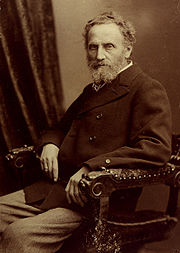
Jacob Ungerer was a German sculptor and Professor of Fine Arts.
.
 After leaving school Jacob Ungerer started, in 1858, to study Art in the Antique Class of the Royal Academy of Fine Arts in Munich, which he completed in 1864. (Matriculation number 1510). His teacher was the sculptor Professor Max von Widnmann. From 1864 till 1866 he took a study trip to Italy, including a longer stay in Rome. After his return in 1866 he moved into his sculpto studio.
In 1890 he became Professor for Sculpture at the Royal Academy of Fine Arts in Munich. Ungerer died 17 April 1920 in Munich. Almost all his artistic estate, among them many models, paintings and drawings, was destroyed in World War II
during an air raid on Chemnitz
.
. The outer basin symbolises the Ocean, the dolphin
s on the edge are the mouths of rivers which let the water flow into the ocean. The Hippocamp
s - fable beings half horse, half fish - show the threatening and forceful sides of water. They are kept under control by the Tritons
, the sons of Poseidon
. The Nereids
symbolise the peaceful relationship between water and humans - as a fruitful exchange, as a sign of the usefulness of water for humans. The obelisk
as well as the Putti point up to the sky which grants water, in the form of rain, to Earth.
During the time of the Mende Fountain Ungerer also created other sculptures in Leipzig: the sculptures for the Museum of Visual Arts, for the Städtische Gewerbeschule ( today College for Technology. Economy and Culture, Leipzig), for the Royal Conservatory of Music (today the College of Music and Theatre "Felix Mendelssohn Bartholdy" Leipzig) and for the old Grassi-Museum.
, asked Ungerer in a letter dated 1893 to create "a decorative, richly structured portal, the so called Bride Gate, to serve young couples as the entrance to the Registrar's Office, should they wish to take the first step into marriage in a more magnificent setting than that offered by our modest Registry Offices which are housed in dirty blocks of flats." Under the God of Marriage Hymen, carrying two torches, there was to be, on the right of the entrance, Adam with his faithful dog and, on the left side Eve with the snake offering the apple. The whole was to be crowned by two turtle doves. Adam and Eve were to be shown “naturally in paradisical nakedness. As the genitals would then be at the eyelevel of onlookers it is recommended that these parts would be covered with a branch as in the naive manner of the Middle Ages." (Source: STAHH 322-1RBK 149). The plans to install also "heads of Bluebeard and Xantippes with the insignia of knife and slipper", as a reminder to the couples, had to be dropped however. "The completion of this work which had been already started by the mason, was denied to us in the strongest terms because images of such horrors might have a negative influence on young couples, perhaps putting them off marriage altogether and would therefore be disadvantageous to the desired increase in the Hamburg population." (Source: Martin Waller, about the building or the Hamburg City Hall, lecture held in the Society for Art and Science on 8th Nov. 1897, Hamburg).
The figures for the Bridal Gate were completed in 1896. Apart from that Ungerer also created the statue of Charles V, Holy Roman Emperor, for the Emperors Galery for the facade of Hamburg City Hall. Plans for a Registry Office in the City Hall were, however, turned down by the Hamburg Senate. Therefore no bride ever walked through the Bridal Gate.
of St. Ursula church. No details are known about the works by Ungerer for Linderhof Castle.
in Meissen, Ungerer designed several figures in 1902, such as the "Gardener Girl with Dog", "Gentleman with Dog", "Gentleman with Field glasses and Walking Stick", "Elegant Lady with Fan", "Lady with Cat" and "Goose Girl”.
Life
Jacob Ungerer was born and died in Munich-Untersendling. On his father's side he descended from a family of Munich Cafetiers and brewery owners who had grown rich in the 19th Century and who had become technical pioneers (e.g. Jacob Ungerer's nephew August Ungerer who in 1886 installed the first Munich Tram Line.) Jacob Ungerer's mother came from a glass blower family from ZwieselZwiesel
Zwiesel is a town in the district of Regen, in Bavaria, Germany.-Geography:Zwiesel is situated in the Bavarian Forest, lying south of Bodenmais and to the northwest of Grafenau...
.
In 1890 he became Professor for Sculpture at the Royal Academy of Fine Arts in Munich. Ungerer died 17 April 1920 in Munich. Almost all his artistic estate, among them many models, paintings and drawings, was destroyed in World War II
World War II
World War II, or the Second World War , was a global conflict lasting from 1939 to 1945, involving most of the world's nations—including all of the great powers—eventually forming two opposing military alliances: the Allies and the Axis...
during an air raid on Chemnitz
Chemnitz
Chemnitz is the third-largest city of the Free State of Saxony, Germany. Chemnitz is an independent city which is not part of any county and seat of the government region Direktionsbezirk Chemnitz. Located in the northern foothills of the Ore Mountains, it is a part of the Saxon triangle...
.
The Mende Fountain in Leipzig
In 1883 in Leipzig, Ungerer created the neo-Baroque figures for the monumental Mende Fountain which was donated by Marianne Pauline Mende. She was a rich widow said to have had a dubious establishment in Leipzig. The Mende Fountain is an allegory of the element Water, depicted as figures from Greek MythologyGreek mythology
Greek mythology is the body of myths and legends belonging to the ancient Greeks, concerning their gods and heroes, the nature of the world, and the origins and significance of their own cult and ritual practices. They were a part of religion in ancient Greece...
. The outer basin symbolises the Ocean, the dolphin
Dolphin
Dolphins are marine mammals that are closely related to whales and porpoises. There are almost forty species of dolphin in 17 genera. They vary in size from and , up to and . They are found worldwide, mostly in the shallower seas of the continental shelves, and are carnivores, mostly eating...
s on the edge are the mouths of rivers which let the water flow into the ocean. The Hippocamp
Hippocamp
The hippocamp or hippocampus , often called a sea-horse in English, is a mythological creature shared by Phoenician and Greek mythology, though the name by which it is recognised is purely Greek; it became part of Etruscan mythology...
s - fable beings half horse, half fish - show the threatening and forceful sides of water. They are kept under control by the Tritons
Triton (mythology)
Triton is a mythological Greek god, the messenger of the big sea. He is the son of Poseidon, god of the sea, and Amphitrite, goddess of the sea, whose herald he is...
, the sons of Poseidon
Poseidon
Poseidon was the god of the sea, and, as "Earth-Shaker," of the earthquakes in Greek mythology. The name of the sea-god Nethuns in Etruscan was adopted in Latin for Neptune in Roman mythology: both were sea gods analogous to Poseidon...
. The Nereids
Nereids
In Greek mythology, the Nereids are sea nymphs, the fifty daughters of Nereus and Doris, sisters to Nerites. They often accompany Poseidon and can be friendly and helpful to sailors fighting perilous storms. They are particularly associated with the Aegean Sea, where they dwelt with their father...
symbolise the peaceful relationship between water and humans - as a fruitful exchange, as a sign of the usefulness of water for humans. The obelisk
Obelisk
An obelisk is a tall, four-sided, narrow tapering monument which ends in a pyramid-like shape at the top, and is said to resemble a petrified ray of the sun-disk. A pair of obelisks usually stood in front of a pylon...
as well as the Putti point up to the sky which grants water, in the form of rain, to Earth.
During the time of the Mende Fountain Ungerer also created other sculptures in Leipzig: the sculptures for the Museum of Visual Arts, for the Städtische Gewerbeschule ( today College for Technology. Economy and Culture, Leipzig), for the Royal Conservatory of Music (today the College of Music and Theatre "Felix Mendelssohn Bartholdy" Leipzig) and for the old Grassi-Museum.
The Hamburg City Hall Sculptures
Martin Haller, architect of the Hamburg City HallHamburg Rathaus
The Hamburg Rathaus is the Rathaus—the city hall or town hall—of Hamburg, Germany, it is the seat of the government of Hamburg, located in the Altstadt quarter in the city centre, near the lake Binnenalster and the central station...
, asked Ungerer in a letter dated 1893 to create "a decorative, richly structured portal, the so called Bride Gate, to serve young couples as the entrance to the Registrar's Office, should they wish to take the first step into marriage in a more magnificent setting than that offered by our modest Registry Offices which are housed in dirty blocks of flats." Under the God of Marriage Hymen, carrying two torches, there was to be, on the right of the entrance, Adam with his faithful dog and, on the left side Eve with the snake offering the apple. The whole was to be crowned by two turtle doves. Adam and Eve were to be shown “naturally in paradisical nakedness. As the genitals would then be at the eyelevel of onlookers it is recommended that these parts would be covered with a branch as in the naive manner of the Middle Ages." (Source: STAHH 322-1RBK 149). The plans to install also "heads of Bluebeard and Xantippes with the insignia of knife and slipper", as a reminder to the couples, had to be dropped however. "The completion of this work which had been already started by the mason, was denied to us in the strongest terms because images of such horrors might have a negative influence on young couples, perhaps putting them off marriage altogether and would therefore be disadvantageous to the desired increase in the Hamburg population." (Source: Martin Waller, about the building or the Hamburg City Hall, lecture held in the Society for Art and Science on 8th Nov. 1897, Hamburg).
The figures for the Bridal Gate were completed in 1896. Apart from that Ungerer also created the statue of Charles V, Holy Roman Emperor, for the Emperors Galery for the facade of Hamburg City Hall. Plans for a Registry Office in the City Hall were, however, turned down by the Hamburg Senate. Therefore no bride ever walked through the Bridal Gate.
Works in Munich and in Linderhof Castle
Ungerer also created figures for various public buildings in Munich such as the Palace of Justice, erected by Friedrich von Thiersch 1897, 4 Apostles for the altarAltar
An altar is any structure upon which offerings such as sacrifices are made for religious purposes. Altars are usually found at shrines, and they can be located in temples, churches and other places of worship...
of St. Ursula church. No details are known about the works by Ungerer for Linderhof Castle.
Works for the Porcelain Manufacture in Meissen
For the Porcelain ManufactureMeissen porcelain
Meissen porcelain or Meissen china is the first European hard-paste porcelain that was developed from 1708 by Ehrenfried Walther von Tschirnhaus. After his death that October, Johann Friedrich Böttger, continued his work and brought porcelain to the market...
in Meissen, Ungerer designed several figures in 1902, such as the "Gardener Girl with Dog", "Gentleman with Dog", "Gentleman with Field glasses and Walking Stick", "Elegant Lady with Fan", "Lady with Cat" and "Goose Girl”.
Honours
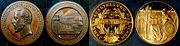
- 1874 Ungerer participated in the International Exhibition of all Fine Arts, Industries and Inventions in London and received a Prize Medal from the President, Albert Edward, Prince of Wales.
- 1896 Ungerer received a Gold Medal in the Yearly Exhibition of Munich Artists.
Further reading
- Arthur Schulz, Deutsche Sculpturen der Neuzeit, Berlin - New Yorck, 1900
- Friedrich Pecht, Geschichte der Münchener Kunst im 19. Jahrhundert, München: Verlagsanstalt für Kunst und Wissenschaft, 1888
- Über Jacob Ungerer, in: Das geistige Deutschland, 1 (1898)
- Jacob Ungerer, in: Kunstchronik, Neue Folge 26 (1915) S. 468f.; 31 (1919/20) S. 621
- Münchener Neueste Nachrichten v. 1. 5. 1920, Nachruf auf Jacob Ungerer
- H. Schnell, Kleine süddeutsche Kirchenführer, 3 (1936) H. 140, S. 4, 10